
CINE-220 · Lesson 8 of 12 · 25 min
Shaping light: flags, diffusion, bounce and grip
Lights rarely look their best straight out of the fixture. Most of the craft of set lighting lies in what happens between the lamp and the subject: cutting light off where it is not wanted, softening it, reducing it, bouncing it, giving it texture, and holding all of these tools safely in place. In North American practice, much of this work belongs to the grip department, working hand in hand with the electricians. This lesson covers flags and cutters, nets, silks and diffusion, bounce and negative fill, frames and butterflies, cookies and patterns, the stands and rigging that hold them, the vocabulary of grip equipment, and how shaping tools combine to create a finished look.
Flags and cutters
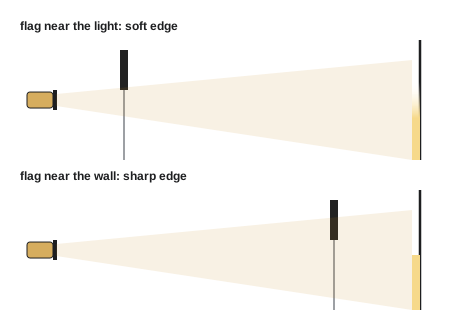
Flags are opaque black panels, usually black duvetyne fabric stretched over a wire frame, used to block light. They prevent light from hitting areas where it is not wanted, such as a background wall, the top of a set or the camera lens, and they create shadows and shape. Flags come in standard sizes, such as 12 × 18 inch, 18 × 24 inch, 24 × 36 inch and 4 × 4 foot, and long, narrow versions called cutters, used to cut a line of light across a wall or the floor. Placing a flag close to the light produces a soft shadow edge; placing it close to the subject produces a sharp edge. Flagging is how cinematographers sculpt light: cutting spill off a wall to darken the background behind an actor, keeping light off the floor, or shading the top of the frame. Flags are also used to prevent lens flare by blocking light falling on the lens, a job often called "teasing" or "lensing" the camera.
Nets
Nets are open-weave fabric panels that reduce light without changing its color or quality, like scrims for the whole beam or for part of it. A single net (with a green binding by convention) reduces light by about half a stop, a double net (red binding) by about a full stop, and a lavender net by about a quarter stop. Open-ended nets have one side without a frame, so that the edge of the net does not cast a visible line, useful for feathering light across a subject. Nets can be placed in front of part of a beam to reduce light on the nearest part of a subject, such as the near end of a table or the top of an actor's head, evening the illumination.
Silks and diffusion
Diffusion scatters light, making the source larger and softer. Diffusion materials come as gel-like sheets, such as Lee 216, 250 and 251 or Rosco Tough Frost and Opal, and as fabrics, such as silk, grid cloth, muslin and Ultrabounce, stretched on frames or clipped to fixtures. Each material differs in how much it softens, how much light it loses, and whether it preserves some of the source's direction. Light diffusion, such as Opal or 1/4 Frost, takes the edge off a hard source; medium diffusion such as 250 or half grid cloth softens considerably; heavy diffusion such as 216, full grid cloth or muslin creates a truly soft source that behaves like a window. The size of the diffusion and its distance from the subject determine softness, as discussed in PHOT-210: a large frame close to the actor is softer than a small sheet on the lamp.
| Material | Softening | Approximate loss | Typical use |
|---|---|---|---|
| Opal / light frost | Slight | 1/3–1/2 stop | Taking the edge off hard light |
| 250 / half grid cloth | Moderate | About 1 stop | General diffusion on fixtures and frames |
| 216 / full grid cloth | Strong | About 1.5–2 stops | Large soft sources, window simulation |
| Silk (China silk) | Moderate, retains direction | About 1 stop | Overhead sun control |
| Muslin (bleached) | Very strong, often bounced | 2+ stops through | Soft sources and bounce |
Bounce and negative fill
Bouncing light off a reflective surface creates soft, indirect light. Bounce surfaces include white foam core and bead board, bleached muslin, Ultrabounce, silver and gold reflectors, and the walls and ceilings of locations. Bounced light is soft and natural, often used as fill or as a soft key, and bouncing a hard light into a large surface creates a large soft source without a diffusion frame. Bounce loses a lot of light, typically two stops or more, and spreads widely, so it can be harder to control; flags and the positioning of the bounce help. Negative fill is the opposite: black surfaces such as floppy flags, duvetyne or solid black frames placed near the subject on the side away from the key absorb light that would otherwise bounce back, deepening shadows and adding contrast and shape. Negative fill is especially important on exteriors, in white rooms and wherever ambient bounce makes the light flat.
Worked problem
Adding shape to a flat exterior
An actor stands in open shade on a sunny day beside a white wall. The light on the face is soft but flat, with little modeling. How can grip tools add shape?
Show solution
- Place a 4 × 4 or larger black floppy close to the actor on the side away from the main light, as negative fill, to deepen the shadow side.
- If the wall bounces too much light onto the shadow side, flag the wall or block it with a black frame out of shot.
- Add a bounce board on the key side, angled to catch sunlight, to increase the key slightly if needed.
- Check the contrast ratio with a meter or false color.
Answer: Use negative fill on the shadow side, block unwanted bounce from the wall, and add a bounce on the key side to create shape.
Frames, butterflies and overheads
Large textiles are mounted on frames. Standard frame sizes, measured in feet, include 4 × 4, 6 × 6, 8 × 8, 12 × 12, 20 × 20 and 30 × 30. Frames hold diffusion, silks, nets, solids, bounce and color-correction materials, and can be interchanged quickly. Butterflies and overheads are large frames mounted on stands above or beside actors outdoors, used to soften and reduce harsh sun, create shade for a scene, or provide large bounce surfaces. A 12 × 12 silk over two actors on a sunny exterior is one of the most common grip setups. Large frames act as sails in wind and are dangerous if not properly secured with sandbags, ropes and adequate crew; on windy days they may need to be lowered or not flown at all.
Cookies and patterns
A cookie, short for cucoloris, is a panel with irregular holes that breaks light into dappled patterns, simulating foliage, windows or abstract shapes, and adding texture to walls and backgrounds. Wooden cookies produce hard-edged patterns, while celo cookies, made of a translucent material, produce softer patterns. Branches held in front of lights (dingles) create moving leaf shadows for natural effects. As with flags, placing the pattern closer to the light softens it, and placing it closer to the subject sharpens it. Ellipsoidal fixtures with gobos project sharper, more precise patterns (Lesson 2). Patterns add depth and visual interest to large, plain surfaces that would otherwise look flat.
Stands and rigging
Grip and lighting tools need safe support. The C-stand (century stand) is the most versatile: a three-legged base with a riser and a grip arm (gobo arm) with a knuckle (grip head) that holds flags, nets and small lights at any angle. Combo stands and roller stands hold heavier fixtures and frames. Clamps, such as Mafer clamps, Cardellini clamps, gaffer grips and pipe clamps, attach lights and tools to furniture, doors, pipes and set walls. Overhead rigging uses speed rail, pipe, trusses and chain motors in studios, and points on location ceilings and walls. Every stand should be stable: its legs set correctly, weighted with sandbags on the leg under the load, and the load positioned over the leg. The rule of thumb is to place the knuckle so that the weight tightens rather than loosens it, often called "righty tighty" for grip heads, so that gravity keeps the arm from rotating. Safety chains or cables secure anything rigged overhead.
Grip vocabulary
Grips have a colorful vocabulary. A "solid" is an opaque flag or frame; a "single" and "double" are nets; a "floppy" is a 4 × 4 flag with an extra fold-down panel; a "teaser" is a long flag or black hung to block light from above; a "topper" and "bottomer" block light from the top and bottom of a beam; a "sider" from the side. "Courtesy flags" shade crew and equipment from the sun. An "apple box", available as full, half, quarter and pancake sizes, is a wooden box used to raise people, objects and equipment. "Gel up", "net it down" and "kill the spill" are everyday requests. Knowing this vocabulary allows clear, fast communication between the DP, gaffer, key grip and crew.
Combining tools
Most finished lighting setups combine several shaping tools. A typical close-up might use an LED panel through a 4 × 4 frame of 250 diffusion as a soft key, a black floppy as negative fill on the other side, a cutter to keep the key off the background wall, a single net on the bottom of the frame to even light on the actor's chest, a small hard back light with a snoot, and a cookie on a light hitting the background for texture. Building lighting in layers this way gives precise control over every part of the frame. With experience, cinematographers learn to see which tool will solve each problem: softer, use diffusion or bounce; darker, flag or net; shape, negative fill; texture, a pattern.
Diffusion on the light versus diffusion in frames
Diffusion can be placed directly on a fixture, clipped to the barn doors, or mounted in a frame some distance in front. Diffusion on the fixture enlarges the source only slightly, taking the edge off the light but keeping it relatively hard. Diffusion in a large frame between the light and the subject becomes the effective source: the larger the illuminated area of the frame, and the closer it is to the subject, the softer the light. To fill a large frame evenly, the light must be placed far enough back that its beam covers the whole frame. Combining frame diffusion with flags on the frame's edges controls spill.
Book lights
A book light is a soft-lighting technique in which a light is bounced into a large white surface, and the bounced light then passes through a diffusion frame placed at an angle to the bounce, like the pages of an open book. The double softening creates an extremely soft, even source with controlled direction, popular for close-ups and beauty lighting. Book lights take space and lose a lot of light, but produce a quality of light that is hard to achieve otherwise.
Grip safety
Grip equipment can be dangerous. Stands with heavy loads must be weighted and positioned so that they cannot tip; frames act as sails in wind and must be secured with ropes and sandbags or lowered; overhead rigging must be rated for its load and secured with safety lines; and C-stand arms at head height should be marked or padded to prevent injuries. Grips check equipment regularly and follow safe practices for lifting heavy items. Clear communication, such as calling out "flying in" when moving a large frame or "points" when carrying a sharp-ended stand, keeps colleagues safe.
Choosing textiles for the job
Textiles are chosen for the quality of light they produce. Grid cloth is durable and fire-resistant, producing smooth, even diffusion; silk gives a slightly directional diffusion with a natural quality; muslin, bleached or unbleached, gives a warm, soft bounce or diffusion; Ultrabounce is a white bounce surface with a black back, doubling as negative fill. Specialized fabrics include gold and silver lamé for warm or sparkling bounce. Rental houses and grip companies supply textiles in standard frame sizes, and key grips choose combinations based on the DP's requests and experience.
Common mistakes
MistakePlacing flags close to the light for a sharp edge.
InsteadPlace flags near the subject for sharp edges.
MistakeDimming or moving the key to reduce light on part of a subject.
InsteadUse nets to reduce light locally.
MistakeFlying large frames in wind without securing them.
InsteadSandbag, rope and lower frames when windy.
MistakeIgnoring bounce from white walls.
InsteadUse negative fill to restore shape.
MistakeLoading grip heads so they loosen.
InsteadSet knuckles so gravity tightens them, and sandbag stands.
Summary and key terms
- Flags and cutters block light; their distance controls edge sharpness.
- Nets reduce light without changing color or quality.
- Diffusion makes sources larger and softer, at a cost in light.
- Bounce creates soft light; negative fill deepens shadows.
- Frames and overheads hold large textiles to control sun and create soft sources.
- Cookies and patterns add texture.
- C-stands, clamps and rigging must be stable and secured.
- Flag
- Opaque panel that blocks light.
- Cutter
- Long, narrow flag.
- Net
- Open-weave panel that reduces light.
- Diffusion
- Material that scatters and softens light.
- Bounce
- Reflective surface creating indirect light.
- Negative fill
- Black surface absorbing light to deepen shadows.
- Butterfly
- Large frame mounted over actors outdoors.
- Cookie
- Patterned panel creating dappled light.
- C-stand
- Versatile grip stand with arm and knuckle.
- Floppy
- 4 × 4 flag with a fold-down extension.
Practice problems
Work each problem on paper first, then reveal the answer to check.
Where should a flag be for a sharp shadow edge?
Show answer
Close to the subject.
What is a cutter used for?
Show answer
Cutting a line of light across a wall or floor.
What does a double net do?
Show answer
Reduces light by about one stop.
Why use open-ended nets?
Show answer
To avoid a visible frame line.
Approximate loss of 216 diffusion?
Show answer
About 1.5–2 stops.
What does negative fill do?
Show answer
Absorbs light to deepen shadows and add shape.
Name three standard frame sizes.
Show answer
6 × 6, 8 × 8, 12 × 12, 20 × 20.
What is a cookie?
Show answer
A patterned panel that breaks up light.
How should a C-stand be loaded?
Show answer
Weight over the leg, sandbagged, knuckle tightening with gravity.
What is an apple box?
Show answer
A wooden box for raising people and equipment.
Lesson quiz · 5 questions
Score 60% or more to complete this lesson.
Create a free account to save your progress, take quizzes and earn a certificate.