
CINE-230 · Lesson 10 of 12 · 25 min
Gimbals, handheld and shoulder rigs
Handheld camera work carries a special energy. A camera on the operator's shoulder breathes with them, reacts to the scene and gives the audience a sense of being there. Motorized gimbals, by contrast, use sensors and motors to keep the camera steady while the operator moves, bringing smooth, stabilized movement to productions of every size. Between these extremes lie many hybrid approaches. This lesson covers the aesthetics of handheld work, shoulder rigs and ergonomics, handheld operating technique, support systems for long handheld days, how gimbals work, balancing and tuning gimbals, gimbal operating modes and techniques, gimbals on vehicles, cranes and arms, and choosing between handheld, gimbal and Steadicam.
The handheld aesthetic
Handheld cinematography emerged as a style with lightweight cameras in the late 1950s and 1960s, in documentary movements such as direct cinema and cinéma vérité, and in the French New Wave, where filmmakers took cameras into streets and apartments. Handheld work suggests immediacy, documentary truth and subjectivity; it can express a character's anxiety, the chaos of action, or simply intimacy with performers. In contemporary drama, handheld ranges from subtle, almost static "breathing" frames that feel alive to aggressive, reactive camera work in action and war films. Handheld is not simply the absence of support; it is a performance by the operator, who responds to actors in real time and chooses when to move, settle and reframe. Excessive shake can tire and disorient audiences, so control is still essential.
Shoulder rigs and ergonomics
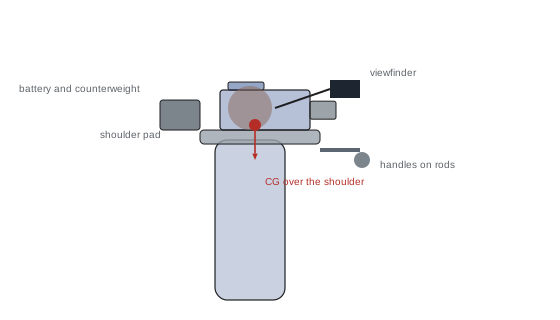
Most cinema cameras are not designed to sit comfortably on a shoulder by themselves. Shoulder rigs add a shoulder pad, handles and often a top handle; rods and plates to position the camera so that its weight sits over the shoulder; counterweights or batteries at the back to balance the front weight of lenses and matte boxes; and mounts for the monitor or viewfinder in front of the operator's eye. A well-built rig balances on the shoulder with little effort from the hands, letting the operator hold it for longer and move it smoothly. Ergonomics matter: a camera that is front-heavy strains the arms and wrists; a viewfinder that is poorly positioned strains the neck. Operators customize rigs to their bodies and the package, and assistants keep the rig as light as possible by choosing compact lenses, small batteries and wireless video.
Handheld operating technique
Good handheld operators control movement with their whole body:
- Stance: feet shoulder-width apart, knees soft, weight centered, ready to move in any direction.
- Breathing: steady breathing, avoiding holding the breath, which causes trembling.
- Walking: heel-to-toe steps with bent knees, absorbing impacts with the legs.
- Leaning: using a wall, door frame or furniture for support during static moments.
- Wider lenses: wide lenses minimize the visible effect of shake; long lenses magnify it, so handheld telephoto work needs great control or support.
- Following action: moving with the actors' energy, settling when they settle.
Many operators also use the camera's weight and inertia: heavier cameras move more smoothly than very light ones, which is why some operators add weight to small cameras for handheld work.
Support for long handheld days
Holding a 10 to 20 kg camera on the shoulder for hours can cause fatigue and injury. Support systems such as the Easyrig, Ready Rig and similar vest-and-arm or bungee systems suspend the camera from an overhead arm attached to a vest, transferring its weight to the hips while preserving handheld movement. Some support systems include a stabilizer or gimbal at the end of the line. Productions with extensive handheld work also provide apple boxes or stands for the operator to rest the camera between takes, and plan breaks. Operators should maintain physical fitness and pay attention to warning signs of strain.
How gimbals work
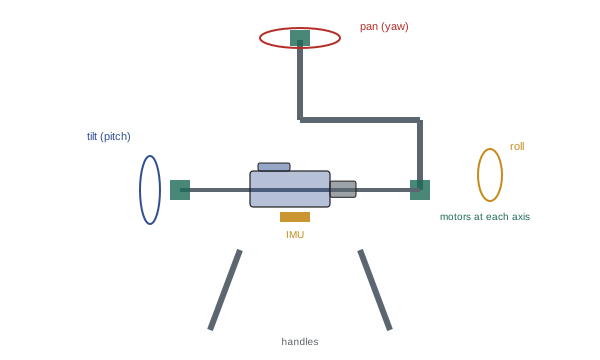
A motorized gimbal holds the camera in a cradle with three motorized axes: pan (yaw), tilt (pitch) and roll. An inertial measurement unit, combining gyroscopes and accelerometers, senses the camera's orientation hundreds or thousands of times per second, and a controller drives brushless motors to counter any unwanted rotation, keeping the camera pointing steadily. The operator can command deliberate moves with a joystick, wheel or by moving the handle, and the gimbal follows smoothly according to its settings. Like Steadicam, gimbals cancel rotation, not translation: if the operator bounces up and down while walking, the camera bounces too, so walking technique still matters. Gimbals range from handheld units for small cameras to large systems for full cinema packages, used handheld, on vehicles, cranes and drones.
| Gimbal class | Typical payload | Typical use |
|---|---|---|
| Small handheld | Up to a few kilograms | Mirrorless cameras, run-and-gun |
| Medium handheld | Several kilograms | Compact cinema cameras |
| Large cinema gimbal | Over 10 kg | Full cinema packages, vehicles, cranes |
| Vehicle or crane-mounted | Varies | Car mounts, telescopic cranes, cable cams |
Balancing and tuning gimbals
A gimbal works best when the camera is balanced on all three axes before the motors are switched on, so that the camera stays in any position with the motors off. Balancing involves sliding the camera forward and back on the tilt plate, adjusting its height relative to the tilt axis, and sliding the roll and pan arms until the camera is neutral in every orientation. An unbalanced camera forces the motors to work constantly, draining batteries, overheating and producing jitter or drift. After balancing, the gimbal is tuned: motor strength or stiffness is set for the payload, and follow speeds and deadbands are adjusted so that the gimbal responds to the operator smoothly. Lens changes, matte boxes, cables and accessories alter the balance, so rebalancing is part of every package change. Cables must be routed so that they do not tug on the camera as it moves.
Worked problem
Checking gimbal payload
A gimbal is rated for a maximum payload of 12 kg. The camera body weighs 3.5 kg, the lens 2.6 kg, a matte box 1.2 kg, a wireless video transmitter 0.4 kg, a lens motor 0.3 kg, a battery 1.1 kg and plates and cables 0.8 kg. Is the payload within limits, and is there a sensible margin?
Show solution
- Total: 3.5 + 2.6 + 1.2 + 0.4 + 0.3 + 1.1 + 0.8 = 9.9 kg.
- Margin: 12 − 9.9 = 2.1 kg, about 18 % of the rating.
- A margin of 15 to 25 % helps the motors cope with acceleration and wind, so this is acceptable.
- Balance the package carefully and test with the actual moves before shooting.
Answer: About 9.9 kg, within the 12 kg rating with an 18 % margin, which is reasonable.
Gimbal modes and techniques
Gimbals offer several follow modes: pan follow, where the gimbal keeps tilt and roll locked but follows the handle's horizontal turns; pan and tilt follow; lock mode, keeping the camera pointing in one direction regardless of the handle; and full follow, including roll for creative barrel rolls. Operators combine modes for different shots. Common gimbal techniques include walking shots with a smooth heel-to-toe "ninja walk"; orbiting a subject while keeping them centered; low-to-high reveals; handing the gimbal between operators or onto a vehicle mid-shot; and dual-operator setups, where one person walks with the gimbal while a second operator controls pan and tilt remotely with wheels or a handheld controller, freeing the carrier to concentrate on movement. Shooting with wider lenses hides residual movement, and adding a vest-and-arm support can reduce vertical bounce.
Gimbals on vehicles, cranes and arms
Large gimbals are increasingly used as stabilized remote heads on vehicles, telescopic cranes, cable cams and drones. On camera cars, a gimbal on a crane arm or a suction mount isolates the camera from road vibration and turns; on boats, it counters swells; on cranes, it smooths the arm's movement. Combining gimbals with passive isolators, such as wire-rope or bungee isolators that absorb high-frequency vibration, improves results on vehicles, since gimbals cannot cancel translation and vibration that exceeds their response. The rigging must be secure enough to carry the gimbal and camera at speed, with safety lines in case of failure.
Choosing between handheld, gimbal and Steadicam
Each tool produces a different quality of movement. Handheld gives organic, reactive movement with human imperfection, quick to set up and responsive to actors. Gimbals give smooth, stabilized movement with a slightly mechanical precision, fast to set up for light packages and versatile on vehicles and cranes, but they can feel weightless or synthetic if overused and still need good walking technique. Steadicam gives smooth, floating movement with the inertia of a heavier sled and the operator's finesse, excellent for long, complex moves with heavy cameras, but requires a specialist operator and more setup. Many productions use all three, choosing for each scene according to the emotional quality required. Practical factors include camera weight, shot duration, space, terrain, the need for vehicles or handoffs, crew skills and budget.
| Approach | Quality of movement | Setup | Best for |
|---|---|---|---|
| Handheld | Organic, reactive, alive | Fast | Drama, documentary, intimacy, action |
| Gimbal | Smooth, precise, light | Fast for light packages | Movement in tight spaces, vehicles, handoffs |
| Steadicam | Floating, weighted, controlled | Slower, specialist | Long takes, walk-and-talks, heavy cameras |
| Easyrig-supported handheld | Handheld with less fatigue | Fast | Long handheld days |
Gimbal handoffs and creative moves
Gimbals make handoffs easy: an operator can carry the camera through a doorway, hand it to someone on a motorcycle or car, or attach it to a crane or cable mid-shot. Some gimbals can be quickly mounted on suction cups, poles or vests, allowing continuous shots that move between systems. Gimbals also enable creative moves such as barrel rolls, where the camera rotates around the lens axis, and very low moves along the ground with an inverted gimbal. Used well, these moves create energy and surprise; overused, they can feel gimmicky.
Gimbal maintenance and troubleshooting
Common gimbal problems include drift, where the camera slowly rotates away from its intended position; jitter or vibration, often from motor settings that are too strong, poor balance or loose mounts; and overheating motors from unbalanced loads. Troubleshooting begins with rebalancing, checking that all plates and clamps are tight, recalibrating the inertial sensors, and adjusting motor stiffness and filters. Firmware updates can improve performance but should be tested before important shoots. Batteries must be charged and spares carried, since gimbals draw power continuously, and cold weather shortens battery life.
Handheld coverage strategies
Handheld drama often shoots with two cameras covering a scene simultaneously, operators responding to actors in real time. Operators agree on lines, the side of the action each camera covers, to avoid seeing each other, and on approximate sizes so that coverage cuts together. The director may encourage actors to move freely, trusting the operators to follow, which suits naturalistic performance. Lighting for handheld must accommodate camera positions anywhere in the room, so overhead and practical lighting is common.
Combining approaches in one production
Many productions mix handheld, gimbal, Steadicam, dolly and crane work, using the change in movement to mark shifts in emotion or story. A film might use steady dolly moves during calm early scenes and move to handheld as tension builds, or use Steadicam for a character's dreamlike memories. Choosing deliberately, and keeping the visual grammar consistent within each mode, helps audiences read the changes.
Ergonomics for gimbal operators
Large gimbals with cinema cameras can weigh 10 to 20 kg, and holding them at arm's length quickly causes fatigue. Operators use dual handles, vest-and-arm supports, overhead support rigs and carry handles to spread the load, and rest the gimbal on stands between takes. Planning shorter takes, rotating operators on long days and keeping packages light protect operators from injury.
Whichever tool is chosen, testing it with the real camera package and lenses during prep reveals balance, weight and handling problems before they cost time on set.
Common mistakes
MistakeUsing long lenses for shaky handheld work.
InsteadUse wider lenses or add support.
MistakePowering gimbals with unbalanced cameras.
InsteadBalance all axes with motors off first.
MistakeAssuming gimbals remove walking bounce.
InsteadUse smooth walking and isolators or arms.
MistakeExceeding gimbal payload ratings.
InsteadTotal every component and keep a margin.
MistakeIgnoring operator fatigue on handheld days.
InsteadUse support rigs, rests and breaks.
Summary and key terms
- Handheld suggests immediacy and subjectivity, but needs control.
- Shoulder rigs balance the camera over the shoulder.
- Stance, breathing, walking and lens choice control handheld shake.
- Support rigs reduce fatigue on long handheld days.
- Gimbals use sensors and motors to cancel rotation on three axes.
- Balance before tuning, keep payload margins, rebalance after changes.
- Choose handheld, gimbal or Steadicam by the quality of movement needed.
- Handheld
- Operating the camera without a fixed support.
- Shoulder rig
- Support that balances a camera on the shoulder.
- Gimbal
- Motorized three-axis stabilizer.
- IMU
- Inertial measurement unit sensing orientation.
- Yaw
- Rotation around the vertical axis (pan).
- Pitch
- Rotation around the horizontal axis (tilt).
- Roll
- Rotation around the lens axis.
- Follow mode
- Gimbal setting determining which axes follow the handle.
- Dual operator
- One person carries the gimbal while another frames remotely.
- Isolator
- Passive damper absorbing vibration.
Practice problems
Work each problem on paper first, then reveal the answer to check.
Name two movements associated with early handheld style.
Show answer
Direct cinema, cinéma vérité, French New Wave.
Where should a shoulder rig's center of gravity sit?
Show answer
Over the shoulder.
Why do wide lenses help handheld?
Show answer
They minimize the visible effect of shake.
What does an Easyrig do?
Show answer
Suspends the camera from an overhead arm on a vest.
What senses orientation in a gimbal?
Show answer
The IMU.
What can gimbals not cancel?
Show answer
Translation such as vertical bounce.
Why balance before switching on motors?
Show answer
Unbalanced loads cause jitter, drain and overheating.
Payload of 4 + 2 + 1 + 0.5 kg against an 8 kg rating?
Show answer
7.5 kg, a small margin of about 6 %.
What is dual-operator gimbal work?
Show answer
One carries, another frames remotely.
Name a reason to choose Steadicam over a gimbal.
Show answer
Weighted floating movement, heavy cameras, long takes.
Lesson quiz · 5 questions
Score 60% or more to complete this lesson.
Create a free account to save your progress, take quizzes and earn a certificate.