
CINE-230 · Lesson 11 of 12 · 25 min
Vehicle rigs and specialty camera systems
Some of the most demanding camera movement happens around vehicles: dialogue scenes in moving cars, chases, shots from the front of a train, aerial views from helicopters and tracking shots alongside horses or runners. Vehicle work combines camera support, rigging, driving and safety in ways that require specialist equipment and crew. This lesson covers the main approaches to car interiors, hard mounts and hostess trays, suction mounts, tow and process trailers, insert cars and camera cars, vehicle-mounted cranes, LED volumes and process work as alternatives, boats, aircraft and other specialty systems, and the safety principles that govern all vehicle filming.
Shooting car interiors
Dialogue in moving cars is common in drama and notoriously difficult to film. Options include having the actor drive while cameras are mounted inside or outside the car; towing the car on a trailer or low-loader so that actors can perform without driving; mounting the car on a process trailer pulled by a camera vehicle; shooting in a stationary car in front of projection or LED screens; and driving the car remotely from a pod on the roof or a separate vehicle. Each has trade-offs in realism, safety, sound and cost. When actors drive while performing, distraction is a real safety risk, so productions limit it to slow, controlled conditions or closed roads, and rely on towing or process work for complex performances.
Hard mounts and hostess trays
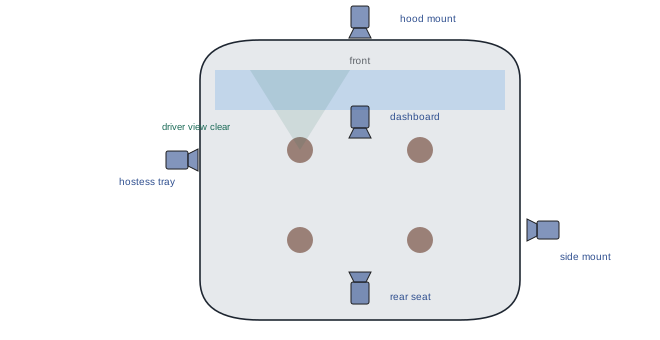
Hard mounts attach cameras rigidly to vehicles using rigging hardware: speed rail, clamps, plates and bolts fixed to the car's structure. A hostess tray is a platform that hangs on the outside of a car door, supported by straps or brackets over the window frame and resting against the door, holding a camera looking in through the window at the driver or passenger. Hood mounts support cameras on the hood looking back through the windscreen at the front seats, using brackets, suction cups and straps. Interior mounts place small cameras on dashboards, headrests, roll bars or between seats. Hard mounts must be extremely secure, because at speed even small cameras become dangerous projectiles if they come loose, and they must not interfere with the driver's view, airbags or controls. Vibration from the road and engine is a major issue, addressed with isolators, careful mounting points and stabilized heads.
Suction mounts
Suction mounts use vacuum cups, often several at once, to attach cameras and rigs to smooth surfaces such as car bodies, windows and boats. Professional vacuum cups have pumps and indicators that show when the seal is weakening, and they are combined with rigging arms and speed rail to create mounts at the angles needed. Suction mounts are quick to set up and do not damage vehicles, but they must be used within their load ratings, on clean, smooth, non-porous surfaces, with safety lines tied to a solid point in case a cup releases. Temperature changes, dust and flexing panels can weaken the seal, so cups should be checked regularly. Suction mounts are generally used at modest speeds; high-speed work demands hard mounts and engineered rigs.
Worked problem
Checking a suction mount
A rig uses three vacuum cups, each rated by the manufacturer for 30 kg of load in shear on a vertical surface. The camera, head and rigging weigh 18 kg. The vehicle will brake and corner, creating forces up to about 0.8 g. Is the mount adequate, and what precautions are needed?
Show solution
- Static load: 18 kg. Dynamic load at 0.8 g braking adds about 0.8 × 18 = 14.4 kg-force horizontally, so loads in some directions approach 18 + 14 kg ≈ 32 kg-force on the system.
- Three cups rated 30 kg each give 90 kg nominal capacity, roughly a 2.8 times margin over the combined load.
- Ratings apply only to clean, smooth, flat surfaces and correct cup orientation; flexing panels reduce capacity.
- Add a safety line to a solid structural point, monitor cup indicators, limit speed, and recheck after every run.
Answer: Nominally adequate with about a 2.8 times margin, but only with safety lines, clean surfaces, monitoring and speed limits.
Towing and process trailers
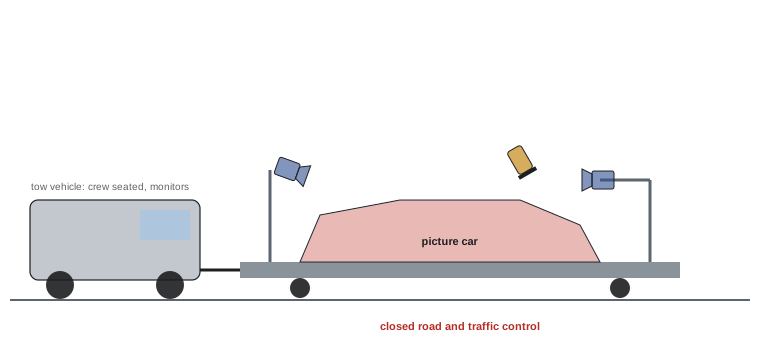
A process trailer is a low flatbed trailer that carries the picture car close to the road, pulled by a camera truck or tow vehicle. Because the actors' car is carried, actors can concentrate on performance while lights, cameras and crew are mounted on the trailer around the car, and sound recording is easier. Low-loader trailers keep the picture car near its natural height so that it looks as if it is being driven. Tow rigs, in which the picture car is towed directly by a tow bar, are simpler but limit camera positions. Process trailer work requires closed or controlled roads, police or traffic control, permits, specialist drivers and coordination between the trailer, the tow vehicle and other traffic. Communication between the director, who may ride in the tow vehicle with monitors, and the crew is by radio.
Insert cars and camera cars
An insert car or camera car is a specially built vehicle carrying camera platforms, mounts and often a crane, used to film other vehicles in motion or to tow picture cars. Camera cars allow cameras to be positioned alongside, ahead or behind a moving vehicle, and to move around it during a shot. Vehicle-mounted cranes, such as remote-head arms on pursuit vehicles, often called by brand names like the Russian Arm, can swing a stabilized camera around a moving car at high speed, enabling dynamic chase shots and commercials. These systems are operated by specialist crews, including precision drivers and crane operators, under strict safety procedures. Smaller productions may use pickup trucks or vans with secured platforms, but improvised camera vehicles must still meet safety requirements, and crew riding on vehicles must be secured.
| Approach | Advantages | Limitations |
|---|---|---|
| Actor driving with mounts | Real motion, low cost | Distraction risk, limited angles, sound |
| Tow rig | Actor does not drive, simpler | Limited camera positions |
| Process trailer / low-loader | Flexible angles, lighting, sound | Needs closed roads, specialist crew |
| Camera car with crane arm | Dynamic moving shots | Cost, specialist operators |
| LED volume or projection | Controlled, repeatable, safe | Cost, realism of light and reflections |
LED volumes and process work
An alternative to filming on the road is to place the car in a studio surrounded by screens showing moving backgrounds. Rear projection, used since the 1930s, and front projection gave way to green screen, and more recently to LED volumes: walls and ceilings of LED panels displaying recorded driving plates or real-time rendered environments, which also cast realistic, changing light and reflections onto the car and actors. LED process work offers safety, repeatability, control over time of day and weather, and comfortable conditions for performance and sound; but it requires high-quality plates, careful matching of perspective and lighting, and attention to reflections and the characteristic look of LED light. Shaking the car gently and moving lights past it adds realism. CINE-302 covers virtual production in depth.
Boats, aircraft and specialty systems
Other environments need their own approaches. On boats, cameras are mounted on stabilized heads or gimbals to counter swells, and crews must manage water, spray and the risk of falling overboard, with flotation equipment and marine safety plans. Aerial filming from helicopters uses stabilized gyro heads in external housings or door mounts, operated by specialist aerial camera operators and pilots under aviation regulations; drones now cover many aerial shots at lower cost, subject to their own regulations (CINE-410). Other specialty systems include tracking vehicles for sport and wildlife, such as quad bikes and electric camera vehicles; snow and ski rigs; underwater housings and remotely operated vehicles; and custom rigs built for specific shots. Each requires experienced specialists and risk assessments.
Vehicle safety principles
Vehicle filming is one of the leading causes of serious accidents in the film industry. Core principles include:
- Planning: a written plan for every vehicle sequence, including routes, speeds, positions, communications, emergency procedures and responsible persons.
- Controlled environments: closed roads, private tracks or police-controlled traffic for anything beyond the simplest shots.
- Qualified people: precision drivers, stunt coordinators, rigging specialists and safety officers as appropriate.
- Secure rigging: mounts and camera equipment engineered and inspected, with safety lines; nothing that can come loose and strike someone.
- Crew restraint: crew riding on camera vehicles seated and restrained, never on unsecured platforms or standing in moving vehicles without proper protection.
- Speeds kept as low as the shot allows, using shutter speed, frame rate, lens choice and editing to enhance the sense of speed.
- Rehearsal: walkthroughs and slow runs before full speed.
- Clear communication by radio, with a single person authorized to call action and stops.
Industry bodies publish safety bulletins and guidelines for vehicle work, and productions must comply with traffic laws, permits and occupational health and safety requirements (Lesson 12).
Speed, lenses and the sense of motion
The sense of speed in vehicle shots comes as much from camera choices as from actual speed. Low camera positions close to the road, wide lenses near passing objects, foreground elements whipping past, slightly slower shutter speeds that add motion blur to backgrounds and wheels, and quick editing all increase the impression of speed. Shooting at slightly lower frame rates, such as 22 fps projected at 24 fps, has long been used to make vehicles appear faster, though it also speeds up actors and must be used carefully. These techniques allow vehicles to travel at safer speeds while appearing fast on screen.
Picture car preparation
Picture cars, the vehicles that appear on screen, are prepared by the transport and picture car departments. Preparation includes mechanical checks, mounting points for rigs, removing or protecting interior trim, managing reflections in windows, tinting or removing glass for lighting and sound, and providing duplicates for stunts. Rigs must not compromise the vehicle's safety systems, such as brakes, steering, lights and airbags, and electrical systems for lights and cameras must be installed safely. Dashboard lights and screens may be replaced with controllable displays for continuity.
Lighting inside moving vehicles
Lighting car interiors is challenging because of limited space, reflections and changing exterior light. Small LED panels and tubes mounted inside the car, on the dashboard, headliner or out of shot, add fill and simulate passing streetlights; on process trailers, lights on stands and rigs around the car can be controlled from the trailer. For night driving, moving light effects, such as streetlight passes created by lights on dimmers or on moving rigs, add realism. Reflections in windows are controlled with polarizing filters, black cloths or by choosing camera angles carefully.
Planning a vehicle sequence
A vehicle sequence plan includes a shot list with each mount, angle and speed; maps of routes and turnaround points; road closure and traffic control plans; communication plans with radio channels; emergency procedures and medical cover; and responsibility assignments. Rehearsals at reduced speed confirm that rigs, cameras and actors are safe, and each run is reviewed before the next. Weather and daylight affect continuity, so sequences are often scheduled across several days under similar conditions.
Boats and water safety
On water, every crew member wears appropriate flotation, equipment is tethered, and a safety boat with a qualified operator stands by. Cameras near water need housings or splash protection, and rigs must account for spray, salt and the movement of the deck. Productions follow marine regulations and use experienced marine coordinators for anything beyond calm, sheltered conditions.
Common mistakes
MistakeHaving actors drive while performing complex scenes.
InsteadUse tow rigs, process trailers or LED volumes.
MistakeSuction mounts without safety lines.
InsteadAlways add a safety line to a solid point.
MistakeMounts that block the driver's view or airbags.
InsteadKeep driver sightlines and safety systems clear.
MistakeFilming on open roads without permits.
InsteadUse controlled roads, permits and traffic control.
MistakeDriving fast to make shots feel fast.
InsteadUse lenses, angles and editing to convey speed.
Summary and key terms
- Car interiors can be shot with actors driving, tow rigs, process trailers or stages.
- Hard mounts and hostess trays attach cameras rigidly with careful isolation.
- Suction mounts need rated cups, clean surfaces and safety lines.
- Process trailers carry picture cars for flexible, safe performance.
- Camera cars and vehicle cranes enable dynamic moving shots.
- LED volumes offer controlled, repeatable vehicle process work.
- Vehicle work demands planning, qualified people, secure rigging and low speeds.
- Picture car
- The vehicle seen on screen.
- Hard mount
- Rigid camera attachment to a vehicle.
- Hostess tray
- Platform hung on a car door for a side camera.
- Hood mount
- Mount on the hood looking into the car.
- Suction mount
- Mount held by vacuum cups.
- Process trailer
- Low trailer carrying a picture car for filming.
- Low-loader
- Trailer keeping the picture car near road height.
- Insert car
- Camera vehicle for filming moving vehicles.
- Russian Arm
- Brand of vehicle-mounted camera crane.
- LED volume
- Stage surrounded by LED screens showing backgrounds.
Practice problems
Work each problem on paper first, then reveal the answer to check.
Name three ways to film car dialogue.
Show answer
Actor driving, tow rig, process trailer, LED volume.
What is a hostess tray?
Show answer
A platform hung on a car door.
Why are hard mounts critical at speed?
Show answer
Loose equipment becomes a projectile.
What must every suction mount have?
Show answer
A safety line.
Dynamic load at 0.5 g on a 20 kg rig?
Show answer
About 10 kg-force extra.
Why use a process trailer?
Show answer
Actors perform without driving; flexible camera and lights.
What is a camera car?
Show answer
A vehicle carrying cameras to film other vehicles.
Name an advantage of LED volumes for car scenes.
Show answer
Safety, repeatability, control, realistic reflections.
Name two specialty environments.
Show answer
Boats, aircraft, snow, underwater.
Name three vehicle safety principles.
Show answer
Planning, closed roads, qualified people, secure rigging, restraint, low speeds.
Lesson quiz · 5 questions
Score 60% or more to complete this lesson.
Create a free account to save your progress, take quizzes and earn a certificate.