
CINE-230 · Lesson 2 of 12 · 25 min
Tripods, fluid heads and the static frame
Before a camera can move well, it must be able to stand still. The tripod and head are the foundation of camera support: most shots in most films and series are made from a tripod, a dolly or a fixed mount with a head that pans and tilts, and the quality of that support determines whether a locked-off frame is rock-steady and whether a pan or tilt is smooth, controlled and repeatable. This lesson covers tripod legs and their parts, spreaders, high hats and low mounts, head mounting standards, fluid heads and how they work, counterbalance and drag, leveling, operating technique for smooth pans and tilts, tripod choice for different camera packages, and the expressive power of the static frame.
The static frame
A camera that does not move is not a lesser choice. Static frames give the audience time to look, let performances and composition carry the scene, create formality and calm, or build tension through what the frame withholds. Filmmakers from Yasujirō Ozu to Wes Anderson and Chantal Akerman have built distinctive styles around carefully composed static frames. Static shots are also efficient: they are faster to light and shoot, easier to edit, and give editors flexible coverage. Even in heavily moving films, the static shots provide moments of stillness that make the movement meaningful. A locked-off shot must be truly still, however; the slightest wobble from a weak tripod, a breeze or a crew member brushing a leg reads as a mistake on a large screen.
Tripod legs
Professional tripod legs, sometimes called sticks, come in several sizes. Standard legs extend from roughly 1 m to 1.8 m or more; baby legs, shorter and stiffer, cover low positions from about 0.5 m to 1 m; and a high hat, a small rigid mount with no legs, puts the camera close to the ground or on an apple box, table, car or other surface. Legs are made of aluminum, carbon fiber or, traditionally, wood, which some grips still prefer for its damping of vibration. Each leg has two or three telescoping sections locked by clamps, and the top, called the bowl or mounting plate, accepts the head. Payload ratings vary from a few kilograms for small video legs to more than 100 kg for heavy cinema legs; choose legs rated comfortably above the full weight of the camera, lens, matte box, follow focus, monitor and head.
| Support | Typical height range | Typical use |
|---|---|---|
| Standard legs | About 1.0–1.8 m (to lens about 1.3–2.1 m) | Eye-level shots, most coverage |
| Baby legs | About 0.5–1.0 m | Low angles, seated eye lines, car interiors |
| High hat | About 10–20 cm above the surface | Ground level, tables, vehicles, apple boxes |
| Low hat or rocker plate | Close to the surface, adjustable angle | Extreme low angles, rocking moves |
| Hi-hat on riser or apple box | Variable | Fine height adjustment between legs |
Spreaders, spikes and feet
Tripod legs must be prevented from splaying outward. A spreader, also called a spider or triangle, links the three legs at the bottom (ground spreader) or partway up (mid-level spreader), keeping them at a fixed angle and adding rigidity. Ground spreaders protect floors and suit studios; mid-level spreaders clear obstacles and uneven ground. Leg tips may have spikes, which grip outdoor ground, or rubber feet, which protect floors. On slippery or delicate floors, a rubber mat or carpet square under the spreader prevents sliding; on sand, snow or soft ground, plates or boards spread the load. Sandbags hung from the center or laid across the spreader add stability, especially in wind.
Mounting standards
Heads attach to legs by several standards. Bowl mounts, in 75 mm, 100 mm and 150 mm diameters, have a hemispherical base that sits in a matching cup in the legs and is tightened from below by a handle, allowing quick leveling by tilting the head in the bowl. Flat-base mounts, such as the Mitchell mount common on cinema equipment, bolt the head flat onto the legs, giving maximum rigidity for heavy cameras, with leveling done by adjusting the legs or a separate leveling base. Euro and other flat mounts are used by some manufacturers. Adapters link different standards, but each adapter adds height and potential flex. The camera attaches to the head through a sliding plate or quick-release plate, often with 3/8-inch and 1/4-inch screw threads, allowing it to be removed and replaced quickly and balanced fore and aft.
Fluid heads
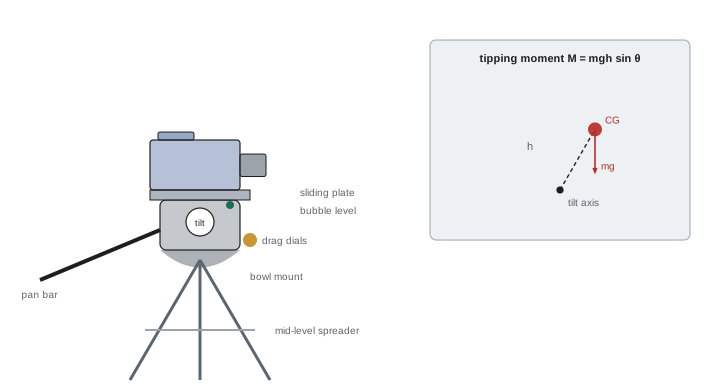
A fluid head controls panning and tilting with viscous resistance, called drag, from thick fluid or grease between closely fitting surfaces, giving smooth, damped movement that resists jerks. Fluid heads are standard for documentary, television, sports and many features, from small video heads to large cinema heads from manufacturers such as OConnor, Sachtler, Cartoni and Vinten. Their key features are:
- Drag: adjustable resistance on the pan and tilt axes, set to suit the camera weight, lens and type of move; heavy drag for slow, deliberate moves and long lenses, light drag for fast following.
- Counterbalance: a spring system that holds the camera at any tilt angle without the operator having to hold it, matched to the weight and center of gravity of the camera package.
- Locks: pan and tilt locks for static shots and for safety when leaving the camera.
- Pan bars: handles that give leverage and control; many operators use one bar, while some use two, or a bar on one side and a hand on the camera.
- Bubble level: an illuminated level that shows whether the head is horizontal.
Counterbalance and the center of gravity
When a camera tilts forward or back, its center of gravity, which sits above the tilt axis, moves away from the axis, creating a turning force (moment) that tries to tip the camera further. The moment grows with the camera's weight, the height of its center of gravity above the axis and the angle of tilt:
Here \(m\) is the camera mass, \(g\) gravitational acceleration, \(h\) the height of the center of gravity above the tilt axis and \(\theta\) the tilt angle. A counterbalance spring provides an opposing moment, ideally matching this one at every angle. Heads offer counterbalance in steps or continuously, rated for a range of payloads at a given center of gravity height. Setting it correctly means the camera stays put when released at any tilt, and the operator feels only the drag. Too little counterbalance and the camera falls forward; too much and it springs back to level. Adding a long lens, a matte box or a monitor changes the balance, so counterbalance should be reset when the package changes. Sliding the camera plate fore and aft first balances the camera at level, then counterbalance handles the tilt.
Worked problem
Is the counterbalance adequate?
A camera package weighs 18 kg with its center of gravity 12 cm above the tilt axis. The operator needs to tilt down 30°. What moment must the counterbalance resist at that angle, and would a head rated for 0 to 25 kg at a 12 cm center of gravity be suitable?
Show solution
- Moment: \(M = 18 \times 9.81 \times 0.12 \times \sin 30° = 18 \times 9.81 \times 0.12 \times 0.5\).
- That is about 10.6 newton-meters.
- The head is rated for 0 to 25 kg at the same center of gravity height, so 18 kg is within range with margin for a monitor or longer lens.
Answer: About 10.6 N·m at 30° tilt; a 25 kg-rated head at 12 cm center of gravity is suitable with reasonable margin.
Leveling
A level camera keeps verticals vertical and horizons horizontal; even a degree or two of tilt is noticeable when panning, because the horizon rises or falls across the pan. With a bowl mount, the operator loosens the bowl clamp, centers the bubble by tilting the head, and tightens it. With flat mounts, the legs are adjusted, or a leveling head or half-ball adapter is used. Level the head itself, not just the camera; a camera leveled by tilting on a non-level head will drift off level during a pan. Some operators deliberately leave a slight tilt for a stylistic effect, but this should be a choice, not an accident. On dollies, cranes and vehicles, leveling is part of setting up every shot, often done with a leveling head or the remote head's own correction.
Operating smooth pans and tilts
Operating a fluid head well is a craft that takes practice. Good technique includes:
- Setting drag and counterbalance for the package and the move before rehearsing.
- Standing comfortably, with feet positioned for the end of the move, so that the body can rotate without stepping.
- Starting and stopping moves smoothly, easing in and out rather than starting abruptly, unless a sudden move is intended.
- Leading moving subjects with space in front of them in the frame, called lead room or nose room.
- Following the motivation: starting the pan as the actor starts to move, not before.
- Practicing with an eyepiece and with monitors, since many operators now operate from a monitor on the head or remotely.
Many operators practice by following moving traffic or people, or by tracing straight lines and curves on a wall, and by drawing shapes with the lens. Smooth operation is as much about anticipation and timing as about the head.
Choosing tripods and heads for a package
Large cinema cameras with heavy zoom lenses, matte boxes and accessories can weigh 20 to 40 kg, requiring heavy-duty legs and 150 mm or Mitchell-mount heads. Lighter cinema and documentary packages of 5 to 15 kg suit 100 mm heads and lighter legs. Mirrorless and small cameras suit 75 mm heads, but even light cameras benefit from a head with good drag and counterbalance, since cheap photo heads lack both and produce jerky moves. For handheld-to-tripod work in documentary, lightweight carbon legs with a quick-release plate allow fast changes. Rental houses supply heads and legs matched to the camera package, and camera assistants prepare and test them during prep (CINE-210 Lesson 12).
Tripods on location
Real locations are rarely flat or stable. On wooden floors, footsteps transmit vibration through the floor to the tripod; placing the legs on sandbags, rubber pads or a stable platform, and asking the crew to stand still during takes, helps. In wind, lower the legs, shield the camera, add weight and avoid extending the top leg sections, which are thinnest. On slopes, extend the downhill leg further, and keep one leg pointing downhill for stability. Near water, edges and crowds, ensure the tripod cannot be knocked over, and never leave a camera on legs unattended where people are moving. In vehicles, the tripod is replaced by rigid mounts (Lesson 11).
Tripods for documentary and run-and-gun work
Documentary and news crews often work without grips and must move fast. Their tripods favor quick-release plates, single-stage or flip-lock legs that extend in seconds, mid-level spreaders for uneven ground, and lightweight carbon fiber that one person can carry all day. Fluid heads for this work should still have adjustable counterbalance and drag, because fast, smooth pans when following unscripted action are central to the craft. Some operators carry a monopod for situations where a tripod is too slow, and a small high hat or clamp for unusual positions.
Care and maintenance
Tripods and heads last for decades if maintained. Clean sand, salt and mud from legs and locks after outdoor use, since grit damages telescoping sections and seals. Check that leg locks hold under load, that spreaders lock firmly, and that heads pan and tilt smoothly without dead spots or stiction, the sticking that makes small moves jerky. Fluid heads should be serviced by qualified technicians when drag becomes uneven. Never leave a head with its counterbalance set high and no camera aboard in a position where it could spring and injure someone, and always carry heads and legs separately when moving long distances.
Common mistakes
MistakeUsing legs rated below the package weight.
InsteadChoose legs and heads rated comfortably above the full package.
MistakeLeaving counterbalance unset after changing lenses.
InsteadRebalance the plate and reset counterbalance for every package change.
MistakeLeveling the camera instead of the head.
InsteadLevel the head so pans stay level.
MistakeFully extending the thinnest leg sections in wind.
InsteadKeep legs low and add weight.
MistakeStarting a pan before the actor moves.
InsteadLet the action motivate the timing.
Summary and key terms
- Static frames are expressive and efficient but must be truly still.
- Standard legs, baby legs and high hats cover different heights.
- Spreaders, feet and sandbags keep legs stable.
- Heads mount by bowl (75, 100, 150 mm) or flat mounts such as Mitchell.
- Fluid heads provide drag, counterbalance and locks.
- Counterbalance opposes the tipping moment M = mgh sin θ.
- Level the head, set drag and practice smooth starts and stops.
- Sticks
- Tripod legs.
- Baby legs
- Short tripod legs for low positions.
- High hat
- Small rigid mount without legs.
- Spreader
- Brace linking tripod legs.
- Bowl mount
- Hemispherical head base for quick leveling.
- Mitchell mount
- Flat heavy-duty head mount.
- Fluid head
- Head with viscous drag for smooth moves.
- Drag
- Adjustable resistance to panning and tilting.
- Counterbalance
- Spring system resisting the tipping moment.
- Lead room
- Space in front of a moving subject in the frame.
Practice problems
Work each problem on paper first, then reveal the answer to check.
Name two expressive uses of a static frame.
Show answer
Calm, formality, tension, letting performance carry.
What are baby legs for?
Show answer
Low positions.
Why use a mid-level spreader?
Show answer
Rigidity while clearing obstacles and uneven ground.
Name three bowl sizes.
Show answer
75, 100 and 150 mm.
What does drag control?
Show answer
Resistance to pan and tilt.
What does counterbalance do?
Show answer
Holds the camera at any tilt.
Tipping moment for 10 kg, 10 cm, 30°?
Show answer
About 4.9 N·m.
Why level the head rather than the camera?
Show answer
So the horizon stays level during pans.
What is lead room?
Show answer
Space in front of a moving subject.
How can you reduce floor vibration on wood floors?
Show answer
Pads, sandbags, stable platforms, crew standing still.
Lesson quiz · 5 questions
Score 60% or more to complete this lesson.
Create a free account to save your progress, take quizzes and earn a certificate.