
CINE-230 · Lesson 6 of 12 · 26 min
Sliders, small moves and motion control
Not every move needs a full dolly and track. A slow creep along a tabletop, a gentle drift past a window, a precise move across a product or a repeatable pass for visual effects can be made with sliders, small motorized systems and motion control rigs. These tools are fast to set up, fit in tight spaces and, when motorized, can repeat a move exactly. This lesson covers sliders and their types, mounting and stability, manual technique, motorized sliders and time-lapse, small dollies and sliders on dollies, pedestals and column moves, motion control and repeatable moves, and choosing the right small-move tool.
Sliders
A slider is a short rail, typically from about 60 cm to 1.5 m long, along which a carriage carrying the camera and head glides on bearings or rollers. Sliders give smooth, short lateral, forward or diagonal moves, the small-scale equivalent of a dolly on track. Their compact size lets them fit on tabletops, car interiors, staircases, shelves and other spaces where track would be impossible, and their quick setup makes them popular in commercials, documentaries, interviews, product photography and music videos. Sliders range from lightweight carbon units for small cameras to heavy-duty sliders that can carry full cinema packages on geared or remote heads.
| Slider type | Typical length | Payload | Typical use |
|---|---|---|---|
| Lightweight carbon slider | 60–100 cm | Small cameras | Interviews, B-roll, travel |
| Heavy-duty slider | 1–2 m | Cinema packages | Commercials, drama, products |
| Motorized slider | 60 cm–1.5 m | Varies | Time-lapse, repeatable moves |
| Modular rail system | Extendable | Varies | Longer moves, curved sections |
Mounting and stability
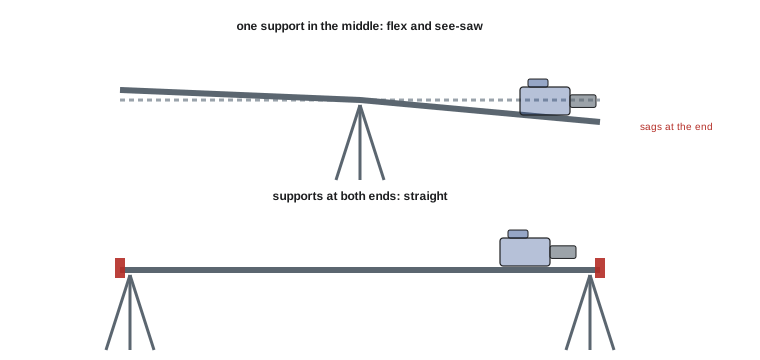
A slider amplifies any instability in its support. Mounted on a single tripod at its center, a slider can see-saw, flex and vibrate as the carriage moves to the ends, especially with heavy cameras. For smooth moves, mount the slider on two supports, one at each end, using two tripods, two stands, apple boxes, or a dolly platform. Level the slider along its length, unless a slope is wanted, and check that it is rigid by tapping the carriage at each end while watching through the lens. With heavy cameras, use sliders rated well above the load, and keep the head as low on the carriage as possible. Safety straps or end stops prevent the carriage from running off the end, and on uneven mounts, a slight slope can make the carriage drift on its own, so a brake or lock should hold it when not moving.
Manual slider technique
Moving a slider by hand smoothly is harder than it looks, because small hand tremors and uneven pushes show in the image. Techniques include setting the slider's drag or fluid damping, if it has it, so that the carriage resists jerks; pushing from the carriage or a handle with a steady, slow motion, using the body rather than the wrist; easing in and out at the ends; using a fluid head on the carriage to add a pan or tilt during the slide, creating a parallax move in which the camera slides past the subject while keeping it centered; and rehearsing several times. Belt-driven or flywheel sliders add smoothness by converting the push into a smoother motion. Because sliders are short, moves are usually slow: a 1 m slide over 6 seconds is about 17 cm per second, a pace that rewards foreground elements close to the lens.
Parallax slides and keeping the subject in frame
One of the most popular slider shots is the parallax or orbit slide, in which the camera slides sideways while panning to keep the subject centered, so that the background swings behind the subject. This creates a strong sense of depth even over a short distance. The pan angle needed depends on the slide distance and the distance to the subject:
Here \(\phi\) is the total pan angle, \(s\) the slide length and \(D\) the distance from the slider to the subject. Motorized sliders with pan-tilt modules can calculate and execute this automatically by setting the start and end framing on the subject.
Worked problem
Pan angle for a parallax slide
A camera slides 1.2 m along a slider while keeping a product 1.5 m away centered in frame. What total pan angle is required?
Show solution
- Half the slide is 0.6 m; the angle each side is \(\arctan(0.6 / 1.5) \approx 21.8°\).
- Total pan angle: \(2 \times 21.8° \approx 43.6°\).
- The background behind the product will sweep through about 44°, giving strong parallax.
Answer: About 44° of pan over the 1.2 m slide.
Motorized sliders and time-lapse
Motorized sliders drive the carriage with a belt or lead screw powered by a stepper motor, giving perfectly smooth, constant-speed moves, programmable acceleration curves, and repeatability. Many include pan and tilt modules for multi-axis moves, controlled by an app or controller. They are ideal for product shots, interviews with subtle movement, and time-lapse photography, in which the motor moves the camera a tiny amount between each frame, a technique called motion time-lapse or move-shoot-move, keeping the camera still during each exposure for sharp frames. Motion time-lapses of clouds, cityscapes and night skies add dimension compared with static time-lapses. For long time-lapses, power, stability and protection from weather and theft must be planned.
Worked problem
Planning a motion time-lapse
A cinematographer wants a 10-second shot at 24 fps of sunset clouds, with the camera moving 90 cm along a motorized slider. Clouds move well with an interval of 3 seconds. How many frames are needed, how long will shooting take, and how far does the slider move per frame?
Show solution
- Frames: 10 s × 24 fps = 240 frames.
- Shooting time: 240 × 3 s = 720 s = 12 minutes.
- Movement per frame: 90 cm / 240 ≈ 0.375 cm, about 3.75 mm.
- Use move-shoot-move so that the camera is still during each exposure.
Answer: 240 frames over 12 minutes, moving about 3.75 mm per frame.
Small dollies and sliders on dollies
Between sliders and full dollies are small camera dollies on portable track, tabletop dollies on wheels for moves across surfaces, and doorway dollies. Sliders are also often mounted on dollies: the dolly provides a long move, and the slider adds a short lateral or forward adjustment, or the slider on the dolly arm provides a precise small move without relaying track. Combining tools gives flexibility but increases weight and complexity; each mounting point must be secure.
Pedestals and column moves
Vertical moves, called booming or pedestal moves, can be made with dolly arms (Lesson 4), jibs (Lesson 7), or pedestals: studio camera supports with a vertical column on a wheeled base, standard in television studios, which let the camera rise and fall smoothly and glide across smooth floors. Small motorized columns and vertical sliders provide short, precise vertical moves for products and tabletop shots. Vertical moves reveal height, change the relationship between foreground and background and can make subjects feel more or less powerful.
Motion control
Motion control systems are computer-controlled camera rigs that can record and repeat a move exactly, often to within fractions of a millimeter, at any speed. Large motion control rigs, such as robotic arms and track-mounted cranes, carry cinema cameras through complex moves that can be repeated for multiple passes: one pass with actors, another with the background only, another for lighting effects or miniatures, all combined in compositing. High-speed robotic arms, popular in commercials and food photography, can whip the camera through a move at several meters per second and stop precisely, synchronized with high-frame-rate cameras, lights and rigs that launch products or liquids. Motion control data, recording camera position, orientation and lens settings for every frame, can also be exported to visual effects software so that computer-generated elements match the camera's movement precisely. Motion control requires specialist operators and programming time, and safety zones around fast robotic rigs are essential.
Choosing small-move tools
For a quick, subtle move in an interview or B-roll, a lightweight slider on two stands is often ideal. For a precise product move, a motorized slider or tabletop dolly gives repeatable results. For a short move with a heavy cinema package, a heavy-duty slider on a dolly or short track may be better. For repeated passes or high-speed precision, motion control is the tool. In every case, consider stability, payload, smoothness, setup time and how the move will be repeated for multiple takes or angles.
Sliders for interviews
Sliders are especially popular for interviews and documentary, where a slow, almost imperceptible drift adds life to otherwise static shots. A common setup places the main camera on a tripod for a stable medium close-up, while a second camera on a slider moves slowly across the subject for a wider or profile angle. The slider move is usually slow enough, perhaps 30 to 60 cm over a minute or more, that viewers sense movement without being distracted. Motorized sliders are ideal for this, since they can run continuously and silently while the interview progresses. Editors cut between the static and moving angles, using the moving angle to hide edits and add visual interest.
Combining sliders with other tools
Sliders can be mounted on dollies, cranes and vehicles for small precise moves within larger moves, or on tripods at angles to create vertical or diagonal moves. A vertical slider, for example, can create a small boom move for a product or tabletop shot. Some slider systems link several sections to extend the travel, and some offer curved rails for small arcs. Accessories such as flywheels, which smooth manual moves by adding inertia, and parallax brackets, which convert a slide into an automatic pan, extend their capabilities.
Motion control in practice
A motion control shoot typically begins with programming the move in the rig's software, often by moving the camera through key positions and recording them, then refining the path and timing. The camera is moved through the path slowly to check for collisions, then at speed. Each pass is recorded with identical timing, often triggered by timecode or a start signal so that lights, special effects and the camera are synchronized. For high-speed commercial work, such as liquids splashing around a product, the rig, the high-speed camera, the lights and the effects rigs are all fired together, and many takes may be needed to capture the perfect splash. Safety interlocks, light curtains and exclusion zones protect crew from fast-moving robotic arms, which can cause serious injury.
Repeatability without motion control
When full motion control is not available, crews can still achieve repeatable moves with marks, careful timing and practice, or with motorized sliders and programmable heads that repeat simpler moves. For visual effects passes, a locked-off camera, with no movement at all, remains the simplest way to ensure perfect alignment between passes, and plates are often shot this way when motion control is not essential.
Choosing slider speed and direction
Slider moves read differently depending on direction. A move toward the subject increases intimacy; a lateral move reveals depth and layers; a diagonal move combines both. Very slow moves suit calm interviews and product beauty shots, while faster moves suit energetic montages. Starting and ending each move with a moment of stillness gives editors flexible in and out points, and shooting each move in both directions doubles the options in the edit for little extra time.
When budgets allow, a production may carry several sliders of different lengths, choosing the shortest one that covers the move, because shorter sliders are stiffer, quicker to level and easier to hide from the shot.
Common mistakes
MistakeMounting a long slider on one tripod.
InsteadSupport it at both ends.
MistakePushing the carriage with the wrist.
InsteadMove smoothly with the body and damped drag.
MistakeSlider moves past empty backgrounds.
InsteadAdd foreground and parallax.
MistakeContinuous movement during time-lapse exposures.
InsteadUse move-shoot-move for sharp frames.
MistakeStanding near fast robotic motion control rigs.
InsteadRespect safety zones and procedures.
Summary and key terms
- Sliders give short, smooth moves in tight spaces.
- Support sliders at both ends and level them.
- Manual slides need damping, body movement and rehearsal.
- Parallax slides combine a slide with a pan of φ = 2 arctan(s/2D).
- Motorized sliders repeat moves and enable motion time-lapse.
- Pedestals and columns provide vertical moves.
- Motion control repeats complex moves precisely for passes and VFX.
- Slider
- Short rail with a gliding camera carriage.
- Carriage
- The moving platform on a slider.
- Parallax slide
- Slide combined with a pan to keep the subject centered.
- Motorized slider
- Slider driven by a motor for repeatable moves.
- Motion time-lapse
- Time-lapse with camera movement between frames.
- Move-shoot-move
- Moving only between exposures.
- Pedestal
- Studio column support for vertical moves.
- Motion control
- Computer-controlled repeatable camera movement.
- Pass
- One repetition of a motion control move.
- Robotic arm
- Industrial robot used as a camera rig.
Practice problems
Work each problem on paper first, then reveal the answer to check.
Typical slider length?
Show answer
About 60 cm to 1.5 m.
Why support a slider at both ends?
Show answer
To prevent flex and see-sawing.
Speed of a 1 m slide over 5 s?
Show answer
20 cm/s.
Pan angle for a 1 m slide at 2 m distance?
Show answer
About 28°.
What is move-shoot-move?
Show answer
Moving between exposures in a time-lapse.
Frames for a 5 s time-lapse at 24 fps?
Show answer
120.
Shooting time for 120 frames at a 4 s interval?
Show answer
8 minutes.
What is a pedestal?
Show answer
A studio column support for vertical moves.
What can motion control data be used for?
Show answer
Matching CG elements in VFX.
Name a safety concern with robotic arms.
Show answer
Fast motion requires safety zones.
Lesson quiz · 5 questions
Score 60% or more to complete this lesson.
Create a free account to save your progress, take quizzes and earn a certificate.