
CINE-330 · Lesson 11 of 12 · 28 min
Social-first deliverables and vertical framing
A modern campaign or music video release rarely ends with one horizontal film. The same shoot must feed television, streaming ads, cinema, websites and a stream of social posts in vertical, square and portrait formats, in lengths from sixty seconds to six. Many viewers will see the work first, or only, on a phone held upright. Cinematographers now plan for these deliverables from the treatment onward: choosing sensor modes and framing that protect several aspect ratios, shooting dedicated vertical set-ups, and lighting and composing so that the message reads on a small screen in the first seconds. This lesson covers aspect ratios and crops, protecting for multiple formats, shooting natively vertical, designing for small screens and short attention, and organizing deliverables.
Aspect ratios in a campaign
An aspect ratio is the ratio of image width to height. Common deliverables include:
- 2.39:1 or 2.00:1 widescreen for cinema-style spots and hero films.
- 16:9 (1.78:1) for television, streaming and horizontal online video.
- 1:1 square for some social feeds.
- 4:5 portrait for many feed placements, taller than square.
- 9:16 vertical for stories, short-form video and full-screen mobile placements.
Platforms change their recommended formats and safe areas frequently, so the agency's media plan should list current specifications. The cinematographer's job is to make sure the camera captures enough image to make every required version look intentional.
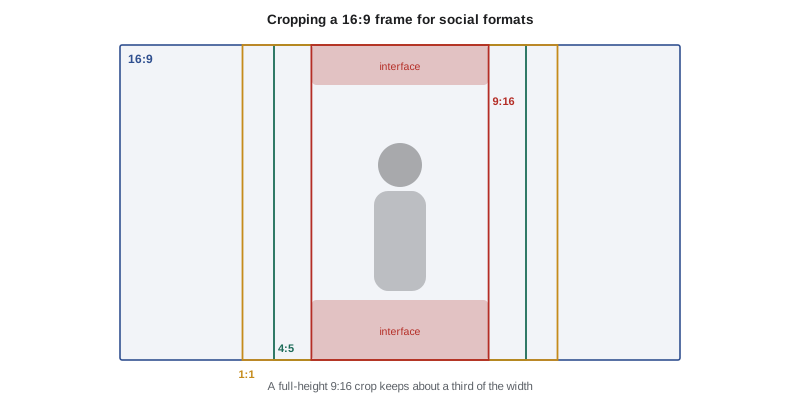
The arithmetic of crops
When a horizontal frame is cropped to a vertical format using its full height, only a fraction of the width remains. That has consequences for resolution and composition.
Here \( h \) is the frame height in pixels and \( a_w : a_h \) the target aspect ratio. For a 3840 × 2160 UHD frame, a 9:16 crop is \( 2160 \times 9/16 = 1215 \) pixels wide, about 32 % of the original width.
Worked problem
How much resolution survives the crop?
A spot is shot in UHD 3840 × 2160. The 9:16 vertical version must be delivered at 1080 × 1920. Is there enough resolution if the vertical crop uses the full height? What about a 4:5 version at 1080 × 1350?
Show solution
- 9:16 crop width = 2160 × 9 ÷ 16 = 1215 px; crop height = 2160 px.
- The crop (1215 × 2160) is larger than 1080 × 1920, so it can be scaled down slightly: enough resolution.
- 4:5 crop width = 2160 × 4 ÷ 5 = 1728 px; crop size 1728 × 2160, larger than 1080 × 1350: enough.
- If the editor wants to punch in further on the vertical, say to 70 % of the height, the crop becomes about 850 × 1512, below 1080 × 1920, and would need upscaling.
Answer: UHD gives enough resolution for full-height vertical and portrait crops, but little room for further punch-in on vertical versions.
Protecting for multiple formats
The traditional approach is to shoot horizontal and protect for other formats by keeping key action within a "safe" area that will survive the crops. Frame lines for each format are loaded into the camera and monitors so the operator and director can see them.
- Load frame guides for 16:9, 4:5 and 9:16 (and any widescreen extraction) on monitors.
- Keep faces, products and key action inside the narrowest required area, usually the 9:16 center strip.
- Allow headroom and foot room for vertical frames, which show more of the subject's height.
- Avoid placing important elements at the edges of the 16:9 frame if vertical is a priority.
- Use open gate or taller sensor modes when available, which record more vertical image than 16:9 and give more freedom to reframe.
Protecting has limits. A wide establishing shot designed for 16:9 often makes a weak vertical; a two-person conversation framed horizontally may lose one person in vertical. For important vertical content, a dedicated set-up is better.
Worked problem
Open gate gains
A camera records 16:9 at 4096 × 2304 or open gate at 4096 × 3072 (4:3). How much taller is the open gate image, and what 9:16 crop width does each allow at full height?
Show solution
- Height ratio: 3072 ÷ 2304 ≈ 1.33, about 33 % taller.
- 9:16 crop width at full height in 16:9 mode: 2304 × 9 ÷ 16 = 1296 px.
- 9:16 crop width in open gate: 3072 × 9 ÷ 16 = 1728 px.
Answer: Open gate is about 33 % taller and allows a 1728-pixel-wide vertical crop instead of 1296, giving more resolution and reframing freedom for vertical and portrait versions.
Shooting natively vertical
When vertical versions matter, many productions shoot dedicated vertical set-ups, sometimes with a second camera rotated 90 degrees or a second unit focused only on social content. Native vertical framing gives the best composition and resolution.
- Rotate the camera with a rotation plate or vertical cage; some cameras offer vertical monitoring and metadata.
- Compose for the phone: subjects large in frame, strong vertical lines, movement toward or away from the lens.
- Light for vertical: a tall frame shows more floor and ceiling, which must be dressed and lit or controlled.
- Plan dual-camera set-ups, one horizontal, one vertical, if time is short; lighting must work for both views.
- Use gimbals and handheld moves that feel natural in vertical, where lateral moves are less effective.
- Remember interface zones: platform buttons, captions and text cover parts of the vertical frame, so keep key elements away from the top and bottom and the right edge where buttons often sit.
Designing for small screens and short attention
Social placements are often seen without sound, on small screens, while scrolling. The opening seconds decide whether the viewer stops.
- Hook early: show the product, the artist or the most striking image within the first one or two seconds.
- Use bold contrast and clear subjects; fine detail and subtle tonal gradations disappear on phones.
- Frame closer: medium close-ups and close-ups read better than wide shots on small screens.
- Design for sound-off viewing: visual storytelling and on-screen text or captions carry the message.
- Keep brand visibility high without being crude; brand guidelines may require logos early in short versions.
- Think in loops: short clips that loop seamlessly can hold attention longer on some platforms.
Worked problem
Cutting a 30-second spot into short versions
A 30-second spot has five scenes of 6 seconds each. The media plan needs a 15-second, a 6-second and a 6-second vertical. The packshot (last 3 seconds) must appear in every version. How much non-packshot time remains in each version?
Show solution
- 15-second version: 15 − 3 = 12 seconds for scenes, roughly two scenes.
- 6-second versions: 6 − 3 = 3 seconds, one short moment.
- The vertical 6-second needs a moment that works in 9:16 framing, ideally shot vertically.
Answer: 12 seconds for scenes in the 15-second, 3 seconds in each 6-second. The shot list must include strong, self-contained moments of 2 to 3 seconds that work in both horizontal and vertical.
Deliverables lists and organization
A campaign deliverables list can run to dozens of files: different lengths, aspect ratios, with and without supers, with different end cards, in several codecs and loudness standards, sometimes in two languages. The cinematographer is not responsible for making deliverables, but planning the shoot around them avoids expensive problems.
In the United States, campaigns may be made in English and Spanish, with separate supers and voice-overs and sometimes separate dialogue takes. Broadcast spots must meet the CALM Act loudness rules based on ATSC A/85, and many networks have their own technical delivery specifications. Online platforms set their own specifications, which change frequently.
| Version | Aspect ratio | Lengths | Notes |
|---|---|---|---|
| Broadcast and streaming | 16:9 | 30, 15 | Loudness standard, supers safe area |
| Cinema | 2.39:1 | 60, 30 | Higher resolution, cinema audio mix |
| Online horizontal | 16:9 | 60, 30, 15, 6 | Captions for sound-off viewing |
| Feed portrait | 4:5 | 15, 6 | Product early, large text |
| Full-screen vertical | 9:16 | 15, 6 | Interface zones, native vertical preferred |
| Square | 1:1 | 15, 6 | For placements that require it |
Music video releases and social content
For music videos, the main video is usually horizontal, but labels also want vertical clips for short-form platforms, often a key hook from the chorus, choreography or a striking visual. Some videos are shot primarily vertical for mobile-first release. Cinematographers plan a vertical unit or dedicated passes, and make sure the artist's performance and look work in a tall frame. Behind-the-scenes content, often shot on phones by a social media team, also needs coordination so it does not interfere with the main shoot.
Captions, supers and text safety
Social videos often carry burned-in captions and on-screen text, because many viewers watch without sound. The cinematographer does not design the text, but composition must leave space for it. In vertical frames, the lower part of the screen is usually busy with platform captions and buttons, so text is placed in the upper middle or center. In horizontal broadcast spots, legal supers and offers usually sit in the lower third, inside a title-safe area. Agree the text layout with the agency early, so the product and faces do not sit under it.
Color and contrast for phones
Phone screens are bright and saturated, and viewers watch them in every kind of light, from dark bedrooms to sunny streets. Images with strong contrast, clear separation between subject and background and confident color read best. Subtle shadow detail that looks beautiful on a calibrated reference monitor may disappear on a phone at low brightness in daylight. Colorists often create a slightly different grade for social versions, and cinematographers can help by lighting subjects with clear separation from the background and avoiding very low-key images where the subject merges into darkness.
Workflow tips for multi-format shoots
On set, the digital imaging technician can generate quick vertical crops of selected takes so the director and agency can check that the vertical versions will work before the set is struck. Metadata should note which takes were framed for vertical, which were shot natively vertical and which were protected. Editors and social teams then find the right material quickly, saving time in post.
The social unit
Some productions hire a separate social unit: a small crew with its own camera, often working alongside the main unit to capture vertical versions, behind-the-scenes clips and short moments designed for specific platforms. The social unit must coordinate with the first assistant director so it does not slow the main unit or appear in shots, and the cinematographer should agree lighting rules so the social camera can borrow the main lighting without moving fixtures.
Planning coverage for many lengths
When a campaign needs a sixty, a thirty, a fifteen and several six-second versions, the shot list should include moments that stand on their own at each length. A good habit is to mark every planned shot with the versions it could serve: some shots work only in the long film, while others are short, self-explanatory and strong enough to open a six-second version. Shooting a few extra beats at the head and tail of key shots gives editors room to trim without losing the action, and capturing product moments in both horizontal and vertical framing protects the most valuable seconds of every version.
Common mistakes
MistakeFraming key action at the edges of 16:9 when vertical is needed.
InsteadKeep key elements inside the 9:16 center strip or shoot vertical set-ups.
MistakeAssuming any 16:9 shot will crop well to vertical.
InsteadPlan dedicated vertical set-ups for important vertical content.
MistakeIgnoring platform interface zones.
InsteadKeep faces, products and text away from areas covered by buttons and captions.
MistakeRelying on sound to tell the story in social versions.
InsteadDesign visuals and text that work with sound off.
MistakeShooting only long, slow moments.
InsteadCapture strong 2–3 second moments for short versions.
Summary and key terms
- Campaigns need many aspect ratios and lengths; the cinematographer plans for them from the treatment.
- A full-height 9:16 crop of a 16:9 frame keeps only about a third of the width.
- Frame guides, safe areas and open gate modes help protect for multiple formats.
- Native vertical set-ups give better composition and resolution for important social versions.
- Small screens and scrolling demand early hooks, bold contrast, close framing and sound-off storytelling.
- Deliverables include language versions and loudness standards that differ between Canada and the US.
- Music video releases need vertical clips and coordinated behind-the-scenes content.
- Aspect ratio
- The ratio of image width to height.
- Protecting
- Framing so that key action survives crops to other formats.
- Frame guides
- On-screen lines showing the boundaries of different formats.
- Open gate
- Recording the full sensor area, usually taller than 16:9.
- Native vertical
- Shooting with the camera rotated for vertical framing.
- Interface zone
- Part of a vertical frame covered by platform buttons and text.
- Cut-down
- A shorter version of a commercial.
- Super
- On-screen text added in post.
- Deliverables
- The final files required by the client and media plan.
- Hook
- The opening moment designed to stop a scrolling viewer.
Practice problems
Work each problem on paper first, then reveal the answer to check.
Width of a 9:16 crop from a 2160-pixel-tall frame?
Show answer
1215 px.
Width of a 4:5 crop from a 2160-pixel-tall frame?
Show answer
1728 px.
Width of a 1:1 crop from a 2160-pixel-tall frame?
Show answer
2160 px.
What fraction of UHD width survives a full-height 9:16 crop?
Show answer
About 32 %.
Why use open gate?
Show answer
It records more height for reframing to taller formats.
Why keep text away from the bottom of vertical frames?
Show answer
Platform interface elements cover it.
In a 15-second version with a 3-second packshot, how much time remains?
Show answer
12 seconds.
Why frame closer for social?
Show answer
Close shots read better on small screens.
Which law governs French in Quebec advertising?
Show answer
The Charter of the French Language.
Which US law governs broadcast commercial loudness?
Show answer
The CALM Act.
Lesson quiz · 5 questions
Score 60% or more to complete this lesson.
Create a free account to save your progress, take quizzes and earn a certificate.