
CINE-330 · Lesson 6 of 12 · 28 min
Car and automotive cinematography
Car commercials are some of the most expensive and technically demanding work in advertising. A new model must look sleek, solid and desirable; its paint must gleam, its lines must read clearly and its motion must feel thrilling yet safe. Cars also appear constantly in music videos, drama and branded content. This lesson is an awareness-level introduction to automotive cinematography: lighting and framing cars, shooting cars in motion with tracking vehicles and stabilized cranes, process trailers and towing, interior car shots, LED volumes and projection for driving scenes, and above all the safety planning that vehicle work demands. Driving stunts and precision driving are specialist trades; the cinematographer needs to understand the methods well enough to plan shots and keep people safe, not to perform them.
Lighting and framing a car
A car is a large reflective object. Like a bottle in tabletop work, its surfaces show reflections of everything around it, so lighting a car is largely about controlling what it reflects.
- Car bodies reflect the sky and surroundings. On location, the time of day and the sky shape the look; a clear blue sky gives a blue tone on the roof, while an overcast sky gives soft, even reflections.
- In studios, car lighting uses huge soft sources, often a giant overhead diffusion frame or a lightbox called a "car light" or "scrim" that runs the length of the car, to create long, smooth highlights along the body lines.
- Black flags and dark surroundings create the dark reflections that define shape; a car in a white room looks flat.
- Wheels, grilles and headlights need separate attention, often with small accent lights.
- Polarizing filters control reflections on glass and paint, but their effect changes as the camera or car moves, so they must be used carefully.
Framing follows the brand's design language. Low angles make a car look powerful; three-quarter front views show both the face and the side profile; long lenses compress the car with the background and flatter its proportions; wide lenses close to the car exaggerate perspective for drama but can distort the design, which some brands forbid.
Shooting cars in motion
Moving car shots need the camera to travel alongside, ahead of or behind the hero car at speed. Several methods exist.
- Tracking vehicles are specially equipped cars or trucks carrying the camera. The most famous type mounts a gyro-stabilized crane arm on the roof of a high-performance vehicle, letting the operator swing the camera around the hero car while both drive. Such systems are often called by the trademarked name of an early product, "Russian Arm", but several manufacturers make them.
- Car mounts attach the camera directly to the hero car with suction cups, clamps or rigs on the hood, sides or bumpers. They give dynamic views of the car or the driver.
- Drones capture aerial views of cars on roads and tracks, subject to aviation rules covered in CINE-320.
- Cable cams and cranes cover specific stretches of road.
- Handheld and gimbal shots from a following vehicle provide energy for music videos and low-budget work.
Worked problem
Relative speed and frame rate for a passing shot
The hero car drives at 60 km/h and a tracking vehicle drives alongside at the same speed in the next lane. For a passing shot, the tracking vehicle slows to 50 km/h so the hero car overtakes it. How fast does the hero car move relative to the camera, and how long does it take to pass a 5 m car length?
Show solution
- Relative speed = 60 − 50 = 10 km/h.
- Convert: 10 km/h ÷ 3.6 ≈ 2.8 m/s.
- Time to move 5 m relative to the camera: 5 ÷ 2.8 ≈ 1.8 s.
Answer: The hero car moves past at about 2.8 m/s relative to the camera, taking about 1.8 s per car length. Slower relative speeds give longer, more controllable passes while both cars travel at road speed.
Many car spots also adjust frame rate. Slightly undercranked footage, shot at 20 or 22 fps and played at 24 or 25 fps, makes cars appear faster while staying at safe speeds. Overcranked footage at 48 or 60 fps can make motion feel smooth and luxurious.
Worked problem
Undercranking to add speed
A car drives safely at 50 km/h. The footage is shot at 20 fps and played at 25 fps. How fast does the car appear to move?
Show solution
- Apparent speed factor = playback ÷ capture = 25 ÷ 20 = 1.25.
- Apparent speed = 1.25 × 50 = 62.5 km/h.
Answer: The car appears to move at about 62.5 km/h, an increase of 25 % without any extra risk.
Process trailers and towing
Shots of actors driving and talking are rarely filmed with the actor actually driving. Instead, the car is placed on a low process trailer or towed behind a camera vehicle, so the actor can concentrate on performance while a professional driver controls the rig.
- A process trailer is a low platform carrying the picture car, towed by a truck that also carries the camera and crew. The trailer keeps the car's height close to the road so the shot looks natural.
- A tow dolly or car tow lifts the front wheels and pulls the car behind a camera vehicle.
- Pod cars or "driving pods" mount a professional driver on the roof or front of the picture car, so the actor appears to drive while the pod driver controls the vehicle.
- Camera positions include hood mounts looking through the windshield, side mounts through the windows and positions on the trailer itself.
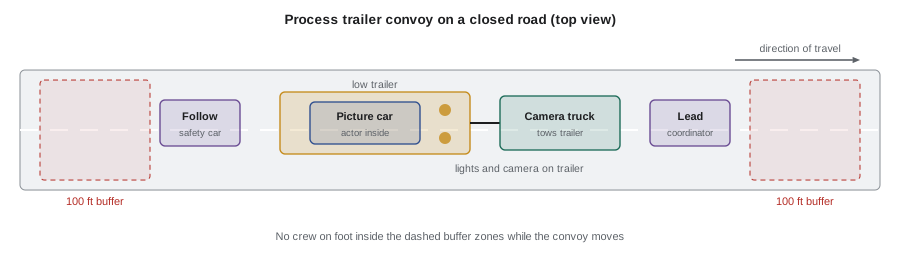
Lighting inside a moving car is a challenge. Daylight changes constantly as the car turns and passes shadows. Small LED panels, soft tubes and bounce cards rigged inside the car or on the trailer keep the actor's face consistent, while ND gels on windows control the outside brightness.
LED volumes and projection for driving scenes
Increasingly, driving scenes are filmed on stages with the car in front of large LED screens showing pre-recorded road footage, or with projection behind the windows. This approach, part of the virtual production methods covered in Lesson 10, has several advantages.
- Actors perform in a controlled, safe space without road traffic.
- Reflections of the moving scene appear naturally on the car's paint and windows, which green screen cannot easily achieve.
- The time of day and weather can be repeated across takes and days.
- Dialogue can be recorded cleanly.
The background footage, called driving plates, is shot by a specialized array of cameras mounted on a vehicle, capturing views in many directions at once. The cinematographer must match the plates' direction, time of day and lens perspective to the foreground. Interactive lighting, such as moving shadows of passing trees, is created with LED fixtures programmed to match the plates.
Interiors and details
Car commercials need many detail shots: the dashboard, the steering wheel, the seats, buttons, the gear selector, headlights turning on. These are tabletop-style shots at car scale, with careful light and motion control in some cases. Screens inside modern cars often need replacing in post or showing specific images, so the art department and post team coordinate content. Interior shots also need attention to reflections of the crew in glass and glossy surfaces.
Safety for vehicle work
Vehicle work is among the most dangerous activities in production. People have been killed and seriously injured on film sets by vehicles, falling equipment and rigs. Every vehicle shot needs planning, the right specialists and clear communication.
In the United States, the OSHA General Duty Clause and state OSHA plans require employers to protect workers from recognized hazards. The Industry-Wide Labor-Management Safety Committee publishes safety bulletins for the motion picture industry, including guidelines for the use of vehicles, camera cars and stunts, administered through Contract Services. Road use requires permits from the city or county film office and police, and traffic control must follow state and local rules.
- Use a stunt coordinator or precision driving team for any vehicle action and a qualified driver for camera vehicles.
- Close roads or use private tracks for driving shots; never mix production driving with public traffic without proper control.
- Hold a safety meeting before every vehicle shot, walking through the route, speeds, positions and abort signals.
- Keep crew inside the camera vehicle seated and secured; no one rides on unprotected positions.
- Mark safe zones for crew and spectators, with buffer distances based on speeds and the stunt coordinator's advice.
- Secure every mount and rig with safety cables, and inspect them after each run.
- Use radios and clear commands; anyone can call "cut" or "stop" for safety.
Worked problem
Stopping distance and buffer zones
A camera car travels at 50 km/h. With a reaction time of 1.0 s and a deceleration of 6 m/s², what is the total stopping distance?
Show solution
- Convert speed: 50 ÷ 3.6 ≈ 13.9 m/s.
- Reaction distance: 13.9 × 1.0 ≈ 13.9 m.
- Braking distance: \( v^2 / (2a) = 13.9^2 / 12 \approx 193 / 12 \approx 16.1 \) m.
- Total ≈ 13.9 + 16.1 = 30 m.
Answer: About 30 m. Buffer zones and spacing between vehicles must exceed stopping distances with a margin, and slower speeds shrink them dramatically.
The automotive crew
Car shoots bring specialist crew alongside the usual departments: precision drivers, a vehicle coordinator, camera car operators and technicians, riggers who mount cameras on cars, and sometimes a car prep team who clean, polish and protect the hero vehicle between takes. Manufacturers often send their own representatives to ensure the car is shown correctly. Pre-production prototypes may be covered in secrecy, with strict rules about where and when they can be filmed.
| Method | Best for | Main risks |
|---|---|---|
| Gyro crane on tracking vehicle | Dynamic moving shots around the car | High speed, vehicle interaction |
| Hard mounts on the car | Driver and car details in motion | Mount failure, debris |
| Process trailer | Dialogue and performance in a car | Trailer handling, low clearance |
| Driving pod | Actor appears to drive at speed | Pod driver visibility |
| LED volume or projection | Controlled driving scenes with reflections | Matching plates and lighting |
| Drone | Aerial views of roads and tracks | Airspace rules, people below |
Weather, light and location planning for car shoots
Car commercials often depend on specific light: a low sun raking along the body, wet roads reflecting city lights at night or mist in a valley at dawn. Location scouts note the direction of roads relative to sunrise and sunset, the reflections that buildings and trees will throw on the paint, and the times when roads can be closed. Wet-down crews spray roads with water at night to create reflections, which also changes grip for the drivers, so the stunt coordinator must approve it. A schedule built around a short golden-hour window needs rehearsals in the afternoon, so that the crew uses those precious minutes for takes rather than for solving problems.
Common mistakes
MistakeLighting a car without controlling reflections.
InsteadUse large soft sources and black flags to shape highlights and dark lines.
MistakeHaving actors drive while performing.
InsteadUse process trailers, tow rigs or pods with professional drivers.
MistakeFilming on open public roads without control.
InsteadObtain permits, close roads or use tracks, and use traffic control.
MistakeSkipping the safety meeting for a "simple" drive-by.
InsteadWalk through every vehicle shot, with abort signals, before each run.
MistakeIgnoring stopping distances when placing crew.
InsteadSet buffer zones larger than stopping distances, with margin.
Summary and key terms
- Car lighting controls reflections with large soft sources and dark surroundings.
- Moving shots use tracking vehicles with stabilized cranes, car mounts, drones and cranes.
- Undercranking can make cars appear faster at safe speeds.
- Process trailers, tow rigs and pods let actors perform while professionals drive.
- LED volumes provide controlled driving scenes with natural reflections.
- Vehicle safety relies on specialists, permits, closed roads, safety meetings and buffer zones.
- Canadian provincial guidance and US industry bulletins set expectations for vehicle and stunt safety.
- Tracking vehicle
- A vehicle equipped to carry a camera alongside a moving subject.
- Gyro-stabilized crane arm
- A remotely controlled arm on a vehicle roof that holds a stabilized camera.
- Process trailer
- A low trailer carrying a picture car, towed by a camera truck.
- Driving pod
- A rig that lets a professional drive while the actor appears to drive.
- Picture car
- The vehicle that appears on screen.
- Driving plates
- Background footage of roads captured for projection or compositing.
- Undercranking
- Shooting below playback rate to speed up motion.
- Hard mount
- A rigid camera mount attached to a vehicle.
- Precision driver
- A specialist driver trained for exact, repeatable vehicle action.
- Stopping distance
- The total distance to stop, including reaction and braking.
Practice problems
Work each problem on paper first, then reveal the answer to check.
Why use black flags around a car?
Show answer
To create dark reflections that define shape.
Relative speed of cars at 70 and 60 km/h?
Show answer
10 km/h, about 2.8 m/s.
Apparent speed of 40 km/h shot at 20 fps, played at 24 fps?
Show answer
48 km/h.
What does a process trailer allow?
Show answer
Actors to perform in a car while a professional drives the truck.
Why are LED volumes useful for driving scenes?
Show answer
They give controlled light and natural reflections on the car.
Stopping distance at 30 km/h, 1 s reaction, 6 m/s²?
Show answer
About 8.3 + 5.8 = 14 m.
Who should plan vehicle action?
Show answer
A stunt coordinator or precision driving team.
What are driving plates?
Show answer
Background road footage for projection or compositing.
Why may wide lenses be forbidden on car spots?
Show answer
They distort the car's design.
Name one safety step before a vehicle shot.
Show answer
A safety meeting walking through routes, speeds and abort signals.
Lesson quiz · 5 questions
Score 60% or more to complete this lesson.
Create a free account to save your progress, take quizzes and earn a certificate.