
CINE-330 · Lesson 12 of 12 · 28 min
Safety on fast shoots and capstone: a spot and a music video
Commercials and music videos combine the most dangerous ingredients in production: tight schedules, long hours, ambitious effects, vehicles, water, smoke, pyrotechnics, strobes, heights and robots, often with small crews and little rehearsal. The cinematographer leads three departments, camera, grip and electric, and has a direct responsibility for how their crews work and an influence on every shot's risk. This final lesson brings together the safety practices for fast, effects-heavy shoots, explains the legal framework in Canada and the United States, and then guides you through a capstone: planning, bidding and shot-listing a thirty-second product spot and a music video using everything in the course.
Why fast shoots are risky
Accidents on sets rarely have a single cause. They usually result from a chain of small decisions under pressure: a skipped safety meeting, a tired crew member, an unrehearsed stunt, a rig not inspected, a change of plan without communication. Commercial and music video schedules make these chains more likely.
- Long days and short turnarounds cause fatigue, which slows reactions and impairs judgment, especially when crew drive home afterward.
- Specialty equipment, such as robots, high-speed lighting, cranes and vehicles, brings unfamiliar hazards.
- Small budgets may tempt productions to skip specialists, such as stunt coordinators, riggers or safety officers.
- Effects such as fire, water, smoke, haze and strobes affect crew and performers' health.
- Last-minute creative changes can bypass planning.
The best protection is a culture in which safety is part of the plan, not an obstacle to it. The cinematographer sets that culture for camera, grip and electric crews.
The legal framework
In the United States, the Occupational Safety and Health Act requires employers to keep workplaces free of recognized hazards, enforced by federal OSHA or state plans such as Cal/OSHA. Workers have rights to information, training and to report hazards without retaliation. The motion picture industry adds the safety bulletins of the Industry-Wide Labor-Management Safety Committee, administered by Contract Services, covering topics such as stunts, firearms, pyrotechnics, aerial work, water, vehicles, robots and fog. Many union agreements require safety training, such as Safety Pass courses in California. Cities and counties control permits for streets and public spaces.
Union agreements also govern hours, meal breaks and turnaround times, which are safety rules as much as pay rules. Cinematographers should know the rest periods required for their crews and plan the day to respect them.
Hazards common on commercial and music video sets
- Vehicles and stunts: follow Lesson 6; use coordinators, closed roads, safety meetings and buffer zones.
- Robots and motion control: exclusion zones, emergency stops and slow previews, as in Lesson 5.
- Electrical: high-output lighting draws large currents; use qualified electricians, proper distribution, ground fault protection near water and generators placed safely.
- Heat and burns: large fixtures run hot; use gloves and keep flammable materials clear.
- Rigging and heights: lights and LED walls rigged overhead need qualified riggers, rated hardware and safety cables; work at height requires fall protection.
- Water: rain towers, tanks and pools require electrical isolation, lifeguards or water safety personnel and hypothermia awareness.
- Smoke, haze and fog: use approved fluids, ventilation and limits on exposure; inform performers with respiratory conditions.
- Pyrotechnics and fire: only licensed pyrotechnicians handle explosives and fireworks; fire safety officers and permits are required.
- Strobes and flashing lights: can trigger seizures in people with photosensitive epilepsy; tell cast and crew in advance and limit flash rates. The final video may also need a viewer advisory.
- Lasers: use only lasers rated for entertainment use with a qualified operator; never aim at eyes or cameras without assessment.
- Fatigue: plan reasonable hours, provide transport when days run long and respect turnaround.
Safety practices that work
- Plan hazards in pre-production: list every risky element, name the specialist responsible and record controls in a hazard assessment.
- Hold a general safety meeting at the start of each day and specific meetings before stunts, effects or vehicle work.
- Use clear communication: radio channels, standard calls and the rule that anyone can stop work for safety.
- Inspect equipment and rigs before use and after changes.
- Rehearse complex shots at slow speed or without effects first.
- Keep emergency information on the call sheet: nearest hospital, first aid personnel, emergency contacts.
- Report and review incidents and near misses to improve the next shoot.
Worked problem
Fatigue and turnaround
A music video shoot wraps at 2:00 a.m. The crew's agreement requires 10 hours of rest between wrap and the next call. The producer wants a 9:00 a.m. call the next day for a second shoot day. Does the call respect turnaround, and what is the earliest call time?
Show solution
- Wrap 2:00 a.m. plus 10 hours of rest equals 12:00 noon.
- A 9:00 a.m. call gives only 7 hours of rest.
- The earliest compliant call is 12:00 noon, or later if travel time is counted.
Answer: The 9:00 a.m. call breaks turnaround; the earliest call is noon. The cinematographer should support the producer in rescheduling rather than asking a tired crew to work unsafely.
Capstone part 1: the thirty-second product spot
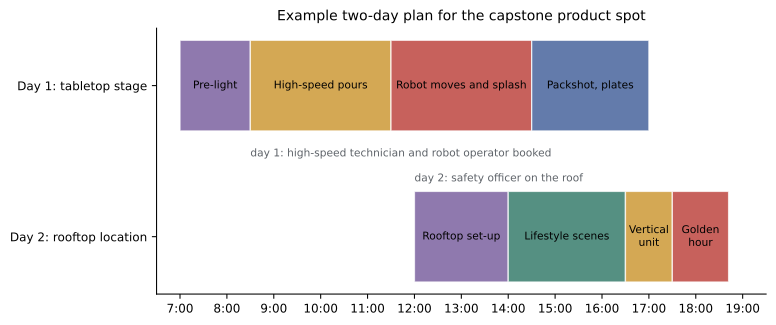
The capstone asks you to plan a commercial and a music video as a director of photography would, using the methods from every lesson. For the commercial, imagine the brief: a premium sparkling fruit drink launching nationally. The agency's boards show five scenes: a high-speed pour into a glass with fruit splashing; a robot-arm move around the bottle; a lifestyle moment of friends on a rooftop at sunset; a vertical-friendly close-up of a friend laughing as she opens the can; and a packshot with logo and tagline. Deliverables include a 30, a 15, two 6-second versions and vertical 9:16 versions.
- Read the brief (Lesson 2): the key message is "fresh, real fruit, sparkling". The pour and splash scenes are the heroes.
- Plan tabletop (Lesson 3): backlit pour with diffusion and black flags; hero fruit prepared by a stylist; acrylic ice; genuine product in all hero shots.
- Plan high-speed (Lesson 4): the splash lasts about 0.1 s; the board shows 2.5 s; slowdown factor 25; at 24 fps that means 600 fps; shoot at 1,000 fps for flexibility; about 5.4 more stops of light than normal; flicker-free fixtures tested.
- Plan motion control (Lesson 5): a fast robot arc around the bottle timed to a splash rig, with a clean plate and label pass.
- Plan the rooftop (Lessons 2 and 9): golden hour window of about 30 minutes; warm backlight with fill; diffusion filter for glow; protect for 9:16.
- Plan social (Lesson 11): a native vertical camera on the can-opening moment; open gate on the main camera; interface zones respected.
- Plan safety (this lesson): robot exclusion zone, rooftop edge protection and fall prevention, electrical distribution away from liquids, permits for the roof.
Worked problem
Capstone budget check for the camera department
The production budget is 400,000. The equipment line is 13 %. The camera package costs 9,000 per day, the lighting and grip package 14,000 per day, the high-speed camera with technician 6,500 for day 1, the robot arm with operator 12,000 for day 1, and media and data 2,500 total. Does the two-day plan fit the equipment line?
Show solution
- Equipment line: 0.13 × 400,000 = 52,000.
- Camera package: 2 × 9,000 = 18,000. Lighting and grip: 2 × 14,000 = 28,000.
- Specialty day 1: 6,500 + 12,000 = 18,500. Media: 2,500.
- Total: 18,000 + 28,000 + 18,500 + 2,500 = 67,000.
- Over budget by 67,000 − 52,000 = 15,000.
- Options: negotiate a package discount (for example 15 % on camera and lighting saves 6,900), reduce day 2 lighting to a smaller package (saving about 6,000) and trim media costs, or ask the producer to move money from another line.
Answer: The plan is 15,000 over the equipment line. Discounts and a lighter location package can close most of the gap; the cinematographer presents these options with their creative consequences.
Capstone part 2: the music video
For the music video, imagine an emerging artist's single at 96 BPM, 3:20 long, with a small budget and one shoot day. The concept: the artist performs in a single room whose color changes with each section of the song, ending with a slow-motion chorus in a rain effect.
- Structure (Lesson 7): map verses, choruses and bridge to color states; each chorus brighter and more saturated.
- Playback (Lesson 8): standard playback at 24 fps for performance; the final chorus in slow motion at 48 fps with 2× playback, pitch-corrected; frames per beat at 96 BPM is 15.
- Look (Lesson 9): RGB LED fixtures programmed on a console to change with each section; haze to reveal beams; a vintage lens set for softness; narrow shutter for crisp choreography in the bridge.
- Social (Lesson 11): a vertical pass of the chorus hook.
- Safety (this lesson): the rain effect needs electrical isolation, ground fault protection, non-slip flooring and warm-up breaks for the artist; strobe effects disclosed to cast and crew in advance.
- Schedule: light all color states in pre-programming, shoot performance passes in song order of color states, finish with rain and slow motion, which take longest to reset.
Worked problem
Off-speed chorus timing
The final chorus lasts 32 beats at 96 BPM. How long is it on screen, how long does the artist sing it on set at 2× playback, and how many frames are recorded at 48 fps?
Show solution
- Seconds per beat: 60 ÷ 96 = 0.625 s; chorus = 32 × 0.625 = 20 s on screen.
- On set at 2× playback: 20 ÷ 2 = 10 s.
- Frames recorded: 10 s × 48 fps = 480 frames, which play at 24 fps for 20 s.
Answer: 20 seconds on screen, 10 seconds of singing on set and 480 frames recorded.
Presenting your plan
In the professional world, a director of photography presents plans to the director, producer and sometimes the client. A strong presentation includes reference frames, lighting diagrams, an equipment list with costs, a schedule, a list of specialists and a safety summary. For the capstone, assemble these elements for both projects. Explain the reasoning: why each tool earns its cost, how each shot serves the brief or song, and how risks are controlled. This combination of creativity, arithmetic and responsibility is what clients and directors value in commercial and music video cinematographers.
| Area | Product spot | Music video |
|---|---|---|
| Concept and references | Fresh fruit, sparkle, premium | Color room, rain chorus |
| Key techniques | High-speed, robot, tabletop, rooftop | Playback, RGB light, off-speed, haze |
| Specialists | High-speed tech, robot operator, stylist, safety | Programmer, effects for rain, safety |
| Deliverables | 30, 15, 6s, vertical | Main video, vertical hook |
| Main risks | Robot, rooftop edge, electricity near liquid | Water and electricity, strobes, fatigue |
| Budget check | Equipment line vs packages | Small budget, one day |
Mental health and respectful sets
Safety includes psychological safety. Long hours, pressure and hierarchy can make sets stressful, and harassment or bullying harms people and work alike. Clear respectful-workplace policies, a known way to raise concerns and leaders who model calm, courteous behavior make fast shoots better for everyone.
Common mistakes
MistakeTreating safety as a separate department's job.
InsteadLead camera, grip and electric crews with safety built into the plan.
MistakeSkipping specialists to save money.
InsteadHire coordinators, riggers and licensed effects personnel for hazardous work.
MistakeIgnoring turnaround after a late wrap.
InsteadRespect rest periods and reschedule calls.
MistakeUsing strobes without telling cast and crew.
InsteadDisclose strobe effects in advance and limit flash rates.
MistakePresenting an equipment list without costs or reasons.
InsteadShow costs, options and how each tool serves the work.
Summary and key terms
- Fast, effects-heavy shoots combine fatigue, specialty equipment and pressure that create accident chains.
- Canadian provincial OHS law and industry guidance, and US OSHA law and industry bulletins, require hazard assessment and safe practices.
- Common hazards include vehicles, robots, electricity, heights, water, smoke, pyrotechnics, strobes, lasers and fatigue.
- Safety meetings, clear communication, inspections, rehearsals and incident reviews work.
- The capstone product spot applies brief reading, tabletop, high-speed, motion control, lifestyle and social planning.
- The capstone music video applies song structure, playback, off-speed, color and safety with water and strobes.
- A professional plan combines references, diagrams, equipment and costs, schedules, specialists and safety.
- Hazard assessment
- A documented review of hazards and controls for a shoot.
- Turnaround
- The rest period between wrap and the next call.
- Safety meeting
- A briefing on hazards and procedures before work or a specific shot.
- Near miss
- An event that could have caused harm but did not.
- Ground fault protection
- A device that cuts power when current leaks to ground.
- Pyrotechnician
- A licensed specialist who handles explosives and fireworks.
- Photosensitive epilepsy
- A condition in which flashing lights can trigger seizures.
- Right to refuse
- A worker's legal right to refuse unsafe work in Canada.
- Safety bulletin
- Industry guidance on a specific hazard in film production.
- Call sheet
- The daily document with schedule, crew, locations and emergency information.
Practice problems
Work each problem on paper first, then reveal the answer to check.
Wrap at 1:00 a.m. with 10 hours turnaround: earliest call?
Show answer
11:00 a.m.
Equipment line at 12 % of 350,000?
Show answer
42,000.
Slowdown factor for a 0.1 s splash to fill 2.5 s?
Show answer
25.
Seconds per beat at 96 BPM?
Show answer
0.625 s.
Frames recorded for 8 s of singing at 48 fps?
Show answer
384.
Who may handle pyrotechnics?
Show answer
Only licensed pyrotechnicians.
Why use ground fault protection near water?
Show answer
To cut power if current leaks, preventing shocks.
What should a call sheet include for safety?
Show answer
Nearest hospital, first aid and emergency contacts.
Name two elements of a DP's plan presentation.
Show answer
Reference frames and an equipment list with costs.
Why disclose strobe effects?
Show answer
They can trigger seizures in people with photosensitive epilepsy.
Lesson quiz · 5 questions
Score 60% or more to complete this lesson.
Create a free account to save your progress, take quizzes and earn a certificate.