
CINE-401 · Lesson 7 of 12 · 29 min
Planning with the gaffer and key grip
A lighting plan on paper becomes light on set through the work of two departments: electric, led by the gaffer, and grip, led by the key grip. Their planning determines whether the DP's ideas can be built safely, on time and on budget. This lesson covers how the DP works with the gaffer and key grip in prep: the technical scout, translating plans into equipment orders, rigging and power planning, pre-rigs, camera support and light shaping, and budgeting the camera, lighting and grip packages. The electrical and rigging safety rules themselves were covered in Course CINE-340; this lesson focuses on planning and collaboration.
Two departments, two partners
In North American practice the work is divided clearly.
- Electric (lighting) department: the gaffer, best boy electric and lamp operators handle lighting fixtures, power distribution, generators, dimming and control. They make light.
- Grip department: the key grip, best boy grip, dolly grip and grips handle camera support (dollies, cranes, mounts), rigging, and the shaping of light with flags, frames, diffusion and overheads. They shape and support light and camera.
Both heads of department should be hired early enough to attend scouts and contribute to the plan. A gaffer who first sees the location on the shooting day cannot pre-rig it; a key grip who first hears of a crane move the night before cannot order or permit it.
Sharing the plan
Before the technical scout, give the gaffer and key grip the script, breakdown, look book, shot lists and overheads for the key scenes. Talk through the lighting idea for each scene: where the light comes from, how it changes, and the contrast and color you want. Good gaffers and key grips will then propose how to achieve it, often with ideas that save time or money: a rigged ceiling bounce instead of many stands, a single large source on a lift instead of several small units, a dolly on a track that fits through a narrow door.
The technical scout
The technical scout (tech scout) is a visit to every location by the heads of department, usually late in prep. The director, DP, first AD, production designer, gaffer, key grip, location manager, sound mixer, transport captain and others walk each location in shooting order.
- Confirm the blocking and camera positions for each scene.
- Decide where large lighting units will go: outside windows, on lifts, on rooftops or on stands, and how they will be secured.
- Identify power sources: where the generator will sit, cable runs, distance and permitted tie-ins (Course CINE-340).
- Check access: door widths, stairs, elevators, floor loading, parking for trucks and lifts, and neighbors.
- Note sun direction and times (Lesson 8), sound problems and any permits needed for lifts, street closures or rigging on buildings.
- Agree what can be pre-rigged and when.
The gaffer and key grip take detailed notes and photographs and often measure distances with laser rangefinders. After the scout they produce equipment lists and rigging plans.
From plans to equipment orders
The lighting plot and grip notes for each location become an equipment order. Productions usually rent a base package for the whole shoot, carried on the electric and grip trucks, plus additional equipment for specific days (called day-plays or add-ons).
- Base package: fixtures, distribution, stands, flags, frames, dolly and track used most days.
- Day-plays: large units, lifts, cranes, extra generators, specialty rigs and extra crew for specific scenes.
- Expendables: gels, diffusion, tape, clothespins, black wrap and other consumables, budgeted separately because they are used up.
| Department | Base package examples | Day-play examples |
|---|---|---|
| Camera | Camera bodies, lens set, filters, monitors, focus systems | Extra camera body, specialty lens, high-speed camera |
| Electric | Fixtures of several sizes, distribution, cable, dimmers, generator | Very large daylight units, extra generator, lift-mounted units |
| Grip | Stands, flags, frames, dolly and track, rigging hardware | Crane, techno-crane, car mounts, large overhead frames |
Rigging plans
Rigging means putting lights, frames or cameras in places stands cannot reach: on ceilings, walls, building exteriors, lifts or vehicles. Rigging is planned by the key grip with the gaffer, and on larger shows by a separate rigging crew led by a rigging gaffer and rigging key grip.
- Ceiling rigs: lights and diffusion hung from pipes, trusses or speed rail, often with softboxes that light a whole set evenly.
- Window rigs: units outside windows on stands, scaffolding or lifts, with frames of diffusion or neutral density on the windows.
- Overhead frames: large fabric frames of 3.6 m (12 ft) or 6 m (20 ft) square, flown over actors to soften or block the sun. They act like sails and need careful securing and wind limits (Course CINE-340).
- Lifts: boom lifts (often called condors) and scissor lifts that hold large units high above night exteriors.
Every rig needs load calculations, safe attachment points and approval from the location owner. The DP's role is to ask for the effect and leave the method to the experts, while respecting their judgment when they say a rig is unsafe.
Power planning
The gaffer and best boy electric calculate power needs from the lighting plot: the total wattage of fixtures that may run at once, plus video village, DIT carts, heaters or fans. Course CINE-340 covered the electrical calculations and safety rules. For planning, the DP needs to understand the consequences.
- Bigger lighting plans need bigger generators, more cable and longer set-up times.
- Locations without generator access (upper floors, remote sites, residential streets) may limit the size of units, or require battery systems, tie-ins by licensed electricians or long cable runs.
- Modern LED fixtures draw much less power than tungsten or HMI units of similar output, which can shrink the generator and simplify distribution.
Worked problem
Sizing the generator for a night exterior
The night exterior plot calls for two large daylight LED units drawing 2,500 W each, four medium LED units at 800 W each, eight small LED units at 200 W each, practical street lamps totaling 1,200 W, and 2,000 W for video village, DIT and a heater. The gaffer wants the generator loaded to no more than about 80 % of its rating. What generator size is needed?
Show solution
- Large units: 2 × 2,500 = 5,000 W. Medium: 4 × 800 = 3,200 W. Small: 8 × 200 = 1,600 W.
- Practicals: 1,200 W. Other loads: 2,000 W.
- Total: 5,000 + 3,200 + 1,600 + 1,200 + 2,000 = 13,000 W, or 13 kW.
- At 80 % loading: 13 ÷ 0.8 ≈ 16.3 kW. Round up to a standard size of at least 20 kW, and check that the load can be balanced across the phases (Course CINE-340).
Answer: The plan draws about 13 kW, so a generator of about 20 kW is appropriate. The same plan with tungsten and HMI units of similar output could easily draw two to three times as much power.
Pre-rigs
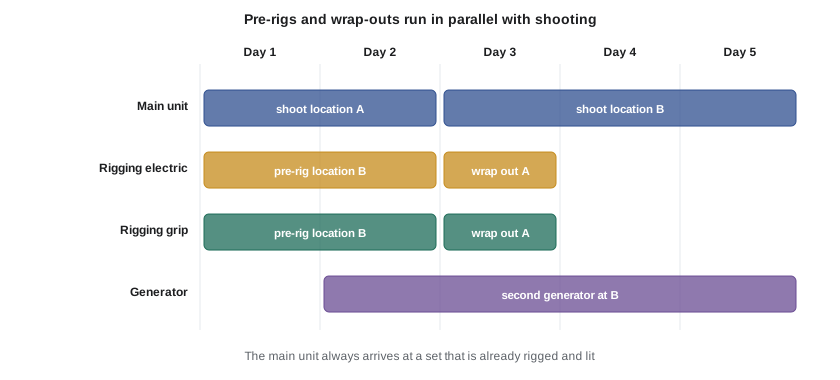
A pre-rig is work done before the shooting crew arrives: hanging lights, building scaffolds, running cable, rigging overheads and testing. Pre-rigs are among the most effective ways to save shooting time, because rigging crews can work while the main unit shoots elsewhere.
- Identify scenes that need pre-rigs during the tech scout: big night exteriors, stages with ceiling rigs, locations with window scaffolds, car rigs.
- Schedule pre-rig crews and equipment: they need their own calls, transport and sometimes their own generator.
- Plan wrap-outs (de-rigs) as well, because rigs must come down and locations must be returned in good condition.
Worked problem
Is a pre-rig worth it?
Lighting a night exterior from scratch on the shooting night would take the main unit about 4 hours before the first shot. A rigging crew of 5 can pre-rig it the day before in 8 hours. The main unit of about 60 people costs roughly 4,000 per hour all-in (crew, equipment, cast and overheads), while the rigging crew costs about 600 per hour. The main unit would still need about 1 hour to fine-tune after a pre-rig. Compare costs.
Show solution
- Without pre-rig: 4 hours of main unit time = 4 × 4,000 = 16,000.
- With pre-rig: rigging crew 8 hours × 600 = 4,800, plus 1 hour of main unit fine-tuning = 4,000. Total 8,800.
- Saving: 16,000 − 8,800 = 7,200, plus 3 more hours of shooting at night, which may be the scarcest resource.
Answer: The pre-rig saves about 7,200 and, more importantly, about 3 hours of darkness for shooting. The figures are illustrative, but the pattern is typical.
Camera support
Camera support (dollies, cranes, Steadicam, gimbals and vehicle mounts) is covered in Course CINE-302. In prep, the DP and key grip match each planned move to equipment and check practicalities.
- Dolly moves: track length, floor surface, door widths and whether the dolly will fit through the location.
- Cranes and telescoping cranes: access, set-up time, weight, operators and counterweights.
- Stabilized systems: operator fatigue on long takes, battery planning and whether the floor is smooth enough.
- Vehicle work: specialist mounts, a process trailer or tracking vehicle, permits and safety plans (Courses CINE-330 and CINE-340).
Light shaping and control
Shaping light is as important as making it. The key grip's equipment includes:
- Flags, cutters and nets to block or reduce light on parts of the set.
- Frames of diffusion, silks, solids, and nets in many sizes.
- Bounce materials: white, silver, gold, ultrabounce and others.
- Overheads and butterflies to control sunlight on exteriors.
- Cucoloris (cookies) to break light into patterns.
Day exteriors depend heavily on grip. Controlling sun on faces with overheads and bounce may matter more than any lighting fixture.
Budgeting the camera, lighting and grip packages
Rental houses quote daily and weekly rates. A widespread convention in North American film rental is that a weekly rate equals a set number of daily rates, often three or four days' rental for a seven-day week, but terms vary between houses and are negotiated, especially for long shows.
Worked problem
A camera and lighting package budget
A four-week independent feature rents a camera package at 2,000 per day and a lighting and grip base package at 3,000 per day. The rental house charges a week as 3 days. Day-plays include a crane for 2 days at 2,500 per day and an extra generator for 4 nights at 600 per night, charged daily. Expendables are budgeted at 4,000. What is the total?
Show solution
- Camera: 4 weeks × 3 days × 2,000 = 24,000.
- Lighting and grip: 4 × 3 × 3,000 = 36,000.
- Day-plays: crane 2 × 2,500 = 5,000; generator 4 × 600 = 2,400.
- Expendables: 4,000.
- Total: 24,000 + 36,000 + 5,000 + 2,400 + 4,000 = 71,400 before tax and insurance.
Answer: About 71,400. The three-day week makes long rentals much cheaper per day than day rates, which is why base packages are rented for the whole shoot and big items are added only on the days they are needed.
In the US, rental quotes are in US dollars and state or local sales tax may apply; productions also budget equipment insurance or rely on the production's insurance certificate.
Communication during production
Once shooting starts, the DP gives the gaffer and key grip the plan for each set-up, usually before the rehearsal ends, so they can begin work while the actors go to makeup. Clear, brief instructions save time: "Window key, soft, from camera left; keep the back wall dark; we'll do the over on him next." Good gaffers and key grips are already thinking two set-ups ahead, so tell them the order of the day early and update them when it changes.
Common mistakes
MistakeBringing in the gaffer and key grip after the tech scout
InsteadHire them in time to scout, propose methods and build equipment orders
MistakeSpecifying the method instead of the effect
InsteadDescribe the effect you want and let the gaffer and key grip propose how to achieve it
MistakeRenting every special item for the whole shoot
InsteadRent a base package and add day-plays only for the days they are needed
MistakeLighting big night exteriors from scratch on the night
InsteadPre-rig with a rigging crew so the main unit arrives at a lit set
MistakeOverruling a key grip's safety concern to save time
InsteadRespect safety judgments; find another way to achieve the shot
Summary and key terms
- The electric department makes light and power; the grip department shapes light and supports the camera.
- The tech scout confirms camera and lighting positions, power, access, permits and pre-rigs.
- Equipment is ordered as a base package, day-plays and expendables.
- Rigging puts lights, frames and cameras where stands cannot reach and needs expert planning and approval.
- Power demand drives generator size; LED fixtures greatly reduce power needs.
- Pre-rigs and wrap-outs run in parallel with shooting and save scarce shooting time.
- Weekly rental terms make base packages efficient; day-plays add special items only when needed.
- Technical scout
- A visit to each location by heads of department to plan the shoot in detail
- Pre-rig
- Rigging and lighting a set before the shooting crew arrives
- Wrap-out
- Removing rigs and equipment and restoring a location after shooting
- Day-play
- Equipment or crew added for specific days on top of the base package
- Expendables
- Consumable supplies such as gels, diffusion and tape
- Condor
- A common name for a boom lift used to hold lights high above a set
- Overhead frame
- A large fabric frame flown above actors to diffuse or block sunlight
- Rigging gaffer
- The electric department head of a rigging crew
- Best boy
- The second in command of the electric or grip department, managing crew and equipment
- Speed rail
- Aluminum pipe used to build rigs for lights and frames
Practice problems
Work each problem on paper first, then reveal the answer to check.
Give two responsibilities of the electric department and two of the grip department.
Show answer
Electric: fixtures and power distribution; grip: camera support and shaping light with flags and frames
A plan draws 9 kW. What generator size gives at most 80 % loading?
Show answer
9 ÷ 0.8 ≈ 11.3 kW, so at least a 12 to 15 kW unit
What is a day-play?
Show answer
Equipment or crew added only on the days a scene needs them
Why attend the tech scout in shooting order?
Show answer
To understand moves, set-ups and logistics as they will happen on each day
A camera package costs 1,500 per day and a week is billed as 3 days. What do 5 weeks cost?
Show answer
5 × 3 × 1,500 = 22,500
Name three things a key grip checks for a dolly move.
Show answer
Track length, floor surface and door widths or access
Why are LED fixtures attractive for locations with limited power?
Show answer
They draw much less power than tungsten or HMI units of similar output
What does an overhead frame do on a day exterior?
Show answer
Diffuses or blocks sunlight on actors
Why plan wrap-outs as well as pre-rigs?
Show answer
Rigs must come down and locations must be returned in good condition on schedule
How should a DP brief a gaffer for a set-up?
Show answer
Briefly describe the effect, source and direction, and the next set-up, before rehearsal ends
Lesson quiz · 5 questions
Score 60% or more to complete this lesson.
Create a free account to save your progress, take quizzes and earn a certificate.