
CINE-401 · Lesson 9 of 12 · 25 min
Leading the camera, lighting and grip departments
A DP is a manager as well as an artist. On a feature or series, the camera, electric and grip departments together may number dozens of people, and the DP sets the tone for all of them. This lesson covers how the three departments are structured, how unions and guilds shape crew roles and working conditions in Canada and the US, how the DP communicates on set, and the leadership habits that build fast, safe, happy crews. It also covers the practical arithmetic of crew costs and overtime that every DP should understand when discussing schedules with producers.
The camera department
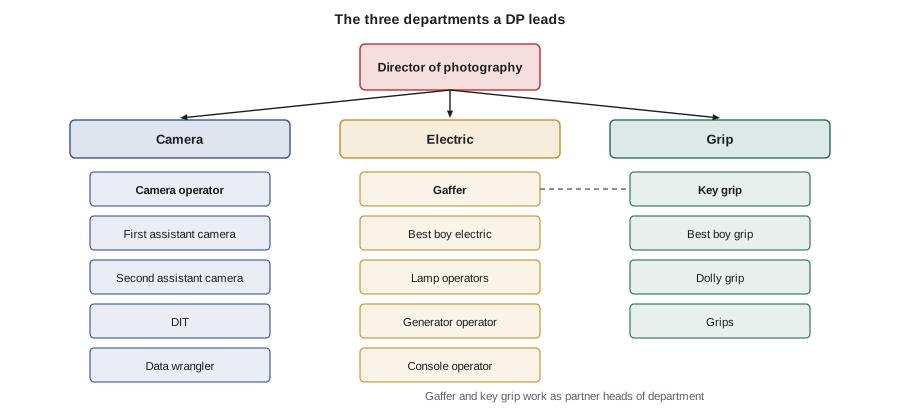
The camera department captures the image. Its size depends on the production, the number of cameras and the format.
- Director of photography: leads the look and the three departments; may also operate.
- Camera operator: frames and moves the camera; on many shows the DP does not operate and works with an operator on each camera.
- First assistant camera (focus puller): maintains and builds the camera, manages lenses and pulls focus, often from a remote focus unit and monitor.
- Second assistant camera (clapper loader): slates takes, keeps camera reports, manages media or film stock, marks actors and supports the first AC.
- Digital imaging technician (DIT): manages image quality on set, applies LUTs and CDLs, monitors exposure and color and oversees data management.
- Data wrangler or loader: copies, verifies and backs up media.
- Camera trainee or utility: supports the team and learns the trade.
With a B camera, there is usually a second operator and a second set of assistants. Specialist roles include Steadicam or gimbal operators, technocrane operators and remote head technicians.
The electric and grip departments
- Gaffer: head of the electric department and the DP's lighting partner.
- Best boy electric: second in command; manages crew, equipment, paperwork and power distribution.
- Lamp operators (electrics): set fixtures, run cable and operate dimmers and lighting consoles.
- Generator operator: runs and monitors generators.
- Lighting console or desk operator: programs DMX-controlled fixtures, practicals and effects.
- Key grip: head of the grip department and the DP's partner for rigging, camera support and light shaping.
- Best boy grip: second in command; manages crew and equipment.
- Dolly grip: operates the dolly and often cranes; a skilled role that strongly affects the quality of movement.
- Grips: set flags, frames, stands and rigging.
Larger shows add rigging gaffers, rigging key grips and their crews (Lesson 7).
Unions and guilds
Most professional narrative production in Canada and the US is unionized, although many independent and low-budget productions are not. Union agreements set minimum rates, hours, overtime, meal penalties, rest periods, benefits, safety provisions and job classifications. A DP must know which agreement applies, because it affects crew size, scheduling and costs.
US unions and guilds
In the US, IATSE Local 600, the International Cinematographers Guild, represents DPs, camera operators, assistants, DITs and other camera crew nationally. Lighting technicians and grips are represented by IATSE locals such as Local 728 (studio electrical lighting technicians) and Local 80 (grips) in Los Angeles, Local 52 in New York, and regional locals elsewhere. The Directors Guild of America (DGA) represents directors and also unit production managers and assistant directors, so the first AD on a DGA production works under DGA terms. Performers are represented by SAG-AFTRA, and drivers and some other roles by the Teamsters. Many states also have right-to-work laws that affect union membership but not the terms of collective agreements on signatory productions. Check the applicable agreement for each show.
Hiring and building a crew
The DP usually chooses or approves the operator, first AC, gaffer and key grip, who then bring their own teams. Long-standing teams work faster because they share habits and shorthand.
- Hire for reliability and temperament as well as skill. A brilliant but difficult gaffer can slow a whole set.
- Respect the department heads' choices for their own crews.
- Include trainees and new entrants where possible; many union agreements and funding programs encourage training positions and diversity in hiring.
- Confirm crew availability for the whole schedule, including pre-rigs and any second unit work.
Communication on set
Clear communication is the core of set leadership.
- Radios: departments use assigned channels (for example, channel 1 for production and the ADs, others for camera, electric, grip and locations). Keep radio talk short and professional.
- Calls: the first AD calls the set's routine ("Rehearsal", "Picture's up", "Roll sound", "Roll camera", "Cut", "Checking the gate", "Moving on") so everyone knows the state of play.
- Briefing the departments: after the director and actors block the scene, the DP briefs the gaffer, key grip, operator and first AC together, so they hear the same plan.
- Before each take, the DP confirms that camera, lighting and focus are ready; the first AC and operator say when they are set.
- After each take, the operator reports any framing or movement issues, the first AC reports focus, and the DP decides whether to go again for technical reasons.
Leading through the day
A shooting day is long, and the crew's energy is a resource. Good DPs manage it.
- Arrive prepared, with a clear plan for the first set-up.
- Stay calm when things go wrong; urgency is contagious, panic more so.
- Credit the crew publicly and correct privately.
- Explain the why behind requests. "We need the window darker because the scene is about her feeling trapped" gets better results than "darker."
- Watch for fatigue and safety lapses, especially late in the day and on night shoots. Stop work that looks unsafe.
- Thank people at wrap.
Set etiquette also matters: stay out of the eyeline of actors, keep chatter away from set, respect the boundaries of each department's work, and never touch another department's equipment without asking.
Respect, inclusion and harassment-free sets
Film sets have long histories of hierarchy, long hours and, in some places, bullying and harassment. Both countries' laws require employers to prevent harassment and violence at work, and union agreements and industry codes add specific obligations and reporting channels. The DP, as a department head, has a duty to model respectful behavior, to address problems in their departments and to support crew who report concerns. Course HSE-108 covers workplace harassment law and prevention in detail.
Crew costs and overtime
DPs often discuss schedules with producers in terms of overtime. Crew are commonly paid a base rate for a set number of hours, with higher rates for hours beyond thresholds set by the applicable agreement or employment standards. The specifics differ between agreements, so treat the following as an illustration.
Worked problem
The cost of an extra hour
A crew of 30 in camera, electric and grip has an average base rate of 50 per hour. Under the agreement in this example, the first 8 hours are paid at straight time, hours 9 to 12 at time and a half, and hours beyond 12 at double time. What does it cost to extend a 12-hour day to 13 hours, and to 14 hours, for these 30 people?
Show solution
- The 13th hour is at double time: 30 × 50 × 2 = 3,000.
- The 14th hour adds another 3,000, for 6,000 in total.
- Compare with a 12-hour day: 30 × 50 × (8 + 4 × 1.5) = 30 × 50 × 14 = 21,000.
- Two extra hours add 6,000 ÷ 21,000 ≈ 29 % to these departments' daily wage cost, before fringe benefits, meal penalties, equipment overtime and the effect on next day's turnaround.
Answer: Each hour past 12 costs about 3,000 for these 30 people in this example, and two extra hours raise the day's wage cost by almost a third. Overtime also shortens rest before the next call, which raises fatigue and safety risks.
Turnaround and the next day
Rest between days is not only a cost question. Union agreements and employment laws set minimum rest periods between shifts, often around 10 hours for crew under major agreements, and violating them triggers penalties and safety risks. A late wrap can force a late call the next morning, which pushes the next day into darkness or overtime. Course CINE-340 covered fatigue and turnaround in detail. The DP should flag early when a day is likely to run long so the first AD and producers can decide whether to go into overtime or carry work over.
| Stage | Leadership tasks |
|---|---|
| Prep | Hire heads of department; share look book and plans; agree crew sizes and equipment |
| Start of day | Brief departments on the first set-up and the day's priorities |
| Each set-up | Brief gaffer, key grip, operator and first AC together; explain the why |
| Takes | Confirm readiness; listen to operator and focus reports; decide on technical retakes |
| Problems | Stay calm; propose solutions; involve the first AD early |
| Wrap | Thank the crew; review the next day's plan with heads of department |
Working with the director's team and other departments
The DP's leadership extends beyond their own three departments. The camera, electric and grip crews depend on smooth working relationships with the assistant directors, the script supervisor, sound, art, costume, makeup and hair, locations and transport. Small habits make a large difference over a long shoot.
- Assistant directors: tell the second AD early when a set-up will be ready so actors are called to set at the right moment, not too early to wait or too late to keep the crew idle.
- Script supervisor: check continuity notes for lens, height and stop when shooting scenes out of order, and confirm eyelines and screen direction before rolling.
- Sound: agree where booms can go and which fixtures or flags might cast boom shadows; keep noisy equipment such as generators, fans and ballasts away from the set or switched off for takes.
- Art department: ask before moving set dressing, and tell the set decorator when a practical lamp needs a different bulb or shade.
- Costume, makeup and hair: give them time for final checks before each take, and warn them when a set-up will reveal something new, such as the back of a costume or a hairline in backlight.
- Locations: respect the location agreement, protect floors and walls, and report damage immediately.
Mentoring and the next generation
Camera, electric and grip skills are still learned largely on set. Many DPs began as trainees or assistants, and the craft depends on experienced crew passing on knowledge. A DP can support this by explaining decisions when time allows, by giving trainees real responsibilities with supervision, by recommending capable assistants for promotion, and by including people from under-represented groups when building teams. Funders and broadcasters in both countries increasingly encourage these practices, and productions often track the make-up of their crews as part of their reporting.
Common mistakes
MistakeBriefing each department separately with different versions of the plan
InsteadBrief the gaffer, key grip, operator and first AC together
MistakeAssuming one union agreement applies everywhere
InsteadCheck which agreement and jurisdiction apply to each production
MistakeCorrecting crew members publicly
InsteadCredit publicly and correct privately
MistakeTreating overtime as a free way to finish the day
InsteadRemember overtime raises costs sharply and shortens rest before the next call
MistakeIgnoring harassment or bullying in your departments
InsteadModel respectful behavior, address problems and support people who report concerns
Summary and key terms
- The camera department includes operators, assistants, DIT and data staff; electric and grip have parallel structures under the gaffer and key grip.
- Union and guild agreements set rates, hours, overtime, rest, safety and job classifications and differ by region and production.
- Assistant directors fall under the DGC in Canada and the DGA in the US on signatory productions.
- Clear, shared briefings and standard set calls keep departments coordinated.
- Calm, prepared, respectful leadership builds faster and safer crews.
- Overtime is costly and erodes rest; flag long days early.
- Department heads must prevent harassment and support people who raise concerns.
- First assistant camera
- The focus puller, who maintains the camera and lenses and pulls focus
- Second assistant camera
- The clapper loader, who slates, keeps reports and manages media
- DIT
- Digital imaging technician, who manages image quality and data on set
- Dolly grip
- The grip who operates the dolly and often cranes
- Best boy electric
- Second in command of the electric department
- Collective agreement
- A contract between a union and producers setting terms for workers
- Turnaround (rest)
- The minimum rest period between the end of one day and the next call
- Time and a half
- Overtime paid at 1.5 times the base rate
- Meal penalty
- A payment owed when a meal break is not given on time
- Signatory production
- A production that has signed a union or guild agreement
Practice problems
Work each problem on paper first, then reveal the answer to check.
Name four roles in a typical camera department.
Show answer
Any four of DP, operator, first AC, second AC, DIT, data wrangler and trainee
What does the dolly grip do?
Show answer
Operates the dolly and often cranes, shaping the quality of camera movement
20 crew at a base of 45 per hour work a 13th hour at double time. What does it cost?
Show answer
20 × 45 × 2 = 1,800
Why brief department heads together?
Show answer
So everyone hears the same plan and can coordinate
Which guild represents assistant directors in Canada and in the US?
Show answer
The DGC in Canada and the DGA in the US, on signatory productions
Give two set etiquette rules.
Show answer
Stay out of actors' eyelines, keep chatter away from set, don't touch other departments' equipment without asking
Why explain the reason behind a lighting request?
Show answer
Crew can make better choices when they understand the story purpose
What does a late wrap do to the next day?
Show answer
It can force a later call because of minimum rest, pushing work into overtime or darkness
Who usually chooses the gaffer's crew?
Show answer
The gaffer, with the DP respecting the department head's choices
Why include trainees on crews?
Show answer
To develop new talent and support diversity, often encouraged by agreements and funders
Lesson quiz · 5 questions
Score 60% or more to complete this lesson.
Create a free account to save your progress, take quizzes and earn a certificate.