
CON-110 · Lesson 3 of 12 · 25 min
Earthwork, excavation, support and dewatering
Earthwork moves soil and rock to shape the site: cutting high areas, filling low ones, excavating for basements, footings and utilities, and backfilling when below-grade work is complete. It is often the first large cost on a project and one of the riskiest, because excavations can collapse, flood, undermine neighboring structures and strike utilities. Trench and excavation collapses kill workers in both Canada and the United States every year, usually in excavations that were not sloped, benched or supported. This lesson explains earthwork quantities, swell and shrinkage, cut and fill, excavation methods and equipment, slopes, benching and support systems, dewatering and groundwater control, and the safety rules that govern excavations, at an awareness level suitable for construction managers and supervisors.
Bank, loose and compacted volumes
Soil changes volume as it is excavated, hauled and compacted. Earthwork quantities are therefore described in three states:
- Bank volume: the soil in its natural, undisturbed state in the ground, measured in bank cubic meters (bcm) or bank cubic yards (bcy).
- Loose volume: the soil after excavation, when it has broken up and bulked, measured in loose cubic meters or yards; this is what fills trucks and stockpiles.
- Compacted volume: the soil after placement and compaction as fill, measured in compacted cubic meters or yards.
Swell is the increase from bank to loose volume, and shrinkage is the decrease from bank to compacted volume. Typical values vary with soil type and moisture:
| Material | Typical swell (bank to loose) | Typical shrinkage (bank to compacted) |
|---|---|---|
| Sand and gravel | 10–15 % | 5–10 % |
| Common earth (loam) | 20–30 % | 10–15 % |
| Clay | 30–40 % | 10–20 % |
| Blasted rock | 50–65 % | Rock usually swells; compacted rock fill is still larger than bank |
Here \(s\) is the swell factor and \(k\) the shrinkage factor, expressed as decimals. Estimators use these factors to calculate truckloads for hauling, stockpile sizes and the amount of borrow material needed to build a fill.
Worked problem
Trucking and fill quantities
A basement excavation removes 3,200 bank m³ of common earth with a swell of 25 %. Trucks carry 12 loose m³ each. After the basement is built, 900 compacted m³ of backfill are needed around the walls, using the same soil, which shrinks 12 % from bank to compacted. How many truckloads leave the site, and how much bank soil should be kept for backfill?
Show solution
- Loose volume excavated: 3,200 × 1.25 = 4,000 loose m³.
- Truckloads if all is hauled: 4,000 ÷ 12 ≈ 334 loads.
- Bank volume needed for 900 compacted m³: 900 ÷ (1 − 0.12) ≈ 1,023 bank m³.
- Keep about 1,023 bank m³ (about 1,279 loose m³) on site or nearby, if space allows; haul the remaining 2,177 bank m³ (about 2,721 loose m³, roughly 227 loads).
- In imperial units, 3,200 m³ is about 4,190 yd³; the same factors apply.
Answer: About 334 loads if everything is hauled; keep roughly 1,023 bank m³ for backfill and haul about 227 loads.
Cut and fill and mass haul
On sites with significant grading, the goal is often to balance cut and fill, reusing excavated soil as fill within the site to avoid the cost of hauling soil away and importing fill. Engineers calculate cut and fill volumes from existing and proposed ground surfaces, using grid methods, cross-sections or three-dimensional surface models in software. A mass haul diagram plots cumulative earthwork volume along a road or site and shows where cut can be moved to fill and how far it must travel. Not all excavated soil is suitable for reuse: wet clays, organic soils, contaminated material and soils with debris may need to be hauled away even when volumes balance. CON-250 covers earthwork calculations and equipment in more depth.
Excavation equipment and methods
Excavation equipment is chosen for the material, depth, volume, space and haul distance:
- Hydraulic excavators: the workhorse of building excavation, digging and loading trucks, available in sizes from mini excavators to large machines.
- Backhoe loaders: versatile machines for small sites, utility trenches and backfilling.
- Bulldozers: pushing and spreading soil over short distances, stripping and rough grading.
- Wheel loaders: loading trucks from stockpiles and moving loose material.
- Scrapers: excavating, hauling and spreading large volumes over medium distances on open sites.
- Trenchers: cutting narrow, continuous trenches for utilities.
- Hydraulic breakers, rippers and blasting: breaking rock.
- Hydro-vacuum trucks: excavating carefully around utilities.
Productivity depends on bucket size, cycle time, soil type, operator skill, haul distance and truck availability. Matching the number of trucks to the excavator's output avoids idle machines or waiting trucks. Urban sites add constraints such as limited access, neighboring buildings, traffic and noise by-laws.
Why excavations collapse
Soil walls stand temporarily because of cohesion and friction, but they lose strength when soil dries, cracks, becomes saturated, vibrates or is loaded at the top by spoil piles, equipment or nearby structures. A cubic meter of soil can weigh about 1,600 to 2,000 kg (roughly 2,700 to 3,400 lb per cubic yard), so even a small collapse can crush or suffocate a worker. Collapses often occur without warning, in excavations that have stood for hours or days. Warning signs include cracks parallel to the edge, bulging walls, water seepage, falling soil and nearby vibration. Because these signs are unreliable, protective systems are required in excavations deeper than the regulatory limits, and a competent person must inspect excavations daily and after rain or other changes.
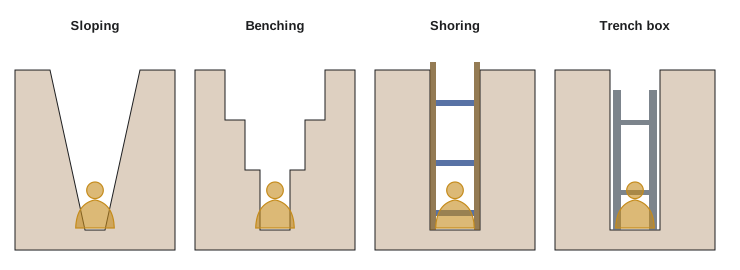
Protective systems
There are four main ways to protect workers in excavations:
- Sloping: cutting back the sides to an angle at which the soil is stable, depending on soil type. Flatter slopes are needed in weaker soils.
- Benching: cutting the sides in a series of horizontal steps; not allowed in some soils, such as running sands.
- Shoring: supporting the walls with sheeting, timber, hydraulic shores, soldier piles and lagging, sheet piles or bracing that prevent movement.
- Shielding: using trench boxes or shields that protect workers inside if the walls collapse, without necessarily preventing collapse.
For deep building excavations, engineered shoring systems such as soldier piles and lagging, secant or contiguous pile walls, sheet piles, slurry walls, soil nails or tiebacks are designed by engineers, installed by specialists and monitored for movement. They also protect neighboring buildings, streets and utilities.
In the United States, OSHA's excavation standard, 29 CFR 1926 Subpart P (1926.650–652), requires a protective system for excavations 5 ft (1.5 m) or deeper unless the excavation is entirely in stable rock, and requires systems for excavations deeper than 20 ft (6.1 m) to be designed by a registered professional engineer. Appendix A classifies soils as stable rock and Types A, B and C, with maximum allowable slopes of 3/4:1, 1:1 and 1.5:1 (horizontal to vertical) respectively for excavations less than 20 ft deep. Spoil and equipment must be kept at least 2 ft from the edge, a competent person must inspect daily, and trenches 4 ft or deeper need a safe means of egress, such as a ladder, within 25 ft of lateral travel. State plans may add requirements.
HSE courses on excavation and trenching cover these rules in more detail; this course focuses on the construction methods and planning implications.
Groundwater control and dewatering
When excavations extend below the water table, groundwater must be controlled to keep the work dry, protect the stability of slopes and the excavation base, and allow concrete to be placed. Methods include:
- Sump pumping: collecting water in pits at the base of the excavation and pumping it out; simple and common in clays and where inflow is modest.
- Wellpoints: rows of small-diameter wells connected to a header pipe and vacuum pump, lowering the water table in sands to depths of about 5 to 6 m (16 to 20 ft) per stage.
- Deep wells: larger wells with submersible pumps for greater depths and volumes.
- Cut-off walls: sheet piles, slurry walls, secant piles or grout curtains that block water from entering the excavation, often used where pumping would lower groundwater beneath neighboring buildings and cause settlement.
- Ground freezing and grouting: specialized methods for difficult conditions.
Dewatering discharges must be managed: sediment removed before discharge, permits obtained for discharge to sewers or water bodies, and large withdrawals licensed.
In the United States, dewatering discharges are generally covered by NPDES construction stormwater permits or separate dewatering permits, local sewer use ordinances govern discharges to sewers, and some states regulate large groundwater withdrawals.
Protecting neighboring structures
Excavation near existing buildings can cause settlement through loss of support, lowering of groundwater, vibration or movement of shoring. Measures include underpinning neighboring foundations, using stiff shoring systems, limiting the depth of each excavation stage, minimizing groundwater drawdown, and monitoring with survey points, inclinometers, crack gauges and vibration monitors, with alert and action levels agreed in advance. Condition surveys before work (Lesson 2) provide the baseline.
Backfilling
After foundations, basement walls, waterproofing and drainage are installed and inspected, the space around them is backfilled. Backfill must be suitable material, placed in thin lifts and compacted (Lesson 4), and placed carefully against walls to avoid damage; basement walls are often designed to be supported by the floor structure, so backfilling before floors are in place may require temporary bracing. Utility trenches are backfilled with bedding and cover material around pipes, then trench backfill, following the utility owner's specifications.
Estimating earthwork productivity
Once volumes are known, the next question is how long the work will take and how much equipment it needs. The productivity of an excavator loading trucks depends on its bucket size, the fill factor of the bucket for the material (a full heaped bucket in loose sand, much less in sticky clay or blasted rock), the cycle time to dig, swing, dump and return, the efficiency of the operation, which allows for delays and repositioning, and whether trucks are always waiting to be loaded. Truck productivity depends on the payload, the haul distance and speed, the time spent waiting, loading, dumping and returning, and road and traffic conditions.
A balanced operation matches the number of trucks to the loading rate of the excavator. If the excavator loads a truck in 4 minutes and a truck takes 32 minutes for a round trip including loading and dumping, the operation needs about 32 ÷ 4 = 8 trucks to keep the excavator busy. Fewer trucks leave the excavator idle; more trucks leave trucks waiting in a queue. In practice, estimators often choose a number slightly below or above the theoretical value depending on whether the excavator or the trucks are the more expensive resource, and they plan for the haul distance to change as the job progresses.
Weather has a large effect on earthwork. Wet clay becomes difficult to dig and impossible to compact, haul roads rut and trucks get stuck, and fill placed at too high a moisture content must be dried or removed. Many earthwork schedules therefore include allowances for weather days and plan the most moisture-sensitive work, such as clay fills, for the drier months. Frozen ground in winter can be dug with heavy equipment but frozen material must not be used as fill or left under foundations.
Excavation near existing structures
Excavations near existing buildings, roads and utilities need special care, because removing soil reduces the support of the adjacent ground. A common rule of thumb is that an excavation can affect foundations within a zone extending outward and upward from the bottom of the excavation at a slope of about 1 horizontal to 1 vertical, or flatter in weak soils. Foundations within that zone may need underpinning, a shoring system designed to limit movement, or monitoring. Monitoring often includes survey points on neighboring buildings, crack gauges, vibration monitors and inclinometers in the soil behind shoring walls, with trigger levels at which work must slow or stop. Agreements with neighbors, such as access agreements for tiebacks under their property, may also be required.
Common mistakes
MistakeEstimating trucks from bank volumes.
InsteadConvert to loose volumes using swell factors.
MistakeEntering unprotected excavations beyond regulatory depths.
InsteadSlope, bench, shore or shield as required.
MistakePiling spoil at the edge of a trench.
InsteadKeep spoil and equipment back the required distance.
MistakeDewatering without considering neighboring buildings.
InsteadAssess drawdown effects and use cut-off walls if needed.
MistakeBackfilling basement walls before they are braced or supported.
InsteadFollow the engineer's sequence and bracing requirements.
Summary and key terms
- Earthwork is measured in bank, loose and compacted volumes.
- Swell and shrinkage factors convert volumes for hauling and fill.
- Balancing cut and fill reduces haul and import costs.
- Equipment choice depends on material, volume, space and haul distance.
- Excavations collapse without warning; protective systems are required beyond set depths.
- Sloping, benching, shoring and shielding protect workers.
- Groundwater control and neighbor protection must be planned and permitted.
- Bank volume
- Soil volume in its natural state.
- Loose volume
- Soil volume after excavation.
- Compacted volume
- Soil volume after placement and compaction.
- Swell
- Increase from bank to loose volume.
- Shrinkage
- Decrease from bank to compacted volume.
- Mass haul diagram
- Plot of cumulative earthwork volume along a site or route.
- Trench box
- Shield protecting workers in a trench.
- Soldier piles and lagging
- Steel piles with horizontal boards supporting an excavation.
- Wellpoint
- Small well used to lower groundwater by vacuum.
- Cut-off wall
- Barrier preventing groundwater from entering an excavation.
Practice problems
Work each problem on paper first, then reveal the answer to check.
Loose volume of 1,000 bank m³ with 30 % swell?
Show answer
1,300 loose m³.
Bank volume needed for 500 compacted m³ with 15 % shrinkage?
Show answer
About 588 bank m³.
Why balance cut and fill?
Show answer
To avoid hauling away and importing soil.
Name three excavation machines.
Show answer
Excavator, backhoe, bulldozer, loader, scraper, trencher.
Name three warning signs of collapse.
Show answer
Cracks, bulging, seepage, falling soil.
What are the four main protective methods?
Show answer
Sloping, benching, shoring, shielding.
What does a trench box do?
Show answer
Shields workers if walls collapse.
When are wellpoints used?
Show answer
To lower groundwater in sands.
Why use a cut-off wall?
Show answer
To block water and avoid lowering groundwater under neighbors.
How should backfill be placed?
Show answer
In thin lifts, compacted, without damaging walls.
Lesson quiz · 5 questions
Score 60% or more to complete this lesson.
Create a free account to save your progress, take quizzes and earn a certificate.