
CON-110 · Lesson 4 of 12 · 25 min
Compaction, fill and subgrade preparation
Almost every structure and pavement is supported somewhere by soil that has been placed and compacted: engineered fill under slabs, granular base under foundations and roads, backfill around basement walls and pipe trenches. Poorly compacted fill settles, cracks slabs, breaks pipes, causes doors to jam and pavements to rut, and can lead to expensive repairs years after a project is finished. Compaction is also one of the most frequently tested activities on site. This lesson explains what compaction does, how soil moisture and density are related, how compaction requirements are specified and tested, which equipment suits which soils, how fill is placed in lifts, and how subgrades and granular bases are prepared under slabs and pavements.
What compaction does
Compaction is the mechanical densification of soil by reducing the air in its voids. It increases strength and stiffness, reduces settlement, reduces permeability and limits the soil's ability to absorb water and swell. It differs from consolidation, the slow squeezing of water out of saturated clays under sustained load, which can take months or years. Compaction is achieved quickly by rolling, vibrating, tamping or impact, and its effectiveness depends on soil type, moisture content, lift thickness, equipment and the number of passes.
Density and moisture: the Proctor test
For a given soil and compactive effort, the dry density achieved depends on the moisture content. At low moisture, particles resist rearrangement; adding water lubricates them and allows denser packing; beyond a certain moisture, water fills voids and keeps particles apart, so density falls again. The moisture content giving the highest dry density is the optimum moisture content (OMC), and that density is the maximum dry density (MDD). These are determined in the laboratory by the Proctor test, in which soil is compacted into a mold at several moisture contents with a standard hammer and the dry density is calculated for each. Two levels of effort are common: the standard Proctor test (ASTM D698) and the modified Proctor test (ASTM D1557), which uses more energy and gives a higher maximum dry density and lower optimum moisture, reflecting heavier modern compaction equipment.
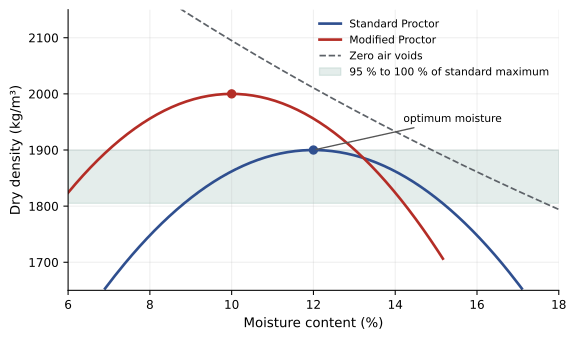
Dry density is calculated from the measured wet (bulk) density and the moisture content:
where \(\rho_d\) is the dry density, \(\rho\) the wet density and \(w\) the moisture content as a decimal. Relative compaction, often called percent compaction, compares the field dry density with the laboratory maximum:
Worked problem
Checking a field compaction test
A nuclear density gauge test on granular fill under a slab measures a wet density of 2,180 kg/m³ (136 pcf) and a moisture content of 7.5 %. The laboratory standard Proctor maximum dry density for this material is 2,100 kg/m³ (131 pcf) at an optimum moisture of 7 %. The specification requires 98 % of standard Proctor maximum dry density. Does the test pass?
Show solution
- Field dry density: 2,180 ÷ 1.075 ≈ 2,028 kg/m³.
- Relative compaction: 2,028 ÷ 2,100 × 100 ≈ 96.6 %.
- Required: 98 %. The test fails by about 1.4 percentage points.
- The moisture content is slightly above optimum, which is acceptable for granular material, so additional compaction passes are likely to bring it up to the requirement; retest after recompacting.
Answer: Relative compaction is about 96.6 %, below the required 98 %; recompact and retest.
How compaction is specified
Specifications and geotechnical reports set compaction requirements by location and material. Typical requirements:
| Location | Typical requirement (check project specifications) |
|---|---|
| Granular base under slabs-on-grade | 98–100 % of standard Proctor MDD, or 95 % modified |
| Granular base under pavements | 98–100 % standard or 95 % modified, often with layer thickness limits |
| Engineered fill under foundations | 98–100 % standard, with geotechnical approval |
| General site fill and landscape areas | 90–95 % standard |
| Utility trench backfill under roads | As specified by the utility or municipality, often 95–98 % standard |
| Backfill against basement walls | 90–95 % standard, compacted with light equipment near walls |
In Canadian practice, requirements are most often expressed as a percentage of standard Proctor maximum dry density (SPMDD), while many US specifications, especially for roads, use modified Proctor. Moisture content limits, such as within 2 % of optimum, are also common, particularly for clays, which are hard to compact when too wet and may swell or crack if compacted too dry. Always confirm which test the percentage refers to, because 95 % of modified Proctor is considerably denser than 95 % of standard.
Field density testing
Compaction is verified by field density tests performed by an independent testing agency, typically at a specified frequency, such as one test per lift per given area or length of trench. Common methods include:
- Nuclear density gauges: the most common method, measuring density and moisture quickly using a radioactive source; operators require training and licensing, and the gauges are regulated.
- Sand cone tests: excavating a small hole, weighing the soil removed and measuring the hole volume with calibrated sand; slower but a reference method.
- Rubber balloon and drive cylinder methods: alternatives for certain soils.
- Non-nuclear gauges and intelligent compaction: newer methods, including roller-mounted sensors that map stiffness across a whole area.
- Plate load and light weight deflectometer tests: measuring stiffness rather than density.
Proof-rolling (Lesson 2) remains a valuable visual check. Supervisors should make sure tests are taken at representative locations and depths, failing areas are reworked and retested before being covered, and results are recorded and filed.
In the United States, nuclear density gauges are regulated by the Nuclear Regulatory Commission or Agreement State programs, and operators must be trained and the gauges stored, transported and used under license conditions, including the US DOT rules for transport.
Compaction equipment
Different soils respond to different compaction methods:
| Equipment | Action | Best suited to |
|---|---|---|
| Smooth drum vibratory roller | Vibration and static weight | Granular soils, sand, gravel, crushed stone |
| Padfoot (sheepsfoot) roller | Kneading and pressure | Clays and silts |
| Pneumatic (rubber-tired) roller | Kneading | Mixed soils, asphalt, sealing surfaces |
| Vibratory plate compactor | Vibration | Granular soils in confined areas |
| Rammer (jumping jack) | Impact | Cohesive soils in trenches and confined areas |
| Trench roller | Kneading and vibration | Trenches |
Granular soils compact best with vibration, which rearranges particles; cohesive soils compact best with kneading and pressure. Near basement walls, pipes and structures, only light equipment should be used to avoid damage and excessive lateral pressure.
Lift thickness and placement
Fill is placed and compacted in layers, called lifts. Compaction effort fades with depth, so thick lifts leave poorly compacted material at the bottom that tests at the surface may not detect. Typical maximum loose lift thicknesses are about 150 to 300 mm (6 to 12 in) for heavy rollers and 100 to 150 mm (4 to 6 in) for hand-operated equipment, as specified. Good practice includes placing fill in uniform lifts across the full width; adjusting moisture by adding water or drying the soil before compaction; making a consistent number of passes with suitable equipment; testing each lift as specified before placing the next; protecting compacted surfaces from rain, frost and traffic; and never placing fill on frozen ground, snow or ice, or using frozen fill.
Subgrades, granular bases and vapor barriers under slabs
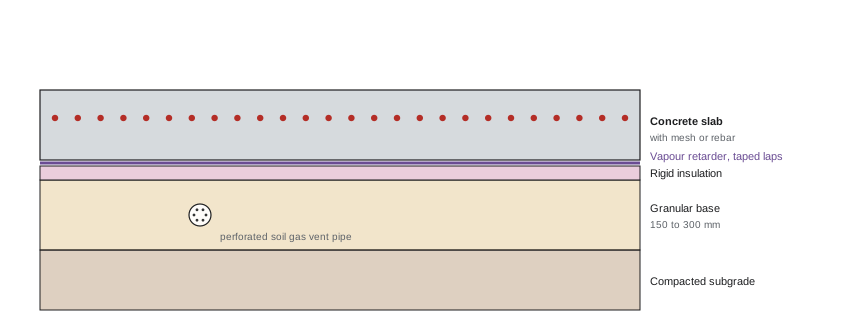
Slabs-on-grade rest on a layered system: the natural or compacted subgrade, a granular subbase or base layer of crushed stone or gravel, and often a vapor retarder, insulation and, in some regions, a radon barrier and soil gas venting. The subgrade is prepared by removing topsoil and unsuitable material, proof-rolling, and compacting or replacing soft areas. The granular base provides uniform support, a working surface, drainage and a capillary break that stops moisture rising into the slab. Its thickness and gradation are specified, commonly 150 to 300 mm (6 to 12 in) of crushed stone compacted to a high percentage of maximum dry density. Vapor retarders under slabs, typically polyethylene sheets of specified thickness, limit moisture transmission into floor finishes and must be lapped and sealed and protected from punctures. Building codes in both countries require soil gas control in many areas, and radon mitigation measures are increasingly common.
Common compaction problems
Typical problems include soil too wet to compact, which pumps and ruts under equipment and may need drying, lime or cement stabilization, or replacement; soil too dry, which needs water added and mixed; oversized rocks that prevent uniform compaction; thick lifts; untested areas covered by later work; frozen material placed in winter; and contamination of clean granular base with mud from traffic. Geotextiles and geogrids can separate soft subgrades from granular bases and add stability. Winter earthwork in Canada and the northern US requires particular care: subgrades must be protected from frost with insulation blankets or heating, and frozen material must be removed before placing new lifts.
Moisture control in practice
The moisture content of fill is the factor that most often decides whether compaction succeeds. Soils that are too dry do not compact well because the particles cannot slide into a dense arrangement; soils that are too wet cannot be compacted because water fills the voids and the material pumps or ruts under the roller. Most specifications require fill to be placed within a range around the optimum moisture content, for example within 2 percentage points above or below optimum, or slightly dry of optimum for clays that will be loaded soon after.
Drying wet soil is slow and weather-dependent. The usual method is to spread the soil in thin layers and work it with discs or graders so that sun and wind can dry it; lime or cement can also be mixed into wet clay to dry and stabilize it, a technique called soil modification or stabilization, but it changes the soil and must be approved by the geotechnical engineer. Adding water to dry soil is easier: a water truck sprays the layer and the soil is mixed to distribute moisture evenly before compaction. Granular soils such as clean sand and gravel are far less sensitive to moisture than silts and clays, which is one reason why specifications often require imported granular fill under slabs and footings even when the excavated native soil seems strong.
Interpreting a failed density test
When a field density test fails, the first step is not to argue with the result but to understand it. The technician and the site supervisor should check whether the test was taken in the correct lift and location, whether the moisture content was within range, and whether the correct Proctor value was used, since a different fill material may have a different maximum dry density. If the material has changed, a new Proctor test may be needed. If the moisture is too high, the area must be dried or the material replaced; if it is within range, more passes of the compactor, a heavier machine or thinner lifts may be needed. After rework, the area is retested, and both the failing and passing tests are recorded.
Repeated failures in one area may point to a deeper problem, such as a soft layer below the fill that prevents compaction from above, or groundwater rising into the fill. In those cases, compacting harder does not help; the soft material may have to be removed, a geotextile and a bridging layer of coarse stone placed, or the area drained. The geotechnical engineer should be involved whenever failures persist.
Compaction around structures and utilities
Backfill against foundation walls, around manholes and over pipes requires special attention. Heavy rollers cannot work close to walls without pushing them over or damaging them, so smaller equipment such as plate compactors and rammers is used in thinner lifts. Backfill against basement walls is usually placed only after the floor framing or slab that supports the top of the wall is in place, unless the wall is designed to cantilever. Around pipes, the bedding and embedment zone is placed and compacted carefully in layers on both sides at the same time so that the pipe is not displaced or deformed, and heavy compaction directly over a pipe is delayed until enough cover is in place. Poorly compacted trench backfill is one of the most common causes of settlement of pavements and slabs, often appearing as a long depression along the line of a buried service months after construction.
Common mistakes
MistakePlacing thick lifts to save time.
InsteadPlace lifts no thicker than specified for the equipment.
MistakeConfusing standard and modified Proctor requirements.
InsteadConfirm which test the specified percentage refers to.
MistakeCovering lifts before test results are known.
InsteadTest each lift and rework failures before covering.
MistakeUsing vibratory rollers on wet clay.
InsteadUse padfoot rollers and control moisture.
MistakePlacing fill on frozen ground.
InsteadProtect subgrades and remove frozen material.
Summary and key terms
- Compaction densifies soil, improving strength and reducing settlement.
- The Proctor test defines maximum dry density and optimum moisture.
- Relative compaction compares field dry density with the laboratory maximum.
- Specifications set percentages by location; confirm standard or modified.
- Nuclear gauges and other tests verify each lift.
- Vibratory rollers suit granular soils; padfoot rollers suit clays.
- Thin lifts, moisture control and protection from frost ensure good results.
- Compaction
- Mechanical densification of soil by removing air.
- Consolidation
- Slow volume decrease of saturated clay under load.
- Optimum moisture content
- Moisture giving maximum dry density.
- Maximum dry density
- Highest dry density for a compactive effort.
- Standard Proctor
- Lab compaction test at standard effort (ASTM D698).
- Modified Proctor
- Lab compaction test at higher effort (ASTM D1557).
- Relative compaction
- Field dry density as a percentage of MDD.
- Lift
- Layer of fill placed and compacted.
- Nuclear density gauge
- Instrument measuring density and moisture with a radioactive source.
- Capillary break
- Granular layer preventing moisture rise.
Practice problems
Work each problem on paper first, then reveal the answer to check.
How does compaction differ from consolidation?
Show answer
Compaction removes air quickly; consolidation squeezes out water slowly.
What does the Proctor test determine?
Show answer
Maximum dry density and optimum moisture.
Dry density for wet density 2,000 kg/m³ at 10 % moisture?
Show answer
About 1,818 kg/m³.
Relative compaction for 1,900 field vs 2,000 maximum?
Show answer
95 %.
Which is denser: 95 % standard or 95 % modified?
Show answer
95 % modified.
Name two field density test methods.
Show answer
Nuclear gauge, sand cone, balloon, drive cylinder.
Which roller suits clay?
Show answer
Padfoot (sheepsfoot) roller.
Typical loose lift for heavy rollers?
Show answer
About 150–300 mm (6–12 in).
What does the granular base under a slab provide?
Show answer
Uniform support, drainage and a capillary break.
How do you handle soil that is too wet?
Show answer
Dry it, stabilize it or replace it.
Lesson quiz · 5 questions
Score 60% or more to complete this lesson.
Create a free account to save your progress, take quizzes and earn a certificate.