
CON-320 · Lesson 6 of 12 · 32 min
Job costing and overhead accounting
Every dollar a contractor spends is either charged to a job or carried as overhead. Where that line is drawn, and how shared costs are spread across jobs, decides each job's reported margin, the firm's apparent overhead rate, the markups used in bids and the volume of work the firm needs just to break even. This lesson looks at job costing from the company's side: what belongs in job cost, how labor burden and shared costs reach jobs through clearing accounts and allocation rates, what happens when allocation rates are wrong, and how overhead and gross margin together determine break-even volume. CON-300 covered how overhead and burden are priced in a bid; here the question is how they are accounted for once the money is spent.
Direct costs, indirect costs and overhead
Contractors usually divide costs into three groups. Direct job costs are incurred for a specific job and can be traced to it: labor on the job, materials installed, subcontracts, equipment working on the job, permits. Indirect job costs, often called field overhead or general conditions, support a job but are not part of the permanent work: site supervision, site offices, temporary utilities, safety, cleanup. Most contractors charge these to the job too. Home office overhead, or general and administrative expense, supports the business as a whole and is not charged to jobs: the head office, executives, estimating, accounting and marketing.
| Cost | Usually charged to | Notes |
|---|---|---|
| Field labor and its burden | Job (direct) | Through payroll and a burden clearing account |
| Materials and subcontracts | Job (direct) | Through purchase orders and subcontract billings |
| Owned equipment working on the job | Job (direct) | At internal equipment rates (Lesson 7) |
| Project manager and superintendent | Job (indirect) or overhead | Policy choice; many firms charge site-based staff to jobs and office-based PMs to overhead |
| Site trailer, temporary power, safety, cleanup | Job (indirect) | General conditions |
| Small tools and consumables | Job, by allocation | Often charged as a percentage of labor |
| Shop, yard and warehouse | Job by allocation, or overhead | Depends on how closely use can be traced |
| Estimating and bidding | Overhead | Costs of obtaining work are not job costs |
| Executive, accounting and office staff | Overhead | General and administrative |
| Office rent and technology | Overhead | General and administrative |
Two contractors with identical economics can report very different gross margins if one charges its project managers to jobs and the other carries them in overhead. Neither choice is wrong, but each firm should be consistent, should price its bids on the same basis it accounts for costs, and should be careful when comparing its margins with industry surveys. Surety analysts usually ask how project management and equipment are treated before comparing a firm's ratios with benchmarks.
Labor burden and the payroll clearing account
A worker's wage is only part of the cost of employing them. Employers also pay Social Security and Medicare taxes under FICA, federal and state unemployment taxes (FUTA and SUTA), workers' compensation premiums and, often, paid leave and health benefits; for union trades, fringe benefit contributions to union trust funds. CON-300 showed how these are built into a loaded labor rate for estimating. In the accounts, most contractors handle them through a payroll burden clearing account.
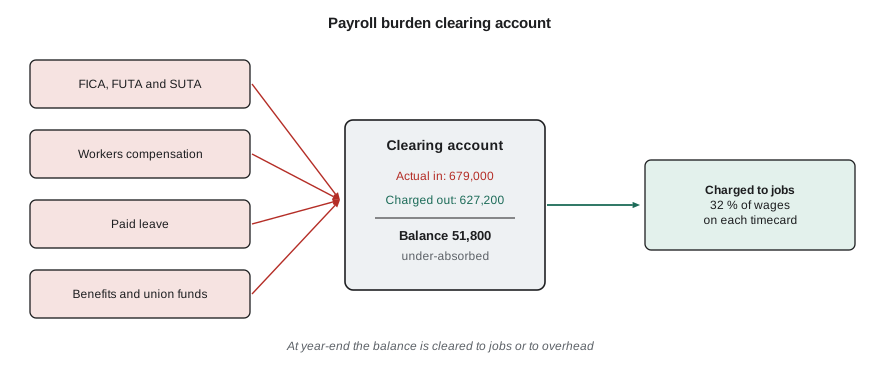
The method works like this. Each week, jobs are charged the gross wages from timecards plus a burden at a standard percentage. The actual burden costs, such as remittances and premiums, are posted to the clearing account as they are paid. If the standard rate is right, the amounts charged out to jobs and the actual costs posted in will roughly cancel, and the clearing account will hover near zero. If not, the balance shows burden that has been under-absorbed (charged to jobs too little) or over-absorbed (charged too much).
# Burden clearing for one quarter (illustrative)
wages_charged_to_jobs = 1_960_000
standard_rate = 0.32                      # burden charged as 32 % of wages
burden_charged = wages_charged_to_jobs * standard_rate
actual_burden = {"payroll taxes and premiums": 268_000,
                 "workers compensation": 121_000,
                 "vacation and holiday pay": 158_000,
                 "benefits and union contributions": 132_000}
actual = sum(actual_burden.values())
balance = actual - burden_charged
print(f"Burden charged to jobs: {burden_charged:,.0f}")
print(f"Actual burden incurred: {actual:,.0f}")
print(f"Under-absorbed burden:  {balance:,.0f}  "
f"(actual rate {actual / wages_charged_to_jobs:.1%})")Burden charged to jobs: 627,200 Actual burden incurred: 679,000 Under-absorbed burden: 51,800 (actual rate 34.6%)
Here the actual burden is 34.6 % of wages, not 32 %. Jobs have been under-charged $52,000 for the quarter, so their reported margins are slightly too high and the $52,000 sits in the clearing account. At year-end, or quarterly, the balance must be dealt with: either allocated to the jobs that used the labor, in proportion to wages, or written off to overhead. Leaving it unexamined distorts both job margins and overhead. A persistent under-absorption also means the bid rates in CON-300 are too low.
| Common reason for under-absorbed burden | Fix |
|---|---|
| Workers' compensation rate increase or experience modifier surcharge | Update the standard rate when the new premium is known |
| Contribution ceilings reached later than expected | Model the seasonal pattern; many payroll taxes are front-loaded each year |
| More paid leave or holidays taken than assumed | Review the leave assumption in the rate |
| Burden on non-productive time (shop, training, waiting) not charged to jobs | Decide whether to include it in the rate or charge it to overhead |
Worked problem
Seasonal burden
Employer Social Security tax stops for each worker once they reach the annual wage base, and FUTA and most SUTA taxes apply only to the first part of each worker's wages. Kestrel uses a single year-round burden rate. What pattern will the clearing account show, and what should management do?
Show solution
- Early in the year, actual payroll taxes are high because every worker is below the ceiling; the clearing account becomes under-absorbed.
- Later in the year, many workers pass the ceilings; actual taxes fall and the account swings back toward over-absorption.
- Over a full year with a correct average rate, the balance should be close to zero.
Answer: Monthly job margins in the first half will look slightly too good and in the second half slightly too poor. Management should either accept the seasonal swing and look only at the annual result, or charge jobs with a seasonal rate. Either way, the clearing account should be reviewed monthly and cleared annually.
Indirect cost pools and allocation
Some costs serve many jobs but cannot easily be traced to one: a fabrication shop, a yard and warehouse, small tools, a safety department, a fleet of pickup trucks. Contractors collect these in indirect cost pools and allocate them to jobs with a rate based on a measure of use, such as labor hours, labor dollars, equipment hours or direct cost. The rate is set at the start of the year from budgets and adjusted when actual costs or volumes differ.
| Pool | Typical allocation base | Example rate |
|---|---|---|
| Small tools and consumables | Field labor hours | $2.40 per labor hour |
| Yard and warehouse | Direct material cost or deliveries | 1.5 % of material cost |
| Fabrication shop | Shop hours on job items | $38 per shop hour above direct wages |
| Pickup trucks and site vehicles | Vehicle days on the job | $95 per vehicle day |
| Safety department | Field labor hours | $0.85 per labor hour |
A good allocation base is one that drives the cost. Small tools wear out in proportion to hours worked, so labor hours are a reasonable base; yard handling is driven by material deliveries. Allocating everything by revenue or direct cost is simple but can distort job margins, charging a heavily subcontracted job for shop and yard costs it barely uses.
Worked problem
Over-absorbed small tools pool
Kestrel budgeted $372,000 for small tools and consumables and 155,000 field labor hours, giving a rate of $2.40 per hour. By year-end, field hours were 168,000 and actual small tools cost was $381,000. What is the year-end balance in the pool?
Show solution
- Charged to jobs = 168,000 × 2.40 = $403,200.
- Actual cost = $381,000.
- Over-absorbed = 403,200 − 381,000 = $22,200.
Answer: Jobs were charged $22,200 more than the pool cost. The surplus can be credited back to jobs in proportion to hours, or to overhead; the rate for next year might be reduced to about $381,000 ÷ expected hours.
General and administrative overhead and its recovery
Home office overhead is not charged to jobs, but it must be recovered through job gross profit. Lesson 3 showed Kestrel's overhead of $3,300,000, or 5.7 % of revenue. In a bid, the firm adds markups for overhead and profit (CON-300 Lesson 8). In the accounts, overhead is simply an expense of the period. Whether it is recovered depends on whether the firm's total gross profit for the year exceeds its overhead, which in turn depends on volume and margins.
Overhead is largely fixed in the short run. Office salaries, rent and software subscriptions do not fall when the firm wins less work. That makes a contractor's profit very sensitive to volume: in a busy year overhead is spread over more work and margins look healthy; in a slow year the same overhead consumes most of the gross profit.
Break-even volume
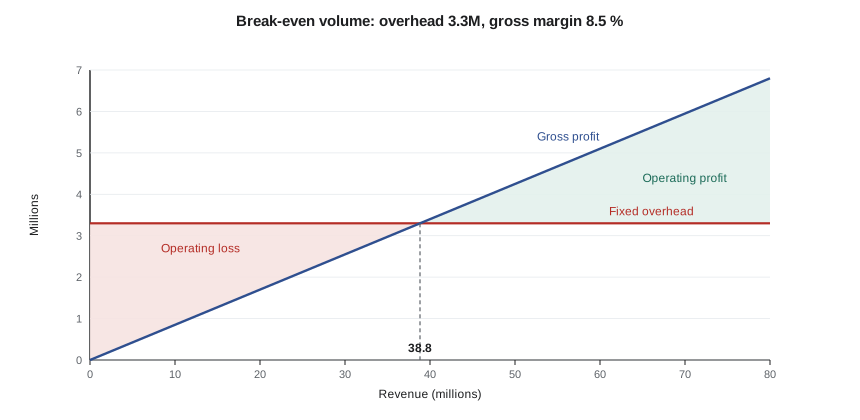
The break-even volume is the revenue at which gross profit just covers overhead. If gross margin is roughly constant as a percentage of revenue and overhead is fixed, the calculation is simple.
overhead = 3_300_000
for gm in (0.065, 0.075, 0.085, 0.095):
    breakeven = overhead / gm
    print(f"Gross margin {gm:.1%}: break-even revenue {breakeven / 1e6:5.1f}M")
# Profit at different volumes with 8.5 % margin
for revenue in (35e6, 45e6, 58.4e6, 70e6):
    op = revenue * 0.085 - overhead
print(f"Revenue {revenue / 1e6:5.1f}M: operating income {op:>11,.0f}")Gross margin 6.5%: break-even revenue 50.8M Gross margin 7.5%: break-even revenue 44.0M Gross margin 8.5%: break-even revenue 38.8M Gross margin 9.5%: break-even revenue 34.7M Revenue 35.0M: operating income -325,000 Revenue 45.0M: operating income 525,000 Revenue 58.4M: operating income 1,664,000 Revenue 70.0M: operating income 2,650,000
At an 8.5 % gross margin, Kestrel needs about $38.8 million of revenue to cover its overhead. Each million dollars of revenue above that adds about $85,000 of operating income; each million below costs $85,000. If its average margin slipped to 6.5 %, the break-even rises above $50 million, which is close to its current volume. Break-even analysis is a powerful planning tool because it shows management how much work it must win, at what margin, to stay profitable, and how much overhead the firm can afford.
In practice, overhead is not perfectly fixed. A firm that grows from $40 million to $70 million will add estimators, project managers and office staff, so overhead steps up in increments. The break-even calculation is best done for a planned range of volume with the overhead budget that goes with it, a topic Lesson 12 returns to.
Under-recovery when volume falls
When volume drops below plan, the overhead percentage used in bids is no longer enough. CON-300 Lesson 8 showed the pricing side: the firm must either raise markups, which may lose bids, cut overhead, or accept lower profit. The accounting side is that the firm's reported gross profit, however good each job's margin, will not cover overhead.
Worked problem
A slow year
Kestrel plans $64 million of revenue for 2026 at an 8.5 % gross margin with overhead of $3.55 million. In June it forecasts only $48 million of revenue at the same margin. What operating income does it now expect, and how much would it have to cut overhead to reach its planned operating income?
Show solution
- Planned operating income = 0.085 × 64,000,000 − 3,550,000 = 5,440,000 − 3,550,000 = $1,890,000.
- Forecast operating income = 0.085 × 48,000,000 − 3,550,000 = 4,080,000 − 3,550,000 = $530,000.
- To reach $1,890,000 at $48 million: overhead would need to be 4,080,000 − 1,890,000 = $2,190,000, a cut of $1,360,000 or 38 %.
Answer: Operating income falls from $1.89 million to $0.53 million. A 38 % overhead cut is not realistic in six months, so the firm would aim to win more work, improve margins and trim overhead where it can, and accept a lower result for the year.
Job profitability and company profitability
Because overhead is recovered in total, not job by job, a job with a positive gross profit is contributing to overhead even if its margin is below the bid markup. In a slow market, contractors sometimes accept work at a margin that covers direct and indirect job costs but not a full share of overhead, reasoning that some contribution is better than none. That can be sensible in the short term, but if the whole backlog is priced that way, the firm will lose money year after year. The WIP schedule and the overhead budget together show whether the firm's total expected gross profit covers its overhead; a firm that tracks only job margins may not notice that its total is falling short.
| Measure | Question it answers |
|---|---|
| Job gross margin | Did this job earn more than its own direct and indirect costs? |
| Job contribution after allocated overhead | Did this job pay its share of overhead at the planned rate? |
| Total gross profit versus overhead | Is the firm as a whole covering its overhead? |
| Break-even revenue | How much work at current margins does the firm need? |
| Overhead as a percentage of revenue | Is overhead in line with volume and with comparable firms? |
Cost behavior and activity-based thinking
Some contractors analyze overhead by activity to understand what drives it. Estimating cost is driven by the number of bids, not the revenue won; accounting cost by the number of transactions and jobs; project management cost by the number and complexity of jobs. A firm that bids many small jobs may carry heavy estimating and administration costs relative to revenue. Understanding these drivers helps management decide which markets are worth pursuing and set overhead allocations for pricing that reflect the true cost of each type of work, even if the financial statements continue to treat overhead as a period expense.
Common mistakes
MistakeComparing gross margins with another contractor or an industry survey without checking cost classification.
InsteadFind out whether project management, equipment and field overhead are in job cost or overhead before comparing.
MistakeIgnoring the balance in the labor burden clearing account.
InsteadReview it monthly, understand the reason, update the standard rate and clear it to jobs or overhead at least annually.
MistakeAllocating every shared cost on revenue or direct cost.
InsteadUse allocation bases that drive the cost, such as labor hours for small tools or deliveries for the yard.
MistakeTreating overhead as variable when planning.
InsteadOverhead is largely fixed in the short run, so profit is very sensitive to volume.
MistakeJudging the firm's health by job margins alone.
InsteadCheck that total expected gross profit covers overhead, and know the break-even volume.
MistakePricing all work at a contribution margin in a slow market.
InsteadSome contribution helps in the short term, but a whole backlog that does not recover overhead leads to losses.
Summary and key terms
- Costs are direct job costs, indirect job costs (field overhead) or home office overhead; where the lines are drawn is a policy choice that affects reported margins.
- Labor burden is charged to jobs at a standard rate through a clearing account; its balance shows under- or over-absorption.
- Shared costs such as small tools, shop and yard are collected in pools and allocated with rates based on what drives the cost.
- Home office overhead is a period expense recovered through total gross profit, not job by job.
- Break-even revenue equals fixed overhead divided by the gross margin percentage.
- Falling volume makes overhead harder to recover; cutting overhead quickly is difficult.
- Job margins, total gross profit against overhead and break-even volume together show company profitability.
- Direct cost
- A cost traceable to a specific job.
- Field overhead
- Indirect job costs such as supervision, site facilities and temporary services.
- General and administrative overhead
- Home office costs that support the whole business.
- Labor burden
- Employer payroll costs added to wages, such as payroll taxes, insurance and benefits.
- Clearing account
- A temporary account that collects actual costs and is relieved by standard charges to jobs.
- Under-absorbed
- A pool or clearing account where actual cost exceeds amounts charged to jobs.
- Cost pool
- A group of indirect costs collected for allocation.
- Allocation base
- The measure used to spread a cost pool to jobs, such as labor hours.
- Break-even revenue
- The volume at which gross profit equals overhead.
- Contribution
- The amount a job adds toward overhead and profit after its own costs.
Practice problems
Work each problem on paper first, then reveal the answer to check.
Name one direct cost, one indirect job cost and one overhead cost.
Show answer
Direct: installed concrete. Indirect: site trailer. Overhead: estimating salaries.
Wages charged to jobs are $800,000 at a 30 % standard burden rate; actual burden is $256,000. What is the clearing balance?
Show answer
Charged $240,000; actual $256,000; under-absorbed $16,000.
What should be done with a persistent under-absorbed burden balance?
Show answer
Find the cause, update the standard rate and bid rates, and clear the balance to jobs or overhead.
A small tools pool is budgeted at $250,000 over 125,000 hours. What is the rate?
Show answer
$2.00 per labor hour.
Overhead is $2,400,000 and gross margin is 12 %. What is break-even revenue?
Show answer
$20 million.
At an 8.5 % margin, how much does each $1 million of revenue below break-even reduce operating income?
Show answer
$85,000.
Why can two contractors with identical economics show different gross margins?
Show answer
They may classify project management, equipment or field overhead differently between job cost and overhead.
Why is overhead hard to cut when volume falls?
Show answer
Most overhead is fixed in the short run: salaries, rent, systems.
What is the risk of pricing an entire backlog at contribution margins?
Show answer
Total gross profit may not cover overhead, producing losses year after year.
Give an example of an activity that drives overhead other than revenue.
Show answer
The number of bids prepared drives estimating cost.
Lesson quiz · 5 questions
Score 60% or more to complete this lesson.
Create a free account to save your progress, take quizzes and earn a certificate.