
CON-320 · Lesson 7 of 12 · 29 min
Equipment accounting and internal rates
For earthwork, road and heavy civil contractors, equipment can be the largest asset on the balance sheet and one of the largest costs on every job. Even a building contractor like Kestrel owns loaders, skid steers, forklifts, trucks, concrete equipment and forming systems worth several million dollars. Owning equipment raises accounting questions that a firm which rents everything never faces: how to measure what a machine really costs per hour, how to charge that cost to jobs, what to do when the fleet sits idle, how to depreciate it for the financial statements and for tax, and when to replace it. CON-300 priced equipment into an estimate; this lesson looks at how owned equipment is costed and accounted for.
Ownership costs and operating costs
The cost of owning and running a machine falls into two groups. Ownership costs are incurred whether or not the machine works; operating costs are incurred only when it runs. Operator wages are usually charged separately as labor.
| Group | Cost | How it is estimated |
|---|---|---|
| Ownership | Depreciation | Purchase price less expected resale value, spread over the expected life in hours or years |
| Ownership | Cost of capital (interest) | Interest on the average investment, whether the machine is financed or bought with cash |
| Ownership | Insurance | Equipment floater premium allocated by value |
| Ownership | Property taxes, licenses and registration | Annual amounts by machine |
| Ownership | Storage and yard | Share of yard cost while idle |
| Operating | Fuel | Consumption per hour at the expected load factor times fuel price |
| Operating | Lubricants, filters and fluids | Often a percentage of fuel cost |
| Operating | Repairs and maintenance | Lifetime repair cost as a share of purchase price, spread over life hours |
| Operating | Tires, tracks and wear parts | Replacement cost divided by expected life in hours |
Rate guides published by governments and industry associations give typical ownership and operating rates by machine class, and some public owners use them to price force-account work and changes. A contractor should use its own records where it can, because its utilization, maintenance practices and financing differ from the averages behind the guides.
# Hourly cost of a 20-tonne excavator owned by Kestrel (illustrative)
price, resale, life_years, hours_per_year = 285_000, 95_000, 6, 1_400
life_hours = life_years * hours_per_year
depreciation = (price - resale) / life_hours
avg_investment = (price + resale) / 2
interest = avg_investment * 0.07 / hours_per_year          # 7 % cost of capital
insurance_tax = price * 0.025 / hours_per_year            # 2.5 % per year
ownership = depreciation + interest + insurance_tax
fuel = 16 * 1.65                                          # 16 L/h at 1.65 per liter
lube = 0.15 * fuel
repairs = price * 0.80 / life_hours                       # lifetime repairs 80 % of price
wear = 6.50
operating = fuel + lube + repairs + wear
print(f"Ownership per hour: {ownership:6.2f}  (depreciation {depreciation:.2f}, "
      f"interest {interest:.2f}, insurance and tax {insurance_tax:.2f})")
print(f"Operating per hour: {operating:6.2f}  (fuel {fuel:.2f}, lube {lube:.2f}, "
      f"repairs {repairs:.2f}, wear {wear:.2f})")
print(f"Total internal rate, without operator: {ownership + operating:.2f} per hour")Ownership per hour: 37.21 (depreciation 22.62, interest 9.50, insurance and tax 5.09) Operating per hour: 64.00 (fuel 26.40, lube 3.96, repairs 27.14, wear 6.50) Total internal rate, without operator: 101.21 per hour
In this example, owning and running the excavator costs about $101 per working hour before the operator. About $37 of that is ownership cost, which continues whether or not the machine works, and repairs are the largest single operating cost. The fuel figures are illustrative (16 liters per hour, about 4.2 gallons); a contractor should use its own fuel records.
Utilization: the key to equipment cost
Ownership cost per hour depends on how many hours the machine works. The excavator above was costed at 1,400 hours a year. If it only works 900 hours, its ownership cost per hour rises by more than half, because the same annual depreciation, interest, insurance and taxes are spread over fewer hours. Utilization, the hours worked divided by the hours available, is therefore the most important number in equipment management.
annual_ownership = (285_000 - 95_000) / 6 + (285_000 + 95_000) / 2 * 0.07 + 285_000 * 0.025
operating_per_hour = 64.00
for hours in (600, 900, 1_200, 1_400, 1_600):
    own = annual_ownership / hours
print(f"{hours:>5} h/year: ownership {own:6.2f}/h, total {own + operating_per_hour:6.2f}/h")600 h/year: ownership 86.82/h, total 150.82/h 900 h/year: ownership 57.88/h, total 121.88/h 1200 h/year: ownership 43.41/h, total 107.41/h 1400 h/year: ownership 37.21/h, total 101.21/h 1600 h/year: ownership 32.56/h, total 96.56/h
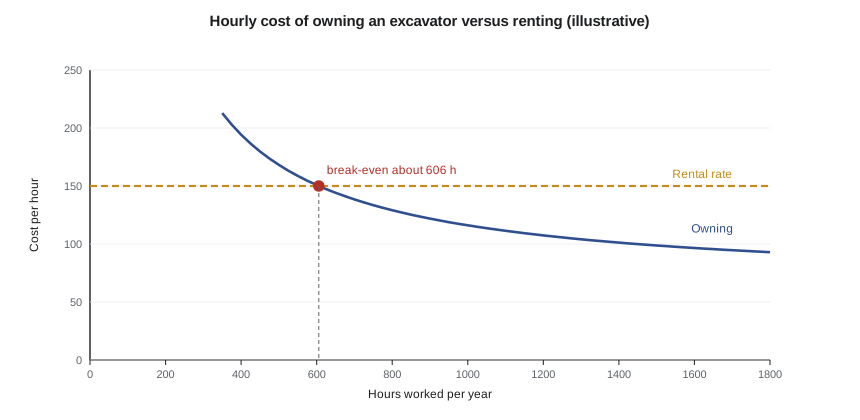
At 600 hours a year the machine costs about $151 an hour; at 1,600 hours about $97. A machine that sits in the yard is not free: its ownership cost has to be recovered from the hours it does work, or it becomes overhead. That is the basic economic case for renting equipment that will be used only occasionally.
Own, rent or lease
Contractors acquire equipment in three ways. Owning, whether paid in cash or financed with a loan, gives control, availability and lower cost at high utilization, but ties up capital and carries the risk of idle time and obsolescence. Short-term rental gives flexibility for occasional needs and passes maintenance to the rental company, but costs more per hour. Long-term leasing sits in between and is covered from the financing side in Lesson 9.
Worked problem
Buy or rent a telehandler
Kestrel can buy a telehandler for $165,000 with an expected resale of $60,000 after five years. Annual ownership costs other than depreciation (interest, insurance, taxes) are about $13,500, and operating costs are $22 per hour. A rental company offers the same machine at $5,800 a month, including maintenance, with operating costs (fuel) of about $12 per hour. Kestrel expects to need a telehandler 9 months a year, about 1,250 hours. Which is cheaper?
Show solution
- Owning per year: depreciation (165,000 − 60,000) ÷ 5 = $21,000, plus other ownership $13,500, plus operating 1,250 × 22 = $27,500. Total $62,000.
- Renting per year: 9 × 5,800 = $52,200, plus operating 1,250 × 12 = $15,000. Total $67,200.
- Difference: owning saves about $5,200 a year at this level of use.
Answer: Owning is slightly cheaper at 9 months of use, but the margin is small. If use fell to 6 months, renting would cost 6 × 5,800 + 833 × 12 = $44,800 against owning at about $52,800, so renting would win. Kestrel should buy only if it is confident about utilization, and should consider whether tying up capital affects its bonding capacity.
Charging equipment to jobs: the equipment clearing account
Owned equipment is charged to jobs at internal rates, either per hour of use, per day on site or per month. As with labor burden in Lesson 6, the charges flow out of an equipment clearing account (or a separate equipment cost center), and the actual ownership and operating costs flow in. If rates are right and utilization is as planned, the account balances. If utilization falls short, or costs rise, the account is under-recovered.
| Kestrel equipment cost center, 2025 (illustrative) | $ |
|---|---|
| Depreciation | 620,000 |
| Interest on equipment loans | 95,000 |
| Insurance, licenses and property taxes | 140,000 |
| Fuel and lubricants | 310,000 |
| Repairs, parts and tires | 265,000 |
| Mechanic wages and shop costs | 180,000 |
| Total actual equipment cost | 1,610,000 |
| Charged to jobs at internal rates | 1,470,000 |
| Under-recovered equipment cost | 140,000 |
What to do with an under-recovery is a policy question. Some firms leave it in the equipment cost center and report it as part of overhead, so that job margins reflect the internal rates the estimators used. Others allocate it back to jobs at year-end. A large, persistent under-recovery means either that the fleet is bigger than the work requires or that the internal rates are too low; both need action. Estimators also need to know, because bids priced at internal rates will not recover the real cost of an underused fleet.
Some contractors go further and set up their equipment as a separate company or division that rents equipment to the construction company at market rates. This makes the true cost of ownership visible, lets management judge the fleet as an investment and can have liability, financing and tax advantages, though it adds administration and related-party transactions that sureties will look through. Whatever the structure, the principle is the same: the fleet should earn back its cost from the work.
Depreciation in the financial statements
For the financial statements, equipment is recorded at cost and depreciated over its useful life to its estimated residual value. Contractors commonly use straight-line depreciation, or a usage-based method for machines whose wear follows hours. Useful lives and residual values are estimates and should be reviewed; a firm that depreciates its trucks over ten years when it replaces them after six will show inflated profits and then losses on disposal.
Under US GAAP, depreciation is recorded over the useful life using a systematic method; the tax rules below are separate, and most contractors keep two sets of depreciation records, one for the financial statements and one for tax.
Worked problem
Book depreciation and gain on sale
Kestrel bought a loader for $180,000 four years ago, depreciating it straight-line over six years to a residual of $36,000. It sells the loader now for $95,000. What is the gain or loss on sale?
Show solution
- Annual depreciation = (180,000 − 36,000) ÷ 6 = $24,000.
- Accumulated depreciation after 4 years = $96,000; carrying amount = 180,000 − 96,000 = $84,000.
- Gain = 95,000 − 84,000 = $11,000.
Answer: A gain of $11,000. Gains or losses on sale tell management whether its depreciation estimates match reality; consistent large gains mean depreciation is too fast, consistent losses that it is too slow.
Depreciation for tax
For federal income tax, US businesses use the Modified Accelerated Cost Recovery System (MACRS). Most construction equipment (asset class 15.0) is 5-year property, depreciated using the 200 % declining-balance method with a half-year convention, so the deductions are spread over six tax years. In addition, the One Big Beautiful Bill Act of 2025 made 100 % bonus depreciation permanent for qualifying property acquired after 19 January 2025, allowing the full cost to be deducted in the first year, and Section 179 expensing is available up to $2,560,000 for 2026, phasing out above $4,090,000 of purchases. Many states do not conform to federal bonus depreciation. These rules change; confirm them with IRS guidance or a tax adviser.
# MACRS 5-year (200 % DB, half-year) versus 100 % bonus on a 285,000 excavator
cost = 285_000
macrs5 = [0.20, 0.32, 0.192, 0.1152, 0.1152, 0.0576]   # IRS table percentages
print("MACRS 5-year: ", " ".join(f"{cost * p:>8,.0f}" for p in macrs5))
print("100 % bonus:  ", f"{cost:>8,.0f}", "       0" * 5)
print(f"Check: MACRS total {sum(cost * p for p in macrs5):,.0f}")MACRS 5-year: 57,000 91,200 54,720 32,832 32,832 16,416 100 % bonus: 285,000 0 0 0 0 0 Check: MACRS total 285,000
Tax depreciation is usually faster than book depreciation, so a contractor that buys equipment pays less tax now and more later. The difference between book and tax values creates a deferred tax liability in the financial statements. Fast tax write-offs improve cash flow in the year of purchase, which is one reason contractors often buy equipment late in a profitable year. That timing should not drive decisions on its own: a machine bought to save tax still has to earn its cost on jobs, and the cash spent reduces working capital, which sureties watch closely.
Equipment and the balance sheet
Equipment affects a contractor's financial position in several ways. Buying with cash reduces working capital directly. Financing with a term loan keeps cash but adds a current portion of debt to current liabilities. Both increase total assets and, if financed, total liabilities. Sureties focus on working capital and equity, so a large equipment purchase can reduce bonding capacity unless it is financed sensibly or the firm has strong working capital. Lenders often secure equipment loans on the machines themselves and may set covenants limiting further equipment purchases.
| Effect of a $400,000 equipment purchase | Paid in cash | Financed with a 5-year loan |
|---|---|---|
| Cash | −400,000 | 0 at purchase |
| Equipment | +400,000 | +400,000 |
| Current liabilities | 0 | + about 80,000 (current portion) |
| Long-term debt | 0 | + about 320,000 |
| Working capital | −400,000 | − about 80,000 |
| Equity | 0 | 0 |
When to replace equipment
As a machine ages, its depreciation per hour falls but its repair costs and downtime rise. The economic life is the age at which the average total cost per hour over the machine's life is lowest; keeping it beyond that point costs more each year than replacing it. Contractors track cumulative cost per hour for each machine to see when that point is reached. Downtime matters too: a machine that breaks down on a critical activity can delay a whole job, a cost that never appears in the equipment records.
# Average cost per hour over life for a machine kept 1 to 9 years (illustrative)
price, hours = 285_000, 1_400
resale = [220_000, 180_000, 150_000, 125_000, 105_000, 90_000, 78_000, 68_000, 60_000]
repairs = [6_000, 12_000, 20_000, 30_000, 42_000, 55_000, 68_000, 82_000, 96_000]
cum_repairs, best = 0, None
for year in range(1, 10):
    cum_repairs += repairs[year - 1]
    avg = (price - resale[year - 1] + cum_repairs) / (year * hours)
    best = (year, avg) if best is None or avg < best[1] else best
    print(f"Keep {year} years: average {avg:6.2f} per hour")
print(f"Lowest average cost at {best[0]} years")Keep 1 years: average 50.71 per hour Keep 2 years: average 43.93 per hour Keep 3 years: average 41.19 per hour Keep 4 years: average 40.71 per hour Keep 5 years: average 41.43 per hour Keep 6 years: average 42.86 per hour Keep 7 years: average 44.90 per hour Keep 8 years: average 47.50 per hour Keep 9 years: average 50.48 per hour Lowest average cost at 4 years
Common mistakes
MistakeAssuming owned equipment is free when it is idle.
InsteadOwnership costs continue whether or not the machine works; idle time must be recovered from working hours or becomes overhead.
MistakeSetting internal rates once and never updating them.
InsteadReview rates against actual costs and utilization at least annually.
MistakeIgnoring the balance in the equipment clearing account.
InsteadA persistent under-recovery means the fleet is too big or the rates are too low.
MistakeBuying equipment late in the year purely for the tax deduction.
InsteadBuy only if the machine will earn its cost; consider the effect on working capital and bonding.
MistakeUsing book useful lives that do not match how long machines are actually kept.
InsteadAlign lives and residual values with experience; persistent gains or losses on sale are a signal.
MistakeKeeping old machines because they are paid for.
InsteadTrack cumulative cost per hour and replace at the economic life, counting downtime.
Summary and key terms
- Equipment cost has an ownership part (depreciation, cost of capital, insurance, taxes, storage) and an operating part (fuel, lubricants, repairs, wear parts).
- Utilization is the key driver of cost per hour, because ownership cost is fixed per year.
- Owning is cheaper than renting only above a break-even level of use.
- Equipment is charged to jobs at internal rates through a clearing account or cost center; under-recovery signals idle fleet or low rates.
- Book depreciation follows useful life; tax depreciation uses MACRS, with 100 % bonus depreciation and Section 179 expensing available.
- Paying cash for equipment reduces working capital directly; financing spreads the effect.
- Replace machines near their economic life, when average cost per hour is lowest.
- Ownership cost
- Equipment cost incurred whether or not the machine works.
- Operating cost
- Equipment cost incurred only when the machine runs.
- Utilization
- Hours worked divided by hours available.
- Internal rate
- The rate at which owned equipment is charged to jobs.
- Equipment clearing account
- An account that collects actual equipment costs and is relieved by charges to jobs.
- Under-recovery
- Actual equipment cost exceeding amounts charged to jobs.
- Residual value
- The expected resale value at the end of useful life.
- Tax depreciation system
- The Modified Accelerated Cost Recovery System used for US tax depreciation.
- Deferred tax liability
- Tax payable in future because tax depreciation has run ahead of book depreciation.
- Economic life
- The age at which average total cost per hour of a machine is lowest.
Practice problems
Work each problem on paper first, then reveal the answer to check.
List three ownership costs and three operating costs.
Show answer
Ownership: depreciation, interest, insurance. Operating: fuel, repairs, tires.
A machine costs $40,000 a year to own and $35 an hour to operate. What is its total cost per hour at 800 and at 1,600 hours?
Show answer
At 800 h: 50 + 35 = $85/h. At 1,600 h: 25 + 35 = $60/h.
Why does low utilization favor renting?
Show answer
Ownership cost is fixed per year, so it becomes expensive per hour when hours are few.
Kestrel's equipment cost center incurred $1,610,000 and charged $1,470,000 to jobs. What is the under-recovery?
Show answer
$140,000.
What does a persistent under-recovery suggest?
Show answer
The fleet is too large for the work or internal rates are too low.
A truck bought for $90,000 is depreciated straight-line over 5 years to $15,000. What is its carrying amount after 3 years?
Show answer
Annual depreciation $15,000; carrying amount $45,000.
If that truck sells for $52,000 after 3 years, what is the gain?
Show answer
$7,000.
Why does fast tax depreciation create a deferred tax liability?
Show answer
Tax deductions run ahead of book depreciation, so more tax will be payable later.
How does paying cash for equipment affect working capital?
Show answer
It reduces working capital by the full purchase price.
What is a machine's economic life?
Show answer
The age at which its average total cost per hour over its life is lowest.
Lesson quiz · 5 questions
Score 60% or more to complete this lesson.
Create a free account to save your progress, take quizzes and earn a certificate.