
CON-330 · Lesson 10 of 12 · 25 min
Public procurement rules and social procurement
When the owner is a government, a Crown corporation, a municipality, a school board, a hospital or a public agency, procurement is governed by more than contract law. Trade agreements and procurement statutes require open competition above set thresholds; domestic content policies can require or favor local materials and suppliers; and social procurement programs set goals for spending with Indigenous, small or disadvantaged businesses and for community benefits. These rules reach the general contractor's buyout because many of them flow down to subcontracts and supply. This lesson gives a working overview of the rules a contractor's procurement team is most likely to meet.
Why public procurement is different
Public owners spend public money, so the law requires them to buy fairly, openly and with value for money, and to be accountable for how they choose. For contractors this has practical consequences: bid documents are formal and strictly enforced, late or non-compliant bids are rejected, changes after award are scrutinized, and bidders have rights to challenge an unfair process. Public owners also use their purchasing power to pursue policy goals, such as supporting domestic industry, Indigenous economic development or small business, and those goals come with requirements that the contractor must meet in its own buying.
| Feature | Private owner | Public owner |
|---|---|---|
| Choice of contractor | Free to negotiate with anyone | Open competition above thresholds; set evaluation rules |
| Bid rules | Flexible | Strict compliance; late or non-compliant bids rejected |
| Domestic content | Owner's choice | Policies may require or favor domestic materials and suppliers |
| Social goals | Voluntary | Targets or requirements for Indigenous, small or disadvantaged business participation, community benefits |
| Wages and labor | Market or collective agreements | Davis-Bacon prevailing wages on federal and federally funded construction, and state prevailing wage laws |
| Challenges | Contract claims only | Bid protests to the agency, the Government Accountability Office or the Court of Federal Claims for federal procurement |
Trade agreements and thresholds
US federal construction procurement is governed by the Federal Acquisition Regulation (FAR), particularly Part 36 for construction, with sealed bidding or negotiated procurement above the simplified acquisition threshold. International agreements, including the WTO Agreement on Government Procurement, open covered federal procurement to firms from partner countries above set thresholds, which are adjusted every two years. State and local procurement is governed by state codes and local ordinances, often modeled on the American Bar Association's Model Procurement Code, with their own thresholds and preferences.
| Federal measure | Threshold | Effect |
|---|---|---|
| Simplified acquisition threshold | About $350,000 (2025 adjustment) | Above it, full FAR competition procedures apply |
| Miller Act bonds | Construction contracts over $150,000 | Performance and payment bonds required from the prime contractor |
| Davis-Bacon Act | Construction contracts over $2,000 | Prevailing wages and certified payroll, including for subcontractors |
| Small business subcontracting plan | Large-business primes above about $900,000, or $2 million for construction (2025 adjustment) | Plan with goals for small business subcontracting, reported to the agency |
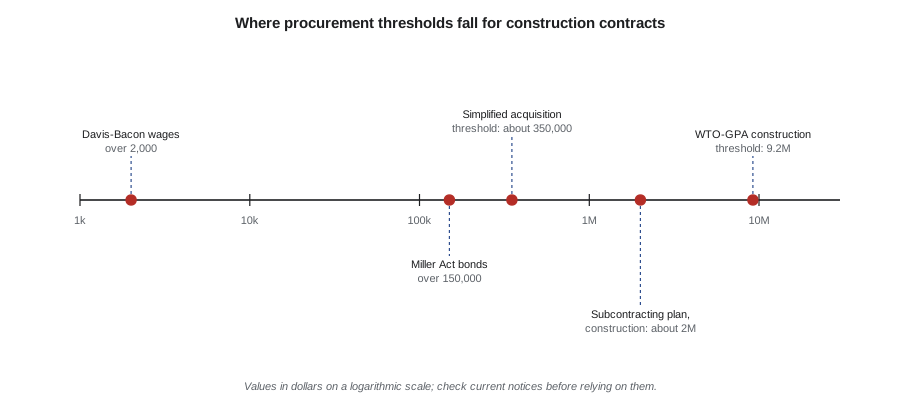
For the general contractor, trade agreement coverage mainly affects the prime contract. But a public owner may also require the contractor to buy subcontracts and supply openly, to advertise packages, or to use the owner's own procurement rules for certain items, particularly on construction management projects where the contractor buys trades on the owner's behalf (CON-340).
Domestic content rules
Federal construction is subject to the Buy American Act, which requires domestic construction materials unless an exception applies. Under the FAR, a manufactured construction material counts as domestic if its domestic component content meets a threshold that rose to 65 % in 2024 and is scheduled to reach 75 % in 2029, with stricter rules for iron and steel. Federally funded infrastructure (for example, highway, transit, water and broadband projects funded through federal grants) is also subject to Build America, Buy America (BABA), enacted in 2021, which requires that iron and steel, manufactured products and construction materials be produced in the US unless a waiver applies. Many states have their own preferences. Contractors must carry these requirements into purchase orders and subcontracts, and collect origin certifications from suppliers.
# Domestic content test for a manufactured construction material (simplified)
def domestic_content(component_costs):
    total = sum(c for c, _ in component_costs)
    domestic = sum(c for c, us_made in component_costs if us_made)
    return domestic / total

switchboard = [(48_000, True), (31_000, False), (12_500, True), (8_500, True)]
share = domestic_content(switchboard)
for year, threshold in [(2026, 0.65), (2029, 0.75)]:
    print(f"{year}: domestic content {share:.1%} vs threshold {threshold:.0%} -> "
f"{'domestic' if share >= threshold else 'foreign'}")2026: domestic content 69.0% vs threshold 65% -> domestic 2029: domestic content 69.0% vs threshold 75% -> foreign
A switchboard with 69 % domestic component cost qualifies as domestic in 2026 but would not meet the 75 % threshold scheduled for 2029. On a federal project, Halyard's electrical purchase order would require the supplier to certify domestic content and keep records, because a false certification can lead to penalties and suspension.
Indigenous and social procurement
Federal small business programs require large prime contractors on contracts above the subcontracting plan threshold to set and report goals for subcontracting with small businesses and certain categories, such as women-owned, service-disabled veteran-owned and HUBZone small businesses. Programs based on race or sex changed significantly in 2025 and 2026. The Department of Transportation issued an interim final rule on 3 October 2025 removing race- and sex-based presumptions of disadvantage from its Disadvantaged Business Enterprise (DBE) program, requiring every certified firm to show individual disadvantage, and pausing DBE contract goals until firms are re-evaluated; a final rule took effect on 25 September 2026, with re-evaluations due by 24 December 2026. The Small Business Administration published a final rule effective 10 September 2026 removing the presumption of social disadvantage for new applicants to its 8(a) program. State and local programs vary and some have also changed. Contractors should check the current requirements in each solicitation and build any participation goals into the procurement plan from the start.
# Tracking small business subcontracting goals on a federal project (illustrative)
subcontracted_total = 31_000_000
goals = {"Small business": 0.30, "Women-owned small business": 0.05, "HUBZone": 0.03}
awards = {"Small business": 8_400_000, "Women-owned small business": 1_250_000, "HUBZone": 560_000}
for cat, g in goals.items():
    share = awards[cat] / subcontracted_total
print(f"{cat:28} goal {g:4.0%} achieved {share:5.1%} {'on track' if share >= g else 'short'}")Small business goal 30% achieved 27.1% short Women-owned small business goal 5% achieved 4.0% short HUBZone goal 3% achieved 1.8% short
Halfway through buyout, the project is short of its small business goal and its HUBZone goal. The procurement team should identify which open packages have qualified small businesses, invite and prequalify them on fair criteria, and consider package sizes that small firms can bid, rather than discovering the shortfall at the end.
Participation programs work only if the participating firms do real work. Public owners and courts treat 'pass-through' arrangements, where a qualifying firm is named but another firm actually performs the work, as serious misconduct, which can lead to penalties, loss of credit toward the goal and suspension from public work. The contractor should verify that each counted firm performs a commercially useful function with its own forces and management.
Wages, integrity and other flow-downs
| Requirement | US examples | What the contractor must do |
|---|---|---|
| Wage rules | Davis-Bacon and state prevailing wage laws; certified payroll | Flow down to subcontracts; collect and check payroll records |
| Integrity | Suspension and debarment lists (SAM.gov); certifications in the FAR | Check that subcontractors and suppliers are not barred; flow down certifications |
| Security | Background checks and site access rules on federal sites | Allow time in procurement for clearances |
| Accessibility and language | Section 508 for some deliverables; Americans with Disabilities Act design requirements | Include in subcontract scope and submittals |
| Supplier codes and forced labor | Uyghur Forced Labor Prevention Act import restrictions (pointer BUS-230) | Ask suppliers for origin and supply chain information on high-risk goods |
Worked problem
Building public requirements into buyout
Halyard bids a $48 million federal laboratory with small business subcontracting goals, Buy American requirements, Davis-Bacon wages and Miller Act bonds. What must its procurement plan add compared with Larch Street?
Show solution
- Small business subcontracting plan with goals by category and a list of packages likely to meet them.
- Domestic content certification clauses for construction materials, and early checks that domestic sources can meet lead times.
- Davis-Bacon flow-down clauses and certified payroll collection from every tier.
- Bond requirements in subcontracts where appropriate, integrity checks against federal exclusion lists, and security clearance lead times.
Answer: Each requirement affects who can bid, what they must certify, and how long buyout takes. Building them into the plan from the start avoids disqualified bids, rejected materials and missed commitments.
Fairness, records and challenges
Public procurement is reviewable. A bidder that believes a public owner broke the rules can challenge the award, and the owner's records, including how the general contractor bought key packages on a construction management project, may be examined. That changes how carefully the procurement team must document its own decisions on public work.
| Practice | Why it matters on public work |
|---|---|
| Written evaluation criteria issued with the invitation | Decisions must follow the published criteria; unpublished factors invite challenge |
| Consistent communication with all bidders | Selective information is a common ground for complaints |
| Records of bids, leveling, scope reviews and awards | Show that the process was fair if questioned |
| Conflict-of-interest declarations by evaluators | Public owners often require them for anyone scoring bids |
| Debriefs for unsuccessful bidders | Reduce complaints and help local and participating firms improve |
Federal bid protests can be filed with the procuring agency, the Government Accountability Office or the Court of Federal Claims, each with short deadlines, and a timely protest to GAO can suspend award or performance. State and local procurement codes set their own protest procedures. Subcontractors generally have no protest rights against a prime contractor's private buying decisions, but the prime's records may be reviewed in a protest or audit.
For the general contractor, the practical lesson is that on public projects the buyout file is part of the public record of how money was spent. A procurement team that already keeps clear award records, as this course recommends for every project, has little extra work to do.
Common mistakes
MistakeAssuming public procurement rules affect only the prime contract.
InsteadCheck which requirements flow down to subcontracts and purchase orders, and include them in every package.
MistakeIgnoring domestic content until materials arrive.
InsteadIdentify affected materials during planning and require origin documentation in purchase orders.
MistakeRelying on last year's program rules.
InsteadSocial procurement and preference programs changed significantly in 2025 and 2026; check the current solicitation.
MistakeCounting participation from firms that do not perform the work.
InsteadVerify that each counted firm performs a commercially useful function with its own forces.
MistakeTreating participation goals as an end-of-project report.
InsteadPlan which packages will meet goals and track them throughout buyout.
MistakeSkipping integrity checks on lower tiers.
InsteadCheck that subcontractors and suppliers are not suspended or barred, and flow down certifications.
Summary and key terms
- Public procurement requires open, fair and accountable buying, and adds policy goals that flow down to subcontracts and supply.
- Federal construction follows the FAR, with thresholds for simplified acquisition, Miller Act bonds, Davis-Bacon wages and small business subcontracting plans.
- The Buy American Act and BABA require domestic construction materials on federal and federally funded work, with domestic content thresholds rising to 75 % in 2029.
- Small business subcontracting goals continue, while DBE and 8(a) programs removed race- and sex-based presumptions in 2025 and 2026.
- Participation must be real: pass-through arrangements are serious misconduct.
- Wage, integrity, security, language and supply chain requirements also flow down.
- The procurement plan should build public requirements in from the start.
- Public procurement
- Buying by government and public bodies under rules requiring fairness, openness and accountability.
- Trade agreement threshold
- The contract value above which a procurement must follow a trade agreement's rules.
- Domestic content
- The share of a product's value produced in the home country.
- Domestic preference policy
- A rule requiring domestic materials, such as the Buy American Act for federal construction and BABA for federally funded infrastructure.
- Participation program
- A program setting goals for spending with particular suppliers, such as federal small business subcontracting goals and the DOT DBE program.
- Social procurement
- Using purchasing to achieve social goals such as local hiring or spending with particular groups of suppliers.
- Community benefits agreement
- A commitment to provide local employment, training or other benefits from a project.
- Commercially useful function
- Real performance of work with a firm's own forces and management, required for participation credit.
- Pass-through
- An arrangement where a qualifying firm is credited but another firm does the work.
- Flow-down
- A requirement in the prime contract that must be passed to subcontracts and purchase orders.
Practice problems
Work each problem on paper first, then reveal the answer to check.
What does the Miller Act require?
Show answer
Performance and payment bonds on federal construction contracts over $150,000.
What does Davis-Bacon require of subcontractors?
Show answer
Payment of prevailing wages and submission of certified payroll.
What domestic content threshold applies to manufactured construction materials in 2026?
Show answer
65 %, rising to 75 % in 2029.
What changed in the DOT DBE program in October 2025?
Show answer
Race- and sex-based presumptions of disadvantage were removed and firms must show individual disadvantage; goals were paused pending re-evaluation.
Why must contractors verify that participating firms perform real work?
Show answer
Pass-through arrangements are misconduct and can cost credit, penalties and suspension.
Goal 25 % of $20 million subcontracted; $3.8 million awarded. How much remains?
Show answer
$5.0 million goal; $1.2 million remains.
Name three requirements that commonly flow down to subcontracts on public projects.
Show answer
Wage rules, integrity certifications, domestic content certification, participation reporting, security, language requirements.
When should participation goals be planned?
Show answer
From the start of procurement planning, by package.
Why can domestic content rules affect the schedule?
Show answer
Domestic sources may have longer lead times or limited capacity.
What should a contractor do before relying on a program's rules?
Show answer
Check the current solicitation and program rules, which may have changed.
Lesson quiz · 5 questions
Score 60% or more to complete this lesson.
Create a free account to save your progress, take quizzes and earn a certificate.