
CON-330 · Lesson 6 of 12 · 25 min
Purchase orders, supply agreements and Incoterms
Not everything a contractor buys is a subcontract. Ready-mix concrete, reinforcing steel, lumber, hardware, rented equipment and owner-specified equipment are usually bought on purchase orders or supply agreements. The difference matters: a supplier that only delivers goods is selling them, and the law of sale of goods applies; a firm that comes on site to install or perform work is a subcontractor and needs a subcontract, insurance and safety orientation. This lesson covers how to write purchase orders that protect the project, how to read suppliers' terms, and how delivery terms, including the international Incoterms rules, decide who pays for shipping and who carries the risk when goods are lost or damaged in transit.
Purchase order or subcontract?
| Situation | Usual instrument | Why |
|---|---|---|
| Goods delivered to site, installed by others | Purchase order | A sale of goods; no site work by the supplier |
| Goods delivered and installed by the supplier's crews | Subcontract | Site work requires insurance, safety, schedule and warranty obligations |
| Supplier's technician supervises startup only | Purchase order with a service rider | Limited site presence, still needs insurance and safety orientation |
| Equipment rental with operator | Rental agreement with operator terms (often treated as a subcontract) | Operator is working on site under the supplier's control |
| Ongoing supply over many projects | Supply or framework agreement, with releases for each delivery | Sets prices and terms once |
The distinction also matters for payment and liens. In most jurisdictions, material suppliers to a project have lien or payment-bond rights for unpaid materials, so a supplier to a subcontractor who is not paid can claim against the project even though it never had a contract with the general contractor or the owner (CON-220).
What a purchase order should contain
A purchase order is a contract. A one-line order ('supply rebar for Larch Street, $865,500') leaves almost every important question to the supplier's standard terms. A good purchase order states the following.
| Element | Detail |
|---|---|
| Description and specification | Exact product, grade, size, standard (for example, deformed bars to the specified grade), with the specification section |
| Quantity and unit price | Including how quantities are measured and how overruns or shortfalls are priced |
| Delivery schedule and place | Dates or release process, site address, delivery hours, unloading responsibility |
| Delivery term | Who arranges and pays freight, and when risk passes (for example, delivered to site, or an Incoterm for imports) |
| Submittals and documentation | Shop drawings, mill certificates, product data, certifications, country-of-origin documents for domestic content rules |
| Inspection and acceptance | Right to inspect on delivery, time to reject non-conforming goods |
| Warranty | Length and start date matching the prime contract, manufacturer warranty transfer to the owner |
| Price validity and escalation | Firm period and any price adjustment formula (Lesson 8) |
| Payment terms | Invoicing, due date, early-payment discounts, holdback or retainage where it applies, lien waivers |
| Title and risk | When title passes, especially for stored or deposit-paid materials |
| Terms and conditions | Which party's terms govern; flow-down of applicable prime contract terms |
The battle of the forms
Contractors send purchase orders with their terms on the back; suppliers reply with order acknowledgments or invoices carrying their own terms, which often limit warranties, exclude consequential damages and make delivery dates estimates only. When the two sets conflict and goods are shipped anyway, which terms govern?
In the US, sales of goods are governed by Article 2 of the Uniform Commercial Code, adopted in every state except Louisiana (which adopted most of it). Under UCC section 2-207, an acknowledgment with additional or different terms can still form a contract, and between merchants the additional terms may become part of it unless they materially alter it or the offer expressly limits acceptance to its own terms. Conflicting terms are often knocked out and replaced by UCC default rules. The practical defense is to have the supplier sign the purchase order, state in the order that acceptance is limited to its terms, or negotiate a supply agreement that overrides both forms.
Default rules on warranties also matter. Sale of goods law implies warranties that goods are of merchantable quality and fit for a known purpose, but suppliers routinely try to exclude them. A contractor that needs a warranty matching the prime contract must write it into the order and make sure the supplier accepts it.
Delivery terms and the risk of loss
Two questions arise for any shipment: who arranges and pays for transport, and who carries the risk if the goods are lost or damaged on the way. For domestic deliveries, construction purchase orders usually say 'delivered to site' or 'FOB jobsite', meaning the supplier arranges and pays freight and carries the risk until the goods arrive; 'FOB factory' or 'FOB shipping point' means the buyer pays freight and carries the risk from the moment the goods leave the supplier.
In the US, the UCC gives domestic FOB terms specific default meanings (FOB place of shipment versus FOB place of destination), which differ from the Incoterms FOB rule used for sea freight. Purchase orders should say in words where delivery occurs and who pays freight, and use Incoterms for imports.
For international purchases, the International Chamber of Commerce's Incoterms rules are the common language. The current version is Incoterms 2020, which has 11 rules. Each three-letter rule allocates the tasks, costs and risks of delivery between seller and buyer, but does not deal with when title passes or with payment; those still need to be in the contract.
| Rule | Seller delivers (risk passes) | Who pays main carriage | Notes for contractors |
|---|---|---|---|
| EXW (Ex Works) | At the seller's premises, not loaded | Buyer | Buyer handles export clearance and loading: rarely suitable for imports |
| FCA (Free Carrier) | To the buyer's carrier at a named place | Buyer | Flexible; works for truck, rail and containers |
| FOB (Free on Board) | On board the vessel at the port of shipment | Buyer | Sea and inland waterway only; often misused for containers and trucks |
| CIF (Cost, Insurance and Freight) | On board the vessel at the port of shipment | Seller, including minimum insurance | Risk passes before the seller's paid carriage ends |
| DAP (Delivered at Place) | At the named destination, ready for unloading | Seller | Buyer handles import clearance and duties |
| DDP (Delivered Duty Paid) | At the named destination, cleared for import | Seller, including duties | Seller carries duty and tariff risk; price reflects it |
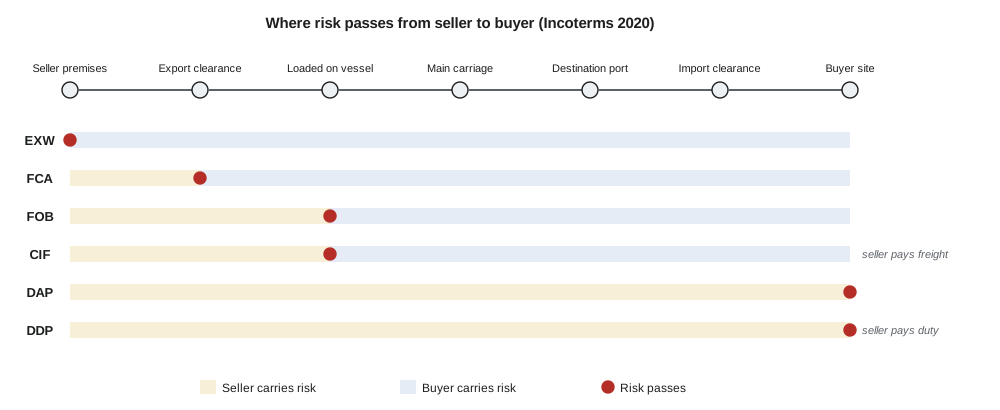
A common misunderstanding concerns CIF and the other 'C' rules. The seller pays for carriage to the destination port, but the risk passes to the buyer when the goods are loaded at the port of shipment. If a container of curtain wall panels is lost at sea under CIF, the buyer carries the loss and must claim on the insurance the seller bought (which, under CIF, need only be minimum cover).
Landed cost
To compare a domestic quote with an imported one, the buyer must calculate the landed cost: the total cost of getting the goods to site, including everything the quote does not include under its Incoterm.
# Landed cost of imported versus domestic glass units for Larch Street (illustrative)
domestic_delivered = 640_000                 # quote delivered to site, duties not applicable
imported_fob = 455_000                       # quote FOB port of shipment
ocean_freight = 38_000
marine_insurance = 0.004 * imported_fob
duty_rate = 0.0                              # depends on tariff classification and origin
customs_broker = 3_500
port_and_drayage = 14_500                    # port charges and trucking to site
extra_float_cost = 22_000                    # carrying a 4-week longer lead time
duty = duty_rate * imported_fob
landed = (imported_fob + ocean_freight + marine_insurance + duty
          + customs_broker + port_and_drayage + extra_float_cost)
print(f"Imported landed cost:  {landed:>10,.0f}")
print(f"Domestic delivered:    {domestic_delivered:>10,.0f}")
print(f"Difference:            {domestic_delivered - landed:>+10,.0f}")
for d in (0.10, 0.25):
print(f"If duty or tariff of {d:.0%} applied: landed {landed + d * imported_fob:,.0f}")Imported landed cost: 534,820 Domestic delivered: 640,000 Difference: +105,180 If duty or tariff of 10% applied: landed 580,320 If duty or tariff of 25% applied: landed 648,570
On these numbers the imported glass is about $105,000 cheaper landed, before any duty. But the comparison is sensitive: a tariff of 25 % on the FOB value would erase the saving entirely. Tariffs on some building materials changed several times during 2025 and 2026 (Lesson 8), and domestic content rules on public projects can rule out imports altogether (Lesson 10). The buyer should also consider the longer lead time, the difficulty of replacing damaged units from overseas, and the currency risk if the price is in another currency.
Payment terms, discounts and stored materials
Supplier terms such as '2/10 net 30' offer a 2 % discount for paying within 10 days instead of 30. That is an expensive form of credit to decline: giving up 2 % to keep the money for 20 extra days is equivalent to a high annual interest rate.
d, net, disc = 0.02, 30, 10
annual = d / (1 - d) * 365 / (net - disc)
print(f"Forgoing 2/10 net 30 costs about {annual:.1%} a year")
invoice = 884_000                     # ready-mix concrete over the podium pours
print(f"Discount available on the ready-mix purchase order: {d * invoice:,.0f}")Forgoing 2/10 net 30 costs about 37.2% a year Discount available on the ready-mix purchase order: 17,680
Taking supplier discounts is usually worth it when the contractor has cash or a credit line costing less than about 37 % a year, which is almost always. But the contractor's cash conversion cycle (CON-320) may make early payment difficult when it is itself paid 30 to 60 days after billing.
Owners sometimes pay for materials delivered but not yet installed, and sometimes for materials stored off site or still at the fabricator. Before paying a supplier or subcontractor for stored materials, the contractor should confirm that title will pass, that the materials are identified for the project and insured, and that the owner's contract allows payment for them. A bill of sale, photographs, an insurance certificate and, for off-site storage, an inspection or a bonded warehouse are common requirements.
Worked problem
Paying a deposit safely
The elevator supplier asks for a 20 % deposit on its $702,000 contract to start engineering and reserve production. What should Halyard require before paying?
Show solution
- Deposit: 0.20 × 702,000 = $140,400.
- Check the owner contract: is the deposit billable to the owner, or must Halyard finance it?
- Ask for security: a refund guarantee or letter of credit, or a payment bond covering the deposit.
- Make the deposit conditional on a signed contract and approved submittal schedule.
Answer: A deposit is unsecured credit to the supplier until goods are delivered. Security and owner reimbursement protect Halyard if the supplier fails before delivery.
Common mistakes
MistakeIssuing a purchase order to a supplier who will install on site.
InsteadUse a subcontract when the supplier performs site work.
MistakeLetting the supplier's acknowledgment terms govern by default.
InsteadHave the supplier sign the purchase order or negotiate a supply agreement that overrides both forms.
MistakeUsing FOB for a truck or container shipment.
InsteadUse FCA, DAP or another rule suited to the transport mode, and name the place precisely.
MistakeAssuming the seller carries transit risk under CIF.
InsteadRisk passes on loading at the port of shipment; check the insurance and consider stronger cover.
MistakeComparing an imported FOB quote with a domestic delivered quote.
InsteadCompare landed costs, including freight, insurance, duties, brokerage, drayage and lead-time cost.
MistakePaying deposits or for stored materials without security.
InsteadRequire title, identification, insurance and security such as a refund guarantee.
Summary and key terms
- Purchase orders cover supply only; any supplier performing site work needs a subcontract.
- A purchase order should state the product, quantity, price, delivery, submittals, acceptance, warranty, escalation, payment, title and governing terms.
- Under UCC Article 2, an acknowledgment with different terms can still form a contract; signed purchase orders or supply agreements avoid the battle of the forms.
- Domestic delivery terms must say who pays freight and when risk passes; for imports, Incoterms 2020 allocate tasks, costs and risks but not title or payment.
- Under the 'C' rules the seller pays main carriage but risk passes at shipment.
- Landed cost comparisons include freight, insurance, duties, brokerage, local delivery and lead-time costs.
- Early-payment discounts are usually worth taking; deposits and stored materials need title, insurance and security.
- Purchase order
- A buyer's contract to purchase goods or services on stated terms.
- Supply agreement
- A negotiated contract governing the supply of goods, often over a period or several deliveries.
- Battle of the forms
- A conflict between the buyer's and seller's standard terms.
- Incoterms
- International Chamber of Commerce rules allocating delivery tasks, costs and risks between seller and buyer.
- FCA
- Free Carrier: the seller delivers to the buyer's carrier at a named place.
- DDP
- Delivered Duty Paid: the seller delivers cleared for import at the named destination.
- Landed cost
- The total cost of getting goods to the site, including all freight, duty and handling.
- Risk of loss
- Which party bears the loss if goods are damaged or destroyed before delivery.
- Early-payment discount
- A price reduction for paying within a short period, such as 2/10 net 30.
- Stored materials
- Materials paid for before installation, on site or at another location.
Practice problems
Work each problem on paper first, then reveal the answer to check.
A rebar supplier will also place the bars on site. Purchase order or subcontract?
Show answer
Subcontract, because it performs site work.
Name five things a purchase order should state.
Show answer
Product and specification, quantity and price, delivery schedule and place, delivery term, warranty, payment terms, escalation, governing terms.
Under CIF, who carries the risk of loss during ocean transit?
Show answer
The buyer, because risk passes on loading at the port of shipment.
Which Incoterm suits a truck shipment to a named site with the buyer handling import duties?
Show answer
DAP (or FCA if the buyer arranges carriage).
An FOB quote is $300,000; freight $24,000; insurance $1,200; brokerage $2,500; drayage $6,000; duty 10 % of FOB. What is the landed cost?
Show answer
300,000 + 24,000 + 1,200 + 2,500 + 6,000 + 30,000 = $363,700.
What is the annualized cost of forgoing 1/10 net 30?
Show answer
0.01 ÷ 0.99 × 365 ÷ 20 ≈ 18.4 %.
Why should the purchase order warranty match the prime contract?
Show answer
So the contractor can pass the owner's warranty claims back to the supplier.
What should be confirmed before paying for materials stored off site?
Show answer
Title, identification for the project, insurance, owner contract terms, and inspection or security.
Do Incoterms say when title passes?
Show answer
No; title and payment must be dealt with in the contract.
Why might a cheaper imported product not be the better buy?
Show answer
Duties or tariffs, longer lead time, replacement difficulty, currency risk and domestic content rules may outweigh the price difference.
Lesson quiz · 5 questions
Score 60% or more to complete this lesson.
Create a free account to save your progress, take quizzes and earn a certificate.