
CON-330 · Lesson 7 of 12 · 26 min
Submittals, shop drawings and long-lead items
Between award and delivery lies the stage that most often makes procurement late: submittals. Before anything is fabricated, the subcontractor or supplier must show the design team exactly what it intends to supply and how it will be built, and the design team must review it. On a mid-size building there may be several hundred submittals, many of them depending on each other, and each one passes through at least three desks. Long-lead equipment adds a second chain of milestones after approval: release, fabrication, testing and shipping. This lesson covers how to plan, track and speed up both chains. The software used to log submittals is covered in CON-260; here the focus is on the procurement logic behind it.
Types of submittals
| Type | What it shows | Examples |
|---|---|---|
| Shop drawings | How the trade will fabricate and install its work, with dimensions and details | Rebar placing drawings, curtain wall details, duct layouts, steel connections |
| Product data | Manufacturer's published information confirming the product meets the specification | Equipment cut sheets, data sheets, wiring diagrams |
| Samples | Physical examples for color, texture or finish selection | Brick, cladding panels, paint colors, hardware |
| Mock-ups | Full-size assemblies built on site or at the plant for approval and testing | Window and cladding mock-up with water testing |
| Delegated design submittals | Calculations and drawings sealed by the trade's engineer where the specification delegates design | Curtain wall anchors, fire sprinkler hydraulics, truss design |
| Certificates and test reports | Proof of compliance with standards or tests | Mill certificates, fire ratings, factory test reports |
| Closeout submittals | Documents for the owner at handover | Operation and maintenance manuals, warranties, as-builts |
The specifications list what each section requires, usually in a 'Submittals' article within each technical section and in the general requirements (Division 01). The first procurement task after award is to extract every requirement into a submittal register, assign it to the responsible package, and give it a required-by date from the procurement schedule.
The review chain
A typical submittal passes from the subcontractor to the general contractor, who checks it against the contract documents and coordinates it with other trades, then to the architect or engineer for review, and back down the chain with a review action. Each hand-off takes time, and the review period allowed to the design team is usually fixed in the prime contract.
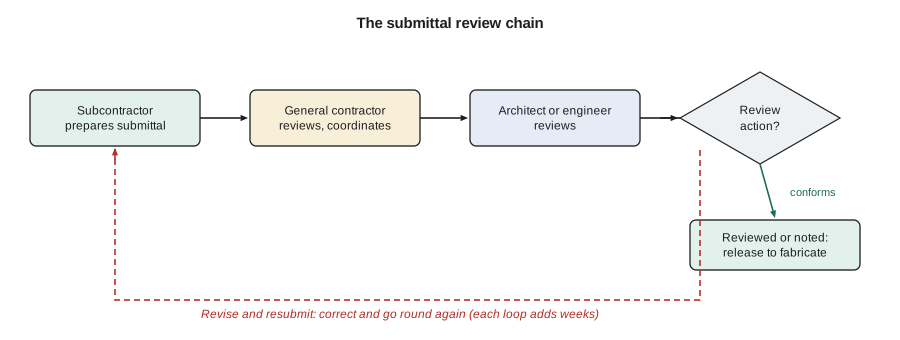
| Review action | Meaning | Next step |
|---|---|---|
| Reviewed (no exceptions) | Conforms with the design intent | Proceed with fabrication |
| Reviewed as noted | Conforms if the noted corrections are made | Proceed, incorporating the notes; resubmit only if required |
| Revise and resubmit | Does not yet conform; corrections needed | Correct and resubmit; do not fabricate |
| Rejected | Does not conform or wrong product | Start again with a compliant submittal |
The general contractor's review is not a formality. Under the standard prime contract forms, the contractor must review submittals for compliance and coordination before passing them on, and the consultant's review does not relieve the contractor of responsibility for errors or deviations it did not clearly flag. A contractor that stamps and forwards everything unread loses time when the consultant rejects obvious errors, and may carry the cost when a deviation slips through.
Planning submittal durations
The procurement schedule in Lesson 2 assumed a fixed number of review cycles. In reality, some submittals are approved first time and some need two or three rounds. Using the expected number of cycles, based on experience with the trade and consultant, gives a more realistic plan.
# Expected submittal duration with resubmittals (weeks)
prep, gc_review, consultant_review, revise = 3, 1, 2, 1.5
p_resubmit = 0.40          # chance a submission comes back "revise and resubmit"
# expected number of consultant reviews with independent resubmittal chance per round
expected_rounds = 1 / (1 - p_resubmit)
first = prep + gc_review + consultant_review
each_extra = revise + gc_review + consultant_review
expected = first + (expected_rounds - 1) * each_extra
print(f"Expected review rounds: {expected_rounds:.2f}")
print(f"First submission cycle: {first} weeks")
print(f"Expected total duration: {expected:.1f} weeks")
for p in (0.2, 0.4, 0.6):
    r = 1 / (1 - p)
print(f" resubmittal chance {p:.0%}: {first + (r - 1) * each_extra:4.1f} weeks")Expected review rounds: 1.67 First submission cycle: 6 weeks Expected total duration: 9.0 weeks resubmittal chance 20%: 7.1 weeks resubmittal chance 40%: 9.0 weeks resubmittal chance 60%: 12.8 weeks
With a 40 % chance of resubmittal on each round, the expected duration is about 9 weeks instead of the 6 weeks a single cycle would suggest. For a complex delegated-design submittal such as curtain wall anchors, where first-time approval is less likely, the expected duration grows quickly. The planner should use these expected durations for long-lead packages, and the project team should work to make first-time approval more likely.
| Action | Effect on first-time approval |
|---|---|
| Pre-submittal meeting with the trade and consultant for complex packages | Clarifies expectations before drawings are prepared |
| General contractor review checklist for each submittal type | Catches incomplete or non-compliant submittals before the consultant sees them |
| Coordinated submittals (for example, mechanical and electrical for the same equipment together) | Avoids rejection because related information is missing |
| Submitting complete packages, not piecemeal | Consultants often refuse to review partial submittals |
| Tracking consultant review times and escalating overdue items | Keeps the owner's side to its contractual review period |
The submittal register and its metrics
The submittal register lists every required submittal with its specification section, responsible package, required date, submitted date, review status and returned date. Its value lies in the reports it produces.
# Submittal register summary for Larch Street at week 14 (illustrative)
import statistics
register = [  # (id, package, required_wk, submitted_wk or None, returned_wk or None, action)
    ("03 20 00-01", "Rebar",       4,  3,    5,    "reviewed"),
    ("08 44 13-01", "Windows",     9,  10,   13,   "revise"),
    ("08 44 13-02", "Windows",     14, None, None, None),
    ("14 21 00-01", "Elevators",   8,  8,    11,   "noted"),
    ("23 74 13-01", "Mechanical",  10, 12,   None, None),
    ("26 24 13-01", "Electrical",  6,  6,    9,    "noted"),
    ("07 54 00-01", "Roofing",     12, 11,   13,   "reviewed"),
    ("09 21 16-01", "Drywall",     16, None, None, None),
]
now = 14
overdue_to_submit = [r[0] for r in register if r[3] is None and r[2] < now]
in_review = [r[0] for r in register if r[3] is not None and r[4] is None]
returned = [r for r in register if r[4] is not None]
cycle = [r[4] - r[3] for r in returned]
first_time = sum(1 for r in returned if r[5] in ("reviewed", "noted")) / len(returned)
late = sum(1 for r in register if r[3] is not None and r[3] > r[2])
print("Overdue to submit:", overdue_to_submit or "none")
print("In review:", in_review)
print(f"Average review turnaround: {statistics.mean(cycle):.1f} weeks")
print(f"First-time approval rate: {first_time:.0%}")
print(f"Submitted late: {late} of {sum(1 for r in register if r[3] is not None)}")Overdue to submit: none In review: ['23 74 13-01'] Average review turnaround: 2.6 weeks First-time approval rate: 80% Submitted late: 2 of 6
The summary shows one window submittal returned for revision, one mechanical submittal still in review two weeks after submission, and two submittals that went in late. The average turnaround of about 2.6 weeks exceeds the two weeks the prime contract allows the consultant, a point the project manager should raise at the next owner meeting. The first-time approval rate of 80 % is reasonable, but the one failure is on a long-lead package, which is exactly where it hurts.
Substitutions
Subcontractors and suppliers often propose products other than those specified, to save cost, shorten lead time or use a product they know. The prime contract usually sets a formal substitution procedure: a written request, before a stated deadline, showing that the proposed product is equal in performance and quality, with any cost or time effect, and with the design team's acceptance. A substitution slipped into a submittal without a formal request is a common source of disputes, rejected submittals and lost time. When a lead-time crisis makes a substitution attractive (for example, a different switchgear manufacturer with a 20-week shorter lead time), the contractor should raise it with the owner and design team early, as a formal request, with the schedule benefit quantified.
Long-lead items: from approval to delivery
For long-lead equipment, approval is only the middle of the story. After approval, the supplier must receive a release for fabrication, schedule production, manufacture, test and ship. Each step is a milestone the contractor should track, because a slip anywhere moves the delivery date.
| Milestone | Who controls it | Early signs of trouble |
|---|---|---|
| Purchase order issued | Contractor | Commercial terms still open |
| Submittal submitted and approved | Supplier and consultant | Resubmittals, coordination with other trades outstanding |
| Release for fabrication | Contractor | Waiting for final field dimensions or owner decisions |
| Production slot confirmed | Manufacturer | Slot not confirmed in writing; supplier vague about dates |
| Fabrication start and finish | Manufacturer | Component shortages, factory backlog |
| Factory testing and inspection | Manufacturer, sometimes witnessed | Test failures, witness scheduling |
| Shipping and delivery | Supplier or carrier | Oversize permits, crane and site readiness |
# Switchgear milestone tracker: planned versus forecast (weeks after award)
milestones = [
    ("PO issued",                 1,  1),
    ("Submittal approved",        8, 10),
    ("Released for fabrication",  9, 11),
    ("Production slot confirmed",10, 13),
    ("Fabrication complete",     49, 52),
    ("Factory test",             51, 54),
    ("Delivered to site",        54, 57),
]
need_by = 56
for name, plan, fc in milestones:
    print(f"{name:26} plan wk {plan:2}  forecast wk {fc:2}  slip {fc - plan:+d}")
slip = milestones[-1][2] - need_by
print(f"Delivery vs need-by (wk {need_by}): {'late by' if slip > 0 else 'early by'} {abs(slip)} week(s)")PO issued plan wk 1 forecast wk 1 slip +0 Submittal approved plan wk 8 forecast wk 10 slip +2 Released for fabrication plan wk 9 forecast wk 11 slip +2 Production slot confirmed plan wk 10 forecast wk 13 slip +3 Fabrication complete plan wk 49 forecast wk 52 slip +3 Factory test plan wk 51 forecast wk 54 slip +3 Delivered to site plan wk 54 forecast wk 57 slip +3 Delivery vs need-by (wk 56): late by 1 week(s)
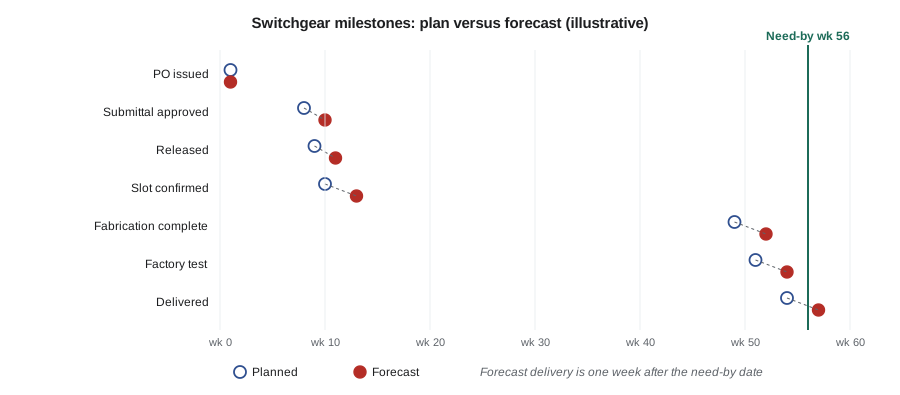
The tracker shows a two-week slip at submittal approval growing to three weeks because the production slot was not confirmed promptly. The forecast delivery is now a week after the need-by date. Without action, energization and everything after it moves. The project manager has three types of response: recover time in the supply chain (expediting), protect the site schedule (resequencing, temporary power), or both.
Expediting: when is it worth paying?
Expediting means actively working to protect or recover delivery dates: regular calls and site visits to the manufacturer, insisting on written production schedules, paying for overtime or priority production, or switching to faster freight. Some of these cost money, and the decision should compare the cost of expediting with the cost of the delay it avoids.
Worked problem
Paying for priority production
The switchgear manufacturer offers to recover two weeks by moving Halyard's order up the production line for a premium of $28,000. A one-week late delivery would delay energization and permanent heat, costing about $15,000 a week in extended general conditions and temporary power, plus a possible $4,000 per day of liquidated damages if the delay reaches the end date. The schedule has no float after energization. Should Halyard pay?
Show solution
- Delay avoided: one week (forecast is one week late); the second week recovered becomes float.
- Cost of one week of delay: $15,000 + up to 7 × $4,000 = $43,000 if the delay carries through to completion.
- Premium: $28,000.
Answer: Paying is justified if there is a reasonable chance the delay would carry to completion; even the general conditions alone ($15,000) plus a modest chance of damages make the premium close to break-even, and the extra week of float has value against other risks. Halyard should also ask whether the owner, whose late consultant review contributed to the slip, will share the cost.
Good expediting is mostly unglamorous: confirming production slots in writing, asking for weekly status reports, visiting the factory for critical items, and keeping the site ready so that equipment can be received when it arrives. The single most effective expediting step is often internal: making sure the contractor itself releases for fabrication promptly once approval is received.
Common mistakes
MistakeBuilding the submittal register late or incompletely.
InsteadExtract every submittal requirement from the specifications immediately after award.
MistakeForwarding submittals to the consultant without review.
InsteadCheck compliance and coordination first; consultant review does not relieve the contractor.
MistakePlanning for one review cycle on complex packages.
InsteadUse expected durations that allow for resubmittals based on experience.
MistakeSlipping substitutions into submittals.
InsteadUse the formal substitution procedure with evidence of equivalence and the cost and time effect.
MistakeTreating approval as the end of procurement.
InsteadTrack release, production slot, fabrication, testing and shipping through to delivery.
MistakeExpediting by instinct.
InsteadCompare the cost of expediting with the cost of the delay it avoids.
Summary and key terms
- Submittals include shop drawings, product data, samples, mock-ups, delegated design, certificates and closeout documents.
- The submittal register, built from the specifications, assigns each submittal to a package and a required date.
- Submittals pass from the trade to the general contractor to the consultant and back; the contractor must review for compliance and coordination.
- Expected durations should allow for resubmittals; first-time approval can be improved by pre-submittal meetings, checklists and complete submissions.
- Register metrics such as overdue items, review turnaround and first-time approval rate guide action.
- Substitutions need a formal request showing equivalence and the cost and time effect.
- Long-lead items need milestone tracking after approval, and expediting decisions should compare cost with delay avoided.
- Submittal
- Information a trade or supplier provides for review before fabrication or installation.
- Shop drawings
- Drawings prepared by a trade showing how it will fabricate and install its work.
- Product data
- Manufacturer's published information about a product.
- Mock-up
- A full-size sample assembly used to approve appearance and performance.
- Delegated design
- Design responsibility assigned by the specification to a trade's engineer.
- Submittal register
- A log of all required submittals with dates and status.
- Revise and resubmit
- A review action requiring correction before fabrication.
- Substitution
- A product proposed in place of one specified.
- Release for fabrication
- The contractor's instruction to a supplier to start manufacturing.
- Expediting
- Actively managing suppliers to protect or recover delivery dates.
Practice problems
Work each problem on paper first, then reveal the answer to check.
Name four types of submittal.
Show answer
Shop drawings, product data, samples, mock-ups, delegated design, certificates, closeout documents.
Where are submittal requirements found?
Show answer
In the submittal articles of each specification section and in Division 01.
What does 'reviewed as noted' mean?
Show answer
The submittal conforms if the noted corrections are made; fabrication can proceed with them.
Why must the contractor review submittals before forwarding them?
Show answer
Contract forms require it, consultant review does not relieve the contractor, and it avoids rejections.
With a 50 % resubmittal chance per round, how many review rounds are expected?
Show answer
1 ÷ (1 − 0.5) = 2 rounds.
First cycle 6 weeks, each extra round 4 weeks, resubmittal chance 25 %. What is the expected duration?
Show answer
Expected rounds 1.33; 6 + 0.33 × 4 ≈ 7.3 weeks.
Give three ways to improve first-time approval.
Show answer
Pre-submittal meetings, a contractor review checklist, coordinated and complete submissions.
What should a substitution request include?
Show answer
Evidence of equivalent performance and quality, the cost and time effect, submitted before the deadline.
List four long-lead milestones after submittal approval.
Show answer
Release for fabrication, production slot confirmed, fabrication complete, factory test, delivery.
An expediting premium is $20,000; it avoids one week of delay costing $12,000 in general conditions with a 50 % chance of $35,000 in damages. Is it worth paying?
Show answer
Expected cost of delay = 12,000 + 17,500 = $29,500 > $20,000, so yes.
Lesson quiz · 5 questions
Score 60% or more to complete this lesson.
Create a free account to save your progress, take quizzes and earn a certificate.