
CON-330 · Lesson 4 of 12 · 28 min
Selecting and awarding subcontracts and supply
Once bidders are prequalified, the contractor invites prices, compares them on a like-for-like basis, confirms that the preferred bidder understands and has priced the whole scope, negotiates any remaining points, and awards. CON-300 covered how estimators level subcontractor quotes on bid day, when the contractor is building its own price for the owner. After award the situation is different: there is more time, the scope is fixed by the contract documents, and the contractor's own money is now at stake. This lesson covers the post-award selection process, from the invitation to bid to the award letter.
The invitation to bid
The invitation to bid (also called a request for quotation or bid package) tells prequalified firms exactly what to price and how. A clear package produces comparable bids; a vague one produces bids that cannot be compared and scopes that will be argued about later.
| Item in the bid package | Why it matters |
|---|---|
| Scope of work narrative and specification sections | Defines the package; cross-referenced to the responsibility matrix |
| Drawings list with revision numbers | Everyone prices the same issue of the drawings |
| Responsibility matrix | Settles commonly disputed items before pricing |
| Schedule: milestones, durations, need-by dates | Bidders price the crew size and overtime the schedule demands |
| Subcontract form and key terms | Bidders price the risk they will carry; exceptions surface early |
| Insurance and bonding requirements | Bidders include the cost and confirm they can comply |
| Site logistics: access, hoisting, laydown, parking | Avoids extras for hoisting or storage later |
| Bid form with unit prices, alternates and separate prices | Makes bids comparable and gives prices for likely changes |
| Owner and public requirements | Domestic content, wage rules, social procurement, approved products (Lesson 10) |
| Bid due date, questions deadline and contact | Fair, consistent process |
A bid form with a mandatory breakdown is one of the most useful tools. Asking every bidder for the same line items (for example, for windows: supply, installation, sealants, mock-up, shop drawings and engineering, and the price of each alternate) turns a single lump sum into something the contractor can compare and later use to value changes.
Managing the bid period
During the bid period, bidders ask questions and the contractor issues clarifications. Two rules keep the process fair and the bids comparable. First, answers that change or clarify scope go to every bidder in writing, as an addendum to the bid package, not to the one firm that asked. Second, the deadline is the deadline for everyone: a contractor that accepts one late bid, or lets one bidder revise after seeing others, invites complaints and, on public projects, possible challenges.
The bid period must be long enough for bidders to obtain their own supplier quotes. For complex packages such as mechanical, electrical or curtain wall, two to three weeks is common; for simple packages, one week may be enough. Shortening it to recover schedule (Lesson 2) is possible but usually reduces the number of bidders and the quality of their pricing.
Leveling the bids
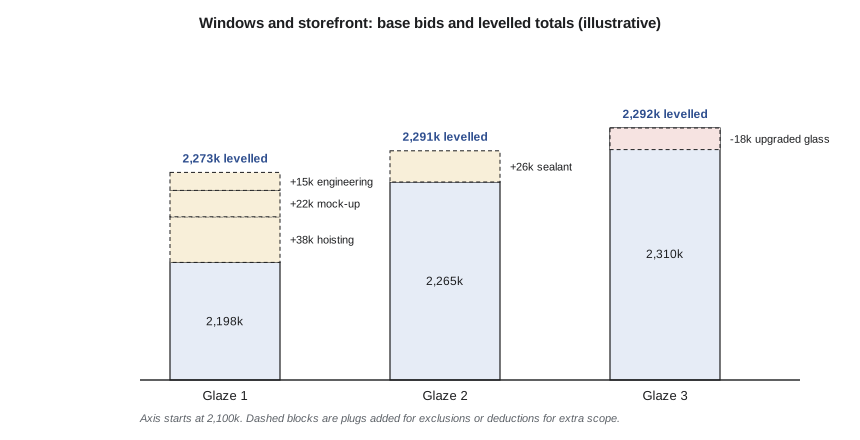
Bids rarely arrive on the same basis. One bidder excludes hoisting, another includes it; one prices an alternate product, another qualifies its price as valid for 30 days. Leveling adjusts each bid to the same complete scope, usually by adding a plug value for anything a bidder excluded and deducting anything it added that is not required. CON-300 covers the method in detail; the post-award version is the same but with more time to confirm each adjustment with the bidders themselves.
# Adjusting the Larch Street windows and storefront bids (illustrative)
base = {"Glaze 1": 2_198_000, "Glaze 2": 2_265_000, "Glaze 3": 2_310_000}
# adjustments: positive = add for an exclusion, negative = deduct for added scope
adjust = {
    "Glaze 1": {"hoisting excluded": 38_000, "mock-up excluded": 22_000, "engineering stamp excluded": 15_000},
    "Glaze 2": {"sealant at cladding interface excluded": 26_000},
    "Glaze 3": {"upgraded glass not required": -18_000},
}
for b in base:
    total = base[b] + sum(adjust[b].values())
    print(f"{b}: base {base[b]:,}  adjustments {sum(adjust[b].values()):+,}  adjusted {total:,}")
adjusted = {b: base[b] + sum(adjust[b].values()) for b in base}
low = min(adjusted, key=adjusted.get)
print("Lowest bid after adjustment:", low, f"{adjusted[low]:,}")Glaze 1: base 2,198,000 adjustments +75,000 adjusted 2,273,000 Glaze 2: base 2,265,000 adjustments +26,000 adjusted 2,291,000 Glaze 3: base 2,310,000 adjustments -18,000 adjusted 2,292,000 Lowest bid after adjustment: Glaze 1 2,273,000
After leveling, the apparent lead of Glaze 1 shrinks from $67,000 to $18,000 over Glaze 2, and the order could change again once the plugs are confirmed. A plug is the contractor's estimate of what an excluded item will cost; if Glaze 1 can include hoisting for less than $38,000, its leveled price falls. This is why the next step, the scope review, matters.
The scope review meeting
Before award, the project manager meets the preferred bidder (and often the second bidder) to walk through the scope line by line. The purpose is not to reopen the price but to make sure the bidder has priced exactly what the contract documents and the responsibility matrix require, understands the schedule and site conditions, and accepts the subcontract terms. Problems found here can be fixed by clarifying scope or adjusting the price before anyone is committed.
| Topic | Questions to settle |
|---|---|
| Scope | Walk the responsibility matrix: is each item included? Any exclusions or qualifications in the bid? |
| Drawings and addenda | Which drawing revisions and addenda were priced? |
| Products | Are named products and approved alternates priced? Any substitutions proposed? |
| Schedule | Can the firm meet the milestones and crew sizes? Who are the project manager and foreman? |
| Submittals and long-lead items | Submittal durations, fabrication lead times, any items needing early release |
| Site logistics | Hoisting, storage, access, temporary services and clean-up |
| Terms | Exceptions to the subcontract form, insurance, bonds, payment terms, warranties |
| Price validity and escalation | How long is the price firm? Any escalation clauses? (Lesson 8) |
The outcome is written scope review minutes, signed by both parties and attached to the subcontract. They record each clarification and its effect on price, so that the subcontract scope matches what was actually agreed. Verbal assurances that are not written down tend to be forgotten by the time the work starts.
Worked problem
Turning a scope review into a price
At the scope review, Glaze 1 agrees to include hoisting for $24,000 (not the $38,000 plug) and the mock-up for $22,000, and confirms that its glass supplier provides stamped engineering at no extra cost. What is its final price, and how does it compare with Glaze 2's leveled price of $2,291,000?
Show solution
- Base bid: $2,198,000.
- Add hoisting $24,000 and mock-up $22,000; engineering stamp is now included: $0.
- Final price: 2,198,000 + 24,000 + 22,000 = $2,244,000.
- Saving against Glaze 2: 2,291,000 − 2,244,000 = $47,000.
Answer: Confirming the plugs with the bidder turned an $18,000 leveled advantage into a $47,000 confirmed advantage on a complete scope. The minutes record each item so that the subcontract scope includes hoisting, the mock-up and stamped engineering.
Negotiation without bid shopping
Contractors legitimately negotiate after bids close, but there is a line between negotiating and bid shopping. Discussing scope, alternates, schedule, payment terms or value engineering ideas with a bidder is fair. Telling a bidder what a competitor bid, or implying a lower price exists that does not, is not. A practical test: would you be comfortable if every bidder saw a transcript of the conversation?
| Fair negotiation | Bid shopping |
|---|---|
| "Can you include hoisting? What would it cost?" | "Bidder X is $40,000 lower; can you match it?" |
| "Would a different glass supplier with the same performance reduce your price?" | "We need you to drop 5 % or we go elsewhere," with no scope change |
| "If we pay within 30 days instead of 45, what is the effect on price?" | Inviting new bidders after the close to undercut the low bid |
| Asking for the price of an alternate the owner may accept | Sharing a competitor's breakdown or methods |
In the US, many public owners require bidders to list major subcontractors in the prime bid, and state listing laws (for example, California's Subletting and Subcontracting Fair Practices Act) restrict substituting a listed subcontractor after award without the owner's consent and a statutory reason. Bid shopping a listed subcontractor's price is therefore both bad practice and, on such projects, potentially unlawful (CON-220).
Choosing: lowest compliant price or best value
Most contractors award subcontracts to the lowest compliant leveled bid among prequalified firms. Prequalification has already screened out firms the contractor would not hire, so the remaining firms are all acceptable, and price decides. For packages where non-price factors differ materially among acceptable firms (schedule capability, key staff, design input on a design-assist package), a best-value method weighs them explicitly.
# Best-value selection for a design-assist mechanical package on another project (scores out of 100)
bids = {"Mech 1": 5_812_000, "Mech 3": 5_905_000}
non_price = {"Mech 1": 72, "Mech 3": 86}   # team, schedule plan, design-assist approach
w_price, w_tech = 0.6, 0.4
low = min(bids.values())
for b in bids:
    price_score = 100 * low / bids[b]       # lowest price scores 100
    total = w_price * price_score + w_tech * non_price[b]
print(f"{b}: price score {price_score:5.1f} technical {non_price[b]} total {total:5.1f}")Mech 1: price score 100.0 technical 72 total 88.8 Mech 3: price score 98.4 technical 86 total 93.5
Consider a design-assist mechanical package on a different Halyard project, a clinic where the mechanical trade helps develop the design. With a 60 % weight on price, Mech 3's stronger technical score outweighs its 1.6 % higher price, and Halyard would award to Mech 3 and record why. On Larch Street, a conventional package fully designed by the engineer, Halyard awarded mechanical to the lowest compliant bidder, Mech 1, at $5,812,000. Best-value methods are useful but easy to misuse: the weights and scoring criteria must be set before bids are opened and applied consistently, or the method becomes a way to justify a decision already made.
Awarding: letters of intent and subcontracts
The award is complete only when the subcontract is signed. Schedules sometimes push contractors to let a trade start, order material or prepare shop drawings before the subcontract is finalized. The usual instrument is a letter of intent (LOI) authorizing limited work up to a stated dollar cap and time. LOIs are useful but risky: if the subcontract is never signed, the parties may find themselves bound by the LOI's few terms, or arguing about whether a contract exists at all.
| Good letter-of-intent practice | Why |
|---|---|
| State exactly what work is authorized (for example, shop drawings and a production slot) | Limits commitment to what the schedule truly needs |
| Set a dollar cap and an expiry date | Caps exposure if the subcontract is not concluded |
| Say which terms apply in the meantime (for example, the attached subcontract form) | Avoids a contract on unknown terms |
| Require insurance before any site work | No uninsured trades on site |
| Set a target date to sign the subcontract and follow up | LOIs that drift become the contract by default |
Worked problem
Sizing an LOI cap
Halyard wants Glaze 1 to start shop drawings and reserve a fabrication slot while the subcontract is finalized. Shop drawings and engineering are worth about $45,000, and the glass supplier requires a non-refundable deposit of 10 % on glass worth $640,000 to hold the slot. What cap should the LOI carry?
Show solution
- Shop drawings and engineering: $45,000.
- Glass deposit: 0.10 × 640,000 = $64,000.
- Cap: about $109,000, plus a small allowance, say $115,000, with a 30-day expiry.
Answer: The cap matches the work and deposit genuinely needed now, not the whole subcontract value. If negotiations failed, Halyard's exposure would be about $115,000, against a package worth over $2.2 million.
When the award is made, the contractor should also notify unsuccessful bidders promptly and courteously. Many contractors share the rank or the range of bids without revealing competitors' prices; this helps bidders improve and keeps them willing to bid next time.
Common mistakes
MistakeAnswering one bidder's scope question privately.
InsteadIssue scope clarifications to all bidders as written addenda.
MistakeComparing base bids without leveling.
InsteadAdjust every bid to the same complete scope, then confirm plugs with the bidders.
MistakeHolding a scope review without written minutes.
InsteadRecord each clarification and its price effect, sign the minutes and attach them to the subcontract.
MistakeTelling a bidder a competitor's price.
InsteadNegotiate on scope, alternates, schedule and terms, never on leaked numbers.
MistakeLetting a letter of intent become the contract.
InsteadCap it, limit its scope, set an expiry and sign the subcontract quickly.
MistakeInventing best-value weights after bids are opened.
InsteadSet criteria and weights in advance and apply them consistently.
Summary and key terms
- A clear invitation to bid with a mandatory breakdown produces comparable bids.
- Scope clarifications during bidding go to all bidders in writing; deadlines apply to everyone.
- Leveling adjusts bids to the same complete scope with plugs for exclusions; post-award, plugs are confirmed with the bidders.
- The scope review meeting confirms the preferred bidder has priced the whole scope, schedule and terms, and is documented in signed minutes.
- Negotiating on scope and terms is fair; disclosing competitors' prices is bid shopping.
- Most awards go to the lowest compliant leveled bid among prequalified firms; best value suits packages where non-price factors differ materially.
- Letters of intent should be capped, limited and short-lived; the award is complete only when the subcontract is signed.
- Invitation to bid
- The package sent to prequalified firms setting out what to price and how.
- Addendum
- A written change or clarification to bid documents issued to all bidders.
- Leveling
- Adjusting bids to a common, complete scope so they can be compared.
- Plug
- The contractor's estimate of the cost of an item a bidder excluded.
- Scope review
- A meeting with the preferred bidder to confirm its price covers the full scope and terms.
- Qualification
- A condition or limitation a bidder attaches to its price.
- Best value
- Selection combining price and non-price factors with predetermined weights.
- Letter of intent
- A document authorizing limited work before the subcontract is signed.
- Alternate
- A priced option the owner or contractor may choose to add or deduct.
- Design-assist
- A package where the trade helps develop the design before or during construction.
Practice problems
Work each problem on paper first, then reveal the answer to check.
Why include a mandatory price breakdown in the bid form?
Show answer
To make bids comparable and to give prices useful for valuing changes later.
A bidder asks whether firestopping is included. How should the answer be issued?
Show answer
As a written addendum to all bidders.
Base bids are $1,200,000 and $1,236,000; the lower excludes cleaning worth $18,000 and scaffolding worth $25,000. Which is lower after leveling?
Show answer
1,200,000 + 43,000 = $1,243,000, so the second bid ($1,236,000) is lower.
What is the purpose of a scope review?
Show answer
To confirm the preferred bidder has priced the complete scope, schedule and terms before award.
Give one example of fair negotiation and one of bid shopping.
Show answer
Fair: asking the price of including hoisting. Bid shopping: telling a bidder a competitor is $40,000 lower.
When is best value more appropriate than lowest compliant price?
Show answer
When non-price factors such as team, schedule or design input differ materially among acceptable firms.
Price weight 0.7, technical 0.3. Bid A is lowest with technical 70; bid B is 2 % higher with technical 90. Which scores higher?
Show answer
A: 70 + 21 = 91.0. B: 0.7 × 98.0 + 27 = 95.6. Bid B scores higher.
Name three features of a safe letter of intent.
Show answer
Defined authorized work, a dollar cap, an expiry date, stated interim terms, insurance before site work.
Shop drawings cost $30,000 and a 15 % deposit on $400,000 of material is needed. What LOI cap is reasonable?
Show answer
About $90,000 (30,000 + 60,000), with a small allowance.
Why notify unsuccessful bidders promptly?
Show answer
Courtesy and fairness keep them willing to bid on future work.
Lesson quiz · 5 questions
Score 60% or more to complete this lesson.
Create a free account to save your progress, take quizzes and earn a certificate.