
CON-340 · Lesson 2 of 12 · 28 min
Design-bid-build
Design-bid-build is the method most people picture when they think of construction: an owner hires an architect or engineer to design the project completely, invites contractors to bid on the finished documents, and awards the contract to the lowest responsive and responsible bidder, who then builds what was drawn. It remains the most common delivery method for public work in both countries and the default for many private owners. It is also the baseline against which every other method is measured. Understanding why it works where it works, and why it fails where it fails, is the foundation for the rest of this course.
How design-bid-build is organized
In design-bid-build the owner holds two separate contracts: one with the design consultant (often an architect leading a team of engineering subconsultants) and one with the general contractor. The designer and the contractor have no contract with each other. They communicate through the owner's contract administration process, usually with the designer acting as the owner's representative during construction: reviewing shop drawings, answering requests for information, certifying payment and deciding on changes within the limits the owner sets.
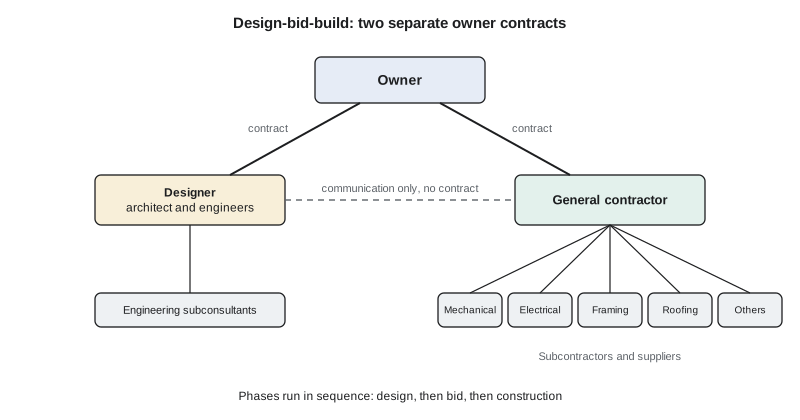
The project moves through three phases in sequence. First, design: pre-design and programming, schematic design, design development and construction documents, with cost estimates by the designer or a cost consultant at each stage. Second, procurement: the owner advertises or invites bids, answers questions by addenda, receives sealed bids at a set time, opens them, checks responsiveness and awards. Third, construction: the contractor mobilizes, builds, and hands over, with the designer administering the contract.
| Phase | Typical share of total time | Main owner decisions | Main contractor role |
|---|---|---|---|
| Design (to 100 % construction documents) | 30 to 40 % | Program, budget, design approvals, scope cuts | None (contractor not yet hired) |
| Bid and award | 5 to 10 % | Bidder list or open advertisement, addenda, award | Estimate and bid in a few weeks |
| Construction and closeout | 50 to 60 % | Changes, payment, acceptance | Build to the documents, manage subcontractors |
Why owners choose it
Design-bid-build has lasted because it does several things very well.
| Strength | Why it matters |
|---|---|
| Open, simple competition on price | Public owners can show taxpayers that work was awarded fairly to the lowest qualified bidder. |
| Owner control of design | The owner and its designer settle every detail before construction, with no builder influence on choices. |
| A firm price on complete documents | Bids are lump sums for defined work, so the owner knows its committed cost before construction starts. |
| Well understood roles and forms | Courts, contractors, sureties and designers have decades of experience with the method and its standard contracts. |
| Access for smaller contractors | Projects can be split into manageable lump-sum contracts that local firms can bid. |
For straightforward, well-defined projects, such as a typical school, a road resurfacing job, a fire hall or a warehouse, these strengths often outweigh everything else. There is little that construction input during design could add, the market is competitive, and the documents can be completed with confidence.
Why it fails
The weaknesses of design-bid-build come from the same sequential structure that gives it its strengths.
| Weakness | What happens |
|---|---|
| No builder input during design | Constructability problems, unrealistic sequences and expensive details are found only after bids, when changing them costs more. |
| Slow | Construction cannot start until design and bidding are complete; no overlap is possible within one contract. |
| Price is known only at bid opening | If bids come in over budget, the owner must redesign and rebid, losing months. |
| Owner carries design risk | Errors and omissions in the documents become change orders the owner pays, and claims follow. |
| Adversarial incentives | The low bidder may have missed scope and look to recover margin through changes and claims. |
| Fragmented responsibility | When something goes wrong, the designer and contractor can each blame the other, with the owner in the middle. |
The most damaging of these is the combination of owner design risk and low-bid pricing. A contractor who wins on price has every reason to price only what is shown and to treat every gap, conflict or ambiguity in the documents as a change. Owners commonly budget a construction contingency of 5 to 10 % of the contract for changes on new buildings and more on renovations, and change orders on public design-bid-build projects frequently consume much of that. Whether that is a weakness of the method or of the documents is a fair question; with excellent, well-coordinated documents, design-bid-build change rates can be low.
In the United States the owner's responsibility for its design is reinforced by the Spearin doctrine, from United States v. Spearin (1918): an owner who provides plans and specifications impliedly warrants that a contractor who follows them will produce an adequate result. Disclaimers can narrow the warranty in some states, but the principle still shapes how design risk sits with the owner in design-bid-build. CON-220 covers implied warranties and differing site conditions clauses.
The bid: responsive and responsible
Public design-bid-build awards usually go to the lowest bidder who is both responsive and responsible. A responsive bid conforms to the bid documents in all material respects: it is on the required form, signed, on time, includes the bid security and any required lists, and does not qualify or change the terms. A responsible bidder is one capable of performing: it has the experience, financial capacity, bonding, safety record and integrity required. Responsiveness is judged on the face of the bid at opening; responsibility may be investigated afterwards. CON-300 lesson 10 covers bid day and bid submission from the contractor's side, including bid bonds, mistakes in bids and Canadian bid depositories.
Worked problem
Evaluating a bid tabulation
The City of Alder Bay (an invented municipality) opens five bids for a $46 million aquatic and recreation center: Bidder A $44,980,000; B $45,620,000; C $46,150,000; D $47,300,000; E $49,900,000. Bidder A omitted the required bid bond. Bidder B is responsive and has the required bonding and experience. The designer's pre-tender estimate was $46,400,000. Which bid should the city award, and how does it compare with the estimate?
Show solution
- Bidder A is non-responsive because the bid security is missing, a material requirement in nearly all public tenders; it cannot be accepted.
- Bidder B is the lowest responsive bid at $45,620,000; the city confirms responsibility (experience, bonding, safety, references).
- Compared with the estimate: 45,620,000 − 46,400,000 = −$780,000, or about 1.7 % under.
- The spread between the lowest and highest responsive bids (B to E) is about 9 %, a normal range for a competitive building market.
Answer: Award to Bidder B at $45,620,000, about 1.7 % below the pre-tender estimate.
# Bid tabulation analysis for the Alder Bay aquatic facility (illustrative)
estimate = 46_400_000
bids = {"A": (44_980_000, False), "B": (45_620_000, True), "C": (46_150_000, True),
        "D": (47_300_000, True), "E": (49_900_000, True)}   # (amount, responsive?)
ok = {k: v for k, (v, r) in bids.items() if r}
low = min(ok, key=ok.get)
vals = sorted(ok.values())
print("Lowest responsive bidder:", low, f"{ok[low]:,}")
print(f"Versus estimate: {ok[low] - estimate:+,} ({(ok[low] - estimate) / estimate:+.1%})")
print(f"Spread low to high (responsive): {(vals[-1] - vals[0]) / vals[0]:.1%}")
print(f"Gap to second responsive bid ('money left on the table'): {vals[1] - vals[0]:,}")
mean = sum(vals) / len(vals)
print(f"Mean responsive bid: {mean:,.0f}; low bid is {(mean - vals[0]) / mean:.1%} below the mean")Lowest responsive bidder: B 45,620,000
Versus estimate: -780,000 (-1.7%)
Spread low to high (responsive): 9.4%
Gap to second responsive bid ('money left on the table'): 530,000
Mean responsive bid: 47,242,500; low bid is 3.4% below the meanThe gap between the lowest and second-lowest bids, often called "money left on the table", is watched closely by contractors. A large gap can signal that the low bidder missed something, which is exactly the situation that leads to aggressive change-order behavior later. Some owners review a bid that is far below the others with the bidder, within the limits their tendering rules allow, before awarding.
Change orders and the real final cost
The contract price in design-bid-build is not the final cost. Owner changes, design errors and omissions, unforeseen conditions and regulatory changes all add to it. A useful owner discipline is to track change orders by cause, because the causes tell you whether the problem is the method, the documents, the site or the owner's own decision-making.
# Change order growth on the Alder Bay aquatic facility at completion (illustrative)
contract = 45_620_000
changes = {   # cause: approved change order value
    "Design errors and omissions":     1_210_000,
    "Owner-requested scope changes":     860_000,
    "Unforeseen site conditions":        540_000,
    "Code or authority requirements":    180_000,
    "Value engineering credits":        -310_000,
}
total = sum(changes.values())
for cause, v in changes.items():
    print(f"{cause:32} {v:>+11,}  {v / contract:+.1%}")
print(f"Net change orders {total:+,} = {total / contract:.1%} of contract")
print(f"Final contract value {contract + total:,}")
contingency = 0.07 * contract
print(f"7 % owner contingency {contingency:,.0f}; remaining {contingency - total:,.0f}")Design errors and omissions +1,210,000 +2.7% Owner-requested scope changes +860,000 +1.9% Unforeseen site conditions +540,000 +1.2% Code or authority requirements +180,000 +0.4% Value engineering credits -310,000 -0.7% Net change orders +2,480,000 = 5.4% of contract Final contract value 48,100,000 7 % owner contingency 3,193,400; remaining 713,400
Here net changes reached about 5.5 % of the contract, inside a 7 % contingency. The largest single cause was design errors and omissions, about 2.7 %. That is the cost the owner bears because, in design-bid-build, it stands behind its designer's documents. The owner may be able to recover part of it from the designer if the errors fell below the professional standard of care, but recovery is rarely complete and always slow.
Multiple-prime contracting
A variant of design-bid-build has the owner award several separate prime contracts, for example general construction, mechanical, electrical and site work, instead of one general contract. The owner, or a construction manager acting as its agent (lesson 3), then coordinates the prime contractors. Multiple-prime contracting can widen competition and let owners buy directly from trades, but it moves the coordination risk to the owner.
In the United States, some states have required multiple prime contracts on public work. New York's Wicks Law, for example, requires separate prime contracts for plumbing, heating and ventilation, and electrical work on many public projects above set dollar thresholds, though the thresholds were raised and project labor agreements can provide exemptions. Several other states have repealed or relaxed similar rules.
Contracts used for design-bid-build
| Purpose | Canada | United States |
|---|---|---|
| Owner and contractor, stipulated price | CCDC 2-2020 Stipulated Price Contract | AIA A101-2017 with A201-2017 General Conditions; ConsensusDocs 200; EJCDC C-520 and C-700 for engineered projects |
| Owner and contractor, unit price | CCDC 4 Unit Price Contract | AIA A101 with unit price exhibit; EJCDC C-520 unit price |
| Owner and designer | RAIC Document Six (architects); ACEC/ Engineers Canada forms | AIA B101-2017; EJCDC E-500 |
| Contractor and subcontractor | CCDC 17 or CCA 1 (see CON-330) | AIA A401-2017; ConsensusDocs 750 |
Because design-bid-build has been the default for so long, its standard forms are the most mature and the most tested in the courts. That is a real advantage: parties know what the words mean.
Making design-bid-build work better
Owners who stay with design-bid-build, often because procurement rules leave little choice, can reduce its weaknesses. They can hire an independent constructability reviewer or a cost consultant during design; run peer reviews of documents at 50 % and 95 %; prequalify bidders to keep the field capable; use early works packages, such as site preparation or demolition, bid separately to start sooner; pre-purchase long-lead equipment and assign it to the contractor; use alternate prices in the bid form to manage the budget; and set a realistic contingency. Some public owners in both countries also use a best-value design-bid-build, in which bidders submit both a price and a short technical proposal, though most still award on price alone.
Worked problem
Alternate prices to protect the budget
The city's construction budget is $45,000,000. The base bid is $45,620,000. The bid form included three deductive alternates: (1) delete the outdoor splash pad, −$410,000; (2) substitute vinyl for porcelain tile in change rooms, −$185,000; (3) delete the second-floor fitness mezzanine fit-out, −$720,000. Alternates must be accepted in numerical order. Which alternates bring the contract within budget with the least scope loss?
Show solution
- Base bid exceeds the budget by 45,620,000 − 45,000,000 = $620,000.
- Accept alternate 1: 45,620,000 − 410,000 = $45,210,000, still $210,000 over.
- Accept alternate 2: 45,210,000 − 185,000 = $45,025,000, still $25,000 over.
- Accept alternate 3: 45,025,000 − 720,000 = $44,305,000, under budget.
Answer: All three alternates are needed, giving $44,305,000. Requiring numerical order prevents the owner from picking alternates to favor a particular bidder, but it can force more scope loss than is strictly needed.
Common mistakes
MistakeAwarding to the lowest price without checking responsiveness.
InsteadCheck the bid against every material requirement before considering price.
MistakeTreating the contract price as the final cost.
InsteadBudget a contingency and track change orders by cause.
MistakeIssuing incomplete documents to start sooner.
InsteadFinish and coordinate the documents, or choose a method designed for overlap.
MistakeIgnoring a bid far below the others.
InsteadReview an outlier low bid within the tendering rules; missed scope causes claims.
MistakeAssuming the contractor carries design risk.
InsteadIn design-bid-build the owner stands behind its designer's documents.
Summary and key terms
- Design-bid-build separates design and construction into two owner contracts and three sequential phases.
- It offers open price competition, full owner control of design and a firm price on complete documents.
- Its weaknesses are slow sequence, no builder input to design, owner design risk and adversarial incentives.
- Awards go to the lowest responsive and responsible bidder.
- Change orders, especially for design errors and omissions, make the final cost higher than the contract price.
- Multiple-prime variants shift coordination risk to the owner.
- Constructability review, early packages, pre-purchase, alternates and good documents improve the method.
- Design-bid-build
- Delivery in which the owner completes design, then bids and awards construction separately.
- Responsive bid
- A bid that conforms to the bid documents in all material respects.
- Responsible bidder
- A bidder capable of performing the contract.
- Bid tabulation
- A table comparing the bids received.
- Money left on the table
- The gap between the lowest and second-lowest bids.
- Change order
- A written amendment to the contract for a change in work, price or time.
- Deductive alternate
- A bid item that reduces the price if the owner deletes or substitutes work.
- Multiple-prime contracting
- Award of several separate prime contracts instead of one general contract.
- Constructability review
- Review of the design by construction experts to improve buildability.
- Bid documents
- The drawings, specifications, forms and instructions on which bids are prepared; also called tender documents.
Practice problems
Work each problem on paper first, then reveal the answer to check.
How many contracts does the owner hold in design-bid-build, and with whom?
Show answer
Two: the designer and the general contractor.
What makes a bid non-responsive?
Show answer
Failing to conform in a material respect, such as missing bid security, late delivery or qualifying the terms.
Bids of $12.4 million and $13.1 million are the two lowest. How much money was left on the table?
Show answer
$700,000.
Why does low-bid pricing combine badly with owner design risk?
Show answer
The low bidder prices only what is shown and treats gaps as changes the owner pays for.
A $20 million contract had net change orders of $1.3 million. What percentage is that?
Show answer
6.5 %.
Name two ways an owner can start construction sooner without leaving design-bid-build.
Show answer
Early works packages bid separately; pre-purchasing long-lead equipment.
Name the AIA owner-contractor agreement used for stipulated sum design-bid-build.
Show answer
AIA A101-2017 with A201-2017 general conditions.
What is multiple-prime contracting?
Show answer
The owner awards several separate prime contracts and coordinates them, instead of one general contract.
Why must deductive alternates often be accepted in order?
Show answer
To prevent the owner choosing alternates to favor a particular bidder.
Give one project type well suited to design-bid-build.
Show answer
A simple, well-defined building such as a fire hall, warehouse or standard school.
Lesson quiz · 5 questions
Score 60% or more to complete this lesson.
Create a free account to save your progress, take quizzes and earn a certificate.