
CON-340 · Lesson 8 of 12 · 29 min
Progressive and collaborative models
The traditional methods share one feature that troubled projects have exposed: the price is fixed early, often before the design is developed and before the risks are understood. On a straightforward project that is efficient. On a complex project, a hospital in a dense city, a subway under existing buildings, a treatment plant expansion while the old plant keeps running, it forces bidders to price risks they cannot see, encourages either inflated bids or under-priced bids followed by claims, and makes it hard to change course when new information emerges. Over the last decade owners in both countries have adopted a family of progressive and collaborative models that fix the price later, after the parties have developed the design and investigated the risks together.
This lesson draws together the progressive variants of the methods already covered and adds a few others: early contractor involvement, progressive P3s, target cost contracts and two-stage approaches. What they share is a development phase in which the owner pays for design and pricing work open book, followed by a commercial close at which a price or target is agreed, with an off-ramp if it is not.
The common structure
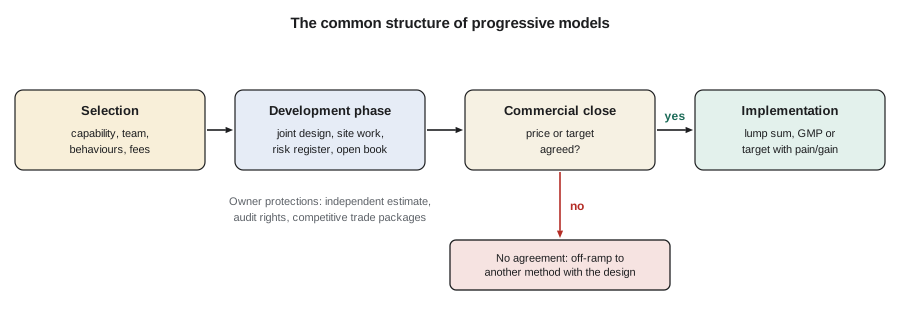
| Stage | What happens | Owner protections |
|---|---|---|
| Selection | Partner chosen on capability, approach, team, behaviors and fees for the development phase | Competitive evaluation of fees, rates and markups; workshops to test collaboration |
| Development phase | Joint design development, investigations, risk register, schedule and open-book estimate | Owner controls scope; independent cost estimate; audit rights |
| Commercial close | Parties agree a lump sum, GMP or target cost and the risk allocation | Benchmark against independent estimate; off-ramp if price is not acceptable |
| Implementation | Final design and construction (and maintenance, in a progressive P3) | Price mechanism, incentives, ongoing open book for target cost |
The trade-off is clear. The owner gives up competition on the construction price, which is the main protection design-bid-build provides, in exchange for a price based on much better information, fewer claims, and influence over how risks are managed. To protect itself, the owner competes the elements that can be competed at selection, such as fees, markups and labor rates, and benchmarks the eventual price.
Early contractor involvement
Early contractor involvement, or ECI, is the general idea of bringing the contractor in during design under a services agreement so that it can advise on constructability, sequencing, temporary works, staging and cost. CMAR and CM/GC are forms of ECI with a defined route to a construction price. In highway, rail and utility work, owners also use ECI agreements in which the contractor helps develop the design with the owner's engineer and then has the first opportunity to price the construction. If the price is acceptable, the contractor builds; if not, the owner can tender the work using the improved design.
Worked problem
Value of constructability input
During a 9-month ECI phase on a rail bridge replacement, the contractor proposes a launched steel girder instead of the reference design's cast-in-place concrete on falsework over a river, reducing in-water work from 14 months to 3 and the estimated cost from $86 million to $81.5 million. The ECI fee was $1.4 million. What is the net benefit if the price is accepted?
Show solution
- Construction saving: 86.0 − 81.5 = $4.5 million.
- Less ECI fee: 4.5 − 1.4 = $3.1 million net.
- Plus non-price benefits: 11 fewer months of in-water work, reducing environmental and flood risk.
Answer: About $3.1 million net saving, plus a large reduction in environmental and schedule risk that would be hard to price in a conventional bid.
Progressive P3s
Progressive P3s are less common in the United States, but the idea has appeared in some transit and social infrastructure procurements, where a private partner is selected on qualifications and fees, develops the design and price with the public owner, and only then signs the full project agreement and financing. More often, US owners combine progressive design-build for construction with separate operations and maintenance contracts, or use predevelopment agreements, in which a private developer studies and designs a project with exclusive rights to negotiate the concession.
A progressive P3 keeps the long-term maintenance and finance features of a P3 while moving the commercial close later, after the development phase. That reduces the risk premium bidders charge for uncertain scope and the risk of a consortium bidding low and failing later. It also reduces competition and makes value for money harder to demonstrate, so owners rely on benchmarking and independent reviews at commercial close.
Target cost contracts
In a target cost contract the parties agree a target for the cost of the work. The contractor is paid its actual costs plus a fee, and the difference between actual cost and target is shared according to agreed ratios, often in bands. Target cost contracts are common in the United Kingdom under the NEC Engineering and Construction Contract options C and D and in alliance agreements, and they appear in North American progressive and alliance models.
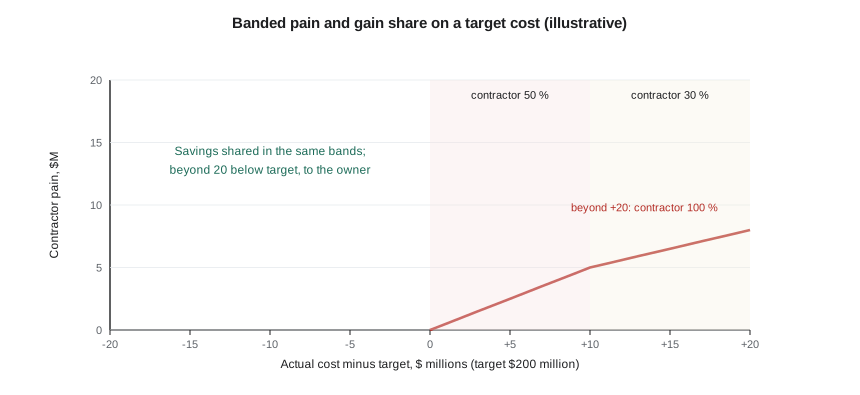
# Banded pain/gain share on a target cost contract (illustrative)
target = 200_000_000
fee_rate = 0.06
bands = [  # (upper limit of over/under-run as share of target, contractor share in that band)
    (0.05, 0.50),   # first 5 % either side: shared 50/50
    (0.10, 0.30),   # next 5 %: contractor 30 %
    (9.99, 1.00),   # beyond 10 % overrun: contractor bears all (savings beyond 10 % to owner only)
]
def contractor_share(diff):          # diff = actual - target (positive = overrun)
    share, remaining, lo = 0.0, abs(diff), 0.0
    for hi, s in bands:
        width = (hi - lo) * target
        part = min(remaining, width)
        if diff < 0 and s == 1.00:
            s = 0.0                    # savings beyond the last band go entirely to the owner
        share += part * s
        remaining -= part
        lo = hi
        if remaining <= 0:
            break
    return share if diff > 0 else -share
for actual in (180e6, 192e6, 200e6, 208e6, 216e6, 230e6):
    fee = fee_rate * actual
    pain_gain = contractor_share(actual - target) or 0.0
    print(f"actual {actual/1e6:5.0f}M: contractor pain(+)/gain(-) {pain_gain/1e6:+6.2f}M, "
f"contractor margin {(fee - pain_gain)/1e6:5.2f}M, owner pays {(actual + fee - pain_gain)/1e6:6.2f}M")actual 180M: contractor pain(+)/gain(-) -8.00M, contractor margin 18.80M, owner pays 198.80M actual 192M: contractor pain(+)/gain(-) -4.00M, contractor margin 15.52M, owner pays 207.52M actual 200M: contractor pain(+)/gain(-) +0.00M, contractor margin 12.00M, owner pays 212.00M actual 208M: contractor pain(+)/gain(-) +4.00M, contractor margin 8.48M, owner pays 216.48M actual 216M: contractor pain(+)/gain(-) +6.80M, contractor margin 6.16M, owner pays 222.16M actual 230M: contractor pain(+)/gain(-) +18.00M, contractor margin -4.20M, owner pays 225.80M
The bands concentrate the shared incentive near the target, where outcomes are most likely, while limiting the owner's exposure to a large overrun. At $230 million the contractor's share of the overrun exceeds its fee and it loses $4.2 million. A contractor facing a large overrun under the last band bears all of it, which protects the owner but can push the contractor toward claims, so some contracts instead cap the contractor's share at its fee, much like IPD. Getting the shares right is as much about behavior as arithmetic.
Worked problem
Contractor margin under a target cost
Using the bands above, actual cost is $208 million against a $200 million target, and the fee is 6 % of actual cost. What does the contractor earn?
Show solution
- Fee: 0.06 × 208 = $12.48 million.
- Overrun: $8 million. First $10 million band (5 % of 200) is shared 50 %, so the contractor bears 0.5 × 8 = $4 million.
- Contractor margin: 12.48 − 4.00 = $8.48 million.
Answer: About $8.48 million, compared with $12.0 million at target. The owner pays 208 + 12.48 − 4.00 = $216.48 million.
Incentives and key performance indicators
Progressive and alliance models often adjust the contractor's fee for performance on key results areas beyond cost: safety, quality, schedule milestones, environmental performance, community impact, Indigenous and local participation. Each indicator has a scale from poor to outstanding, and the fee is adjusted up or down according to a weighted score.
# Fee adjustment from key performance indicators in an alliance (illustrative)
base_fee = 9_000_000
kpis = {  # indicator: (weight, score from -1 poor to +1 outstanding)
    "Safety (recordable injury rate)":       (0.25, +0.6),
    "Quality (non-conformances closed)":     (0.20, +0.2),
    "Milestones achieved on time":           (0.25, -0.4),
    "Environmental incidents":               (0.10, +1.0),
    "Local and Indigenous participation":    (0.20, +0.5),
}
weighted = sum(w * s for w, s in kpis.values())
adjustment = 0.20 * weighted * base_fee          # fee can move up to +/- 20 %
for k, (w, s) in kpis.items():
    print(f"{k:38} weight {w:.2f} score {s:+.1f}")
print(f"Weighted score {weighted:+.3f}; fee adjustment {adjustment:+,.0f}; adjusted fee {base_fee + adjustment:,.0f}")Safety (recordable injury rate) weight 0.25 score +0.6 Quality (non-conformances closed) weight 0.20 score +0.2 Milestones achieved on time weight 0.25 score -0.4 Environmental incidents weight 0.10 score +1.0 Local and Indigenous participation weight 0.20 score +0.5 Weighted score +0.290; fee adjustment +522,000; adjusted fee 9,522,000
Indicators must be measurable, within the parties' control and balanced, so that chasing one does not damage another. A schedule incentive that encourages unsafe acceleration, for example, defeats its purpose.
Protecting the owner without price competition
Because construction prices in progressive models are negotiated, owners use several tools to make sure they are fair.
| Tool | How it protects the owner |
|---|---|
| Competitive selection on fees, markups and rates | Fixes the partner's margins and labor rates before the work is priced |
| Open-book estimating | The owner sees quantities, subcontract quotes and allowances behind the price |
| Competitive subcontract packages | Most of the cost of the work is still bid among trades |
| Independent cost estimate | A third party prices the same scope as a benchmark |
| Off-ramp | The owner can walk away with the design if the price is not acceptable |
| Audit rights | The owner can verify costs during and after construction |
Worked problem
Using the off-ramp
After a 14-month development phase costing $6.2 million, a progressive design-builder proposes $184 million. The independent estimate is $166 million. Negotiation reduces the price to $177 million. The owner estimates that taking the design to a conventional tender would add 7 months and $2.5 million of extra design and procurement cost, with an expected bid around $168 million and a 30 % chance of $8 million in later claims. Compare the options in expected cost, ignoring the time value of money.
Show solution
- Accept: $177 million.
- Off-ramp: 168 + 2.5 + 0.3 × 8 = 168 + 2.5 + 2.4 = $172.9 million, plus 7 months of delay.
- The off-ramp is about $4.1 million cheaper in expected cost but takes 7 months longer.
Answer: The decision depends on what the 7 months cost the owner. If delay costs more than about $0.6 million per month, accepting is better. The off-ramp's real value is often the negotiating leverage it gives the owner.
When progressive models are the right choice
Progressive and collaborative models suit projects with high technical complexity, significant unknowns such as ground conditions or existing facilities, many stakeholders and interfaces, or a market in which bidders will not accept fixed-price risk on reasonable terms. They are not a cure for every problem. They demand owner staff who can engage in joint design and commercial negotiation, they need strong governance to keep development phases from drifting, and they can be criticized for weaker competition. For simpler projects with clear requirements and competitive markets, conventional fixed-price methods remain efficient.
Common mistakes
MistakeUsing a progressive model without competing anything at selection.
InsteadCompete fees, markups and rates, and test teams through workshops.
MistakeLetting the development phase drift.
InsteadSet a budget, schedule and deliverables for the development phase, with decision gates.
MistakeAgreeing a price without an independent benchmark.
InsteadCommission an independent estimate before commercial close.
MistakeDesigning incentives that conflict.
InsteadBalance KPIs so that one does not damage another, such as schedule against safety.
MistakeTreating the off-ramp as a formality.
InsteadKeep the off-ramp credible by securing rights to the design and planning an alternative.
Summary and key terms
- Progressive models select the partner first, develop design and price together, and fix the price at commercial close with an off-ramp.
- Early contractor involvement brings construction advice into design with a route to pricing construction.
- Progressive P3s are rarer in the US; predevelopment agreements and progressive design-build serve similar purposes.
- Target cost contracts share overruns and savings, often in bands, with a fee on actual cost.
- KPI-based fee adjustments reward performance beyond cost.
- Owners protect themselves through competitive fees, open books, trade competition, independent estimates, off-ramps and audits.
- Progressive models suit complex, uncertain projects but demand capable owner staff and strong governance.
- Progressive delivery
- A model in which the price is fixed after a joint development phase.
- Development phase
- The phase in which the partner and owner develop design, risks and price open book.
- Commercial close
- The point at which the parties agree the price or target for implementation.
- Off-ramp
- The owner's right to end the arrangement after development and procure the work another way.
- Early contractor involvement (ECI)
- Engaging the contractor during design to advise and later price construction.
- Progressive P3
- A P3 in which the project agreement is signed after a development phase with the selected partner.
- Target cost contract
- A contract paying actual cost plus fee with overruns and savings shared against a target.
- Pain/gain band
- A range of outcomes with a specified sharing ratio.
- Key performance indicator (KPI)
- A measure of performance used to adjust fees or incentives.
- Predevelopment agreement
- An agreement giving a private developer exclusive rights to study and negotiate a project.
Practice problems
Work each problem on paper first, then reveal the answer to check.
What is the main trade-off of progressive models?
Show answer
Giving up price competition on construction for a better-informed price and fewer claims.
Name three things an owner can compete at selection in a progressive model.
Show answer
Development phase fees, markups or fee percentages, labor rates, team and approach.
What is an off-ramp?
Show answer
The owner's right to stop after development and procure the work another way, keeping the design.
Target $100 million, actual $104 million, first band 50/50 up to 5 %. What overrun does the contractor bear?
Show answer
$2 million.
Target $100 million, actual $95 million, first band 50/50 up to 5 %. What gain does the contractor receive?
Show answer
$2.5 million.
Why use bands in pain/gain sharing?
Show answer
To concentrate incentives near the target and limit exposure to large overruns or windfall savings.
Name two KPIs used to adjust alliance fees.
Show answer
Safety, quality, milestones, environment, local or Indigenous participation.
Why must KPIs be balanced?
Show answer
So chasing one, such as schedule, does not damage another, such as safety.
What is a predevelopment agreement?
Show answer
An agreement giving a developer exclusive rights to study and negotiate a P3 project.
What tool benchmarks a negotiated progressive price?
Show answer
An independent cost estimate.
Lesson quiz · 5 questions
Score 60% or more to complete this lesson.
Create a free account to save your progress, take quizzes and earn a certificate.