
CON-340 · Lesson 6 of 12 · 27 min
Integrated project delivery and alliancing
Every method in the previous lessons draws contract lines that put the owner, the designer and the builder on different sides. Each party protects its own interests, and when something goes wrong each can gain by showing that someone else was at fault. Integrated project delivery and alliancing try to remove that structure. The key parties sign one agreement, agree a target cost together, share the profit or loss against that target, waive most claims against each other, and make decisions jointly. The idea is simple: if everyone wins or loses together, everyone has a reason to solve problems rather than assign blame.
Integrated project delivery, usually shortened to IPD, developed in North America in the 2000s, building on lean construction ideas and on the experience of a few California health systems that used it for hospitals. Alliancing developed earlier, in the North Sea oil industry and then in Australian public infrastructure in the 1990s and 2000s, and in the United Kingdom. The two are close relatives. CON-260 lesson 11 discussed collaborative contracts from the point of view of digital information; this lesson looks at how they are structured and how money moves.
The principles
| Principle | What it means in practice |
|---|---|
| Early involvement of key participants | Owner, designer, builder and key trades (often mechanical, electrical and structural) join at the start of design |
| Shared risk and reward | Profit is at risk and depends on the project outcome against a target cost and goals |
| Joint decision making | A project management team with members from each party decides by consensus, with the owner deciding if consensus fails |
| Liability waivers among the parties | Parties waive most claims against each other except for intentional misconduct or defined exceptions |
| Open books | All parties' costs are transparent and audited |
| Jointly developed goals | Cost, schedule, quality and other goals are agreed together and tied to incentives |
| Collaboration tools | Co-location (a "big room"), lean planning, target value design, shared models |
Not every project labeled IPD has all of these. Practitioners distinguish pure IPD, with a multi-party agreement, shared risk and reward and liability waivers, from "IPD-ish" or "IPD-lite" projects that use collaborative tools under conventional contracts such as CMAR. Both can work, but only the multi-party agreement changes the incentives fundamentally.
The multi-party agreement and its governance
In IPD the owner, the lead designer and the builder, and often several key trade partners and consultants, sign the same agreement. A senior management team of executives from each party sets direction and resolves escalated issues. A project management team runs the project day to day, and cluster or work-stream teams, mixing designers, builders and trades, develop and deliver each part of the work. Decisions are made by consensus, with the owner usually having the final say if the team cannot agree, and with disputes escalating through defined levels before any external process.
In the United States, the main standard forms are the AIA's C191-2009 (a single multi-party agreement) and C195-2008 (a single-purpose entity owned by the parties), ConsensusDocs 300 (a tri-party collaborative agreement), and the Integrated Form of Agreement, or IFOA, developed for Sutter Health in California and widely adapted by health systems and their lawyers.
Validation and the target cost
An IPD project normally begins with a validation phase, sometimes called a conceptualization phase. The team tests whether the owner's program, budget and schedule are achievable, develops an early design and a target cost, and produces a validation report. The owner then decides whether to proceed. If the target cost is not achievable within the owner's budget, the owner can change the program, increase the budget or stop. This step matters: a target that is unrealistic from the start drives behavior toward the very blame and cost-cutting the method is meant to avoid.
The target cost, often called the expected maximum price or estimated maximum price in American IPD contracts, is the team's agreed estimate of the cost to deliver the project. It is set aggressively but realistically, often below the owner's budget, using target value design: designing to a cost rather than costing a design. The team breaks the target into clusters, each with its own target, and tracks the forecast cost of each against its target throughout design, adjusting the design when a cluster runs over.
How the parties are paid
IPD compensation has three layers for each non-owner party.
| Layer | What it is | Risk |
|---|---|---|
| Reimbursable cost | Actual direct costs of labor, materials, equipment and subcontracts, and agreed overhead | Paid in full, usually even if the project overruns, up to any owner cap |
| Profit at risk | The party's planned profit, placed in a shared pool | Grows if the project finishes under target; shrinks or disappears if it overruns |
| Incentive compensation | Additional payments for meeting goals such as quality, safety or schedule | Paid only if goals are met |
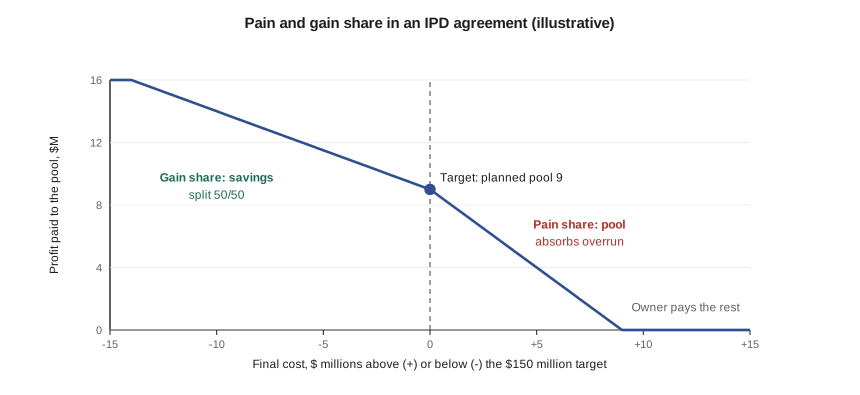
If the actual cost finishes below the target, the savings are shared between the owner and the profit pool, so the non-owner parties earn more than their planned profit. If the actual cost exceeds the target, the overrun first consumes the profit pool. Once the pool is gone, most IPD agreements have the owner pay remaining costs, so the non-owner parties lose their profit but not their own money. That limit is what makes the liability waivers acceptable to designers and builders: they put profit at risk, not their companies.
# Profit pool under an IPD agreement for a $150 million target cost (illustrative)
target = 150_000_000
pool = 9_000_000          # planned profit of designer, builder and trade partners at risk
gain_share = 0.50         # share of savings to the profit pool
pain_share = 1.00         # overrun absorbed by the pool until exhausted
def outcome(actual):
    if actual <= target:
        profit = pool + gain_share * (target - actual)
    else:
        profit = max(0, pool - pain_share * (actual - target))
    owner_pays = actual + profit
    return profit, owner_pays
for actual in (138e6, 145e6, 150e6, 154e6, 159e6, 165e6):
    p, o = outcome(actual)
print(f"actual cost {actual / 1e6:6.1f}M: profit pool paid {p / 1e6:5.2f}M, owner pays {o / 1e6:6.2f}M")actual cost 138.0M: profit pool paid 15.00M, owner pays 153.00M actual cost 145.0M: profit pool paid 11.50M, owner pays 156.50M actual cost 150.0M: profit pool paid 9.00M, owner pays 159.00M actual cost 154.0M: profit pool paid 5.00M, owner pays 159.00M actual cost 159.0M: profit pool paid 0.00M, owner pays 159.00M actual cost 165.0M: profit pool paid 0.00M, owner pays 165.00M
At target, the owner pays the cost plus the planned profit of $9 million. At $138 million, the parties earn $15 million and the owner still pays $6 million less than at target. At $159 million, the pool is exhausted and the parties earn no profit; above that, the owner bears every additional dollar. Real agreements vary: some share overruns with the owner from the first dollar, some cap the gain share, and some include an owner contribution to the pool if goals are met.
Worked problem
Distributing the profit pool
On an IPD project the profit pool at completion is $11.2 million. The agreement distributes the pool in proportion to each party's planned profit: architect $1.6 million, builder $4.0 million, mechanical trade partner $1.8 million, electrical trade partner $1.2 million, structural engineer $0.4 million (total planned $9.0 million). How much does the builder receive?
Show solution
- Builder share: 4.0 ÷ 9.0 = 44.4 %.
- Builder receives 0.444 × 11.2 = $4.98 million.
- Check: the pool is 11.2 ÷ 9.0 = 124 % of planned profit, so every party receives 124 % of its planned profit.
Answer: About $4.98 million, 124 % of its planned profit.
Alliancing
An alliance is a similar arrangement used mainly for infrastructure. The owner and one or more non-owner participants, such as a contractor and a designer, form an alliance under a project alliance agreement. Decisions are made unanimously by an alliance leadership team, the parties commit to "no blame, no dispute" (they agree not to sue each other except for deliberate default), and commercial terms combine reimbursed costs, a fee for corporate overhead and profit, and a pain/gain share against a target outturn cost. Alliances were used extensively in Australia for roads, rail and water from the late 1990s, guided by national alliance contracting guidelines, and in the United Kingdom, where the NEC4 suite added an alliance contract in 2018.
Alliancing is less common in United States public infrastructure than in Australia or Canada, because public procurement laws often require price competition. Collaborative models in US transportation more often use CM/GC or progressive design-build. Some health systems, universities and private owners use IPD agreements that function much like alliances.
| Feature | IPD (buildings) | Alliance (infrastructure) |
|---|---|---|
| Typical owners | Health systems, universities, private developers | Public transport, road and water agencies |
| Parties | Owner, designer, builder, key trades | Owner, contractor, designer, sometimes operator |
| Decision making | Consensus with owner tie-break | Unanimous alliance leadership team |
| Commercial model | Cost + profit at risk + incentives against target cost | Cost + fee + pain/gain share against target outturn cost |
| Claims among parties | Mutual waivers with exceptions | "No blame, no dispute" with exceptions |
Does it work?
Case studies of IPD and alliance projects report strong results on cost, schedule, quality and relationships, and surveys of participants are generally positive. But most evidence comes from projects whose owners chose the method enthusiastically and staffed it well, so it is hard to separate the method from the people. The same studies identify recurring conditions for success: an owner willing to lead and make decisions quickly, partners chosen for capability and culture, a realistic target from validation, co-location, real training in lean and collaborative behaviors, and executives who resist the habit of turning problems into claims. Where those conditions are missing, IPD projects can stall in consensus, overrun the target and leave parties disappointed that the profit pool vanished.
Worked problem
Is a target realistic?
An owner's budget is $120 million. After validation, the team's estimate of the cost to deliver the program as designed is $124 million. The team identifies $7 million of design changes it believes will not reduce function. Should the owner set a target of $117 million, $120 million or $124 million?
Show solution
- The owner's budget allows a target up to about $120 million.
- Achievable savings bring the estimate to 124 − 7 = $117 million.
- Setting the target at $117 million gives no margin for estimating error; $120 million leaves $3 million of the identified savings as a cushion.
Answer: A target near $120 million is defensible: within budget and achievable with most of the identified savings. A target of $117 million would require every saving to materialize and risks wiping out the profit pool early, which damages collaboration.
Common mistakes
MistakeCalling a CMAR project with a big room "IPD" and expecting IPD incentives.
InsteadRecognize that only a multi-party agreement with shared risk and reward changes incentives.
MistakeSetting an unrealistic target cost to look good.
InsteadUse validation to set a target that is aggressive but achievable.
MistakeChoosing partners only on price.
InsteadSelect partners on capability, behavior and alignment, and use price where appropriate.
MistakeExpecting non-owner parties to fund overruns beyond their profit.
InsteadUnderstand that most agreements limit their loss to profit at risk; the owner carries the rest.
MistakeSkipping training and co-location.
InsteadInvest in collaborative tools, lean training and a big room.
Summary and key terms
- IPD and alliancing put the key parties under one agreement with shared risk and reward and joint decision making.
- Parties usually waive most claims against each other, with exceptions such as intentional misconduct.
- A validation phase tests whether program, budget and schedule are achievable and sets the target cost.
- Compensation layers are reimbursed cost, profit at risk and incentive compensation.
- Below target, savings are shared; above target, the profit pool absorbs overruns until exhausted, then the owner pays.
- AIA C191 and C195, ConsensusDocs 300 and the IFOA are used in the United States.
- Success depends on owner leadership, partner selection, a realistic target and real collaboration.
- Integrated project delivery (IPD)
- Delivery under a multi-party agreement with shared risk and reward and joint decisions.
- Multi-party agreement
- A single contract signed by the owner, designer, builder and other key parties.
- Validation phase
- An early phase that tests program, budget and schedule and sets the target cost.
- Target cost
- The agreed estimate of cost against which profit is shared.
- Target value design
- Designing to a target cost rather than costing a finished design.
- Profit at risk
- Planned profit placed in a pool that varies with project outcome.
- Pain/gain share
- The sharing of overruns and savings against a target.
- Liability waiver
- An agreement not to bring claims against other parties, with defined exceptions.
- Alliance
- A collaborative arrangement for infrastructure with unanimous decisions and no-blame commitments.
- Big room
- Co-located space where the integrated team works together.
Practice problems
Work each problem on paper first, then reveal the answer to check.
Name three core principles of IPD.
Show answer
Early involvement, shared risk and reward, joint decisions, liability waivers, open books, joint goals.
What is the purpose of the validation phase?
Show answer
To test whether program, budget and schedule are achievable and set a realistic target cost.
Name the three layers of IPD compensation.
Show answer
Reimbursable cost, profit at risk and incentive compensation.
Target $80 million, actual $76 million, pool $5 million, gain share 50 %. What is the profit paid?
Show answer
$7 million.
Target $80 million, actual $83 million, pool $5 million, pain share 100 %. What is the profit paid?
Show answer
$2 million.
Target $80 million, actual $88 million, pool $5 million. What profit is paid and who pays the rest?
Show answer
Zero; the owner pays the remaining overrun.
Why are liability waivers acceptable to designers and builders under IPD?
Show answer
Their loss is usually limited to profit at risk, not their own capital.
How does an alliance differ from IPD in decision making?
Show answer
Alliances typically require unanimous decisions of the leadership team; IPD often uses consensus with an owner tie-break.
Name two US IPD standard forms.
Show answer
AIA C191 and C195; ConsensusDocs 300; the IFOA.
Name two conditions for IPD success.
Show answer
Owner leadership, capable aligned partners, a realistic target, co-location, collaborative training.
Lesson quiz · 5 questions
Score 60% or more to complete this lesson.
Create a free account to save your progress, take quizzes and earn a certificate.