
CON-340 · Lesson 9 of 12 · 25 min
Standard contract families by delivery method
Every delivery method needs a set of contracts that fit together: the owner's contract with the builder or design-builder, the owner's or design-builder's contract with the designer, and the builder's contracts with its subcontractors. Industry organizations publish standard forms for each method so that parties do not have to draft from scratch and so that courts, insurers and sureties know what the words mean. CON-220 lesson 4 looked inside the main stipulated-price forms clause by clause. This lesson steps back and maps the families of forms to the delivery methods in lessons 2 to 8, so that you can recognize which documents belong together and what to watch for when an owner mixes them.
Who publishes standard forms
In the United States the main publishers are the American Institute of Architects (AIA), whose documents are the most widely used for buildings; ConsensusDocs, a coalition of over forty owner, contractor, subcontractor, surety and design organizations; the Engineers Joint Contract Documents Committee (EJCDC), used mainly for engineered infrastructure such as water and wastewater; and the Design-Build Institute of America (DBIA) for design-build. The Construction Management Association of America (CMAA) publishes agency construction management forms. Federal agencies contract under the Federal Acquisition Regulation and agency supplements, and state transportation departments and large public owners often use their own standard specifications and contracts.
| Feature | Canada | United States |
|---|---|---|
| Main building forms | CCDC | AIA, ConsensusDocs |
| Engineered infrastructure | CCDC with owner supplements; owner-specific forms | EJCDC; owner-specific forms |
| Design-build | CCDC 14 and 15 | DBIA, AIA A141 family, ConsensusDocs 400 series, EJCDC D-series |
| Integrated project delivery | CCDC 30 | AIA C191 and C195, ConsensusDocs 300, IFOA |
| Subcontracts | CCDC 17 (CM projects), CCA 1 | AIA A401, ConsensusDocs 750 |
| P3 project agreements | Provincial agency templates (for example Infrastructure Ontario and Infrastructure BC) | Agency-specific concession and availability-payment agreements |
Forms mapped to delivery methods
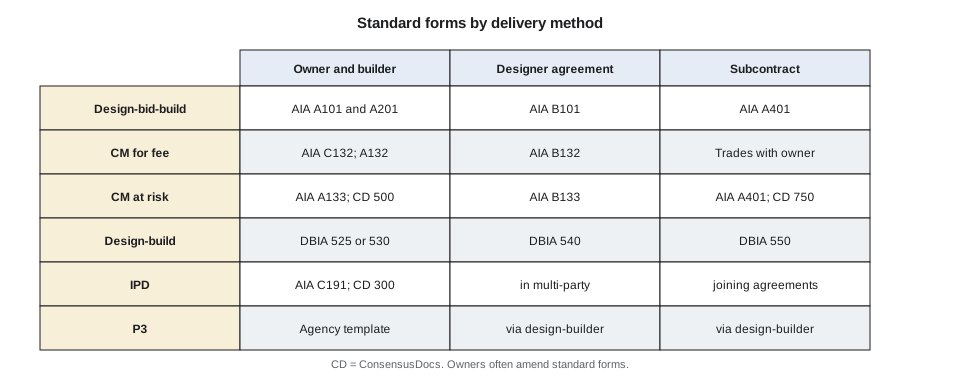
| Delivery method | Owner and builder | Owner and designer | Builder and subcontractor |
|---|---|---|---|
| Design-bid-build | AIA A101-2017 with A201-2017; A102 and A103 (cost plus); ConsensusDocs 200; EJCDC C-520/C-525 with C-700 | AIA B101-2017; EJCDC E-500; ConsensusDocs 240 | AIA A401-2017; ConsensusDocs 750 |
| CM for fee | AIA C132-2019 (CMa); A132-2019 with A232-2019 (owner and contractor); CMAA A-1 and A-2 | AIA B132-2019 | Trades contract directly with owner under A132 |
| CM at risk | AIA A133-2019 (GMP) or A134-2019 (no GMP) with A201; ConsensusDocs 500 | AIA B133-2019; ConsensusDocs 240 | AIA A401; ConsensusDocs 750 |
| Design-build | DBIA 500 series; AIA A141-2014; ConsensusDocs 410/415; EJCDC D-520 with D-700 | AIA B143-2014; DBIA 540; ConsensusDocs 420 | AIA A441-2014; DBIA 550; ConsensusDocs 450 |
| IPD | AIA C191-2009 or C195-2008; ConsensusDocs 300; IFOA | Part of the multi-party agreement | Trade partners sign joining agreements or subcontracts that flow down IPD terms |
| P3 | Agency project or concession agreement | Project Co hires designer under the design-build contract | Design-build joint venture subcontracts trades |
Two observations stand out. First, the design-builder's and the IPD team's contracts with the designer differ from the owner-designer contracts used in design-bid-build: the designer works for or alongside the builder, and its scope, insurance and liability must match the obligations the builder or team gives the owner. Second, P3s rarely use industry forms at the top level; provincial and state agencies have developed their own project agreements, which they refine with each procurement, and the design-build and services subcontracts underneath are negotiated to mirror them.
Editions and why they matter
Standard forms are revised every decade or so to reflect new law and practice, such as prompt payment legislation, adjudication, digital information, electronic signatures and new insurance products. Using an outdated edition on a new project can leave the contract out of step with the law. Mixing editions, for example a 2010 subcontract under a 2025 prime contract, can leave clauses that refer to provisions that no longer exist.
The AIA's 2017 revision of A201 and A101 and its 2019 revision of the construction management family illustrate the point. Each revision changed provisions such as insurance (moved to a separate exhibit in 2017), consequential damages, termination for convenience fees and digital practice protocols. Subcontracts based on older AIA editions can conflict with current prime contracts, for example on insurance requirements or notice periods.
Worked problem
Checking alignment between prime and subcontract terms
A construction manager signs a CM at risk contract that requires it to give the owner written notice of a claim within 10 working days of the event. Its standard subcontract gives subcontractors 15 working days to notify the construction manager. A subcontractor notifies on day 14. What is the problem, and how should the subcontract be fixed?
Show solution
- The construction manager must notify the owner by day 10, but the subcontractor's notice arrives on day 14.
- The construction manager may lose its right to pass the claim to the owner, but remain liable to the subcontractor.
- Fix: set the subcontract notice period shorter than the prime, for example 5 working days, so the construction manager has time to assess and forward the notice.
Answer: Misaligned notice periods leave the builder carrying claims it cannot pass on. Subcontract time limits should be shorter than the prime contract's (CON-330 lesson 5).
Supplementary conditions and owner amendments
Few owners use a standard form unchanged. They add supplementary conditions to address project-specific matters, such as insurance limits, liquidated damages, site rules and phasing, and often to shift risk toward the contractor. Industry bodies publish guides warning against amendments that upset the balance of the form. Some amendments are routine and expected; others, such as broad indemnities, waivers of delay claims or making the contractor responsible for design errors in a design-bid-build contract, can change the delivery method in substance while keeping its name.
AIA documents are designed to be modified, and the AIA publishes guides for supplementary conditions; ConsensusDocs encourages owners to use its forms with minimal changes. Contractors and sureties often flag owner amendments such as no-damages-for-delay clauses, broad indemnities and pay-if-paid language, some of which are restricted by state law.
| Amendment | Effect | Why it matters |
|---|---|---|
| Broad form indemnity | Contractor indemnifies owner even for owner's own negligence | Unenforceable in some jurisdictions; uninsurable in part |
| No damages for delay | Contractor gets time but no money for owner-caused delay | Shifts a major owner risk; restricted by some state laws |
| Contractor responsible for design coordination | Contractor must find and fix errors in the owner's design | Moves design risk in a design-bid-build contract |
| Short or strict notice provisions | Claims barred if notice is late | Can defeat legitimate claims; needs matching subcontract terms |
| Owner's sole discretion on changes | Owner decides value of changes | Removes negotiation and dispute protections |
Choosing forms for a project
Choosing contracts is a sequence of decisions. Pick the delivery method and pricing basis first, then choose a family, so that the owner-builder, owner-designer or builder-designer, and subcontract forms come from the same family and edition. Decide what the owner must change, and keep changes as few and as clear as possible. Then check alignment down the chain: every obligation the builder gives the owner on time, quality, insurance, notice and payment needs a matching obligation from subcontractors and designers.
# A simple form selector for US projects (illustrative; check current editions)
forms = {
    ("design-bid-build", "stipulated"): ["AIA A101-2017 + A201-2017", "AIA B101-2017", "AIA A401-2017"],
    ("design-bid-build", "cost plus"):  ["AIA A102-2017 + A201-2017", "AIA B101-2017", "AIA A401-2017"],
    ("cm for fee", "fee"):              ["AIA C132-2019", "AIA A132-2019 + A232-2019 for each contractor", "AIA B132-2019"],
    ("cm at risk", "gmp"):              ["AIA A133-2019 + A201-2017", "AIA B133-2019", "AIA A401-2017"],
    ("design-build", "stipulated"):     ["DBIA 525 + 535", "DBIA 540", "DBIA 550"],
    ("design-build", "gmp"):            ["DBIA 530 + 535", "DBIA 540", "DBIA 550"],
    ("ipd", "target cost"):             ["AIA C191-2009 (multi-party)"],
}
def select(method, pricing):
    return forms.get((method, pricing), ["owner-specific or adapted forms; seek advice"])
for m, p in [("cm at risk", "gmp"), ("design-build", "stipulated"), ("design-build", "gmp"), ("ipd", "target cost")]:
print(f"{m:16} {p:11} -> {', '.join(select(m, p))}")cm at risk gmp -> AIA A133-2019 + A201-2017, AIA B133-2019, AIA A401-2017 design-build stipulated -> DBIA 525 + 535, DBIA 540, DBIA 550 design-build gmp -> DBIA 530 + 535, DBIA 540, DBIA 550 ipd target cost -> AIA C191-2009 (multi-party)
The selector shows how the DBIA family distinguishes lump-sum design-build (525) from cost-plus design-build with a GMP (530), both used with the 535 general conditions. Where no standard family fits, such as a progressive P3, owners draft their own agreements with expert advice.
Owner-specific forms in public infrastructure
Large public owners, especially transportation departments, transit agencies and water utilities, frequently use their own contracts rather than industry forms, refined over hundreds of projects. Highway contracts typically rely on standard specifications with general and special provisions, unit prices and measured quantities. P3 agencies use project agreement templates with long schedules for output specifications, payment mechanisms and handback. Contractors bidding public infrastructure must learn each owner's documents, which is why experience with a given owner is valuable and why prequalification often asks for it.
Federal construction in the United States is contracted under the Federal Acquisition Regulation, with standard clauses such as differing site conditions (FAR 52.236-2), changes (52.243-4) and default (52.249-10) incorporated by reference, and agency supplements for the Army Corps of Engineers, the Naval Facilities Engineering Systems Command and others. State departments of transportation use their own standard specifications, and many follow the AASHTO Guide Specifications for model language.
Reading a form for its delivery method
A quick way to check whether a contract really matches the delivery method it claims is to read five clauses: who provides the design and who warrants it; how the price is set and what adjusts it; who holds the trade or subcontracts; how changes are valued; and how disputes are resolved. A so-called construction management contract that makes the construction manager guarantee the design, or a design-build contract in which the owner keeps approving and directing the details, has drifted away from its method. The drift matters because insurers, sureties and courts will look at what the words actually say, not at the title on the cover page.
| Clause to read | What it should say for the method |
|---|---|
| Design responsibility | Owner's designer (DBB, CM); design-builder (DB); shared under the team agreement (IPD); Project Co (P3) |
| Price basis and adjustments | Stipulated price; cost plus fee with or without GMP; target cost; availability payment |
| Who holds the trades | General contractor (DBB, CMAR, DB); owner (CM for fee); team or trade partners (IPD) |
| Valuation of changes | Unit rates, agreed markups, open-book cost plus fee, or variation procedure |
| Disputes | Negotiation, adjudication, mediation, arbitration or courts, or internal escalation in IPD and alliances |
Contractors reviewing an unfamiliar owner form before bidding should make the same five checks and price, qualify or decline accordingly. A clear summary of these points at the start of the project, as CON-220 lesson 4 recommends for every contract, helps the whole team work to the contract the parties actually signed.
Common mistakes
MistakeMixing forms from different families or editions without checking cross-references.
InsteadUse one family and edition, or check every cross-reference and definition.
MistakeAssuming a standard form is unchanged.
InsteadRead the supplementary conditions and owner amendments carefully.
MistakeUsing design-bid-build designer agreements on a design-build project.
InsteadUse design-builder and consultant forms that align design obligations with the design-build contract.
MistakeLeaving subcontract notice periods longer than the prime.
InsteadMake subcontract time limits shorter than the prime contract's.
MistakeHeavily amending a balanced form and expecting the same bid prices.
InsteadExpect fewer bidders and risk pricing when risk is shifted.
Summary and key terms
- AIA, ConsensusDocs, EJCDC, DBIA and CMAA publish the main US forms; federal work uses the FAR.
- Each delivery method has a matching family of owner, designer and subcontract forms.
- Design-build and IPD change the designer's contract and liability to match the builder's or team's obligations.
- P3 agencies use their own project agreement templates.
- Editions matter; outdated or mixed editions can conflict with current law and with each other.
- Supplementary conditions can shift risk and even change a method's substance while keeping its name.
- Choose the method and pricing first, then a family, and check alignment down the contract chain.
- Standard form contract
- A contract published by an industry body for repeated use.
- Contract family
- A set of coordinated forms for one delivery method.
- Edition
- A dated version of a standard form.
- Supplementary conditions
- Project-specific changes and additions to a standard form.
- Flow-down
- Passing obligations from the prime contract into subcontracts.
- Project agreement template
- An agency's standard P3 contract refined across projects.
- Joining agreement
- An agreement by which a trade partner joins a multi-party contract.
- Broad form indemnity
- An indemnity covering the indemnified party's own negligence.
- No-damages-for-delay clause
- A clause limiting the contractor to a time extension for delay.
- Standard specifications
- An owner's published technical and contractual requirements used across many contracts.
Practice problems
Work each problem on paper first, then reveal the answer to check.
Which body publishes the most widely used US building contracts?
Show answer
The American Institute of Architects (AIA).
Name the AIA owner and CM as constructor agreement with a GMP.
Show answer
AIA A133-2019.
Which DBIA forms distinguish lump-sum from GMP design-build?
Show answer
DBIA 525 (lump sum) and 530 (cost plus with GMP), with 535 general conditions.
Name two US IPD forms.
Show answer
AIA C191-2009 and C195-2008; ConsensusDocs 300; the IFOA.
Which publisher focuses on engineered infrastructure such as water projects?
Show answer
EJCDC.
Why should subcontract notice periods be shorter than the prime's?
Show answer
So the builder can receive, assess and forward notices in time.
Give one example of an owner amendment that shifts risk.
Show answer
Broad indemnity, no damages for delay, contractor responsible for design coordination, strict notices.
Why do P3s rarely use industry forms at the top level?
Show answer
Agencies developed their own project agreement templates for long-term, financed arrangements.
Which FAR clause covers differing site conditions?
Show answer
FAR 52.236-2.
What does ConsensusDocs represent?
Show answer
A coalition of more than forty owner, contractor, subcontractor, surety and design organizations.
Lesson quiz · 5 questions
Score 60% or more to complete this lesson.
Create a free account to save your progress, take quizzes and earn a certificate.