
CON-375 · Lesson 12 of 12 · 20 min
Records retention and the project documentation plan
Seven years after Westgate opened, a water leak in the library's archive room damaged a collection of local history maps. The library board's insurer investigated and found that a sprinkler fitting had failed. The insurer wrote to Brightwater, Tallis Mechanical and the fitting's supplier asking for the installation records, the pressure test reports, the shop drawings and the commissioning results. Brightwater's project files had long since been archived, but they had been archived properly. Within two days Jun Park, now a project manager herself, retrieved the hydrostatic test report signed in 2026, the reviewed shop drawing showing the specified fitting, and the photos of the installed piping before the ceiling closed. The records showed the installation had passed its tests and matched the design, and the inquiry moved on to the fitting's manufacturer.
Projects end, but their records keep working for years. They are needed for warranty claims, latent defects, insurance investigations, tax audits, lawsuits, renovations and the owner's own operations. This final lesson covers how long records should be kept and how to keep them safely, how to preserve records when a dispute is expected, and then brings the whole course together in a project documentation plan for Brightwater's next project.
Why records must outlive the project
The risk window for a construction contractor extends well beyond the warranty period. Defects can stay hidden for years, and the law allows claims to be brought long after completion.
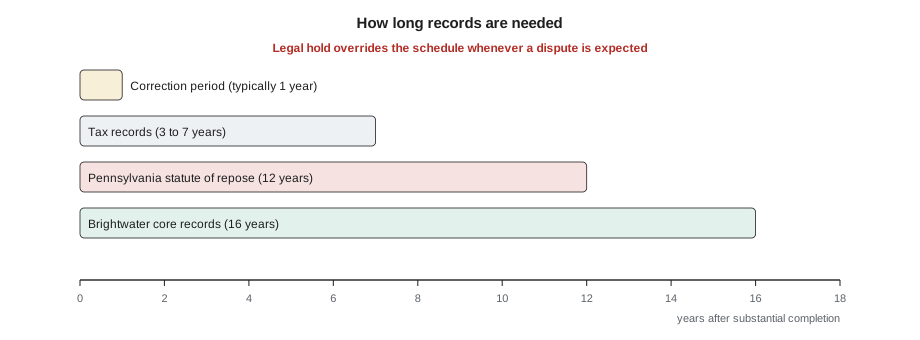
In Pennsylvania, claims for breach of contract generally must be brought within four years, but the clock may start later than completion, and the statute of repose for claims arising from improvements to real property generally bars claims brought more than twelve years after completion of construction. A latent defect discovered in year 9 can therefore lead to a claim in year 10 or 11. Federal tax rules generally require business records to be kept for at least three years, and longer in some situations. Contracts may impose longer periods, and some public owners require records to be kept and made available for audit for a set number of years after final payment.
These limits are general and have exceptions, and the rules differ from province to province and state to state. Brightwater's legal counsel sets its retention schedule, and project staff follow it rather than deciding for themselves what to keep.
A retention schedule
A retention schedule lists categories of records, how long each is kept, from what trigger date, in what format, and who may authorize destruction at the end. Brightwater's schedule groups project records into classes.
| Record class | Examples | Retention (Brightwater policy) | Trigger |
|---|---|---|---|
| Contract and change records | Contract, change orders, directives, claims, notices, correspondence | 16 years | Substantial completion |
| Field records | Daily reports, diaries, photos, video, inspection and test records | 16 years | Substantial completion |
| Design and submittal records | Issued drawings, RFIs, reviewed submittals, as-builts | 16 years | Substantial completion |
| Financial and tax records | Invoices, payment applications, payroll, cost reports | 7 years | End of fiscal year |
| Safety records | Incident reports, training, inspections | As required by law, and at least 16 years for serious incidents | Date of record |
| Personal information | Worker records, visitor logs, access card data | Only as long as needed and permitted by privacy law | End of purpose |
Brightwater keeps its core project records one year longer than the longest limitation or repose period it faces, to allow for claims that are started at the last moment and served later. Personal information is the exception: privacy laws in both countries require organizations to keep personal information only as long as needed for the purposes for which it was collected, and then to destroy it securely.
Worked problem
When can the Westgate records be destroyed?
Westgate reached substantial completion on 2027-09-10. Under Brightwater's policy, contract and field records are kept for 16 years from substantial completion, and financial records for 7 years from the end of the fiscal year in which they were created; Brightwater's fiscal year ends on 31 March. When may the field records be destroyed, and when may a payment application dated 2027-02-25 be destroyed, assuming no legal hold applies?
Show solution
- Field records: 2027-09-10 plus 16 years = 2043-09-10.
- The payment application dated 2027-02-25 falls in the fiscal year ending 2027-03-31.
- Seven years from the end of that fiscal year: 2034-03-31.
- Destruction requires authorization under the schedule and a check that no legal hold, claim or audit is pending.
Answer: Field records after 2043-09-10; the payment application after 2034-03-31, if no hold applies.
# Compute destruction-eligible dates from the retention schedule
from datetime import date
def add_years(d, n):
    try:
        return d.replace(year=d.year + n)
    except ValueError:  # 29 February
        return d.replace(year=d.year + n, day=28)

def fiscal_year_end(d, end_month=3):
    year = d.year if d.month <= end_month else d.year + 1
    return date(year, end_month, 31)

substantial = date(2027, 9, 10)
print('Field records:', add_years(substantial, 16))
invoice = date(2027, 2, 25)
print('Payment application:', add_years(fiscal_year_end(invoice), 7))
invoice2 = date(2027, 6, 25)
print('Later application:', add_years(fiscal_year_end(invoice2), 7))Field records: 2043-09-10 Payment application: 2034-03-31 Later application: 2035-03-31
Legal holds and disclosure
Retention schedules allow records to be destroyed in the ordinary course when their time is up. That changes the moment a dispute is expected. Once litigation, arbitration or an investigation is reasonably anticipated, a party has a duty to preserve relevant records, and destroying them, even under a routine schedule, can lead to serious consequences.
In the US, the duty to preserve relevant information arises when litigation is reasonably anticipated. Under the Federal Rules of Civil Procedure, particularly Rule 37(e), a court that finds electronically stored information was lost because a party failed to take reasonable steps to preserve it can order measures to cure the prejudice and, where the party acted with intent to deprive, can impose severe sanctions such as adverse inference instructions. State courts apply similar principles.
A legal hold notice is the practical tool. It tells everyone who may have relevant records, including site staff and subcontractors, what to preserve, suspends routine deletion for those records, and records who received the notice. Brightwater's legal counsel issues holds; project managers make sure they reach the field.
- Identify the people, systems and devices likely to hold relevant records: platform, email, shared drives, phones, cameras, schedule files, accounting system.
- Suspend automatic deletion, including email clean-up rules and phone message expiry.
- Preserve text messages and messaging apps used for project communication; they are records too, and are often the hardest to recover.
- Keep a record of the hold, its recipients and the steps taken.
- Do not create new commentary about the dispute in project records; communicate with counsel instead.
Keeping archives usable and secure
A record kept for sixteen years must still be readable, findable and trustworthy at the end. Software changes, companies stop supporting file formats, and cloud subscriptions end. Brightwater's archive procedure at project closeout has four parts.
| Step | Practice |
|---|---|
| Export | Export all records from the project platform, with metadata and audit logs, in open formats |
| Convert | Store documents as PDF/A, the archival form of PDF defined in ISO 19005, alongside native files where useful |
| Index | Keep the registers, logs and an index that maps the folder structure to record classes and retention dates |
| Protect | Store in at least two locations with different media or providers, with access controls and regular test restores |
Cybersecurity applies to archives as much as to live projects. Construction firms are frequent targets of ransomware and payment fraud. Strong authentication on every system, encrypted storage, offline or immutable backups, and a tested restore process protect both live and archived records. A common rule of thumb is to keep three copies of important data, on two different types of storage, with one copy off site or offline.
Messages, phones and personal devices
Much project communication now happens in text messages, group chats and calls from personal phones. A foreman's group chat may hold the only record of an instruction given at the slab edge or a photo of a damaged delivery. Those messages are project records, but they live on devices the company does not control and may vanish when a phone is replaced. Brightwater's policy is that decisions and instructions given by message must be confirmed in the project platform the same day, that photos are uploaded rather than left in chats, and that company phones are used for project communication wherever possible. When a worker leaves, their project messages are exported before the phone is returned or reset. The aim is not to stop people texting, which would be unrealistic on a busy site, but to make sure nothing important exists only in a chat.
Capstone: a documentation plan for Riverside
Brightwater has just been awarded its next project: the Riverside Transit Operations Center, a $74 million maintenance garage and office building for the regional transit authority, under AIA A101 and A201-2017 with extensive supplementary conditions. Elena Vasquez is the project manager and asks Jun to prepare the project documentation plan before the pre-construction meeting.
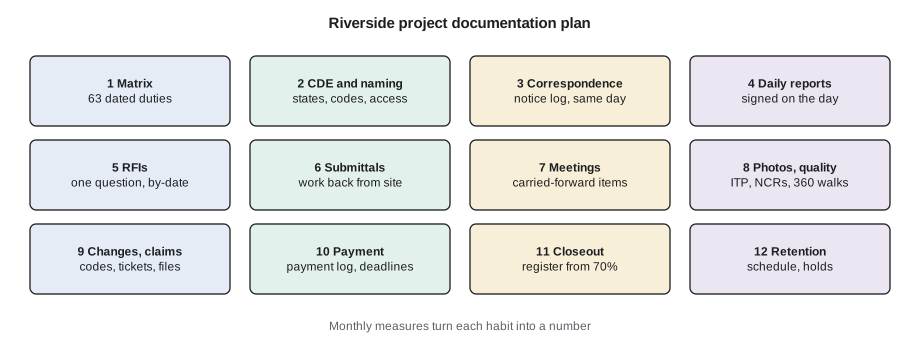
The plan pulls together every lesson in this course into a single document that the whole team, including subcontractors, will follow.
| Part | Contents for Riverside |
|---|---|
| 1 Documentation matrix | Every record and notice required by the contract and specifications, with owner, recipient, frequency, format and time limit |
| 2 CDE and naming | Platform set-up, folder structure, ISO 19650-style naming, status codes, permissions, monthly register reconciliation |
| 3 Correspondence and notice | Numbering, templates, notice log, delivery methods agreed with the authority, same-day notice rule |
| 4 Daily reports | Template, review by the project manager within two days, subcontractor reports by 09:00, weather data |
| 5 RFIs | Format, one question per RFI, required-by dates, weekly overdue review, change screening of answers |
| 6 Submittals | Register from the specifications, schedule working back from on-site dates, contractor review checklist |
| 7 Meetings | Meeting schedule, agenda, minutes format with carried-forward items, correction period |
| 8 Photos and quality | Photo plan, before-cover-up rule, 360° walks, inspection and test plan, NCR process |
| 9 Changes and claims | Change log, separate cost codes, daily T&M tickets, monthly schedule updates, claim files |
| 10 Payment | Schedule of values, application checklist, payment log, statutory deadlines diarized |
| 11 Closeout | Closeout register from 70 percent complete, as-built checks with payment, asset data, warranties |
| 12 Retention and holds | Retention schedule, archive procedure, legal hold process, privacy rules |
The plan is short, about fifteen pages, because it points to templates and logs rather than repeating them. Its most important feature is the documentation matrix, built clause by clause from the Riverside contract. Jun's first pass found 63 provisions requiring a notice, record or submission with a time limit, 11 of them added by the authority's supplementary conditions. Each one is now a row in the matrix and a reminder in the platform.
The plan also sets measures that Elena will review monthly: the share of daily reports signed on the day, the number of superseded sheets found in field audits, RFI and submittal response times, open action items older than two meetings, notices sent within their periods, and the closeout register percentage once the project passes 70 percent. Each measure is a habit from this course turned into a number, so that weak records are found while there is still time to fix them.
Common mistakes
MistakeDeleting project files once the warranty period ends.
InsteadKeep records under a retention schedule tied to limitation and repose periods.
MistakeLetting routine deletion continue after a dispute is expected.
InsteadIssue a legal hold and suspend deletion for relevant records, including phones and messaging apps.
MistakeArchiving only in the project platform's own format.
InsteadExport with metadata to open formats such as PDF/A and keep an index.
MistakeKeeping personal information forever 'just in case'.
InsteadKeep personal information only as long as needed and permitted, then destroy it securely.
MistakeWriting a documentation plan that repeats every template.
InsteadKeep the plan short and point to the templates, logs and matrix.
Summary and key terms
- Project records are needed long after completion for defects, insurance, tax, disputes, renovation and operations.
- Pennsylvania's contract limitation period is generally four years and its construction statute of repose twelve years; tax records are kept at least three years.
- A retention schedule sets each record class, its period, trigger, format and who authorizes destruction.
- When a dispute is reasonably anticipated, a legal hold must suspend routine deletion of relevant records.
- Archives must be exported with metadata in durable formats, indexed, and protected with tested backups.
- A project documentation plan brings together the matrix, CDE, correspondence, daily reports, RFIs, submittals, meetings, photos, quality, changes, payment, closeout and retention.
- Monthly measures turn documentation habits into numbers that reveal weak records early.
- Limitation period
- The time within which a legal claim must be started.
- Statute of repose
- A law that bars claims after a fixed period from an event, such as completion of construction, regardless of discovery.
- Retention schedule
- A policy listing record classes, how long each is kept and when it may be destroyed.
- Legal hold
- An instruction to preserve records relevant to an anticipated or actual dispute, suspending routine deletion.
- Spoliation
- The destruction or loss of relevant evidence, which can lead to sanctions or adverse inferences.
- PDF/A
- An archival form of PDF, defined in ISO 19005, designed for long-term preservation.
Practice problems
Work each problem on paper first, then reveal the answer to check.
Why keep core project records longer than the warranty period?
Show answer
Latent defect and other claims can be brought years later, within limitation and repose periods.
Substantial completion is 2028-05-20 and records are kept 16 years. When may they be destroyed if no hold applies?
Show answer
After 2044-05-20.
What should a legal hold cover besides email?
Show answer
Platform records, shared drives, phones, text and messaging apps, cameras, schedule files and accounting records.
Why archive in PDF/A and open formats?
Show answer
So records remain readable after software and subscriptions change.
What is the most important part of the documentation plan, and why?
Show answer
The documentation matrix, because it lists every required record and notice with its owner and time limit, built from the contract.
Lesson quiz · 5 questions
Score 60% or more to complete this lesson.
Create a free account to save your progress, take quizzes and earn a certificate.