
CON-375 · Lesson 7 of 12 · 20 min
Meetings and minutes
Every second Tuesday at ten o'clock, about fourteen people gather in the Westgate site office: Elena Vasquez and Marcus Bell for Brightwater, Robert Kaminski for the library board, Simone Achebe for Arden Moss, a representative of Kessler Structural, and the project managers of the main subcontractors. The meeting lasts ninety minutes. Within two working days, Jun Park issues minutes that run to six pages and record, item by item, what was reported, what was decided and who will do what by when. Over the life of the project there will be more than forty of these meetings. Together their minutes form a running history of the project that every party has seen and had the chance to correct.
Meetings are where much of the real coordination of a project happens, and minutes are how that coordination becomes a record. Good minutes turn a conversation into decisions and actions with owners and dates. Poor minutes, or none, leave each participant with a different memory of what was agreed. This lesson covers the meetings a typical project holds, how to run them, how to write minutes that work, and the limits of minutes as a contractual record.
Meetings on a typical project
| Meeting | Who attends | Purpose | Westgate frequency |
|---|---|---|---|
| Pre-construction meeting | Owner, architect, consultants, contractor, key subcontractors | Confirm roles, procedures, communication lines, submittals, payment and site rules | Once, before mobilization |
| Progress meeting (owner-architect-contractor) | Owner, architect, consultants, contractor; subcontractors as needed | Review progress, schedule, RFIs, submittals, changes, quality, safety, payment | Every two weeks |
| Subcontractor coordination meeting | Contractor and all active subcontractors | Short-term schedule, interfaces, access, safety, materials | Weekly |
| Look-ahead or pull planning session | Superintendent and foremen | Plan the next three to six weeks in detail and make commitments | Weekly |
| Pre-installation meeting | Contractor, installer, manufacturer, consultant | Agree methods, tolerances, inspections and mock-ups before critical work starts | Before each major system |
| Model coordination meeting | Designers, trade modelers, contractor | Resolve clashes in the coordinated building model | Weekly during coordination |
| Safety committee meeting | Worker and management representatives | Review incidents, inspections and hazards | Monthly, or as the law requires |
| Commissioning and closeout meetings | Contractor, commissioning agent, owner operations staff | Track testing, training and handover documents | From about 70 percent complete |
Division 01, usually in a section on project management and coordination, sets out which meetings the contractor must arrange, who chairs them, who takes minutes and how quickly minutes must be distributed. On Westgate the contract makes Brightwater responsible for scheduling and minuting the progress meetings, which gives Brightwater the pen, a responsibility worth taking seriously.
Running an effective meeting
A meeting earns its time only if it ends with decisions and clear actions. Elena runs the Westgate progress meetings to a standard agenda that is issued two working days ahead with the previous minutes.
- Start with safety: incidents, near misses and upcoming high-risk work.
- Review the previous minutes and confirm or correct them.
- Work through open action items, in number order, closing those that are done.
- Progress against the schedule, with the look-ahead for the next period and any critical path changes.
- RFIs, submittals and changes: overdue items first, with the work each is holding up.
- Quality: inspections, test results, non-conformances.
- Payment: status of the current application and any disputed amounts.
- New business, then the date of the next meeting.
Time-boxing keeps meetings useful. Detailed technical problems are taken offline to a smaller group, with an action item recording who will meet and when. Elena's rule is that if a topic takes more than ten minutes without a decision, it needs a separate meeting.
What good minutes look like
Minutes are not a transcript. They record the essence: what was reported, what was decided, and what each person committed to do. On Westgate, items are numbered by meeting and sequence, so item 14.06 is the sixth item raised at meeting 14. An item keeps its number until it is closed, carrying forward from meeting to meeting, so anyone can follow its history.
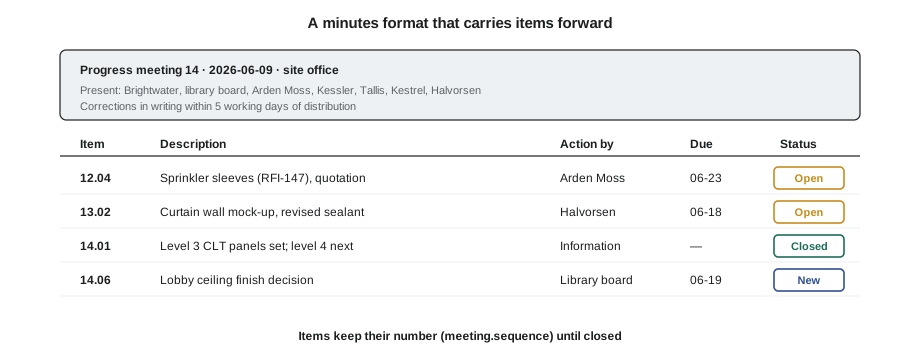
| Item | Description | Action by | Due | Status |
|---|---|---|---|---|
| 12.04 | Sprinkler sleeves through glulam beams (RFI-147). Brightwater considers answer a change; quotation submitted 2026-06-02. | Arden Moss to review proposal | 2026-06-23 | Open |
| 13.02 | Curtain wall mock-up: comments on sealant color issued; revised mock-up ready for review 2026-06-18. | Brightwater / Halvorsen Glazing | 2026-06-18 | Open |
| 14.01 | Level 3 CLT panels set; level 4 starts 2026-06-15 as scheduled. | Information | — | Closed |
| 14.06 | Owner to confirm finish selection for lobby ceiling; affects level 1 ceiling start. | Library board (R. Kaminski) | 2026-06-19 | New |
Several features make these minutes useful. Each item names a person or organization responsible, not 'all' or 'TBD'. Each action has a date. Decisions are stated plainly: 'Owner confirmed …' rather than 'discussed'. References to RFIs, submittals and change records link the minutes to the rest of the record. And the status column lets readers scan for what is new or still open.
Minutes should be neutral. The minute-taker holds the pen, and it is tempting to record discussions in a way that favors one's own position. Experienced owners and designers notice this, and slanted minutes provoke long correction letters and damage trust. Jun's instruction is to write what each party said in plain words, attributed to that party, and to let the facts speak.
Distribution, correction and acceptance
Minutes are only a reliable shared record if every attendee receives them promptly and has a fair chance to correct them. Westgate's Division 01 requires Brightwater to distribute minutes within 3 working days, and says that minutes will be taken as accurate unless written corrections are received within 5 working days of distribution. Corrections are raised in writing and confirmed at the next meeting.
- Send minutes to all attendees and to those on the distribution list who were absent.
- Keep the distribution record: who received the minutes, when and how.
- Log corrections and record how each was resolved; do not silently edit the issued minutes.
- If you disagree with minutes issued by someone else, correct them in writing within the period. Silence may later be treated as agreement.
That last point applies to Brightwater as a recipient as much as to others. On Westgate the commissioning meetings are minuted by the owner's commissioning agent. When one set of minutes recorded that 'the contractor accepted responsibility for the delay to the controls integration', Elena wrote the next day to correct it: Brightwater had agreed to investigate, not accepted responsibility. The correction went into the next minutes.
What minutes can and cannot do
Minutes are good evidence of what was discussed and when people knew about an issue. They are generally not a substitute for the formal steps the contract requires.
A statement in minutes that the owner will pay for extra work is not, by itself, a Change Order under the A201-2017, which requires a written instrument signed by the owner, contractor and architect. A mention of a delay in minutes may show the owner was aware of it, but it may not satisfy the A201's written notice requirements for claims. Brightwater uses minutes to support formal notices and changes, never to replace them: if a meeting discussion affects time or money, a separate notice or change document follows within the contract period.
Courts and tribunals sometimes do give weight to minutes in deciding whether a party knew about an issue or waived a requirement, especially where the minutes were distributed and not corrected. But relying on that is a gamble. The safer course is to treat minutes as the second record of every important event, not the first.
Subcontractor and field meetings
The progress meeting gets the most attention, but the weekly subcontractor coordination meeting and the foremen's look-ahead session often matter more to day-to-day progress. These meetings are shorter and more informal, and they are where trades commit to finishing areas so the next trade can start. Their records can be lighter, but they should still exist. On Westgate, Marcus records each look-ahead session as a marked-up three-week schedule with the commitments each foreman made, photographed and uploaded the same afternoon. The following week he records which commitments were kept. Over the project, the percentage of commitments kept became one of Brightwater's most useful measures of how reliably the work was flowing, and when a disruption claim was later disputed, the look-ahead records showed which trades had been ready to work and which had been held up by others.
Pre-installation meetings deserve full minutes. They are where installers, manufacturers and consultants agree on tolerances, sequences, inspections and the acceptance standard for critical systems such as the roofing membrane, the curtain wall and the timber connections. If an installation later fails, the pre-installation minutes show what was agreed and who agreed to it.
Recording meetings
Video calls have made recording and automatic transcription easy, and some teams use them in place of written minutes. A recording captures everything, which is both its strength and its weakness: an hour-long recording is hard to search, and a transcript full of half-sentences is not a list of decisions. Brightwater uses recordings, where they are made at all, only as a backup to written minutes.
Before recording, everyone in the meeting should be told and should agree. Recording laws differ by state: Pennsylvania, where Westgate is located, generally requires the consent of all parties to record a conversation, and calls may involve participants in other states with their own rules. Brightwater announces any recording at the start, obtains agreement and notes it in the minutes.
Automatic transcripts and AI-generated summaries raise the same questions as recordings, plus another: a machine summary may misstate what was decided. If such tools are used, a person must check the summary before it is issued, and the issued minutes, not the raw transcript, are the record.
Worked problem
How healthy is the action list?
Before meeting 15, Jun reviews the action items carried forward. There are 28 open items. Their ages, in meetings since they were first raised, are: 0 meetings for 6 items (new at meeting 14), 1 meeting for 9 items, 2 meetings for 7 items, 3 meetings for 4 items and 5 meetings for 2 items. Brightwater's guideline is that no item should stay open more than 2 meetings without escalation. How many items need escalation, and what is the average age?
Show solution
- Items older than 2 meetings: 4 + 2 = 6 items need escalation.
- Total item-ages: 6 × 0 + 9 × 1 + 7 × 2 + 4 × 3 + 2 × 5 = 0 + 9 + 14 + 12 + 10 = 45.
- Average age: 45 ÷ 28 = 1.6 meetings.
- The 6 old items go to the top of the agenda with the name of the person responsible and the work affected.
Answer: Six items need escalation; the average open item is about 1.6 meetings old.
# Age of open action items and escalation list
items = {  # item number: meeting raised
    '9.03': 9, '9.07': 9, '11.02': 11, '11.05': 11, '11.08': 11, '11.10': 11,
    '12.04': 12, '12.06': 12, '13.02': 13, '13.05': 13, '14.06': 14, '14.07': 14,
}
current = 14
ages = {k: current - m for k, m in items.items()}
escalate = sorted(k for k, a in ages.items() if a > 2)
print('Open items:', len(items))
print('Average age:', round(sum(ages.values()) / len(ages), 1), 'meetings')
print('Escalate:', ', '.join(escalate))Open items: 12 Average age: 2.3 meetings Escalate: 11.02, 11.05, 11.08, 11.10, 9.03, 9.07
Common mistakes
MistakeWriting minutes as a transcript or a vague summary.
InsteadRecord decisions and actions with a named person and a due date for each.
MistakeSlanting minutes toward your own position.
InsteadAttribute statements fairly and let the facts speak.
MistakeIgnoring minutes issued by others.
InsteadCorrect inaccurate minutes in writing within the period allowed.
MistakeTreating a statement in minutes as a change order or a notice.
InsteadFollow up with the formal document the contract requires.
MistakeRecording meetings without telling participants.
InsteadAnnounce and agree any recording, respect the law of the place, and keep written minutes as the record.
Summary and key terms
- Projects hold pre-construction, progress, coordination, look-ahead, pre-installation, model, safety and closeout meetings.
- Effective meetings follow a standard agenda, start with safety and end with decisions and actions.
- Good minutes number items, carry them forward until closed, and give each action an owner and due date.
- Minutes should be neutral, distributed promptly and open to correction within a stated period.
- Recipients must correct inaccurate minutes in writing; silence may be treated as agreement.
- Minutes support but do not replace formal notices and change orders.
- Recordings and automatic transcripts need consent where the law requires it and are a backup, not the record.
- Minutes
- The written record of a meeting's reports, decisions and actions.
- Action item
- A task arising from a meeting with a named owner and a due date.
- Carry forward
- To keep an open item in the minutes, under its original number, until it is closed.
- Pre-installation meeting
- A meeting held before critical work starts to agree methods, tolerances and inspections.
- Look-ahead schedule
- A detailed short-term schedule, usually three to six weeks, used to plan and commit work.
- Distribution list
- The people who must receive a document, such as minutes, and the record that they did.
Practice problems
Work each problem on paper first, then reveal the answer to check.
What makes an action item useful?
Show answer
A clear description, a named person or organization responsible and a due date.
Why number items by meeting and sequence?
Show answer
So each item keeps an identity that can be followed from meeting to meeting until it is closed.
Minutes say Brightwater accepted responsibility for a delay, but it only agreed to investigate. What should it do?
Show answer
Correct the minutes in writing within the correction period and make sure the correction is recorded at the next meeting.
Ten open items are 0, 0, 1, 1, 1, 2, 2, 3, 4, 6 meetings old. What is the average age and how many exceed 2?
Show answer
Average 20 ÷ 10 = 2.0 meetings; 3 items exceed 2.
Why are minutes not enough to claim extra time?
Show answer
The contract usually requires formal written notice to a named person in a set time; minutes may not meet those requirements.
Lesson quiz · 5 questions
Score 60% or more to complete this lesson.
Create a free account to save your progress, take quizzes and earn a certificate.