
CON-375 · Lesson 3 of 12 · 21 min
Correspondence, transmittals and written notice
In month four of the Westgate project, Brightwater's excavation crew hit a buried concrete foundation where the geotechnical report showed only fill. Marcus Bell phoned Robert Kaminski, the owner's project manager, who came to look that afternoon. Everyone agreed it was unexpected. Everyone agreed it would cost money. Nobody wrote anything down for nine days, by which time the old foundation had been broken out and trucked away. When Elena Vasquez later submitted the change request, the first response from the owner's side questioned whether the condition had been as extensive as Brightwater claimed, and whether written notice had been given before the conditions were disturbed. The phone call and the site visit were real, but they were not notice.
Construction contracts run on written communication. Letters, emails, platform messages and transmittals are how instructions are given, information is exchanged and rights are preserved. Some of these communications are ordinary coordination. Others are formal notices that the contract requires, in a set form, to a set person, within a set time, before a party can claim extra time or money. This lesson is about knowing the difference and getting both right.
On Westgate, the AIA A201-2017 General Conditions require that notices be in writing and set out how they are delivered. Notices of claims have stricter delivery rules than ordinary notices: they must be delivered to the designated representative in person, by certified or registered mail, or by a courier that provides proof of delivery, unless the parties have agreed otherwise, for example in an AIA E203 digital data protocol exhibit. Brightwater's first job at contract award was to read every clause that required written notice and list it, with its trigger, recipient and time limit, in the documentation matrix.
Three kinds of written communication
| Kind | Examples | Formality |
|---|---|---|
| Coordination messages | Emails arranging site visits, questions about schedules, informal updates | Low: still recorded, but not relied on for rights |
| Formal correspondence | Letters on letterhead or numbered platform correspondence, transmittals, requests and responses | Medium: numbered, logged and filed |
| Contractual notices | Notices of delay, changed conditions, claims, default, termination, objections to determinations | High: required form, recipient, method and time limit |
The danger lies in letting a contractual notice hide inside a coordination message. An email that says 'FYI, we hit some old concrete today, will keep you posted' may be enough to show the owner knew about the condition, but it may not satisfy a clause that requires notice to a named person, describing the condition and stating an intention to claim. Brightwater's rule is that anything which might lead to a change in time or money gets its own numbered letter, separate from routine traffic, sent by the method the contract requires.
Correspondence that works
Every piece of formal correspondence on Westgate follows the same pattern, whether it is a letter or a numbered message in the project platform.
- A unique number from the correspondence log, such as BWC-WGT-L-0147, and a clear subject line that names the issue, for example 'Level 2 transfer beam embed plates: RFI-112 response'.
- The date, the sender and the named recipient, with copies to those who need them. Copies are never a substitute for sending to the person the contract names.
- References to the documents involved: drawing numbers and revisions, specification sections, RFIs, earlier letters.
- The facts, in order, without opinion or exaggeration.
- What the writer wants: a decision, information, a meeting, acknowledgment, by a stated date.
- Where rights may be affected, a reservation of rights and, if required, an express statement that the letter is notice under a named clause.
Tone matters. Correspondence is often read later by people who were not there. A letter that is calm, factual and specific reads well to an adjudicator; one that is sarcastic or accusatory makes the writer look unreasonable even when the writer is right. Elena's habit is to draft a difficult letter, leave it overnight, and remove every adjective that is not a fact.
Transmittals
A transmittal is a cover record that lists what was sent, to whom, when, why and what action is required. It turns the act of sending documents into a traceable event. On Westgate every drawing issue, submittal, sample delivery and closeout package moves under a transmittal, and the platform generates most of them automatically.
| Transmittal field | Example |
|---|---|
| Number and date | TR-0418, 2026-04-14 |
| From and to | Arden Moss Architects to Brightwater, attention Jun Park |
| Items | Sheets A-2101 to A-2108, revision C03, 8 sheets |
| Purpose | Issued for construction |
| Action required | Distribute to framing and drywall subcontractors; withdraw C02 |
| Response required by | Not required; acknowledge receipt |
| Remarks | Revised to suit RFI-112 response; embed plates relocated |
The purpose field is the one most often left vague. 'For your information', 'for review and comment', 'for approval' and 'issued for construction' mean very different things, and a recipient who acts on a document sent only for information may find the sender disowns it later. Transmittals that need a response should state the response date, and the log should show when it came back.
Contractual notice: why the clauses are strict
Notice clauses exist so that the party who will pay for a problem learns about it early enough to do something: to investigate, to change the design, to stop work, to keep records of its own, or to budget. A notice given months later deprives the other party of those choices. Courts and tribunals in both countries have often enforced notice requirements strictly, treating timely notice as a condition that must be met before a claim can succeed, although outcomes depend heavily on the exact wording, on conduct and on the law of the place.
Under the A201-2017, claims must generally be initiated by written notice within 21 days after the event giving rise to the claim, or within 21 days after the claimant first recognizes the condition giving rise to it, whichever is later. Concealed or unknown conditions must be reported promptly, before they are disturbed, and no later than 14 days after first observance. Claims for additional time must include an estimate of the probable effect of the delay on the progress of the work. Supplementary conditions often change these periods, so the specific contract must always be read.
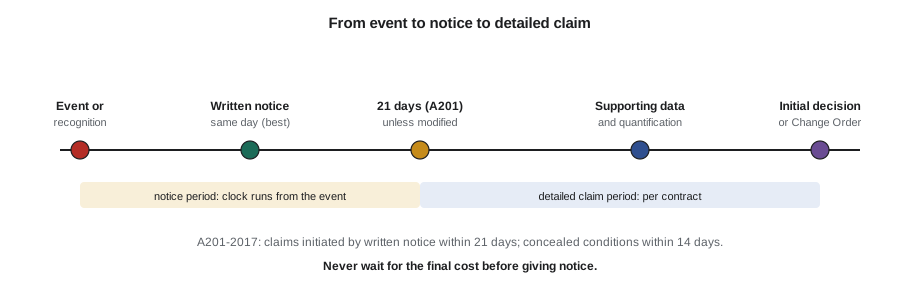
The figure shows the sequence Brightwater follows for every potential claim. The clock starts when the event happens or when Brightwater recognizes it, not when it gets round to writing. A short notice goes first, within the contract period, saying what happened and that Brightwater intends to claim. The detailed claim, with quantified time and cost and supporting records, follows later, within whatever period the contract allows. Waiting until the cost is known before giving notice is one of the most common and expensive mistakes in construction.
Writing a notice
A notice does not need to be long. It needs to be complete, clear and on time. Brightwater uses a template with seven parts.
| Part | Purpose | Westgate example |
|---|---|---|
| Clause | Show which contract provision the notice is given under | A201 Sections 3.7.4 and 15.1 |
| Event | Describe what happened, where and when | Buried concrete foundation found at grid C-D/4-6 on 2026-02-17 |
| Comparison | Explain how this differs from the contract documents | Geotechnical report borehole BH-4 showed fill to 3.2 m |
| Effect | State the expected effect on cost and time, even if not yet quantified | Additional excavation, breaking and disposal; possible delay to footing work |
| Intent | State expressly that a claim will be made or rights are reserved | Brightwater intends to claim an adjustment to the price and time |
| Request | Ask for what is needed | Inspection before removal; instruction on how to proceed |
| Records | Say what is being kept and attached | Photos, survey, daily reports, separate cost code from today |
Had Brightwater sent this notice on the day the foundation was found, Robert Kaminski could have arranged for the geotechnical engineer to inspect it, the extent could have been surveyed jointly, and the argument about how much concrete there had been would never have arisen. Since Westgate, Marcus carries the notice template on his tablet, and the rule on site is that a notice goes the same day as the phone call.
Counting the days
Time limits are expressed in different units: calendar days, working days, business days or periods tied to events such as receipt of an invoice. Each contract defines its terms, and statutes may define them differently. A notice period of five working days that spans a statutory holiday ends later than five calendar days would; a period of 21 calendar days does not stop for weekends.
Worked problem
When is the notice due?
Brightwater discovers a concealed condition on Thursday, 2026-04-02. Its supplementary conditions require notice within 5 working days after first observance, where working days exclude weekends and statutory holidays. Good Friday falls on 2026-04-03. On what date is notice due? If the period were 14 calendar days instead, when would it be due?
Show solution
- Count working days after 2026-04-02: Friday 3 April is a holiday and is skipped.
- Monday 6 April is day 1, Tuesday 7 day 2, Wednesday 8 day 3, Thursday 9 day 4, Friday 10 day 5.
- Working-day deadline: Friday, 2026-04-10.
- Calendar-day deadline: 2026-04-02 plus 14 days = Thursday, 2026-04-16.
- Brightwater's own practice is to send notice the same day, so either deadline is a backstop, not a target.
Answer: Notice is due by 2026-04-10 under the working-day clause, or 2026-04-16 under a 14-calendar-day clause.
Counting by hand invites mistakes, especially across holidays. Jun keeps a small script that computes deadlines for each notice clause in the documentation matrix whenever a new event is logged.
# Compute notice deadlines in working days and calendar days
from datetime import date, timedelta
holidays = {date(2026, 4, 3), date(2026, 5, 18), date(2026, 7, 1)}

def working_deadline(start, n):
    d, count = start, 0
    while count < n:
        d += timedelta(days=1)
        if d.weekday() < 5 and d not in holidays:
            count += 1
    return d

event = date(2026, 4, 2)
print('Event:', event, event.strftime('%A'))
print('5 working days:', working_deadline(event, 5))
print('14 calendar days:', event + timedelta(days=14))
print('21 calendar days:', event + timedelta(days=21))Event: 2026-04-02 Thursday 5 working days: 2026-04-10 14 calendar days: 2026-04-16 21 calendar days: 2026-04-23
Email, platforms and proof of delivery
Most correspondence now travels by email or through a project platform. That is efficient, but it raises questions the contract may answer. Does the contract allow notices by email? To which address? When is an email received: when it is sent, when it arrives, or at the start of the next business day? Does a message posted in a platform count as delivery to the named person, or only when that person opens it? Brightwater checks these points at the start of every project and, if the contract is silent or unclear, asks the owner to agree a protocol in writing.
- Send contractual notices by the method the contract requires, even if everyone usually uses email, and keep the proof: courier receipt, registered mail slip, or a written acknowledgment.
- When email is allowed, send to the named individual, ask for acknowledgment and file the sent message with its headers.
- Do not rely on a platform's internal message for notice unless the contract or a signed protocol says platform delivery counts.
- Keep a notice log separate from the general correspondence log, with the clause, trigger date, deadline, date sent, method and acknowledgment.
Common mistakes
MistakeTreating a phone call or site visit as notice.
InsteadFollow every conversation that might affect time or money with written notice under the named clause, the same day.
MistakeWaiting until costs are known before giving notice.
InsteadGive short notice of intent within the time limit and follow with the detailed claim later.
MistakeCopying the owner's representative but not sending to the person the contract names.
InsteadAddress notices to the designated recipient; copies are extras, not substitutes.
MistakeBurying a notice inside a routine email.
InsteadSend each notice as its own numbered letter that names the clause and states the intent to claim.
MistakeCounting calendar days when the contract says working days, or the reverse.
InsteadRead the contract's definitions and compute deadlines with the holiday calendar.
Summary and key terms
- Written communication ranges from coordination messages to formal correspondence to contractual notices.
- Formal correspondence is numbered, dated, addressed to the named recipient, referenced to documents and factual in tone.
- Transmittals record what was sent, to whom, when, for what purpose and what action is needed.
- The A201-2017 generally requires claims within 21 days and notice of concealed conditions within 14 days; supplementary conditions may change these.
- A good notice names the clause, describes the event, compares it with the contract, states the effect and the intent to claim, makes a request and lists the records kept.
- Deadlines must be counted using the contract's definition of days and the holiday calendar.
- Email and platform delivery count as notice only when the contract or an agreed protocol says so.
- Written notice
- A formal communication delivered in writing as the contract requires.
- Transmittal
- A record listing documents sent, the recipient, the date, the purpose and the action required.
- Reservation of rights
- A statement that a party is not giving up any entitlement by acting or by not yet claiming.
- Condition precedent
- A requirement, such as timely notice, that must be met before a right, such as a claim, arises.
- Claim
- Under the A201, a demand by one party seeking an adjustment of contract terms, payment or time.
- E203
- The AIA exhibit for agreeing protocols for digital data, including electronic delivery.
Practice problems
Work each problem on paper first, then reveal the answer to check.
Why do contracts require early notice of claims?
Show answer
So the paying party can investigate, change course, keep its own records and budget while it still has choices.
List four parts of a good notice.
Show answer
Any four of: the clause, the event, the comparison with the contract, the effect, the intent to claim, the request, the records kept.
An event happens on Monday 2026-06-01; the period is 10 working days and there are no holidays. When is notice due?
Show answer
Count 10 weekdays after 1 June: Monday 15 June 2026.
What is wrong with an email to a site engineer saying 'we found some rock, will update you'?
Show answer
It may not reach the named recipient, cites no clause, states no intent to claim and gives no details or request.
What should a notice log record?
Show answer
The clause, trigger date, deadline, date sent, method of delivery and acknowledgment.
Lesson quiz · 5 questions
Score 60% or more to complete this lesson.
Create a free account to save your progress, take quizzes and earn a certificate.