
CRE-110 · Lesson 3 of 12 · 25 min
Audience research: who you serve and what they need
A niche is defined as much by its audience as by its topic. Two creators can cover the same subject, say home workouts, and build completely different channels because one serves busy parents with fifteen minutes a day and the other serves competitive athletes training for events. The better you understand the people you serve, the easier every later decision becomes: which topics to cover, how to title them, how long to make them, what tone to take, which sponsors fit, and what products to offer. Audience research is the work of learning who those people are, what they need, where they spend time, and what they already watch or read. This lesson covers the main research methods available to an individual creator, the frameworks used to organize what you learn, and the ethics of researching real people.
Ways to describe an audience
Audiences can be described in several layers. Each is useful, but the deeper layers usually matter more for content decisions.
- Demographics: age, gender, location, language, income, education, occupation and family situation. They help with platform choice and sponsor conversations, but people of the same age and income can want completely different things.
- Psychographics: interests, attitudes, values, lifestyle and identity. They explain why someone cares about a topic.
- Situation and context: the circumstances that create a need, such as moving to a new country, starting a first job, being diagnosed with a condition, adopting a dog or buying a first home. Situations often define the best niches, because people actively search for help when their situation changes.
- Behavior: how people consume content (short videos on a commute, long videos on a TV in the evening, podcasts while working), which platforms they use, and what they buy.
- Needs and goals: what they are trying to achieve and what stands in their way.
Jobs to be done
A helpful framework from product design asks what "job" a person "hires" a piece of content to do. Someone watching a ten-minute recipe video may be hiring it to decide what to cook tonight, to learn a technique, to relax after work, or to feel competent in the kitchen. The same video might do some of those jobs well and others badly. Framing audience needs as jobs keeps the focus on outcomes rather than on topics:
- Functional jobs: learn a skill, solve a problem, make a decision, save time or money.
- Emotional jobs: feel calm, feel entertained, feel less alone, feel inspired, feel confident.
- Social jobs: have something to talk about with friends, belong to a community, signal an identity.
A strong niche usually does one primary job very well and supports one or two others. A personal finance channel for new immigrants might mainly do a functional job (understand how credit scores work) while also doing an emotional job (feel less overwhelmed) and a social job (find others in the same position).
Audience personas
A persona is a short, research-based portrait of a typical member of your target audience, written as if describing one real person. It turns scattered research into something you can picture while planning content. A good persona includes a first name and a short description, situation, goals, frustrations, the jobs they hire content for, where and when they consume content, the creators they already follow, and a quote that sums up their attitude, ideally taken or paraphrased from real research.
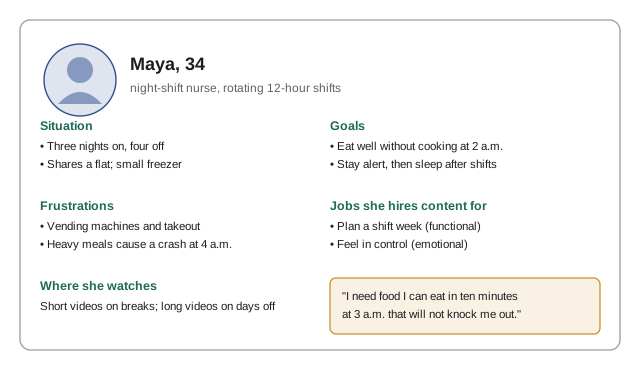
Personas go wrong when they are invented from assumptions rather than evidence, when there are too many of them, or when they describe stereotypes. Start with one primary persona, and add a secondary one only if research shows a distinct group with different needs.
Research methods
Individual creators cannot afford large market research studies, but they have access to many free or cheap sources:
- Social listening: reading what people say in comments on similar creators' content, in online communities and forums, in reviews of related books and products, and in question-and-answer sites. Look for repeated questions, frustrations, misunderstandings and requests. Copy representative quotes (without names) into a research file.
- Search data: search engines and platforms offer tools that show what people search for and how often. Autocomplete suggestions, "people also ask" boxes and keyword research tools reveal the language people use and the questions they have. Trend tools show whether interest is growing, stable or seasonal.
- Competitor audit: studying the content that performs best for creators in or near your niche. Sorting a channel by most popular shows what the audience responds to; reading the comments shows what they still want.
- Surveys: short online questionnaires shared with an existing audience or in communities (with permission from moderators). Keep them short, ask about behavior and problems rather than hypothetical preferences, and include at least one open question.
- Interviews: fifteen- to thirty-minute conversations with five to ten people in your target audience. Ask about their situation, what they have tried, what frustrated them, and where they look for help. Interviews provide depth and the exact words people use, which later become titles and hooks.
- Public data: official statistics show how many people are in a situation and where they live.
In the United States, the Census Bureau (including the American Community Survey) and the Bureau of Labor Statistics publish data on population, language, occupations and household spending, and the Pew Research Center publishes surveys on internet and social media use, which can size an audience.
Asking good questions
People are poor at predicting what they would do but good at describing what they have done. "Would you watch videos about budgeting?" invites polite yes answers that mean little. "Tell me about the last time you tried to make a budget. What happened? Where did you look for help?" reveals real behavior, real problems and real sources. Other useful questions include: "What is the hardest part of [situation]?", "What have you tried that did not work?", "Who do you follow for this, and what do you wish they did differently?", and "If you could wave a magic wand, what would change?" Avoid leading questions that suggest the answer you want.
Organizing what you learn
Research produces a pile of notes, quotes and numbers. To make it useful, group findings into themes: repeated problems, common goals, recurring questions, objections and misconceptions, and the words people use. An affinity map is a simple method: write each finding on a separate note, then cluster similar notes and name each cluster. The largest and most emotionally charged clusters usually point to the most valuable content opportunities.
Worked problem
From listening to content ideas
Sam is researching a niche helping adults learn to swim. In two weeks of reading forums and comments, Sam records 120 relevant comments. The largest clusters are: fear and embarrassment about swimming in public (38 comments), breathing technique (27), finding adult lessons (19), floating (14), and buying gear (8). The rest are miscellaneous. What do these findings suggest?
Show solution
- The largest cluster (38 of 120, about 32 %) is emotional, not technical: fear and embarrassment.
- Breathing (about 23 %) and floating (about 12 %) are the main technical problems.
- Finding lessons (about 16 %) suggests a practical, local information need.
- Gear is a small cluster (about 7 %), so gear reviews are probably not the core of the channel, though they may support affiliate income later.
Answer: The core brand promise should address fear as well as technique: for example, "calm, judgment-free swimming lessons for nervous adults", with series on breathing and floating and a guide to finding adult classes.
Ethics of audience research
Audience research involves real people, so it carries obligations. Read public conversations, but do not quote people by name or identifiable details in your content without permission, and never share screenshots that could expose someone. Follow community rules: many forums prohibit self-promotion or surveys without moderator approval. In surveys and interviews, tell participants who you are and how you will use their answers, collect only what you need, and keep personal information secure. Be particularly careful with sensitive topics such as health, sexuality, immigration status or finances, and with anyone who may be under the age of majority.
In the United States, there is no single federal privacy law for most creators, but state laws such as the California Consumer Privacy Act apply to businesses above certain thresholds, and the Children's Online Privacy Protection Act (COPPA) restricts collecting personal information from children under 13; an anonymous survey with no names or contact details greatly reduces obligations.
The audience profile
Summarize your research in an audience profile for your brand plan: one primary persona (and at most one secondary), the top three jobs your content will do, the top five problems or questions with representative quotes, where and how the audience consumes content, the creators and sources they already use, and an estimate of audience size from search and public data. Note the date: audiences and platforms change, so the profile should be refreshed every six to twelve months.
Turning research into language
One of the most practical outputs of audience research is vocabulary. People search, comment and share using their own words, which are often different from the words experts use. A nurse might say "circadian disruption", while a shift worker searches for "how to stop feeling sick on night shifts". Keep a list of the exact phrases your audience uses for their problems, goals and frustrations. These phrases become titles, thumbnail text, hooks and search keywords, and using them signals to viewers that you understand their situation. Review the list regularly, because language changes and new questions emerge as the audience grows.
Research also reveals what your audience already believes, including misconceptions. Content that gently corrects a widespread misconception, with clear evidence, often performs well because it surprises viewers while helping them. Treat misconceptions respectfully: people who hold them are not foolish, they have usually been given poor information.
How much research is enough?
New creators sometimes research for months without publishing, while others publish without any research at all. A balanced approach is to spend two to four weeks on initial research, enough to build a first persona, collect the main questions and estimate demand, and then start publishing. Publishing itself is a research method: every piece produces data and comments that refine your understanding of the audience. Plan a short research review every few months to update the profile with what you have learned.
Remember too that your audience is made of individuals, not averages. Personas and statistics help with planning, but each comment and message comes from a real person with a particular situation. Reading and responding to individual audience members, especially in the early months, keeps research grounded and reminds you who the brand is for. Many creators keep a folder of messages from viewers describing how content helped them; it is both a research archive and a source of motivation on difficult days.
Common mistakes
MistakeDescribing the audience only by age and gender.
InsteadInclude situation, goals, problems and behavior.
MistakeInventing personas from assumptions.
InsteadBuild them from listening, search data, surveys and interviews.
MistakeAsking people what they would watch in future.
InsteadAsk about past behavior and real problems.
MistakeQuoting forum users by name in content.
InsteadAnonymize quotes and respect community rules.
MistakeTreating research as a one-time task.
InsteadRefresh the audience profile every six to twelve months.
Summary and key terms
- Audiences can be described by demographics, psychographics, situation, behavior, and needs and goals.
- Jobs to be done frame content as functional, emotional and social jobs people hire it for.
- Personas are short, evidence-based portraits; start with one primary persona.
- Listening, search data, competitor audits, surveys, interviews and public data are affordable methods.
- Ask about past behavior, not hypothetical future choices.
- Affinity mapping groups findings into themes that reveal content opportunities.
- Research ethically: anonymize, follow community rules and protect personal information.
- Demographics
- Measurable characteristics such as age, location and income.
- Psychographics
- Interests, attitudes, values and lifestyle.
- Jobs to be done
- The outcomes people seek when they choose content.
- Persona
- A research-based portrait of a typical audience member.
- Social listening
- Studying what people say publicly about a topic.
- Keyword research
- Finding the terms people search for and how often.
- Competitor audit
- Studying what performs well for similar creators.
- Affinity map
- A method of clustering research findings into themes.
- Leading question
- A question that suggests the expected answer.
- Audience profile
- A summary of research about the target audience.
Practice problems
Work each problem on paper first, then reveal the answer to check.
Why is situation often more useful than demographics?
Show answer
Situations create active needs, and people search for help when their situation changes.
Name the three types of jobs content can do.
Show answer
Functional, emotional and social.
What does a good persona include?
Show answer
Situation, goals, frustrations, jobs, consumption habits, creators followed, and a quote.
Name four low-cost research methods.
Show answer
Social listening, search data, competitor audits, surveys, interviews, public data.
Rewrite: "Would you watch videos on composting?"
Show answer
"Tell me about the last time you tried composting. What happened?"
How many interviews are typically enough to find patterns?
Show answer
About five to ten.
What is an affinity map?
Show answer
Clustering individual findings into named themes.
A cluster holds 45 of 150 comments. What percentage is that?
Show answer
30 %.
Name two ethical rules for audience research.
Show answer
Anonymize quotes; follow community rules; get consent; protect personal data.
How often should the audience profile be refreshed?
Show answer
Every six to twelve months.
Lesson quiz · 5 questions
Score 60% or more to complete this lesson.
Create a free account to save your progress, take quizzes and earn a certificate.