
CRE-110 · Lesson 5 of 12 · 24 min
Positioning and differentiation
Choosing a niche tells you where to compete; positioning tells you how to win there. Positioning is the place your brand occupies in the audience's mind relative to the alternatives they already know. When a viewer thinks "I want to learn to cook cheaply", several creators may come to mind; positioning determines whether you are one of them, and what they think of you when you are. Differentiation is the set of real, meaningful differences that justify that position. Without them, a creator is one more interchangeable option in a crowded feed. This lesson explains how positioning works, the main ways creators differentiate, how to map the competitive landscape, how to write a positioning statement, and how to test whether your positioning actually lands with an audience.
How positioning works
People cannot remember everything they see, so they sort options into simple mental categories and remember a few names in each. Marketers have long observed that it is easier to be first in a small category than tenth in a large one. For creators, this means defining a category where you can be one of the first names people think of, and making the reason clear and easy to repeat. A good position can be said in one sentence that a viewer would use to recommend you to a friend: "She explains tax for freelancers without the jargon", "He builds furniture from pallets with only hand tools", "They review budget phones by actually living with them for a month."
Positioning has three ingredients:
- A frame of reference: the category or alternatives you are compared with (cooking channels, finance podcasts, gaming streamers).
- A point of difference: what makes you meaningfully different and better for your audience.
- A reason to believe: evidence that the difference is real, such as credentials, experience, results, a distinctive process or consistent proof in your content.
Ways to differentiate
Creators differentiate along several dimensions. Strong brands usually combine two or three.
- Audience: serving a specific group others overlook (beginners, seniors, parents, a language community, people with disabilities, a profession).
- Angle or perspective: a distinctive viewpoint from your background (a chef reviewing fast food, a lawyer analyzing courtroom dramas, an engineer testing fitness gadgets).
- Depth or level: going far deeper than others (hour-long breakdowns), or making things far simpler (sixty-second explainers).
- Format: a recognizable structure or medium (challenge series, side-by-side tests, animated explainers, live builds, interview formats, newsletters with diagrams).
- Tone and personality: calm where others are loud, funny where others are dry, warm where others are clinical (Lesson 7).
- Values and stance: commitments the audience shares, such as sustainability, honesty about sponsors, budget-consciousness, accessibility or body neutrality.
- Proof and process: testing claims, showing real results over time, citing sources or documenting failures as well as successes.
- Production style: visual and audio style that makes content instantly recognizable (Lesson 8).
Differentiation must matter to the audience. Being the only creator who films in black and white is different, but unless the audience values it, it is not a reason to choose you. Return to your audience research and ask which differences address real jobs, frustrations or desires.
Mapping the competitive landscape
A positioning map plots competitors on two axes that matter to the audience, revealing crowded areas and empty spaces. Choose axes from your research: beginner to advanced, entertaining to educational, budget to premium, short to long, casual to authoritative, solo to community-driven. Plot the leading creators in the niche, then look for open space that corresponds to a real audience need.
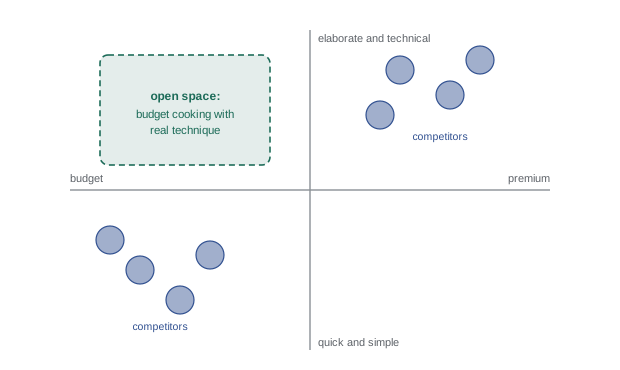
Empty spaces are not automatically opportunities. Some are empty because nobody wants that combination. Check each gap against demand evidence (Lesson 4) before claiming it.
The positioning statement
A positioning statement is an internal sentence, not a slogan, that captures your position precisely. A common template is:
"For [target audience] who [need or problem], [brand] is the [frame of reference] that [point of difference], because [reason to believe]."
Worked problem
Writing a positioning statement
Jordan, the nurse from Lesson 1, has researched shift workers and found that existing meal prep channels assume nine-to-five schedules, use long recipes and rarely address fatigue. Write a positioning statement.
Show solution
- Target audience: nurses and other shift workers.
- Need: eating well on rotating and night shifts, with little time and energy.
- Frame of reference: meal prep channels.
- Point of difference: plans built around shift schedules, with food that is quick to eat on short breaks and avoids the sluggishness of heavy meals.
- Reason to believe: Jordan is a registered nurse who has worked night shifts for eight years and shows real shift-week preparation on camera.
Answer: "For nurses and shift workers who struggle to eat well on rotating and night shifts, Night Shift Kitchen is the meal prep channel that plans food around your shifts, quick to eat on a fifteen-minute break and easy on energy, because it is made by a night-shift nurse who preps this way every week."
From the positioning statement come shorter external expressions: a tagline ("Meal prep for people who work while everyone sleeps"), a channel description, a bio and an elevator pitch for sponsors (Lesson 10).
Category creation
Sometimes the best position is a new category: a label for something that did not have one, which the creator then owns. Examples include formats such as "study with me" streams, "day in the life" videos for specific professions, or "slow living" content. Creating a category is powerful but slow, because audiences must first understand and want the new thing. More often, creators win by defining a sub-category: "budget technical cooking" rather than a wholly new category.
Testing your positioning
Positioning lives in the audience's mind, so test it there:
- The friend test: show three pieces of your content to people in your target audience who do not know you, then ask them to describe the creator in one sentence. Compare their words to your positioning statement.
- Comment analysis: do comments mention the differences you intended ("finally a channel that works with night shifts")?
- Recommendation language: when people share your content, what do they say about it?
- Search terms: which searches lead people to you, and do they match your intended category?
If the audience describes you differently from your intent, either adjust your content to express the position more clearly or adopt the position the audience has already given you, if it is a good one.
Staying consistent without becoming repetitive
A position must be expressed consistently for audiences to absorb it. Every title, thumbnail, intro, series and collaboration either reinforces the position or blurs it. That does not mean every piece must be the same: within a clear position, you can vary topics, guests and formats freely. A useful check before publishing is to ask, "Could this only have come from me? Does it keep my promise?" If a piece could have come from any creator in the niche, it adds little to your position, even if it gets views.
Positions also need defending. When a successful creator's angle becomes popular, imitators appear. The best defenses are continued improvement, a deepening relationship with the audience, and expanding the parts of the position that are hardest to copy, such as personal experience, community and trust.
Positioning examples across niches
It helps to study how positioning works in practice. Consider three hypothetical creators in personal finance. The first is positioned as the calm, practical guide for people who feel embarrassed about money, with slow-paced explanations and no judgment. The second is positioned as the data-driven analyst for people who enjoy spreadsheets, with detailed comparisons and charts. The third is positioned as the voice of first-generation professionals, discussing money in the context of family obligations and cultural expectations. All three cover budgeting, saving and investing, yet they attract different audiences who would rarely confuse them with each other. Each position is supported by a reason to believe: personal experience of financial anxiety, a background in finance, or a shared cultural story.
Notice that none of these positions rely on claiming to be the best or the most complete. Claims of superiority are hard to prove and easy for competitors to match. Positions built on a specific audience and a specific perspective are easier to defend, because they depend on who you are and who you serve.
Positioning and pricing
Positioning also influences how creators earn money. A position as a trusted expert supports higher prices for courses, consulting and sponsorships. A position as a fun, accessible entertainer may support higher volumes of advertising and merchandise sales but lower prices per product. Consider whether your position fits the income model you want, and adjust either one if they conflict. A creator positioned as a budget-friendly helper may struggle to sell an expensive premium course without first explaining clearly why it offers value for money.
Revisiting positioning as you grow
Positions are not permanent. As a channel grows, its audience broadens, competitors respond and the creator gains experience. A position that suited a new creator, such as "a beginner learning alongside you", becomes less believable after five years of practice. Review your positioning statement at least once a year. Ask whether the audience, the need, the frame of reference, the difference and the proof are all still accurate. Small updates keep the position credible and help you notice when a larger change is needed (Lesson 11).
When a creator grows into a stronger position, such as moving from enthusiastic amateur to recognized expert, the change should be reflected gradually in titles, descriptions and the reasons to believe you share, rather than announced suddenly.
Finally, remember that positioning is expressed mostly through content, not through statements. A clear positioning statement and tagline help, but audiences learn your position by watching what you make, how you make it and how you treat them. Ten pieces that consistently deliver on the promise communicate the position far more powerfully than any description. Treat every piece as evidence for your position, and the audience will form the impression you intend.
A practical exercise is to collect the one-sentence descriptions that viewers use in comments and shares over a month, then compare them with your positioning statement. Where the words match, your position is landing. Where they differ, look for patterns that suggest either a clearer way to express your intended position or a better position the audience has already chosen for you.
Common mistakes
MistakeDifferentiating on features the audience does not care about.
InsteadChoose differences that address real needs from research.
MistakeClaiming a gap on a positioning map without checking demand.
InsteadVerify that someone wants the empty combination.
MistakeWriting a positioning statement full of vague words such as "quality" and "fun".
InsteadBe specific about audience, need, difference and proof.
MistakeAssuming the audience sees you as you intend.
InsteadTest with the friend test, comments and search terms.
MistakePublishing content that could have come from anyone.
InsteadAsk whether each piece reinforces your position.
Summary and key terms
- Positioning is the place your brand occupies in the audience's mind relative to alternatives.
- A position has a frame of reference, a point of difference and a reason to believe.
- Differentiate by audience, angle, depth, format, tone, values, proof and production style.
- Positioning maps reveal crowded areas and gaps; check gaps against demand.
- The positioning statement template captures audience, need, category, difference and proof.
- Sub-categories are usually more practical than wholly new categories.
- Test positioning with real audience language, and express it consistently.
- Positioning
- The place a brand occupies in the audience's mind.
- Differentiation
- Meaningful differences that justify a position.
- Frame of reference
- The category or alternatives you are compared with.
- Point of difference
- What makes you different and better for the audience.
- Reason to believe
- Evidence that the difference is real.
- Positioning map
- A chart plotting competitors on two meaningful axes.
- Positioning statement
- An internal sentence defining the position precisely.
- Tagline
- A short external phrase expressing the position.
- Category creation
- Defining a new category that the brand owns.
- Friend test
- Asking strangers to describe you in one sentence.
Practice problems
Work each problem on paper first, then reveal the answer to check.
What is the difference between a niche and a position?
Show answer
The niche is where you compete; the position is how you are seen relative to alternatives there.
Name the three ingredients of positioning.
Show answer
Frame of reference, point of difference, reason to believe.
List five ways creators differentiate.
Show answer
Audience, angle, depth, format, tone, values, proof, production style.
Why must differentiation matter to the audience?
Show answer
Differences nobody values give no reason to choose you.
Suggest two axes for a positioning map of fitness channels.
Show answer
Beginner to advanced; gym-based to home-based.
Why are some gaps on a map empty?
Show answer
Nobody wants that combination.
Write the positioning statement template.
Show answer
For [audience] who [need], [brand] is the [category] that [difference], because [proof].
How does a tagline differ from a positioning statement?
Show answer
A tagline is a short external phrase; the statement is internal and precise.
Describe the friend test.
Show answer
Show content to strangers in the audience and ask them to describe the creator in one sentence.
How can a creator defend a position against imitators?
Show answer
Keep improving and deepen hard-to-copy assets like experience, community and trust.
Lesson quiz · 5 questions
Score 60% or more to complete this lesson.
Create a free account to save your progress, take quizzes and earn a certificate.