
CRE-110 · Lesson 4 of 12 · 25 min
Validating a niche: demand, competition and viability
By now you have a shortlist of candidate niches that fit you (Lesson 2) and a growing picture of the people they would serve (Lesson 3). Before committing months of work, it is worth testing each finalist against three questions. Is there enough demand: do enough people want this, and is interest growing or shrinking? Can you compete: who already serves this audience, how well, and is there room for you? Is it viable: can the niche eventually support your goals, whether those are income, influence, a portfolio or a community? This lesson shows how to gather evidence on each question with free and low-cost tools, how to combine the evidence in a scoring matrix, and how to run a small publishing test that provides the most reliable evidence of all: real audience response.
Measuring demand
Demand is the number of people actively interested in a topic and the strength of their interest. Useful indicators include:
- Search volume: keyword tools estimate how many searches a term receives each month. Look at the main term and the long-tail questions around it ("how to start swimming as an adult", "adult swim lessons near me", "how to breathe while swimming freestyle"). A niche with many moderately searched questions often beats one with a single high-volume term dominated by large sites.
- Trends: trend tools show whether interest is rising, stable, falling or seasonal. A seasonal niche (gardening, tax filing, holiday crafts) can work, but plan for quiet months.
- Community size: the number of members and level of activity in forums, groups and subreddits about the topic. Active daily discussion signals living demand; large but silent groups may be dormant.
- Creator performance: view counts on recent videos from small and medium creators in the niche. If channels with 5,000 subscribers regularly get 20,000 views on some videos, the topic attracts viewers beyond existing subscribers, a sign of demand that the platform is willing to recommend.
- Spending: products, courses, books and services sold in the niche. If people pay for solutions, they value the topic.
No single indicator is decisive. Look for several pointing in the same direction.
Assessing competition
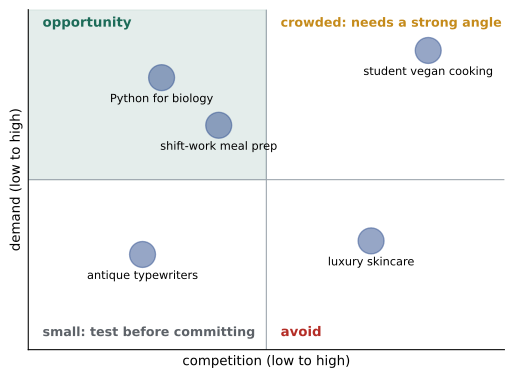
Competition is not just the number of creators; it is how well the audience's needs are already met. A crowded niche with mediocre content can be easier to enter than a small niche dominated by one excellent, beloved creator. A competitor audit for each finalist niche asks:
- Who are the top ten creators, and how large are they?
- How recently were they active, and are they growing?
- What formats and angles do they use? What do they all do the same way?
- What do their comments ask for that they do not provide?
- Are there audience segments they ignore, such as beginners, older people, a language group, a region, a budget level or a disability community?
- How strong is the quality bar: could you match or exceed their production quality and depth within a reasonable time?
Gaps found this way become your positioning opportunities (Lesson 5). A niche where every creator makes long, expert-level tutorials may have room for short beginner explainers; a niche full of polished studio content may welcome a relaxed, documentary style.
Assessing viability
A niche must support your goals. If you want creator work to become a living, the niche needs routes to income; if your goal is a portfolio for a job, it needs to demonstrate relevant skills; if your goal is community, it needs people who want to connect. For income, consider:
- Advertising rates: platforms share ad revenue, and advertisers pay more to reach some audiences than others. Niches about finance, business, software and technology usually earn much higher revenue per thousand views than entertainment, gaming or general lifestyle, because their viewers are valuable to advertisers.
- Sponsorship potential: are there companies that sell to this audience and sponsor creators? Look at the sponsors on competitors' content.
- Affiliate potential: are there products the audience buys that offer affiliate commissions?
- Products and services: could you eventually sell courses, templates, coaching, physical products, memberships or consulting to this audience?
- Audience spending power: an audience of students may be large and enthusiastic but have little money; an audience of small-business owners may be smaller but spend more.
High-paying niches are attractive but crowded with creators chasing income. Lower-paying niches can still be viable through volume, memberships or products, and they may face less competition.
The niche scoring matrix
A scoring matrix combines the evidence. List each finalist niche, score it from 1 to 5 on each criterion, multiply by a weight that reflects your priorities, and add the results. The weights force you to decide what matters most to you.
| Criterion | Weight | Niche A: budget vegan for students | Niche C: Python for biology students |
|---|---|---|---|
| Personal fit (Lesson 2 total ÷ 4) | 3 | 4.25 → 12.75 | 4.25 → 12.75 |
| Demand | 2 | 4 → 8 | 3 → 6 |
| Competition (5 = little) | 2 | 2 → 4 | 4 → 8 |
| Monetization potential | 2 | 2 → 4 | 4 → 8 |
| Differentiation available | 1 | 3 → 3 | 4 → 4 |
| Total | 31.75 | 38.75 |
Worked problem
Interpreting the matrix
Using the matrix above, which niche should Priya test first, and what would change the result?
Show solution
- Niche C scores 38.75 against 31.75 for A, mainly because of lower competition and better monetization (biology and data science learners may buy courses; employers and software companies may sponsor).
- Niche A has higher demand, but student vegan cooking is crowded, and the audience has little spending power.
- If Priya cared mainly about reach rather than income, she might raise the weight on demand to 3 and lower monetization to 1. Recalculate: A = 12.75 + 12 + 4 + 2 + 3 = 33.75; C = 12.75 + 9 + 8 + 4 + 4 = 37.75. C still leads.
- The matrix gives a starting point; a publishing test will provide stronger evidence.
Answer: Test Niche C first. The result is robust to reasonable changes in weights, but real audience response in the test will be the deciding evidence.
Running a publishing test
The most reliable validation is to publish. A niche test is a planned batch of content, typically eight to fifteen pieces published over four to eight weeks, designed to learn rather than to go viral. Plan the test like an experiment:
- Choose formats you can sustain, and keep production simple so effort goes into ideas and clarity.
- Cover a range of sub-topics within the niche to see which resonate.
- Use titles and thumbnails that state clearly who the content is for and what it offers.
- Decide in advance what you will measure: views from non-subscribers, average view duration or completion rate, click-through rate on thumbnails, saves and shares, comments that ask for more, and subscriber conversion.
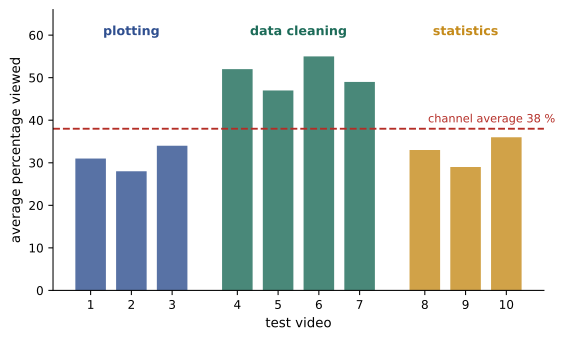
- Decide in advance what result would make you continue, adjust or stop. For example: "If at least three of ten videos get above-average retention for my channel and comments ask follow-up questions, continue."
Be patient with absolute numbers in a new account: early views are small and noisy. Compare pieces with each other, and pay attention to qualitative signals such as comments that say "finally someone explains this" or "can you do one on...". Those signals often appear before large numbers do.
Reading the results
Results usually fall into one of four patterns:
- Clear signal: some pieces perform well above the rest and attract enthusiastic comments. Double down on that sub-topic and format.
- Spread interest: everything performs modestly, with no standout. The niche may be too broad, or the content too generic; sharpen the angle and test again.
- Strong reach, weak connection: some pieces get views but little engagement or few subscribers. The topic attracts curiosity, but the audience does not see a reason to follow; strengthen the brand promise and series structure.
- Little response: almost no views or engagement after a fair test. Check packaging (titles and thumbnails) and discoverability first; if those are sound, consider the next niche on your list.
Keep a test log recording what was published, when, and the results, along with your interpretation. This becomes part of your brand plan and helps future decisions.
When the evidence conflicts
Sometimes the data say one thing and your heart says another: the niche you love tests poorly, or the niche that tests well bores you. Remember that a niche must pass both tests to be sustainable. Often the solution is a blend: bring your passion to the format or perspective while serving the topic and audience that showed demand. A creator who loves storytelling but found demand for practical tax advice might tell the stories of real (anonymized) tax mistakes, keeping both the data and the enjoyment.
Validating with small experiments
Validation does not have to wait for a full test batch. Small experiments can provide early evidence. Posting a question in a relevant community (where rules allow) and seeing how many people respond, publishing a short clip on a secondary platform to test a sub-topic, or sending a simple survey to a newsletter list can all reveal interest within days. Each experiment should test a specific question, such as whether beginners or intermediate learners respond more strongly, or whether people care more about cost or speed.
Keep experiments cheap and fast, record the results in your test log, and look for consistent signals across several experiments before drawing conclusions. A single post that happens to catch attention may reflect timing or luck rather than real demand.
Ethical validation
Validation should never involve deceiving people. Avoid fake accounts to inflate engagement, misleading surveys that promise rewards you will not give, or posting in communities in ways that break their rules. Apart from being dishonest, these tactics produce unreliable evidence: engagement you manufactured tells you nothing about real demand. Honest experiments, even small ones, give you information you can actually trust and build on.
It is also worth validating your own commitment. During the test, track how much time each piece actually took and how you felt making it. A niche that tests well with audiences but leaves you exhausted after a month may need a different format or pace before it becomes sustainable.
When the test is complete, write a short decision memo for your brand plan: which niche you chose, the evidence that supported the choice, the evidence that worried you, and what you will watch for in the next three months. Writing the reasons down protects against hindsight bias later, when it is easy to remember the decision as more obvious than it was, and it gives you a baseline to compare against as the channel develops.
Validation also continues after launch. The first year of publishing is, in effect, a longer and richer test. Keep comparing pieces, sub-topics and formats, and treat each quarterly review as an opportunity to confirm or adjust the original decision with far more evidence than you had at the start. A niche chosen carefully and then checked regularly rarely leads a creator far off course.
Common mistakes
MistakeJudging demand from one indicator.
InsteadLook for several indicators pointing the same way.
MistakeCounting competitors instead of assessing how well needs are met.
InsteadAudit quality, gaps and ignored segments.
MistakeIgnoring monetization until later.
InsteadCheck sponsor, affiliate and product potential now.
MistakePublishing without deciding what to measure.
InsteadSet metrics and continue, adjust or stop criteria in advance.
MistakeGiving up after a few low-view videos.
InsteadRun a fair test of eight to fifteen pieces and compare within it.
Summary and key terms
- Validate finalist niches on demand, competition and viability before committing.
- Demand indicators include search volume, trends, community activity, creator performance and spending.
- Competition is about how well needs are met; gaps become positioning opportunities.
- Viability depends on your goals; check advertising, sponsors, affiliates and products.
- A weighted scoring matrix combines evidence and makes priorities explicit.
- A planned publishing test of eight to fifteen pieces gives the strongest evidence.
- Read results as patterns, keep a test log, and blend passion with demonstrated demand.
- Demand
- The number of interested people and the strength of their interest.
- Long-tail keyword
- A specific, lower-volume search phrase.
- Seasonality
- Regular rises and falls in interest through the year.
- Competitor audit
- A structured review of creators serving the same audience.
- Viability
- The niche's ability to support the creator's goals.
- RPM
- Revenue per thousand views earned by the creator.
- Scoring matrix
- A weighted table for comparing options.
- Niche test
- A planned batch of content published to gather evidence.
- Completion rate
- The share of viewers who reach the end.
- Test log
- A record of test content, results and interpretation.
Practice problems
Work each problem on paper first, then reveal the answer to check.
Name the three validation questions.
Show answer
Demand, competition and viability.
Why can long-tail questions be valuable?
Show answer
Together they represent large demand with less competition from big sites.
What does a small channel getting many views on some videos indicate?
Show answer
The platform recommends the topic beyond subscribers, a sign of demand.
Why might a crowded niche still be enterable?
Show answer
If existing content is mediocre or ignores segments.
Why do finance channels often earn higher ad revenue per view?
Show answer
Advertisers pay more to reach those viewers.
Score a niche: fit 4 (weight 3), demand 3 (2), competition 2 (2), money 5 (2), differentiation 3 (1).
Show answer
12 + 6 + 4 + 10 + 3 = 35.
How many pieces make a reasonable niche test?
Show answer
About eight to fifteen over four to eight weeks.
Name four metrics to track in a niche test.
Show answer
Non-subscriber views, retention, click-through rate, shares, comments, subscriber conversion.
What does "strong reach, weak connection" suggest?
Show answer
Strengthen the brand promise and series so viewers have a reason to follow.
How can you resolve a conflict between passion and data?
Show answer
Blend: bring passion to format or perspective while serving demonstrated demand.
Lesson quiz · 5 questions
Score 60% or more to complete this lesson.
Create a free account to save your progress, take quizzes and earn a certificate.