
FILM-120 · Lesson 1 of 12 · 28 min
Why cinema history matters and how historians work
Cinema is little more than 130 years old, yet in that time it has gone from a fairground novelty to one of the most powerful art forms and industries in the world. Every film you watch, and every film you will make, sits in a long conversation with the films that came before it. Camera movements, editing patterns, genres, lighting styles and even the length of a feature film all have histories. This course traces that history from optical toys of the nineteenth century to the streaming platforms of today, with attention to Canada, the United States and cinema around the world. This first lesson asks why that history matters, how film historians actually work, and why the story of cinema is always being rewritten.
Why image makers study cinema history
Film students sometimes ask why they should watch old films when they want to make new ones. There are at least four good answers.
- Vocabulary: almost every technique has a name and a history. Knowing that crosscutting developed in the 1900s, that deep-focus photography became a celebrated style in the early 1940s, or that the jump cut was popularized by the French New Wave lets you discuss and choose techniques with precision.
- Solutions: early filmmakers faced the same problems you face, such as how to show two places at once, how to suggest time passing, or how to make an audience feel fear, and they invented solutions you can borrow, adapt or deliberately reject.
- Context: films are shaped by technology, money, law, politics and culture. Understanding why a film looks the way it does means understanding the conditions in which it was made.
- Originality: you cannot know whether an idea is new until you know what has been done. Many celebrated innovations turn out to be rediscoveries of older ideas.
Directors often describe themselves as students of film history. Many of the French New Wave critics-turned-directors of the late 1950s learned cinema by watching hundreds of older films at a Paris film archive, and many filmmakers since have built their style on deep knowledge of earlier work. Studying history is not nostalgia; it is training.
What counts as cinema history?
Cinema history is not a single story. Historians write several overlapping kinds of history, and it helps to recognize which kind a book, documentary or lecture is offering.
| Kind of history | Main question | Typical sources |
|---|---|---|
| Aesthetic history | How did film style and form change? | The films themselves, frame studies, shot counts, scripts |
| Technological history | How did cameras, film stocks, sound and projection develop? | Patents, equipment, trade journals, engineering papers |
| Industrial and economic history | How were films financed, made, distributed and shown? | Studio records, box office data, contracts, court cases |
| Social and cultural history | How did audiences use and understand films, and what did films say about society? | Reviews, fan magazines, censorship records, oral histories |
| National and regional history | How did cinema develop in a particular country or community? | Government policy, national archives, local newspapers |
These approaches overlap constantly. The coming of sound in the late 1920s, for example, was a technological change, an industrial upheaval, an aesthetic challenge and a cultural event all at once. Good history connects them rather than treating any one as the whole story.
Periods, movements and turning points
To make a long and tangled story manageable, historians divide it into periods and identify movements and turning points. Common divisions include early cinema (roughly 1890s to about 1915), the silent feature era (about 1915 to the late 1920s), the coming of sound (about 1926 to 1932), the studio era (roughly the 1930s and 1940s), postwar and new wave movements (late 1940s to the 1960s), New Hollywood (late 1960s to about 1980), and the digital era (from the 1990s onward, accelerating after about 2010).
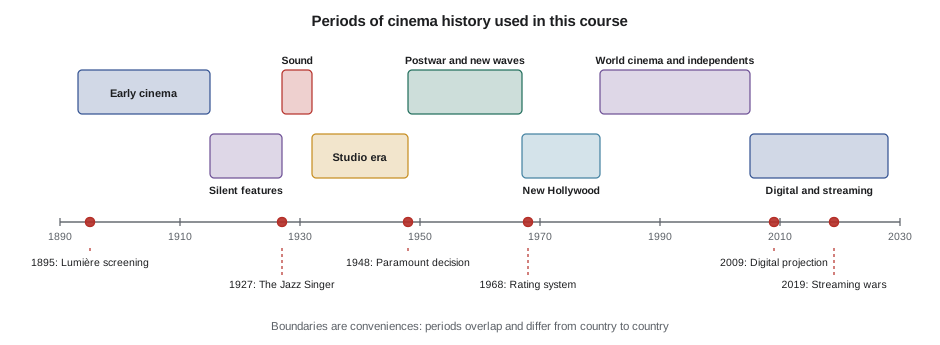
Periods are tools, not facts of nature. The studio era in the United States does not map neatly onto Japan, India or Canada, and some national cinemas converted to sound years after Hollywood did. A movement such as Italian Neorealism had a few core years but long influence. Always ask whose history a periodization describes.
The problem of survival: lost films
A historian of literature can usually read the books under discussion. A film historian often cannot see the films. Early film was printed on cellulose nitrate stock, which is highly flammable and chemically unstable. Nitrate fires destroyed vaults and cinemas, and nitrate prints decompose over decades, turning sticky, then to powder. Studios also deliberately destroyed prints and negatives they no longer saw as valuable, or melted them down to recover silver. Many early films were simply never preserved because nobody imagined they would matter.
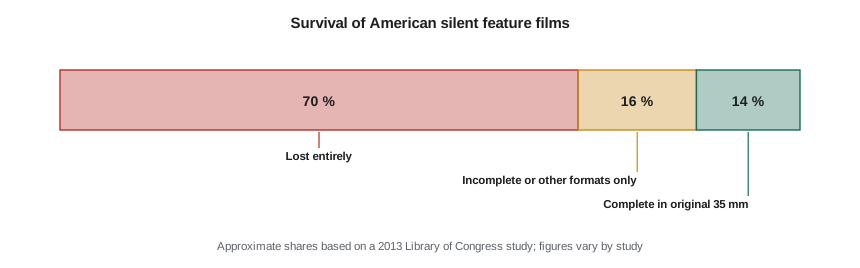
The losses are enormous. A widely cited 2013 study for the Library of Congress estimated that about 70 % of American feature films from the silent era are lost entirely, and only a small fraction survive in their original 35 mm form. Losses in many other countries are similar or worse. Canadian silent production was smaller, but much of it has also disappeared.
Worked problem
How much of a body of work survives?
Suppose a historian lists 240 feature films produced in a country between 1912 and 1928. Archives hold complete prints of 31, incomplete prints or fragments of 41, and nothing at all of the rest. What share survives completely, partly and not at all?
Show solution
- Films with nothing surviving: \( 240 - 31 - 41 = 168 \).
- Complete share: \( 31 \div 240 \approx 0.129 \), about 13 %.
- Partial share: \( 41 \div 240 \approx 0.171 \), about 17 %.
- Lost share: \( 168 \div 240 = 0.70 \), or 70 %.
Answer: About 13 % survive complete, 17 % survive in part and 70 % are lost, a pattern close to the estimates for American silent features. Any history of this period must be written from a minority of the films that were made.
Because so much is lost, historians also rely on secondary evidence: scripts, stills, posters, trade-paper reviews, censorship records and memoirs. Occasionally lost films resurface, for example in a private collection or a foreign archive, and history has to be revised.
Archives, restoration and access
Film archives collect, preserve and provide access to films and related materials. The International Federation of Film Archives, known by its French initials FIAF, was founded in 1938 and links archives around the world. Archives copy decaying nitrate and acetate films to more stable materials, store originals in cold, dry vaults, and increasingly scan films to create digital masters.
Restoration aims to bring a film as close as possible to its original state using the best surviving elements. Restorers may combine sections from several prints, repair scratches and tears, stabilize shaky images, correct faded colors and rebuild soundtracks. Restoration involves judgment: which version counts as original when a film was released in several cuts, or when the director later changed it? Ethical restorers document their decisions.
In the United States, the Library of Congress holds the largest film collection in the country at its Packard Campus in Virginia, and under the National Film Preservation Act of 1988 it names 25 culturally, historically or aesthetically significant films to the National Film Registry each year. The Academy Film Archive, the Museum of Modern Art, the UCLA Film and Television Archive and the George Eastman Museum are among the other major collections.
Primary and secondary sources
Like all historians, film historians distinguish primary sources, created at the time under study, from secondary sources, which interpret the past later.
- Primary sources include the films themselves, production files, scripts and continuity reports, studio memos, contracts, trade journals, newspaper reviews, censorship board decisions, posters, equipment and interviews with people who were there.
- Secondary sources include later histories, biographies, critical studies and documentaries about cinema.
Primary sources are not automatically reliable. Studio publicity invented stories, memoirs written decades later can misremember, and box office figures reported in trade papers were sometimes inflated. Historians cross-check sources against one another and ask who created a document and why.
The canon and its critics
The canon is the informal list of films considered most important, the films that appear on syllabi, critics' polls and festival retrospectives. Canons are useful because they give students a shared starting point. They are also limited. For most of the twentieth century, canons favored films from Western Europe and Hollywood, films by men, and feature-length fiction over documentary, animation, experimental work, amateur film and television.
Since the 1990s, historians have worked to recover the contributions of women filmmakers such as Alice Guy, who directed some of the earliest narrative films in France and later ran her own studio in the United States; of Black filmmakers such as Oscar Micheaux, who produced and directed dozens of films for Black audiences from 1919; of Indigenous filmmakers; and of cinemas from Africa, Asia and Latin America. Critics' polls have shifted too: lists published in the 2020s include more films by women and from more countries than lists from earlier decades. When you meet a list of "the greatest films", ask who made the list, when, and what it leaves out.
In the United States, the National Film Registry has helped broaden the canon by naming home movies, newsreels, industrial films, early independent features and films by women and filmmakers of color alongside Hollywood classics.
Thinking historically about films
Thinking historically means asking questions beyond "is this film good?". Useful questions include:
- When and where was the film made, and by whom?
- What technology was available, and what did it make easy or hard?
- How was the film financed, distributed and shown, and to which audiences?
- What rules shaped it, such as censorship codes or national policies?
- What films was it responding to, and which films responded to it?
- How has its reputation changed over time, and why?
These questions help you avoid two common traps. The first is presentism, judging the past only by today's standards of technique or taste, as if early filmmakers were trying and failing to make modern films. The second is the great-man myth, explaining history only through a few famous geniuses while ignoring collaborators, institutions and audiences.
Worked problem
Timeline arithmetic for historical context
A film studies class watches three films: one released in 1903, one in 1939 and one in 1975. How many years separate each pair, and what share of cinema's history (from 1895 to 2026) had passed when each film appeared?
Show solution
- Gaps: \( 1939 - 1903 = 36 \) years; \( 1975 - 1939 = 36 \) years; \( 1975 - 1903 = 72 \) years.
- Length of cinema history to 2026: \( 2026 - 1895 = 131 \) years.
- Share elapsed at 1903: \( (1903 - 1895) \div 131 = 8 \div 131 \approx 6 \% \).
- At 1939: \( 44 \div 131 \approx 34 \% \); at 1975: \( 80 \div 131 \approx 61 \% \).
Answer: The films are evenly spaced 36 years apart. The 1903 film comes from the first 6 % of cinema history, the 1939 film from about a third of the way in, and the 1975 film from about three-fifths of the way through. Simple arithmetic like this reminds us that the "classic" era is now closer to cinema's beginning than to our present.
How to use this course
Each lesson in this course combines a period or theme with the technologies, industries and films that defined it. You will meet films described in words, not shown, so you will need to seek out the films themselves through libraries, archives, streaming services and repertory cinemas. Keep a viewing journal: for each film, note the year, country, director, how it was made and shown, and one technique or idea you might use. By the end of the course, you will plan and carry out a short research project using primary sources.
Where Canadian and American paths differ, the lessons say so. Both countries share a continent and a common history in many ways: American films have dominated Canadian screens since the 1910s, and Canada has supplied talent, locations and crews to Hollywood for just as long. But their film cultures, institutions and policies have developed very differently, and much of the most interesting history lies in those differences.
Common mistakes
MistakeTreating periods as fixed boundaries
InsteadUse periods as rough conveniences that overlap and differ between countries
MistakeAssuming the films we can watch represent everything that was made
InsteadRemember that most silent films are lost and history is written from survivors
MistakeJudging early films only by modern standards
InsteadAsk what filmmakers were trying to do with the tools and conventions of their time
MistakeExplaining film history only through a few famous directors
InsteadInclude collaborators, studios, technologies, policies and audiences
MistakeAccepting every primary source at face value
InsteadCross-check sources and ask who created each document and why
Summary and key terms
- Cinema history gives image makers vocabulary, tested solutions, context and a way to judge originality.
- Historians write aesthetic, technological, industrial, social and national histories, which overlap.
- Periods and movements are useful tools, but their boundaries are conventions that vary from country to country.
- Most silent films are lost; a 2013 Library of Congress study estimated that about 70 % of American silent features no longer exist.
- Archives preserve, restore and provide access to films, and restoration requires documented judgment.
- Primary sources must be cross-checked, and secondary sources interpreted critically.
- The canon is useful but limited, and historians continue to recover films by women, filmmakers of color, Indigenous filmmakers and non-Western cinemas.
- Periodization
- Dividing history into named periods to make it manageable
- Nitrate film
- Early film stock based on cellulose nitrate, flammable and prone to decay
- Lost film
- A film of which no copy is known to survive
- Film archive
- An institution that collects, preserves and provides access to films and related materials
- Restoration
- Work to return a film as closely as possible to its original state using the best surviving elements
- Primary source
- A document or object created during the period being studied
- Secondary source
- A later work that interprets or analyzes the past
- Canon
- The informal set of works widely considered most important
- Presentism
- Judging the past mainly by present-day standards
- FIAF
- The International Federation of Film Archives, founded in 1938
Practice problems
Work each problem on paper first, then reveal the answer to check.
Name four reasons a filmmaker might study cinema history.
Show answer
Vocabulary, borrowed solutions, understanding context and judging originality.
Why did so many early films disappear?
Show answer
Nitrate stock burned and decayed, and studios destroyed or failed to preserve prints they thought worthless.
Of 150 films from a period, 18 survive complete and 27 in part. What share is lost?
Show answer
\( 150 - 45 = 105 \) lost, so \( 105 \div 150 = 70 \% \).
Give two examples of primary sources for a 1930s film.
Show answer
Any two of: the film, the script, studio memos, trade reviews, censorship records, posters, contracts.
What is presentism?
Show answer
Judging past films by today's standards rather than the conditions of their time.
Why are periods such as the studio era only conveniences?
Show answer
They overlap, are defined differently by different historians and do not fit every country.
What does a film restorer have to decide?
Show answer
Which elements and which version to use, how far to repair damage, and how to document the choices.
Name one criticism of the traditional film canon.
Show answer
It favored Western, male-directed, feature-length fiction over other filmmakers and forms.
Why might a studio press release be an unreliable source?
Show answer
It was written to publicize the film and may exaggerate or invent details.
How many years of cinema history had passed when a 1960 film was released?
Show answer
\( 1960 - 1895 = 65 \) years.
Lesson quiz · 5 questions
Score 60% or more to complete this lesson.
Create a free account to save your progress, take quizzes and earn a certificate.