
FILM-120 · Lesson 9 of 12 · 28 min
New Hollywood, the blockbuster and American independent film
Between the late 1960s and the 1990s, North American cinema went through a creative upheaval and then a commercial transformation. As the Production Code collapsed and studios struggled, a generation of young directors made personal, adventurous films in what became known as New Hollywood. The success of a few films in the mid-1970s then launched the blockbuster era of wide releases, saturation marketing and franchises. Alongside the studios, independent filmmaking grew, and in Canada a federal funding agency and new tax policies began building a feature film industry. This lesson connects these stories.
The end of the Production Code and the rating system
By the 1960s, the Production Code was failing. Foreign films that ignored it drew audiences, television had taken the family audience, courts had extended free-speech protection to films, and filmmakers pushed against the rules. In November 1968, the Motion Picture Association of America (MPAA, now the Motion Picture Association, or MPA) replaced the Code with a voluntary rating system. The original categories were G, M (later PG), R and X; PG-13 was added in 1984 and NC-17 replaced X in 1990. Ratings meant that films for adults could deal openly with sex, violence and language, while parents received guidance.
The MPA rating system remains voluntary, but most major theater chains will not show unrated films widely, and an NC-17 rating can sharply limit a film's release and advertising. Critics have long argued that the system treats violence more leniently than sex and gives studios advantages over independents in negotiating ratings.
New Hollywood
From about 1967 to the late 1970s, studios facing falling attendance and failed expensive musicals gave unusual freedom to young directors and to films aimed at the youth audience. Bonnie and Clyde (1967), with its startling violence and sympathetic outlaws, and Easy Rider (1969), a low-budget road film about counterculture bikers that became a huge hit, signaled the change. Many New Hollywood filmmakers had studied film at university or learned from European art cinema and the French New Wave; they were sometimes called the "movie brats".
Directors of this period included Francis Ford Coppola, Martin Scorsese, Robert Altman, Hal Ashby, Elaine May and Terrence Malick. Their films often featured anti-heroes, ambiguous endings, location shooting, overlapping dialogue, and critical views of American institutions shaped by the Vietnam War, the civil rights movement and political scandal. The period also saw "Blaxploitation" films of the early 1970s, made for Black audiences with Black stars, which created opportunities while also attracting criticism for stereotypes.
The blockbuster era
In the mid-1970s, the industry discovered a new business model. Jaws (1975), directed by Steven Spielberg, opened in hundreds of cinemas at once, supported by heavy national television advertising, and became the highest-grossing film up to that time. Two years later, George Lucas's space adventure Star Wars (1977) broke that record and generated enormous revenue from toys and merchandise. These films established the summer blockbuster: a high-concept, effects-driven film released widely on the same weekend across the country, with marketing designed to make it an event.
Worked problem
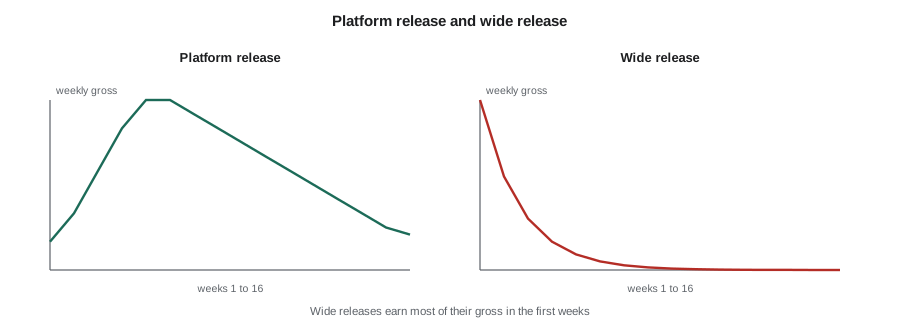
Front-loading in a wide release
A wide release earns 60 million dollars in its first week, then falls by 45 % each following week. Approximately what is its total gross after 8 weeks, and what share came from week 1?
Show solution
- Weekly decline factor: \( 1 - 0.45 = 0.55 \).
- Total of 8 weeks: \( 60 \times \frac{1 - 0.55^8}{1 - 0.55} \).
- Compute: \( 0.55^8 \approx 0.0084 \), so total \( \approx 60 \times \frac{0.9916}{0.45} \approx 132 \) million dollars.
- Week 1 share: \( 60 \div 132 \approx 0.45 \), about 45 %.
Answer: The film earns about 132 million dollars in 8 weeks, with roughly 45 % in the first week. Front-loading explains why studios concentrate marketing before release and why opening-weekend numbers became headline news.
The blockbuster model reshaped Hollywood. Studios increasingly favored franchises, sequels and pre-sold properties; marketing budgets grew; and multiplex cinemas with many screens, built in suburban malls from the 1970s and 1980s, made wide releases possible. Home video, beginning with videocassettes in the late 1970s and 1980s, created a major new revenue window. Conglomerates bought studios, linking film to television, music, publishing and theme parks.
American independent cinema
Independent film has existed throughout American history, from Oscar Micheaux's race films to the experimental cinema of Maya Deren and the New York underground. John Cassavetes made personal, improvised films outside the studios from the late 1950s. In the 1980s and 1990s, a new independent sector grew around festivals, specialized distributors and home video. The Sundance Institute, founded by Robert Redford in 1981, took over a Utah festival that became the Sundance Film Festival, the leading showcase for independent film. Steven Soderbergh's sex, lies, and videotape (1989) won at Sundance and Cannes and proved that low-budget films could find large audiences.
The 1990s independent boom brought filmmakers such as Spike Lee, whose She's Gotta Have It (1986) and Do the Right Thing (1989) brought Black urban life and politics to wide audiences, Quentin Tarantino, Kelly Reichardt and Todd Haynes. Studios created specialty divisions to acquire and market independent films, blurring the line between independent and studio cinema.
Building a Canadian feature film industry
Until the late 1960s, Canada had little feature film production. In 1967, Parliament created the Canadian Film Development Corporation (CFDC) to invest in Canadian feature films; it began operating in 1968. In 1984 it was renamed Telefilm Canada and its mandate expanded to television. Quebec created its own funding bodies, now consolidated as SODEC, and other provinces followed with agencies and tax credits.
In 1974, the federal government introduced a 100 % capital cost allowance for investment in certified Canadian films, allowing investors to deduct their full investment from taxable income. Production boomed in the late 1970s, but many tax-shelter films were made mainly to attract investors, imitated American genres, hid their Canadian settings and were never widely released. When the incentive was reduced in the early 1980s, the boom collapsed. The experience shaped later policy, which tied support to Canadian creative control and cultural goals through a points system administered by the Canadian Audio-Visual Certification Office (CAVCO) and to refundable tax credits rather than shelters.
Worked problem
How the capital cost allowance changed an investor's risk
Under the 1974 rules, an investor with a 50 % marginal tax rate put 100,000 dollars into a certified film and could deduct 100 % of it from income. What was the investor's after-tax cost, and what share of the investment had to come back for the investor to break even?
Show solution
- Tax saved: \( 100000 \times 0.50 = 50000 \) dollars.
- After-tax cost: \( 100000 - 50000 = 50000 \) dollars.
- Ignoring tax on returns, break-even required recovering 50,000 dollars, or 50 % of the investment.
Answer: The investor's real exposure was only 50,000 dollars, half the investment, so films could be financed with little expectation of box office success. This illustrative calculation shows why the shelter encouraged quantity over quality and why later policy shifted toward cultural criteria.
Canadian filmmakers of the 1970s to the 2000s
Despite the industry's problems, distinct Canadian voices emerged. David Cronenberg began with low-budget horror films in the 1970s, some financed by the CFDC, exploring body horror and technology, and became one of the world's most influential genre directors. Atom Egoyan's films, including Exotica (1994) and The Sweet Hereafter (1997), which won the Grand Prix at Cannes, explored memory, family and media. Denys Arcand's The Decline of the American Empire (1986) and The Barbarian Invasions (2003), which won the Academy Award for foreign language film, made Quebec cinema internationally known. Patricia Rozema, Deepa Mehta and Guy Maddin developed singular styles, and Inuit filmmaker Zacharias Kunuk's Atanarjuat: The Fast Runner (2001), made in Inuktitut, won the Caméra d'Or for best first feature at Cannes.
From the American side, Canada became a major production location from the 1980s onward. Studios and independent producers shot in Toronto, Vancouver and Montreal for lower costs, favorable exchange rates and provincial and federal tax credits for labor, and Canadian cities often stood in for American ones on screen, a practice nicknamed "Hollywood North".
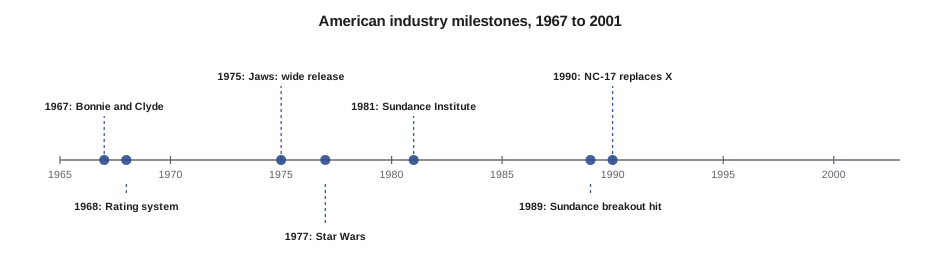
| Year | Event |
|---|---|
| 1967 | Canadian Film Development Corporation created; Bonnie and Clyde released |
| 1968 | MPAA rating system replaces the Production Code |
| 1974 | Canada introduces the 100 % capital cost allowance for certified films |
| 1975 | Jaws launches the wide-release summer blockbuster |
| 1976 | Toronto's Festival of Festivals, later TIFF, founded |
| 1977 | Star Wars breaks box office records and transforms merchandising |
| 1981 | Sundance Institute founded |
| 1984 | CFDC renamed Telefilm Canada; PG-13 rating added |
| 1989 | sex, lies, and videotape wins at Sundance and Cannes |
| 2001 | Atanarjuat wins the Caméra d'Or at Cannes |
| 2003 | The Barbarian Invasions released; it wins the Academy Award in 2004 |
Worked problem
Domestic market share
In an illustrative year, total box office in Canada is 900 million dollars. English-language Canadian films earn 9 million dollars and French-language Canadian films earn 27 million dollars. If French-language markets account for 180 million dollars of the total, compare the shares.
Show solution
- Canadian films overall: \( (9 + 27) \div 900 = 36 \div 900 = 4 \% \).
- English-language market: \( 900 - 180 = 720 \) million; Canadian share \( 9 \div 720 \approx 1.25 \% \).
- French-language market: \( 27 \div 180 = 15 \% \).
Answer: In this illustrative year, Canadian films earn 4 % overall, about 1 % in the English-language market but 15 % in the French-language market. This gap, typical of real patterns, reflects language, star systems and audiences' loyalty to Quebec cinema.
Comparing two systems of support
The Canadian and American stories in this period show two very different ways of financing films. American filmmaking relied mainly on private capital: studios, banks, investors, presales to distributors and later home video and television licenses. Public money played a small role, mostly through state tax incentives that grew from the 1990s onward. Canadian feature filmmaking, by contrast, came to depend heavily on public support: Telefilm Canada investments, provincial agencies, federal and provincial tax credits, and requirements that broadcasters show and fund Canadian content. Each approach has strengths and weaknesses. Private financing rewards films that can attract large audiences but can neglect riskier or local stories. Public financing can support distinctive voices and cultural goals but may struggle to connect films with audiences in a market dominated by Hollywood distribution and marketing. Understanding this difference helps explain why so many Canadian filmmakers have built careers that move between Canadian public funding and American commercial work.
- Ask of any film you study: who paid for it, what did they expect in return, and how did that shape what the film became?
Common mistakes
MistakeThinking the Production Code ended because filmmakers simply ignored it
InsteadExplain the combined pressures of foreign films, television, court rulings and changing audiences
MistakeTreating New Hollywood as purely artistic
InsteadNote that studios gave freedom partly because they were in financial crisis
MistakeAssuming blockbusters began with superhero franchises
InsteadTrace the model to Jaws (1975) and Star Wars (1977)
MistakeCalling the tax-shelter era a success because production rose
InsteadExplain that many films were made for investors and never reached audiences
MistakeAssuming Canadian films are equally popular in English and French markets
InsteadNote Quebec films' much larger share of their home market
Summary and key terms
- The 1968 MPAA rating system replaced the Production Code; Canada kept provincial classification.
- New Hollywood (about 1967 to the late 1970s) gave young directors freedom to make personal, critical films.
- Jaws (1975) and Star Wars (1977) launched the wide-release, heavily marketed blockbuster and merchandising model.
- American independent film grew around festivals such as Sundance (Sundance Institute founded in 1981) and specialized distributors.
- The Canadian Film Development Corporation (1967), renamed Telefilm Canada in 1984, began building a feature industry.
- The 1974 capital cost allowance caused a production boom of mostly forgettable films and shaped later cultural criteria.
- Cronenberg, Egoyan, Arcand, Kunuk and others brought international recognition to Canadian cinema.
- Rating system
- A classification of films by audience suitability, introduced by the MPAA in 1968
- New Hollywood
- The period of director-driven American filmmaking from about 1967 to the late 1970s
- Blockbuster
- A high-budget film released widely with saturation marketing
- Wide release
- Opening a film in many cinemas at the same time
- Platform release
- Opening a film in a few cities and expanding gradually
- Front-loading
- Earning a large share of a film's gross in its first weeks
- Telefilm Canada
- The federal film agency, originally the Canadian Film Development Corporation
- Capital cost allowance
- A tax deduction; in 1974 a 100 % allowance for certified Canadian films created a tax shelter
- CAVCO
- The Canadian Audio-Visual Certification Office, which certifies Canadian content
- Hollywood North
- A nickname for Canada as a production location for American films and series
Practice problems
Work each problem on paper first, then reveal the answer to check.
When did the MPAA rating system begin?
Show answer
In November 1968.
Name two New Hollywood directors.
Show answer
Any two of: Coppola, Scorsese, Altman, Ashby, May, Malick.
Which 1975 film launched the summer blockbuster?
Show answer
Jaws.
Who founded the Sundance Institute and when?
Show answer
Robert Redford, in 1981.
What was the CFDC renamed in 1984?
Show answer
Telefilm Canada.
With a 40 % tax rate and a 100 % deduction, what is the after-tax cost of a 50,000-dollar film investment?
Show answer
\( 50000 \times (1 - 0.40) = 30000 \) dollars.
Why did the tax-shelter boom produce weak films?
Show answer
Investors' risk was low, so films were made to attract investment rather than audiences.
Which Inuit-language film won the Caméra d'Or in 2001?
Show answer
Atanarjuat: The Fast Runner.
A film earns 40 million in week 1 and drops 50 % weekly. About how much does it earn in 4 weeks?
Show answer
\( 40 + 20 + 10 + 5 = 75 \) million dollars.
Why do Quebec films earn a larger share of their home market?
Show answer
Language, a local star system and audience loyalty to Quebec cinema.
Lesson quiz · 5 questions
Score 60% or more to complete this lesson.
Create a free account to save your progress, take quizzes and earn a certificate.