
FILM-120 · Lesson 11 of 12 · 28 min
Digital cinema and streaming
In little more than two decades, cinema moved from photochemical film to digital capture, digital effects, digital projection and online distribution. Streaming platforms became major producers, changing how films are financed, released and watched, and raising new questions about national culture, labor and artificial intelligence. This lesson traces the digital transition from the 1990s to the 2020s, explains how films now travel from camera to screen, and compares Canadian and American responses to the streaming era.
Digital effects and digital post-production
Computer-generated imagery (CGI) appeared in feature films in the 1970s and 1980s and became a major force in the 1990s. Landmark uses included photorealistic computer-generated creatures in a 1993 dinosaur blockbuster and the first fully computer-animated feature, released by Pixar in 1995. Digital compositing, digital matte painting and motion capture expanded what filmmakers could show.
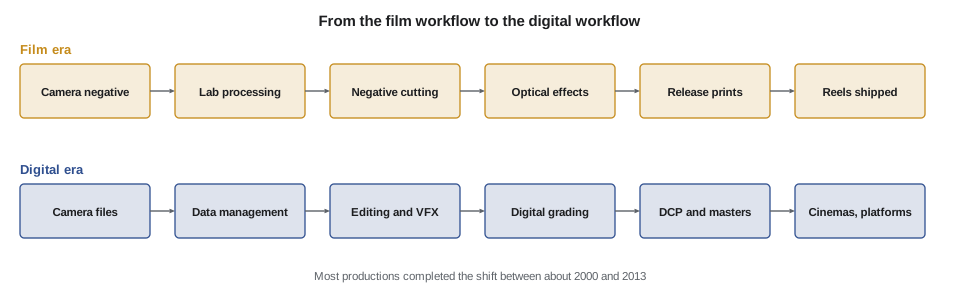
Post-production also went digital. Non-linear editing systems, such as Avid from the late 1980s, let editors cut on computers rather than physically splicing film. From around 2000, the digital intermediate process scanned entire films so that color could be graded digitally before printing back to film, giving colorists precise control over the look. By the 2010s, editing, effects, color grading and sound mixing were almost entirely digital.
Digital capture
Digital video cameras were used for low-budget and documentary filmmaking from the 1990s. The Danish Dogme 95 movement, launched by Lars von Trier and Thomas Vinterberg, used handheld consumer video cameras for some of its films, and digital video helped independent filmmakers shoot cheaply. In the 2000s, high-definition cinema cameras improved rapidly, and by the 2010s digital cameras with large sensors and high dynamic range had largely replaced film for both studio and independent production. A minority of filmmakers continue to shoot on 35 mm and 65 mm film for its look and working discipline, and Kodak continues to manufacture motion picture film, but film capture is now a choice rather than the default.
Worked problem
The cost of film stock versus digital storage
A low-budget feature shoots 40 hours of footage. On 35 mm at 24 fps (90 feet per minute), suppose stock and processing together cost an illustrative 0.80 dollars per foot. Digitally, suppose the footage uses 2 terabytes per hour of raw files, with storage and backup at 40 dollars per terabyte for three copies. Compare costs.
Show solution
- Film footage: \( 40 \times 60 = 2400 \) minutes; \( 2400 \times 90 = 216000 \) feet.
- Film cost: \( 216000 \times 0.80 = 172800 \) dollars.
- Digital data: \( 40 \times 2 = 80 \) terabytes; three copies \( = 240 \) terabytes.
- Digital storage cost: \( 240 \times 40 = 9600 \) dollars.
Answer: In this illustrative comparison, film stock and processing cost about 172,800 dollars against about 9,600 dollars for digital storage, roughly 18 times less. Real costs vary widely and digital shoots carry other costs, such as data management staff and long-term archiving, but the difference explains why digital capture spread so quickly.
The digital projection transition
For a century, films reached cinemas as 35 mm prints, heavy reels that cost about a thousand dollars or more each to print and ship. In 2005, the Digital Cinema Initiatives consortium of major studios published specifications for digital cinema, defining the Digital Cinema Package (DCP), encryption and projection standards. Studios and exhibitors created financing arrangements, often called virtual print fees, under which distributors helped pay for cinemas' digital projectors from savings on prints. The 3D boom around 2009, led by a record-breaking science-fiction epic, accelerated conversion because digital 3D required digital projectors.
Between about 2009 and 2013, most cinemas in North America converted to digital projection. By the end of 2013, a large majority of screens were digital, and studios soon stopped distributing 35 mm prints for most releases. Many small independent cinemas that could not afford conversion closed, while some community fundraising campaigns saved local theaters.
Worked problem
Print costs versus digital delivery
A wide release opens on 3,000 screens. A 35 mm print cost an illustrative 1,200 dollars to make and ship. A digital release costs an illustrative 100 dollars per screen for drive duplication or satellite delivery and key management. Compare the distribution costs.
Show solution
- Film prints: \( 3000 \times 1200 = 3600000 \) dollars.
- Digital delivery: \( 3000 \times 100 = 300000 \) dollars.
- Saving: \( 3600000 - 300000 = 3300000 \) dollars, about 92 %.
Answer: In this illustrative case, digital delivery saves about 3.3 million dollars, over 90 % of print costs, which is why distributors were willing to help finance cinemas' conversion through virtual print fees.
Home video to streaming
Home viewing evolved through several stages: broadcast television, then videocassettes (VHS) in the late 1970s and 1980s, then DVD from the late 1990s and Blu-ray from 2006. Each format became a major revenue stream and changed how films were watched and studied. DVDs, with commentaries and restored versions, also helped create a new culture of film collecting and criticism.
Netflix began as a DVD-by-mail service in 1997 and launched streaming in 2007. In 2013 it released its first major original series, and it soon became a major producer of films and series, followed by Amazon, Apple, Disney (whose Disney+ service launched in 2019), Warner Bros. Discovery and others. Netflix reported about 301.6 million paid memberships at the end of 2024, then stopped reporting quarterly subscriber numbers in 2025. Streaming services offered vast libraries, original films and series, and personalized recommendations driven by viewing data.
Worked problem
Comparing growth rates
An illustrative streaming service has 22 million subscribers at the end of 2010 and 220 million at the end of 2020. What was the average annual growth rate?
Show solution
- Growth factor over 10 years: \( 220 \div 22 = 10 \).
- Annual factor: \( 10^{1/10} \approx 1.259 \).
- Annual growth rate: \( 1.259 - 1 \approx 0.259 \), about 26 % per year.
Answer: Growing tenfold in ten years requires about 26 % compound growth every year. Growth of this kind cannot continue indefinitely in a saturated market, which is why streaming services in the 2020s shifted toward price increases, advertising tiers and limits on password sharing.
The pandemic and release windows
For decades, films followed a sequence of release windows: an exclusive theatrical run, typically about 90 days in North America, followed by home video, pay television, streaming and free television. The COVID-19 pandemic closed cinemas in North America for long periods in 2020 and 2021. Studios postponed films, sent some directly to streaming, and experimented with releasing films in cinemas and on streaming on the same day. After cinemas reopened, studios and exhibitors negotiated shorter theatrical windows, often around 45 days or less for many films, though window lengths vary by film and studio.
Consolidation and policy in the United States
In the United States, the 2020 termination of the Paramount decrees removed restrictions that had limited studios' involvement in cinema ownership since 1948. Media consolidation continued: Disney acquired most of Twenty-First Century Fox's entertainment assets in 2019, Amazon acquired MGM in 2022, and WarnerMedia merged with Discovery in 2022. Critics argue that consolidation reduces the number of buyers for films and the diversity of what gets made, while supporters argue that scale is needed to compete with global technology companies.
In 2023, the Writers Guild of America struck from May to September and the Screen Actors Guild-American Federation of Television and Radio Artists (SAG-AFTRA) struck from July to November, the first time both unions had struck at the same time since 1960. Key issues included pay and residuals in the streaming era, staffing levels, and protections against the use of artificial intelligence to generate scripts or replicate performers' likenesses and voices. The agreements that ended the strikes included the first contract terms governing AI in Hollywood labor.
In the United States, the 2023 settlements set precedents that other entertainment unions built on, including requirements for consent and compensation when digital replicas of performers are created, and rules that AI-generated material cannot be treated as literary material that reduces writers' credit or pay.
Canada's Online Streaming Act
Canada's broadcasting policy has long required Canadian broadcasters to show and fund Canadian content. In April 2023, Parliament passed the Online Streaming Act, often known by its bill number, C-11, which amended the Broadcasting Act to bring online streaming services under the regulator, the Canadian Radio-television and Telecommunications Commission (CRTC). In June 2024, the CRTC required large online streaming services to contribute 5 % of their Canadian revenues to funds supporting Canadian and Indigenous content and news. The decision was challenged in court by streaming companies, and its implementation was delayed. In 2026 the federal government announced it intended to reset this approach, so the final shape of streaming obligations remains in flux; check current CRTC decisions before relying on any figure.
For American companies, Canadian policy is part of a wider set of international rules, from European streaming quotas and investment obligations to trade disputes, that shape how streaming services operate outside the United States.
| Year | Development |
|---|---|
| 1995 | First fully computer-animated feature released; Dogme 95 manifesto |
| 2005 | Digital Cinema Initiatives publishes digital cinema specifications |
| 2007 | Netflix launches streaming |
| 2009–2013 | Most North American cinemas convert to digital projection |
| 2019 | Disney+ launches; Disney acquires Fox entertainment assets |
| 2020 | Pandemic closes cinemas; Paramount decrees terminated |
| 2023 | WGA and SAG-AFTRA strikes; Online Streaming Act passed in Canada |
| 2024 | CRTC sets base contributions for streaming services (later delayed and reconsidered) |
What digital change means for film history
Digital technology has transformed film history in two directions. It has made thousands of older films more accessible than ever through restoration, home video and streaming. It has also created new preservation problems: digital files depend on formats, software and storage media that become obsolete quickly, and archives must migrate data regularly. Some archivists still recommend recording important digital films back to photochemical film for long-term preservation. And the vast libraries of streaming services can disappear when licenses expire or titles are removed, a reminder that access is not the same as preservation.
Studying recent film history
Recent film history poses its own challenges. Sources are abundant but scattered across press releases, trade reporting, social media, company filings and interviews, and much of it is shaped by public relations. Streaming services often do not publish detailed viewing figures, so claims about a film's popularity may rest on company statements that cannot be checked independently. Rules and policies, such as streaming regulations, are changing as you study them. When researching events of the last few years, date every source carefully, prefer documents such as court filings, regulatory decisions and company reports over commentary, and be ready to revise your conclusions as new evidence appears.
Common mistakes
MistakeAssuming digital projection arrived gradually over decades
InsteadNote that most North American cinemas converted between about 2009 and 2013
MistakeTreating streaming as only a distribution change
InsteadRecognize streamers as major producers that changed financing, windows and labor
MistakeAssuming release windows are fixed by law
InsteadExplain that windows are negotiated business practices that changed sharply after 2020
MistakeBelieving digital files preserve films forever
InsteadExplain format obsolescence, migration and the gap between access and preservation
MistakeAssuming Canada's streaming obligations are settled
InsteadCheck current CRTC decisions, since policy has been challenged and reconsidered
Summary and key terms
- CGI and digital post-production became central to filmmaking in the 1990s and 2000s.
- Digital cameras largely replaced film capture by the 2010s, though some filmmakers still shoot on film.
- Digital Cinema Initiatives (2005) defined the DCP, and most North American cinemas converted to digital projection between about 2009 and 2013.
- Home viewing moved from VHS to DVD and Blu-ray to streaming; Netflix launched streaming in 2007.
- The pandemic shortened theatrical windows and accelerated streaming releases.
- The 2023 WGA and SAG-AFTRA strikes produced the first Hollywood contract terms on artificial intelligence.
- Canada's Online Streaming Act (2023) brought streamers under the CRTC, but contribution rules remain contested.
- CGI
- Computer-generated imagery
- Non-linear editing
- Editing digitally on a computer rather than physically cutting film
- Digital intermediate
- Scanning a film to grade and finish it digitally before output
- Digital Cinema Package
- The standard set of files used to deliver films to digital cinemas
- Virtual print fee
- A payment from distributors that helped finance cinemas' digital projectors
- Release window
- The period during which a film is available only in a particular format or venue
- Streaming service
- A platform delivering films and series over the internet on demand
- Online Streaming Act
- Canada's 2023 law bringing online streaming under the Broadcasting Act
- Residuals
- Ongoing payments to writers, performers and directors when work is reused or rebroadcast
- Format obsolescence
- The loss of access to files when software, formats or storage media become outdated
Practice problems
Work each problem on paper first, then reveal the answer to check.
What did the digital intermediate allow?
Show answer
Digital color grading and finishing of a whole film before output.
When did most North American cinemas convert to digital projection?
Show answer
Between about 2009 and 2013.
What is a DCP?
Show answer
A Digital Cinema Package, the standard file set for delivering films to cinemas.
What did virtual print fees do?
Show answer
Distributors helped pay for cinemas' digital projectors from savings on film prints.
How many feet of 35 mm film are used in 10 hours at 24 fps?
Show answer
\( 600 \times 90 = 54000 \) feet.
When did Netflix launch streaming?
Show answer
In 2007.
Name two issues in the 2023 Hollywood strikes.
Show answer
Any two of: streaming pay and residuals, staffing, AI protections for writers and performers.
What did Canada's Online Streaming Act do?
Show answer
It brought online streaming services under the CRTC and the Broadcasting Act.
A service grows from 10 to 40 million in 4 years. What is the annual growth factor?
Show answer
\( 4^{1/4} \approx 1.41 \), about 41 % a year.
Why is access through streaming not the same as preservation?
Show answer
Titles can be removed when licenses expire, and digital files need ongoing migration.
Lesson quiz · 5 questions
Score 60% or more to complete this lesson.
Create a free account to save your progress, take quizzes and earn a certificate.