
FILM-120 · Lesson 12 of 12 · 28 min
Capstone: a cinema history research project
This final lesson turns you from a reader of cinema history into a researcher. You will plan and carry out a short research project on a question in film history, using primary sources from archives, libraries and databases, and present your findings in a well-argued essay or presentation. The lesson walks through choosing a question, finding and evaluating sources, working with archives in Canada and the United States, using quantitative evidence, citing sources correctly and avoiding common pitfalls. It ends with a model project plan.
From topic to research question
A topic is a broad area, such as "Quebec cinema of the 1960s" or "early sound films." A research question is a specific, answerable question that guides your investigation. Good questions are narrow enough to answer with the sources available, open enough to require argument, and significant enough to matter.
| Broad topic | Too broad question | Focused research question |
|---|---|---|
| Early cinema in Canada | What was early Canadian cinema like? | How did Montreal newspapers describe the Ouimetoscope's programs in 1906 and 1907? |
| The coming of sound | How did sound change film? | How did trade papers report the conversion of cinemas to sound in one region between 1928 and 1931? |
| The NFB | What did the NFB do in the war? | How did Canada Carries On films represent women's war work between 1941 and 1945? |
| Blockbusters | Why are blockbusters popular? | How did newspaper advertising for Jaws in 1975 differ from advertising for a major 1970 release? |
| Streaming | How did streaming change film? | How did Canadian newspapers frame the Online Streaming Act debate in 2022 and 2023? |
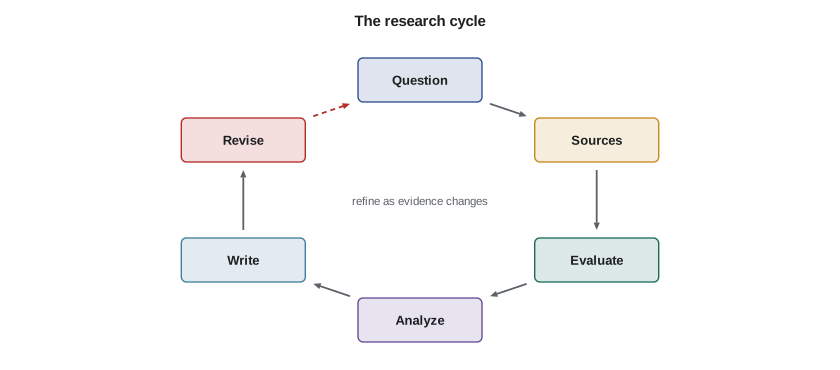
Questions that ask "how" or "why" usually lead to stronger arguments than questions that ask "what" or "whether." Begin with a working question and expect to refine it as you find sources.
Finding primary sources
Primary sources for film history include films, scripts, production files, studio correspondence, trade journals, newspapers and magazines, censorship records, posters and promotional materials, photographs, equipment, government documents and oral histories. Many are now digitized.
In the United States, key sources include the Library of Congress, including its Moving Image Research Center and the National Film Registry; the Margaret Herrick Library of the Academy of Motion Picture Arts and Sciences, which holds scripts, production files and the files of the Production Code Administration; the Museum of Modern Art; the UCLA Film and Television Archive; university special collections; and the Media History Digital Library, which provides free digitized trade papers and fan magazines.
Internationally, the FIAF directory lists film archives around the world, and many national archives, such as the British Film Institute, have extensive online collections and catalogs.
Evaluating sources
Every source has a creator, a purpose, an audience and a context. Evaluating a source means asking:
- Who created it, and what did they know?
- Why was it created: to inform, to sell, to persuade, to entertain, to record?
- When was it created, and how close was it to the events it describes?
- Who was the intended audience?
- Is it complete, edited, translated or a later copy?
- How does it compare with other sources about the same events?
Trade papers, for example, were written for exhibitors and industry insiders, so they focus on business and box office, and they sometimes printed studio publicity as news. Fan magazines promoted stars. Memoirs written decades later may misremember dates or flatter their authors. Comparing several independent sources is the historian's main defense against error.
Working with archives
Visiting an archive, in person or online, requires preparation. Search catalogs and finding aids before you go, contact archivists with specific requests, and allow time: some materials must be retrieved from storage or are fragile. Archives have rules about handling materials, photography, copying and citing. Film materials in particular may need to be viewed on specialized equipment or as digital access copies, and rights holders may restrict copying or public screening.
Archivists are expert guides; explain your question and they can often suggest collections you would not have found. Keep careful records of what you consult: collection names, box and file numbers, film titles and versions, and dates accessed. These details are essential for citation and for anyone who wants to check your work.
Using quantitative evidence
Numbers can strengthen historical arguments when used carefully. Film historians count shots and measure average shot lengths, tally films by genre or country, compare box office or admissions, and track the number of screens or cinemas over time.
Worked problem
Measuring change in average shot length
A student measures the average shot length (ASL) of three described films: a 1935 drama with 410 shots in 82 minutes, a 1975 drama with 980 shots in 112 minutes, and a 2015 drama with 1,850 shots in 118 minutes. Calculate each ASL in seconds and describe the trend.
Show solution
- 1935: \( 82 \times 60 = 4920 \) seconds; \( 4920 \div 410 = 12.0 \) seconds.
- 1975: \( 112 \times 60 = 6720 \) seconds; \( 6720 \div 980 \approx 6.9 \) seconds.
- 2015: \( 118 \times 60 = 7080 \) seconds; \( 7080 \div 1850 \approx 3.8 \) seconds.
- Trend: ASL roughly halves from 1935 to 1975 and nearly halves again by 2015.
Answer: The ASLs are about 12.0, 6.9 and 3.8 seconds. Three films prove nothing on their own, but the pattern is consistent with larger studies reporting that average shot lengths in American films became much shorter over the twentieth century. A real study would need many films chosen systematically and a clear method for counting shots.
Numbers need context. Box office figures must be adjusted for inflation and compared with admissions; counts of films depend on definitions; and small samples can mislead. Always state your method and sources so others can check your work.
Worked problem
Inflation and admissions together
A 1950 film sold an estimated 30 million admissions in North America at an average ticket price of 0.53 dollars. A 2015 film earned 650 million dollars at an average ticket price of 8.43 dollars. Compare grosses and admissions.
Show solution
- 1950 gross: \( 30000000 \times 0.53 = 15.9 \) million dollars.
- 2015 admissions: \( 650000000 \div 8.43 \approx 77.1 \) million.
- Gross ratio: \( 650 \div 15.9 \approx 41 \); admissions ratio: \( 77.1 \div 30 \approx 2.6 \).
Answer: The 2015 film's gross is about 41 times larger, but it sold only about 2.6 times as many tickets. Comparing admissions rather than dollars gives a far more realistic picture of relative popularity across decades; the figures here are illustrative.
Writing the history essay
A history essay presents an argument based on evidence. A strong essay:
- Opens with context and a clear thesis that answers your research question.
- Organizes body paragraphs around claims, each supported by specific evidence from primary sources and informed by secondary scholarship.
- Quotes sparingly and analyzes what each quotation shows.
- Acknowledges counter-evidence and limits, such as missing films or biased sources.
- Concludes by explaining the significance of your findings for film history.
Describe films precisely in your own words, citing timecodes for specific moments where helpful. When writing about films you could not see, such as lost films, say so and explain which sources you used instead.
Citing sources
Citation lets readers find your sources and gives credit to others' work. Use the style your instructor requires, such as Chicago (common in history), MLA or APA. Film citations usually include the title, director, production company or distributor, country and year, and the version or format consulted. Archival citations include the repository, collection name, box and file numbers, and document details. For digitized newspapers and trade papers, include the publication, date, page and database.
Be careful with online sources: prefer archives, libraries, scholarly databases and reputable publications, and record the date you accessed them. Fan sites and anonymous wikis can be useful starting points but should not be cited as authorities.
Ethics and rights in film history research
Researching film history raises ethical questions. Films and archives can contain racist, sexist and violent material, propaganda, and representations of communities who did not consent to how they were shown. Treat such material with care: give context, avoid reproducing harmful images unnecessarily, and consider the perspectives of the communities involved. When researching Indigenous material, follow protocols for consultation and respect community rights over cultural knowledge and images. When interviewing people for oral history, obtain informed consent, explain how their words will be used, and respect requests for anonymity.
Copyright also matters. Many films and archival documents are still protected by copyright. Using short excerpts for criticism, review and research may be allowed under fair dealing in Canada or fair use in the United States, but rules differ and depend on the purpose and amount used. When in doubt, ask your instructor, librarian or archive.
In the United States, fair use under the Copyright Act is assessed using four factors: the purpose and character of the use, the nature of the work, the amount used, and the effect on the market for the original.
A model project plan
The following example shows how a project might be planned over six weeks.
| Week | Task | Output |
|---|---|---|
| 1 | Choose topic, read two secondary sources, draft a research question | Working question and short bibliography |
| 2 | Search archive catalogs and digitized newspapers; contact an archivist | List of primary sources with locations |
| 3 | Consult sources, take notes with full citation details | Annotated source notes |
| 4 | Analyze evidence, gather any quantitative data, refine thesis | Outline with thesis and evidence for each claim |
| 5 | Write a full draft with citations | Draft essay or presentation |
| 6 | Revise using feedback, check citations and add images with permission | Final essay or presentation |
Worked problem
Budgeting research time
A student has 30 hours for a project. They plan to spend 15 % on choosing a question, 35 % on finding and reading sources, 20 % on analysis, 20 % on writing and 10 % on revision. How many hours go to each stage?
Show solution
- Choosing a question: \( 30 \times 0.15 = 4.5 \) hours.
- Sources: \( 30 \times 0.35 = 10.5 \) hours.
- Analysis: \( 30 \times 0.20 = 6 \) hours; writing: \( 6 \) hours.
- Revision: \( 30 \times 0.10 = 3 \) hours.
Answer: The plan allots 4.5, 10.5, 6, 6 and 3 hours. Source work takes the largest share because finding, reading and evaluating primary sources is the heart of historical research.
Common mistakes
MistakeStarting with a topic too broad to answer
InsteadNarrow it to a specific how or why question answerable with available sources
MistakeRelying only on secondary sources
InsteadBuild your argument on primary sources, informed by scholarship
MistakeComparing box office dollars across decades without adjustment
InsteadAdjust for inflation and compare admissions where possible
MistakeFailing to record archival details
InsteadNote collection, box, file and access dates as you work
MistakeReproducing harmful material without context
InsteadProvide context, use excerpts sparingly and consider affected communities
Summary and key terms
- A research question should be specific, answerable and significant, and is refined as you work.
- Primary sources include films, scripts, studio records, trade papers, newspapers, censorship records and oral histories.
- Canadian sources include Library and Archives Canada, the NFB, the Cinémathèque québécoise and the TIFF Film Reference Library; American sources include the Library of Congress, the Margaret Herrick Library and MoMA.
- Evaluate sources by asking who created them, why, when and for whom, and compare several independent sources.
- Quantitative evidence such as average shot length and admissions needs clear methods, adequate samples and context.
- A strong history essay presents a thesis supported by evidence, acknowledges limits and explains significance.
- Researchers must cite carefully, respect copyright, follow archive rules and treat sensitive material ethically.
- Research question
- A specific, answerable question that guides an investigation
- Finding aid
- A guide describing the contents and organization of an archival collection
- Trade paper
- A publication written for people working in the film industry
- Average shot length
- Running time divided by the number of shots
- Admissions
- The number of tickets sold
- Citation
- A reference identifying the source of information or quotation
- Chicago style
- A citation style widely used in history
- Fair dealing
- Canada's copyright exception for purposes such as research, education, criticism and review
- Fair use
- The American copyright doctrine assessed with four factors
- Oral history
- Recorded interviews with people about their experiences
Practice problems
Work each problem on paper first, then reveal the answer to check.
Turn the topic "Canadian war films" into a research question.
Show answer
For example: How did NFB films of 1942 to 1944 represent Canadian soldiers overseas?
Name two Canadian archives for film history.
Show answer
Any two of: Library and Archives Canada, NFB, Cinémathèque québécoise, TIFF Film Reference Library.
Name two American archives for film history.
Show answer
Any two of: Library of Congress, Margaret Herrick Library, MoMA, UCLA Film and Television Archive.
Why should trade papers be read critically?
Show answer
They were written for the industry and sometimes printed studio publicity as news.
A 90-minute film has 900 shots. What is its ASL?
Show answer
\( 5400 \div 900 = 6 \) seconds.
A film sold 10 million tickets at 0.75 dollars. What was its gross?
Show answer
\( 10000000 \times 0.75 = 7.5 \) million dollars.
Why compare admissions rather than dollars across decades?
Show answer
Ticket prices and inflation distort dollar comparisons.
What details should an archival citation include?
Show answer
Repository, collection, box and file numbers and document details.
What should you do when writing about a lost film?
Show answer
Say you could not see it and explain the sources you used instead.
With 40 hours and 35 % for sources, how many hours go to sources?
Show answer
\( 40 \times 0.35 = 14 \) hours.
Lesson quiz · 5 questions
Score 60% or more to complete this lesson.
Create a free account to save your progress, take quizzes and earn a certificate.