
HSE-380 · Lesson 11 of 12 · 18 min
Heat in the kitchen
▶ Video coming soon A video version of this lesson is on the way.
Commercial kitchens are among the hottest indoor workplaces most people will ever experience. Fryers, ranges, griddles, broilers and ovens throw off heat all shift, the dish machine adds steam and humidity, and the people working there are moving fast in layers of clothing. On a summer evening with the patio full, the air at the hot line can be far hotter than the street outside. Heat makes people tired, irritable and clumsy, which raises the risk of cuts, burns and falls, and in serious cases it causes heat illness that can kill. HSE-243 covers heat stress in general. This lesson applies it to the kitchen.
Where the heat comes from
Heat reaches the body in four ways, and a kitchen has all of them.
- Air temperature. The air around the line is heated by every appliance under the hood.
- Radiant heat. The open flame of the charbroiler, the glowing elements of the salamander and the hot surface of the griddle radiate heat straight onto the cook's face and arms, even when the air is cooler.
- Humidity. Steam from the dish machine, the combi oven, stockpots and the steam kettle raises the humidity, which slows the evaporation of sweat, the body's main way of cooling itself.
- Work and clothing. Moving quickly, lifting and carrying produce heat inside the body, and a chef jacket, apron and hat hold it in.
The hood system is the most important control for kitchen heat as well as for smoke and grease. Exhaust fans pull hot air, smoke and grease vapor out through the hood, and a makeup air system brings fresh air back into the kitchen. When the makeup air is not working, or is not tempered, the kitchen gets hotter and the hood pulls less well. HSE-382 covers hood systems in detail.
Juniper's summer problem
Juniper's hot line has always been hot, but the first warm week of the patio season made it a problem. On a humid evening, Aisha measured the conditions at three places with a thermometer and humidity gauge: the fry and grill station, the sauté station and the dish pit. Ben said he felt dizzy near the end of a double shift, Hana reported a headache that would not go away, and a new line cook had to sit down outside during the rush. Nobody needed medical treatment, but the pattern was a warning.
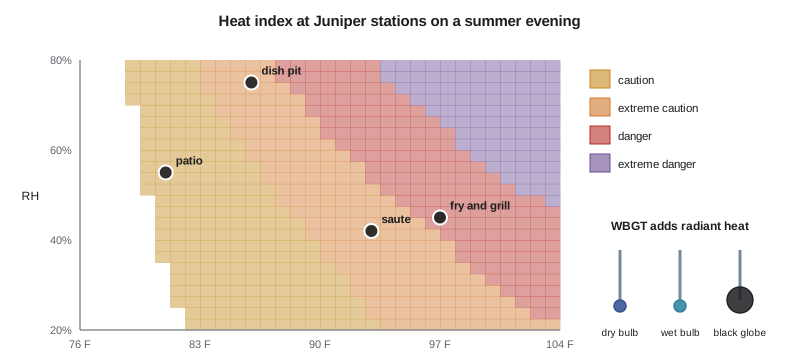
The US National Weather Service uses the heat index to describe how hot conditions feel, combining air temperature and humidity into a single number. The program below calculates the heat index at Juniper's three stations from Aisha's readings using the Weather Service's standard formula.
# NWS heat index from air temperature (deg F) and relative humidity (invented readings).
def heat_index(t, rh):
    simple = 0.5 * (t + 61.0 + (t - 68.0) * 1.2 + rh * 0.094)
    if (simple + t) / 2 < 80:
        return simple
    hi = (-42.379 + 2.04901523 * t + 10.14333127 * rh - 0.22475541 * t * rh
          - 0.00683783 * t * t - 0.05481717 * rh * rh + 0.00122874 * t * t * rh
          + 0.00085282 * t * rh * rh - 0.00000199 * t * t * rh * rh)
    if rh > 85 and 80 <= t <= 87:
        hi += ((rh - 85) / 10) * ((87 - t) / 5)
    return hi

def band(h):
    if h >= 125:
        return "extreme danger"
    if h >= 103:
        return "danger"
    if h >= 90:
        return "extreme caution"
    if h >= 80:
        return "caution"
    return "below caution"

readings = {"fry and grill": (97, 45), "saute": (93, 42), "dish pit": (86, 75), "patio": (81, 55)}
for place, (t, rh) in readings.items():
print(f"{place:14s} {t} F, {rh}% RH -> heat index {heat_index(t, rh):5.1f} ({band(heat_index(t, rh))})")fry and grill 97 F, 45% RH -> heat index 106.3 (danger) saute 93 F, 42% RH -> heat index 96.4 (extreme caution) dish pit 86 F, 75% RH -> heat index 97.3 (extreme caution) patio 81 F, 55% RH -> heat index 82.4 (caution)
The fry and grill station reached a heat index of about 106, in the danger range, and the dish pit was in the extreme caution range because of the steam. The heat index leaves out the radiant heat from the charbroiler and salamander and the heat the cooks produce by working, so the real strain on the body at the line was even higher. For a more accurate measure, safety professionals use the wet bulb globe temperature, which adds a black globe thermometer to capture radiant heat and is the basis of the occupational heat limits published by ACGIH and NIOSH.
Heat illness
Heat illness is a range of conditions, from mild to deadly, that happen when the body cannot get rid of heat fast enough. Everyone working in a hot kitchen should know the signs, because people with heat illness often do not notice it themselves.
| Condition | Signs | What to do |
|---|---|---|
| Heat rash | Red, itchy bumps where sweat is trapped | Keep skin dry, wear loose breathable clothing |
| Heat cramps | Painful muscle cramps in the legs, arms or stomach | Rest somewhere cool, drink water or an electrolyte drink |
| Heat exhaustion | Heavy sweating, weakness, dizziness, headache, nausea, cool clammy skin | Stop work, move to a cool place, loosen clothing, sip water, cool the skin; get medical care if not better within an hour |
| Heat stroke | Confusion, slurred speech, collapse, seizures, very high body temperature, hot skin that may be dry or sweating | Call emergency services, start cooling immediately with cold water or ice packs, stay with the person |
Heat stroke can kill or cause permanent brain damage, and cooling the person fast is what saves them. If a coworker becomes confused or collapses in a hot kitchen, assume heat stroke, call for emergency help, move them somewhere cooler and cool them with cold water, wet towels and ice packs on the neck, armpits and groin while you wait. Do not give fluids to someone who is confused or not fully awake. HSE-110 covers first aid for heat illness.
Who is most at risk
- New workers and workers returning after a week or more off. The body takes one to two weeks to acclimatize to heat, and most heat deaths at work happen in the first few days on the job.
- Anyone at the start of a heat wave, when the kitchen suddenly becomes much hotter than usual.
- People who are dehydrated, unwell, recovering from a stomach bug, short on sleep or who drank alcohol the night before.
- People taking some medications, such as some blood pressure medicines, antihistamines and antidepressants.
- Workers on double shifts with few breaks.
The new line cook who had to sit down outside was in his third shift at Juniper. He was exactly the kind of worker most at risk, and nobody had told him what to watch for.
Controls for kitchen heat
As with every hazard in this course, the strongest controls change the conditions, and the weakest rely on people coping.
- Ventilation. Keep the hood and makeup air working, clean the filters on schedule, and add spot cooling such as fans or a cooled-air diffuser directed at the line where possible. Fans help only when the air they move is cooler than skin temperature; they are directed at people, not at burners or the fryer.
- Reduce heat sources. Turn off or turn down equipment that is not in use, keep oven doors closed, and use lids on pots.
- Shield radiant heat. Insulate or shield hot surfaces where possible, and keep the salamander and charbroiler from facing directly into a workstation.
- Water. Put cool drinking water within reach of every station, and encourage cooks to drink a cup every 15 to 20 minutes rather than waiting until they are thirsty.
- Rest and rotation. Give short breaks in a cooler area during long hot shifts, and rotate people off the hottest stations.
- Acclimatization. Start new and returning workers with shorter shifts or cooler stations and build up over one to two weeks.
- Clothing. Light, breathable chef jackets with mesh panels, skull caps instead of tall hats, and moisture-wicking layers help the body shed heat.
- Watch each other. A buddy system on the line means someone notices when a coworker is struggling.
Juniper adopted a heat plan after that first warm week. Aisha checks the humidity and temperature at the line before dinner service on hot days. A cooler of water and electrolyte drinks sits at the end of the line, and Tomás calls a two-minute water break for the line whenever the reading at the fry station is in the top band. New cooks start on the cooler sauté station before working fry and grill, and nobody works a double on the fry station during a heat wave.
Federal OSHA has no specific heat standard yet. It published a proposed rule on heat injury and illness prevention in indoor and outdoor workplaces on August 30, 2024, held public hearings from June 16 to July 2, 2025, and accepted post-hearing comments until October 30, 2025; no final rule has been issued. In the meantime OSHA uses the General Duty Clause and a National Emphasis Program on heat that includes hot indoor workplaces such as kitchens. Some states, including California, Washington, Oregon, Colorado, Maryland and Nevada, have their own heat rules; Georgia does not.
The patio
Servers and bussers on the patio face a different kind of heat: sun, hot paving and long walks between the kitchen and the tables. They need water stations, shade for side stations, sun protection, breaks inside and the same knowledge of heat illness as the cooks. Bartenders working an outdoor bar in summer face both sun and the heat of ice machines and glass washers.
For supervisors: heat on your shift
- Check the heat at the line on hot days and before big events, and act on the reading.
- Brief the crew on heat illness signs at the first pre-shift meeting of the summer, and repeat it in a heat wave.
- Ease new and returning workers in, and watch them closely in their first week.
- Keep water at every station and make breaks real.
- Report hood or makeup air problems the same day; a failing system makes the whole kitchen dangerous.
Summary and key terms
- Kitchen heat comes from hot air, radiant heat from the line, humidity from steam and heat produced by hard work in heavy clothing.
- The heat index combines temperature and humidity into one number; the wet bulb globe temperature also captures radiant heat and is the basis of occupational heat limits.
- Heat illness ranges from rash and cramps to exhaustion and heat stroke, which is a medical emergency requiring immediate cooling and emergency help.
- New and returning workers are most at risk and need one to two weeks to acclimatize.
- Ventilation, reducing heat sources, water, rest, rotation, acclimatization, light clothing and watching each other control kitchen heat.
- Humidex
- A Canadian index combining air temperature and humidity to describe how hot conditions feel.
- Heat index
- A US index combining air temperature and humidity to describe how hot conditions feel.
- Wet bulb globe temperature
- A heat stress measure that combines air temperature, humidity, radiant heat and air movement.
- Acclimatization
- The gradual adaptation of the body to working in heat over one to two weeks.
- Heat stroke
- A life-threatening condition in which body temperature rises out of control, causing confusion or collapse.
Worked problem
Easing a new cook into the fry station
Juniper hires a new line cook, Leila, in late June, the start of the busy patio season. She has cooked before but has been out of kitchen work for two months. How should Tomás schedule her first two weeks to allow for acclimatization?
Show solution
- Treat her as unacclimatized, since two months away from hot work means most of her heat tolerance has been lost.
- Start her on the sauté station, the coolest station on the line, for her first few shifts, with shorter shifts rather than doubles.
- Increase her time at the hotter stations gradually over the first week, moving to the fry and grill station only for part of a shift at first.
- Pair her with an experienced cook who knows the signs of heat illness, and make sure she knows them too and where the water is.
- By the end of the second week, schedule her normally, but keep the heat plan in force on the hottest evenings for everyone.
Answer: A one- to two-week build-up, starting on cooler stations and shorter shifts with a buddy and clear knowledge of the warning signs, lets Leila acclimatize safely.
Heat, alcohol and caffeine
Kitchen culture often runs on coffee and energy drinks during the shift and a drink at the bar afterward. Moderate caffeine is not a major heat risk for most people who are used to it, but large amounts of energy drinks with sugar and caffeine are a poor substitute for water during a hot shift. Alcohol is a real risk: drinking the night before a hot shift leaves the body dehydrated, and drinking during a shift is not allowed at Juniper for safety as well as service reasons. The simplest rule is water first, and an electrolyte drink during long, sweaty shifts.
Common mistakes
MistakeDrink water only when you feel thirsty.
InsteadThirst lags behind need in heat; drink small amounts often, about every 15 to 20 minutes.
MistakeAn experienced cook can handle a heat wave on the first day.
InsteadA sudden rise in heat affects everyone, and anyone back from a week off has lost some acclimatization.
MistakeA coworker who is confused in the heat just needs to sit down for a minute.
InsteadConfusion is a sign of heat stroke; call emergency services and start cooling immediately.
Practice problems
Work each problem on paper first, then reveal the answer to check.
Why does the dish pit feel almost as hot as the line even though the air is cooler?
Show answer
Steam from the dish machine raises the humidity, which slows the evaporation of sweat.
A new cook in his second shift says he feels dizzy and nauseated and is sweating heavily. What is likely happening and what should you do?
Show answer
Probably heat exhaustion; stop his work, move him somewhere cool, loosen his clothing, give him water and cool his skin, and get medical care if he does not improve.
Name two engineering controls for kitchen heat.
Show answer
A well-maintained hood and makeup air system, spot cooling at the line, or turning off and shielding unused hot equipment.
Lesson quiz · 5 questions
Score 60% or more to complete this lesson.
Create a free account to save your progress, take quizzes and earn a certificate.