
HSE-380 · Lesson 7 of 12 · 16 min
Walk-in coolers and freezers
▶ Video coming soon A video version of this lesson is on the way.
Walk-in coolers and freezers are small rooms that most kitchen workers enter dozens of times a shift. They seem harmless, but they combine several hazards in a confined, insulated box: being shut in, cold, slippery floors, heavy shelving, compressed gas and, in some systems, refrigerant. At Juniper Street, the freezer's sticking door latch was one of the three near misses that worried Aisha most. This lesson covers how to work in walk-ins safely. HSE-243 covers cold stress in general, and HSE-381 covers walk-in temperatures and storage for food safety.
Juniper's walk-ins
Juniper's walk-in cooler is 80 ft² (about 7 m²) and runs at 37 °F (3 °C). The walk-in freezer, 64 ft² (about 6 m²), runs at −4 °F (−20 °C) and is entered through the cooler, so anyone going into the freezer passes through two doors. The cooler also holds the bar's draft beer kegs and the carbon dioxide cylinders that push beer to the taps. Both rooms have metal wire shelving on three walls, an inside light switch, a push-button inside door release and a thermometer outside the door. The freezer has a heated door frame to stop the door freezing shut.
Being shut in
The worst walk-in hazard is being trapped inside. It is rare, but it happens: a door closes and the inside release does not work because it is broken, iced up, blocked by boxes or was never installed, or someone padlocks the outside hasp at closing without checking that the room is empty. A worker trapped in a freezer at −4 °F (−20 °C) in kitchen clothes faces serious hypothermia within an hour or two.
- Every walk-in door must open from the inside at all times, even when the outside is locked. A push-button or plunger release that pushes the latch open from inside is standard on modern doors.
- The inside release must be kept clear of boxes and ice and tested regularly. Juniper tests both releases at the start of every day as part of the opening checklist.
- Padlocks go on the outside hasp only after a person has looked inside, and only on a hasp designed so that the inside release still works when it is locked.
- An inside light switch, or a light that cannot be switched off from outside, means nobody is left in the dark.
- An alarm button inside, connected to a buzzer in the kitchen or the office, lets a trapped worker call for help. Juniper installed one in the freezer after the latch near miss.
- Tell someone before you go into the freezer for more than a quick grab, especially at closing.
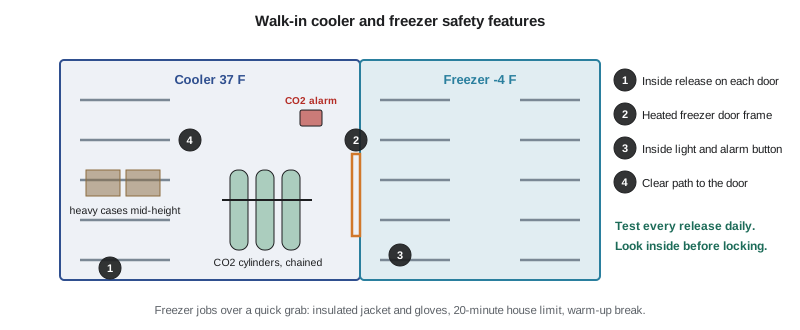
When Aisha investigated the sticking freezer latch, she found that ice had built up inside the latch because the door's heater wire had failed, and that two cooks had learned to slam the door to make it catch. A refrigeration technician replaced the heater and adjusted the latch the same week, and the daily release test now includes the freezer door closing smoothly without a slam.
Cold
Short trips into a cooler are no problem, but restocking a freezer after a delivery or doing a monthly inventory can mean twenty minutes or more at −4 °F (−20 °C), often in a chef jacket that is damp with sweat from the hot line. Going straight from a hot kitchen into a freezer and back again adds stress on the body, and wet clothing loses most of its insulation.
- Wear an insulated freezer jacket and insulated gloves for any freezer task longer than a quick grab. Juniper keeps two jackets and several pairs of gloves on hooks outside the freezer door.
- Limit time in the freezer. Juniper's house limit is 20 minutes at a time for restocking or inventory, followed by a warm-up break of at least 10 minutes in the kitchen, and two people share long jobs.
- Keep hands dry. Cold, wet hands lose grip and feeling quickly, which leads to dropped boxes and cuts from box cutters.
- Know the early signs of cold stress: shivering, numb or white fingers, clumsiness and confusion. Leave the freezer if they start.
Federal OSHA has no specific cold stress standard, but the General Duty Clause applies to serious cold hazards, and OSHA's guidance calls for protective clothing, limited exposure time and warm-up breaks. HSE-243 covers cold stress in general. For young workers, 29 CFR 570.34 allows 14- and 15-year-olds to enter freezers only momentarily to retrieve items, so Ethan may grab a box of fries but does not restock or clean the freezer.
Slips, shelving and lifting in the walk-in
Walk-in floors get wet from condensation and spills and can ice over in the freezer, especially near the door where warm air comes in. Boxes on the floor become trip hazards in a small space. Shelving that is overloaded or poorly arranged can collapse or drop heavy cases.
- Keep the floor clear. Nothing is stored on the walk-in floor except kegs and the bulk items on dollies that are designed for it.
- Clean up spills, ice and frost on the freezer floor right away, and report water dripping from the evaporator.
- Store the heaviest items, such as cases of milk, butter, frozen fries and full stock containers, on the middle and lower shelves between knee and shoulder height. Lesson 8 covers lifting zones.
- Do not overload wire shelving past its rated capacity, and keep shelving units level and tied together or to the wall.
- Use a cart or dolly for heavy deliveries, and wheel kegs rather than carrying them.
- Leave a clear path to the door and the inside release.
Compressed gas in the cooler
Juniper's bar uses carbon dioxide to push draft beer from the kegs in the cooler to the taps, and stores two full cylinders and one in use in the cooler. Carbon dioxide cannot be seen and has almost no smell, and it is heavier than air, so a leak in a closed room collects near the floor. High concentrations displace oxygen and cause headache, dizziness, confusion and loss of consciousness. People have died in walk-ins and beer cellars from carbon dioxide leaks.
- Chain or strap every cylinder upright to the wall or a cylinder stand, including empties, with valve caps on cylinders that are not connected.
- Change cylinders only after training, closing the valve fully before disconnecting and checking new connections for leaks.
- Install a carbon dioxide detector with an alarm in the walk-in at the height the maker recommends, usually low on the wall, and a warning display outside the door so nobody walks into a room that is in alarm.
- If the alarm sounds, do not enter. Ventilate if it can be done from outside, and call the gas supplier or the fire department.
- Larger systems that use bulk carbon dioxide tanks rather than small cylinders are subject to fire code requirements for detection and ventilation in many places. HSE-382 covers fire and gas codes for kitchens.
Dry ice, which is solid carbon dioxide, sometimes arrives with frozen deliveries. It releases carbon dioxide gas as it warms, so it is never left in the walk-in or another closed room; it is moved outdoors to a ventilated area and handled only with insulated gloves, because it is cold enough to cause frostbite on contact.
Refrigerant and equipment
Walk-in refrigeration systems contain refrigerant under pressure. Leaks are rare, and most refrigerants in restaurant walk-ins are of low toxicity, but some newer systems use flammable refrigerants. Kitchen staff should never work on the refrigeration system. They should report hissing, oily stains on piping, unusual smells, frost on lines where there normally is none, or a room that will not hold temperature, and they should keep the evaporator fan and coil clear of boxes. A technician services the system, and the compressor's electrical disconnect is locked out before any work on it, as Lesson 4 explained.
Tracking time in the freezer
After the latch near miss, Aisha asked staff to sign in and out on a small whiteboard by the freezer door for any task longer than a quick grab. The whiteboard tells the closing manager who might still be inside, and after a month it showed whether the 20-minute house limit was working.
# Freezer sign-in board for one week at an invented restaurant (clock times as minutes).
entries = [  # (worker, task, time in, time out)
    ("Luis", "restock after delivery", 9 * 60 + 5, 9 * 60 + 31),
    ("Hana", "inventory", 14 * 60 + 0, 14 * 60 + 18),
    ("Ben", "restock fries", 16 * 60 + 40, 16 * 60 + 52),
    ("Luis", "restock after delivery", 9 * 60 + 10, 9 * 60 + 28),
    ("Noah", "defrost check", 15 * 60 + 15, 15 * 60 + 38),
    ("Kofi", "clean floor", 22 * 60 + 45, 23 * 60 + 2),
]
LIMIT = 20
over = []
for worker, task, t_in, t_out in entries:
    mins = t_out - t_in
    flag = " <- over the limit" if mins > LIMIT else ""
    print(f"{worker:5s} {task:24s} {mins:3d} min{flag}")
    if mins > LIMIT:
        over.append((worker, task))
print(f"{len(over)} of {len(entries)} long entries were over {LIMIT} minutes")Luis restock after delivery 26 min <- over the limit Hana inventory 18 min Ben restock fries 12 min Luis restock after delivery 18 min Noah defrost check 23 min <- over the limit Kofi clean floor 17 min 2 of 6 long entries were over 20 minutes
Two of the six long entries ran over the limit. Luis's 26-minute restock happened on a delivery day when he worked alone; the fix was to schedule a second person to help with Tuesday deliveries. Noah's 23-minute defrost check showed a training gap: he had stayed in to finish a task that could have been split into two trips. Neither was dangerous on its own, but both showed where the routine needed adjusting.
For supervisors: walk-in checks
- Test every inside release at opening, and take the room out of use for anything but quick grabs if a release fails, until it is repaired.
- Look inside both walk-ins before locking up at night, every night.
- Keep freezer jackets and gloves clean, dry and on their hooks.
- Check the carbon dioxide detector's status light daily and its test date monthly, and make sure every cylinder is chained.
- Watch shelving loads after big deliveries, and keep the path to the door clear.
Summary and key terms
- Every walk-in door must open from the inside at all times, with the release kept clear, tested daily and not defeated by an outside padlock.
- Insulated clothing, time limits, warm-up breaks and shared tasks control cold stress during long freezer jobs.
- Keep walk-in floors clear and dry, store heavy items between knee and shoulder height, and respect shelving limits.
- Carbon dioxide for beer systems and dry ice can displace oxygen in a closed room; chain cylinders, install detection and never enter a room in alarm.
- Under federal rules, 14- and 15-year-olds may enter freezers only momentarily to retrieve items.
- Inside release
- A push-button or plunger on the inside of a walk-in door that opens the latch from inside.
- Heated door frame
- A heater wire in a freezer door frame that keeps the door seal and latch from freezing.
- Warm-up break
- Time spent in a warm area between periods of work in the cold.
- Asphyxiant
- A gas that can cause suffocation by displacing oxygen, such as carbon dioxide in a closed room.
- Evaporator
- The cold coil and fan inside a walk-in that removes heat from the room.
If you are ever trapped
Knowing what to do keeps a frightening situation from becoming a dangerous one. First, try the inside release firmly and more than once; an iced latch sometimes gives on the second push. Second, press the alarm button if there is one, and bang on the door with a hard object such as a can, since sound carries through the kitchen. Third, keep warm while you wait: put on any freezer jacket or gloves inside, move into the cooler if you are in the freezer and the connecting door is open, stand on cardboard rather than the cold floor and keep moving your arms and legs. Do not damage the refrigeration piping or the evaporator to try to get out. When you are free, report the failure immediately so the door is repaired before anyone else goes in.
Deliveries and the walk-ins
Delivery days are when most freezer time and most walk-in lifting happen. Juniper's produce, dairy and frozen deliveries arrive between 8 and 10 a.m., before the lunch crew is busy. The cases are checked on the receiving table by the back door, the cold and frozen items go into the walk-ins first so they do not warm up, and two people put away the frozen order together: one inside the freezer placing cases on shelves, one outside passing them in from a cart. That split keeps each person's time in the cold short, keeps the heavy lifting at waist height on the cart, and means someone is always outside the door. HSE-381 covers receiving temperatures and food safety checks.
Common mistakes
MistakeSlamming a sticky freezer door is fine as long as it closes.
InsteadA sticking latch is a sign of a fault that could trap someone; report it and get it repaired.
MistakeA chef jacket is warm enough for a long freezer restock.
InsteadKitchen clothing is often damp and thin; wear an insulated freezer jacket and gloves and limit the time.
MistakeCarbon dioxide is harmless because it is in soft drinks.
InsteadAt high concentrations in a closed room carbon dioxide causes unconsciousness and death.
Practice problems
Work each problem on paper first, then reveal the answer to check.
At closing, Kofi is about to padlock the walk-in. What must he do first?
Show answer
Look inside both rooms to make sure nobody is there, and confirm the inside release still works with the hasp locked.
The carbon dioxide alarm is sounding outside the cooler door. Should Rafael go in to grab a keg?
Show answer
No. Nobody enters a room in alarm; ventilate from outside if possible and call the gas supplier or the fire department.
Why did Juniper add an alarm button inside the freezer?
Show answer
So a worker trapped inside can call for help even if the release fails.
Lesson quiz · 5 questions
Score 60% or more to complete this lesson.
Create a free account to save your progress, take quizzes and earn a certificate.