
HSE-380 · Lesson 8 of 12 · 18 min
Lifting, carrying and repetitive work
▶ Video coming soon A video version of this lesson is on the way.
Strains and sprains are the quiet injuries of food service. They do not bleed or blister, so they are easy to ignore, but they cause a large share of lost work time in restaurants, and they often build up for weeks before one ordinary lift is the last straw. In BC's food and beverage sector, muscle strains made up about a quarter of injuries in go2HR's 2024 profile. At Juniper Street, Hana's back strain from lifting a full stockpot cost five days of light duty, and the first-aid log showed three more strains. This lesson covers the lifting, carrying, reaching and repetitive motion in kitchen and service work. HSE-107 teaches manual handling and the lifting equation in depth.
Heavy things in a restaurant
Many restaurant loads are heavier than they look, and many are awkward, hot, wet or all three.
- Full stockpots and soup containers: a 5 gal (20 L) pot of stock weighs over 44 lb (20 kg) with the pot, and it is hot.
- Cases on delivery day: frozen fries, cooking oil jugs, cases of produce, milk crates and canned goods, often 22 to 44 lb (10 to 20 kg) each.
- Bags of flour, sugar and rice of 44 lb (20 kg) or more.
- Beer kegs: a full keg weighs 130 to 165 lb (about 60 to 75 kg) and is never lifted by hand at Juniper.
- Dish racks of plates or glasses, bus tubs full of dirty dishes, and trays of plated food carried overhead by servers.
- Garbage bags, grease bins and the used oil caddy at the end of the night.
Why kitchen lifting hurts
Weight is only one factor. The same box is much harder on the back when it is far from the body, near the floor or above the shoulders, lifted with a twist, lifted many times an hour, or slippery. Kitchens combine all of these. Ranges and stockpots put loads at arm's length over hot burners. Walk-in shelves reach from the floor to above head height. Dish machines are fed racks from a low counter. And everything happens in narrow spaces where turning the feet is hard.
Hana's stockpot
Hana's injury happened at the end of a lunch shift. She lifted a full pot of chicken stock, 48 lb (about 22 kg) with the pot, off a back burner of the range to carry it to the prep sink for straining. To reach it she had to lean over a front burner, which kept the pot far from her body, and she twisted to turn away from the range while lifting. The pot was hot, so she held it by its side handles at arm's length.
The revised NIOSH lifting equation, taught in HSE-107, gives a recommended weight limit for a lift based on how far the load is from the body, how high it starts, how far it moves, how much the worker twists, how often the lift happens and how good the grip is. Dividing the actual weight by the recommended limit gives a lifting index; a value above 1 means the lift puts many workers at increased risk of injury, and above about 3 almost everyone is at risk. The program below compares Hana's original lift with the new method Juniper adopted: ladle half the stock into a second container first, slide the pot to a front burner, and lift it onto a cart at the same height with no twist.
# Revised NIOSH lifting equation (US units), two versions of a stockpot lift.
def rwl(H, V, D, A, FM=1.0, CM=0.95, LC=51.0):
    HM = min(1.0, 10 / H)                  # horizontal distance, in
    VM = 1 - 0.0075 * abs(V - 30)          # starting height, in
    DM = min(1.0, 0.82 + 1.8 / max(D, 10)) # vertical travel, in
    AM = 1 - 0.0032 * A                    # twist, degrees
    return LC * HM * VM * DM * AM * FM * CM

lifts = {
    "full pot from back burner, twisting": (48.0, dict(H=18, V=37, D=16, A=30)),
    "half pot from front burner onto cart": (24.0, dict(H=12, V=37, D=0, A=0)),
}
for name, (lb, geo) in lifts.items():
    limit = rwl(**geo)
print(f"{name}: limit {limit:.1f} lb, load {lb:.0f} lb, lifting index {lb / limit:.2f}")full pot from back burner, twisting: limit 21.5 lb, load 48 lb, lifting index 2.23 half pot from front burner onto cart: limit 38.3 lb, load 24 lb, lifting index 0.63
The original lift had a lifting index well above 2, which puts most workers at risk, mostly because of the reach over the front burner and the twist. Halving the load, bringing it close and removing the twist brought the index well below 1. The new method takes about a minute longer and has been the rule at Juniper since Hana's injury. Pots larger than 5 gal (20 L) are no longer filled on the back burners at all; large batches of stock go in the tilting steam kettle, which pours into containers without lifting.
Lifting and carrying habits
- Plan the lift. Know where the load is going, clear the path and open the doors first.
- Test the weight by tipping one corner before committing to the lift.
- Get the load close. Slide it to the edge of the shelf or counter, or step close enough that it touches your body.
- Bend at the hips and knees, keep the back in its natural curve and lift smoothly without jerking.
- Turn with your feet, not by twisting your back.
- Split loads. Two half-full containers are easier and safer than one full one.
- Use help: a cart, a dolly, a keg dolly, a second person, or a smaller container. Team lifts need one person to call the moves.
- Carry hot or liquid loads low and close, and never on stairs or through a crowd during service.
Storage height and layout
The best lift is the one that never has to happen from the floor or above the shoulders. Juniper reorganized its dry storage and walk-ins after Hana's injury.
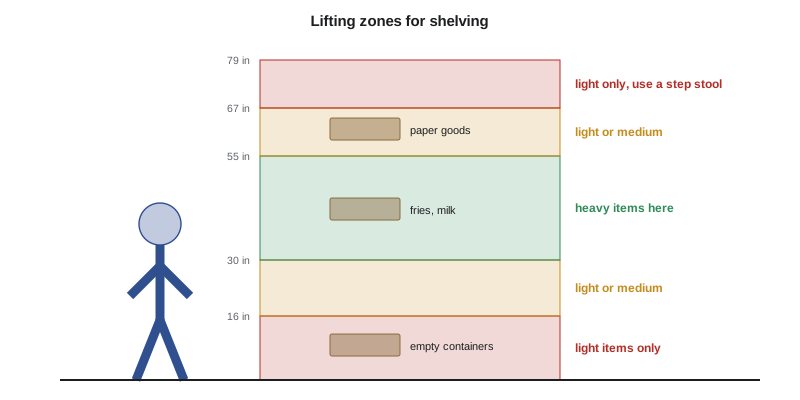
- Heavy cases and bulk bags sit between knee and shoulder height. Flour and sugar moved from floor sacks into wheeled bins that roll under the prep tables, filled from the sack using a scoop.
- Light items such as paper goods, napkins and spices go on top shelves, and empty containers go at the bottom.
- A step stool is kept in dry storage for the top shelf. Nobody climbs shelving or stands on milk crates. HSE-213 covers step stools and ladders.
- Kegs are moved on a keg dolly and lowered and raised with a keg lifter when they are changed.
- The basement storage room is used only for light, slow-moving stock, so nobody carries heavy loads up and down the stairs.
Repetitive work
Some kitchen strains come not from one heavy lift but from thousands of small movements. Prep cooks chop, dice, whisk and peel for hours. Line cooks flip, toss and plate the same dishes all night. Dishwashers lift racks and spray dishes, and servers carry heavy trays on one hand at shoulder height. Repeated, forceful or awkward hand and arm movements can lead to tendinitis, carpal tunnel syndrome, tennis elbow and shoulder problems that can take months to heal.
- Keep tools sharp and well designed. A sharp knife needs less grip force. Tools with comfortable handles and scoops sized for the portion reduce wrist strain. OSHA's restaurant eTool recommends ergonomic tools that keep the wrist straight.
- Work at the right height. Prep tables should put the hands slightly below elbow height for chopping. A riser board helps shorter cooks; a taller cook can raise the board.
- Rotate tasks. Juniper splits big prep jobs, such as a case of onions, between two cooks or breaks them up with other tasks.
- Use machines for big volumes. A food processor or a mandoline with its guard turns an hour of dicing into minutes.
- Carry trays at waist height on a tray stand route where possible, and use bus carts for heavy dish loads.
- Take micro-breaks. Shaking out the hands and stretching for a few seconds between tickets helps.
- Report early. Tingling, numbness, aching at night or weak grip are early signs, and they are far easier to treat when reported early.
Standing all shift
Most kitchen and service workers stand or walk for their whole shift on hard tile, often eight or ten hours. Standing for long periods causes aching feet, legs and lower backs and contributes to varicose veins. The controls are simple: cushioned anti-fatigue mats at standing stations such as the prep tables, the expo window and the bar; supportive, slip-resistant shoes; a footrest rail or a low box so workers can shift weight; a stool for seated tasks such as rolling cutlery or peeling; and real breaks off the feet.
Federal OSHA has no specific ergonomics standard, but it can cite serious musculoskeletal hazards under the General Duty Clause and publishes guidance for restaurants, including the eTool's advice on stools, footrests, adjustable work surfaces, task rotation and mechanical aids. Some state plans have their own ergonomics rules.
For supervisors: lifting and repetitive work
- Look at the delivery: ask suppliers for smaller cases or bags where possible, and schedule enough people to put away big orders.
- Fix storage heights after every big menu change, because new products end up wherever there is space.
- Watch for the warning signs: rubbing a wrist, shaking out a hand, standing with one hand on the lower back.
- Make carts, dollies, keg lifters and small containers easy to find and in good repair.
- Never reward heroics. The cook who carries the full stockpot alone to save a minute is setting the example everyone else follows.
Summary and key terms
- Strains and sprains cause a large share of lost time in food service, often building over weeks before a final injury.
- Distance from the body, height, twisting, repetition and poor grip make loads riskier than their weight alone suggests.
- The NIOSH lifting index compares a load with a recommended limit; Juniper's revised stockpot method cut the index from above 2 to well below 1.
- Store heavy items between knee and shoulder height, split loads, use carts, dollies and keg lifters, and turn with the feet.
- Sharp tools, correct work heights, rotation, machines for big jobs, anti-fatigue mats and early reporting control repetitive and standing strain.
- Lifting index
- The load weight divided by the recommended weight limit from the NIOSH lifting equation.
- Recommended weight limit
- The weight that nearly all healthy workers can lift under given conditions without increased risk.
- Power zone
- The area between knee and shoulder height, close to the body, where lifting is safest.
- Tendinitis
- Inflammation of a tendon, often from repeated or forceful movement.
- Team lift
- A lift shared by two or more people, with one person calling the moves.
Front of house and the dish pit
Servers and dishwashers have their own strain hazards. A server carrying a large oval tray of six entrées holds 22 lb (10 kg) or more on one hand at shoulder height while weaving through tables, and bussers carry tubs of dirty plates that can weigh as much. In the dish pit, Kofi and Ethan lift racks of wet plates from a low counter into the machine and back out, hundreds of times a night, and reach across the pre-rinse sink to spray.
- Juniper limits tray loads to four entrées and uses tray stands at every section so servers lower the tray at hip height before serving.
- Bus tubs are filled only halfway, and a bus cart is used for big tables and at closing.
- The dish machine's loading counter was raised on adjustable legs so racks slide into the machine instead of being lifted, and the clean racks roll onto a dish cart rather than being stacked high.
- Glass racks go no more than four high on the cart, so nobody lifts a rack from above shoulder height.
Worked problem
Reorganizing the walk-in cooler
After a menu change, Aisha found 40 lb (18 kg) cases of milk on the floor of the walk-in cooler, 33 lb (15 kg) cases of butter on the top shelf at 71 in (180 cm), and paper-wrapped herbs on the middle shelves. How should she rearrange the shelves?
Show solution
- List the items by weight and how often they are used: milk and butter are heavy and used daily, herbs are light and used daily, backup paper goods and empty containers are light and rarely used.
- Assign the power zone, roughly knee to shoulder height, to the heavy daily items: milk on the lower-middle shelf and butter on the middle shelf, at the front.
- Put light, frequently used items such as herbs at the upper-middle shelf, and light, rarely used items on the top shelf.
- Keep the floor clear except for the kegs on their dolly, and label each shelf so the arrangement survives the next delivery.
Answer: Heavy daily items move into the power zone, light items go high, rarely used items go to the top, and the floor stays clear; labeling the shelves keeps the new layout in place.
Common mistakes
MistakeA strong cook can lift a full stockpot off the back burner safely.
InsteadThe reach and twist make that lift risky for anyone; ladle out, bring the pot close and use a cart.
MistakeLifting with the legs makes any lift safe.
InsteadDistance, twisting, frequency and grip matter as much; keep the load close and avoid the twist.
MistakeWrist pain from chopping is just part of the job.
InsteadEarly hand and wrist symptoms are a warning sign; report them so tools, heights or rotation can be changed.
Practice problems
Work each problem on paper first, then reveal the answer to check.
A new delivery of 44 lb (20 kg) rice bags arrives. Where should they be stored?
Show answer
On a shelf or pallet between knee and shoulder height, or emptied into a wheeled bin, never on the top shelf or the floor.
Why did Juniper move large batches of stock to the tilting kettle?
Show answer
The kettle pours into containers without anyone lifting a heavy, hot pot.
A prep cook is dicing onions for an hour and feels tingling in her fingers. What should she do?
Show answer
Report it to the supervisor, take a break, and switch to another task or use the food processor for the rest.
Lesson quiz · 5 questions
Score 60% or more to complete this lesson.
Create a free account to save your progress, take quizzes and earn a certificate.