
HSE-380 · Lesson 2 of 12 · 17 min
Rights, roles and young workers in restaurants
▶ Video coming soon A video version of this lesson is on the way.
Every kitchen safety rule in this course sits on a legal foundation. The law says who is responsible for what, what workers are entitled to know and do, and which jobs young people may not do at all. HSE-101 covers workplace safety law in general. This lesson applies it to a restaurant, with special attention to the young workers who make up so much of the industry's workforce.
Who is responsible
In the United States, the Occupational Safety and Health Act requires every employer to provide a workplace free from recognized hazards that are causing or likely to cause death or serious physical harm. That requirement is called the General Duty Clause, and it applies even where no specific standard exists. OSHA's general industry standards in 29 CFR 1910 cover walking surfaces, exits, personal protective equipment, machine guarding, lockout, first aid and hazard communication, all of which apply in restaurants. Georgia has no state OSHA plan, so federal OSHA covers Juniper Street directly; about half the states run their own plans, which must be at least as effective as federal OSHA and are often stricter.
- The employer, in Juniper's case the owner Elena Varga and the business she owns, must provide safe equipment and a safe workplace, train and supervise workers, keep records and make sure supervisors know their duties.
- Supervisors, such as Tomás, Aisha and Olivia, must make sure the workers they direct know the hazards, follow safe procedures and use the protective equipment provided. A supervisor is anyone who directs the work of others, whatever the job title.
- Workers must follow safe procedures, use the equipment and protective gear provided, report hazards and injuries, and not put themselves or others at risk.
A shift lead who runs the line on a Sunday night is acting for the employer during those hours, even without a manager's title. OSHA holds the employer responsible for what its supervisors know and do, so the shift lead's knowledge of a hazard is treated as the employer's knowledge.
Workers' rights
Federal law gives workers a set of basic rights, summarized on OSHA's workers' rights pages and in the poster every employer must display.
- The right to a safe workplace and to the protections required by OSHA standards.
- The right to information and training about hazards, in a language and vocabulary the worker understands, including chemical information under the Hazard Communication standard.
- The right to report injuries and hazards, to see injury records, and to file a confidential complaint with OSHA asking for an inspection.
- The right to be protected from retaliation for using any of these rights. A complaint about retaliation must be filed with OSHA within 30 days under Section 11(c).
- A limited right to refuse dangerous work. When a worker believes in good faith that there is an imminent danger of death or serious injury, has asked the employer to fix it, and there is no time to get OSHA to inspect, the worker can refuse that task without being punished.
In practice the refusal right is narrow, so the better path in a kitchen is almost always to raise the problem first. If Noah were told to clean the slicer, which federal law forbids for anyone under 18, he should stop, tell the supervisor and ask for another task. Juniper's policy goes further than the law: any worker may stop a task they believe is unsafe and ask a supervisor to look at it, with no penalty for asking.
Committees and representatives
Federal OSHA does not require safety committees, but many states do, through their workers' compensation or state plan rules, and many restaurants form one because it works. Juniper Street has a voluntary safety committee of four: Kofi is the worker member from the kitchen, Nadia represents the front of house, and Aisha and Daniel represent management. It meets monthly, takes part in safety walks and reviews every injury and near miss.
Reporting injuries and hazards
Every injury, however small, should be reported to a supervisor and written in the first-aid log. Small injuries reveal hazards, and an unreported injury can become a problem later if it gets worse and there is no record of how it happened.
OSHA requires employers to report a work-related death within 8 hours and any in-patient hospitalization, amputation or loss of an eye within 24 hours. Workers' compensation claims follow state rules; in Georgia, an injured worker should report the injury to the employer within 30 days to protect the claim, and the employer reports qualifying claims to the State Board of Workers' Compensation. An employer may not discourage workers from reporting injuries, and OSHA's recordkeeping rule requires a reasonable reporting procedure.
Why young workers need special rules
Teenagers are not just small adults. They are often in their first job, they may not know that they can say no, they want to impress, and they are less likely to recognize a hazard they have never seen. Their bodies are still growing, and an injury such as a hand amputation from a slicer changes their whole life. For these reasons every province and the United States limit the jobs and hours of young workers, and restaurants are one of the main places those limits apply.
Federal child labor rules under the Fair Labor Standards Act are found in 29 CFR Part 570. They set 14 as the minimum age for most non-farm work, limit the hours and tasks of 14- and 15-year-olds, and bar everyone under 18 from 17 Hazardous Occupations Orders. States have their own child labor laws as well, and where federal and state rules differ, the employer must follow the stricter one.
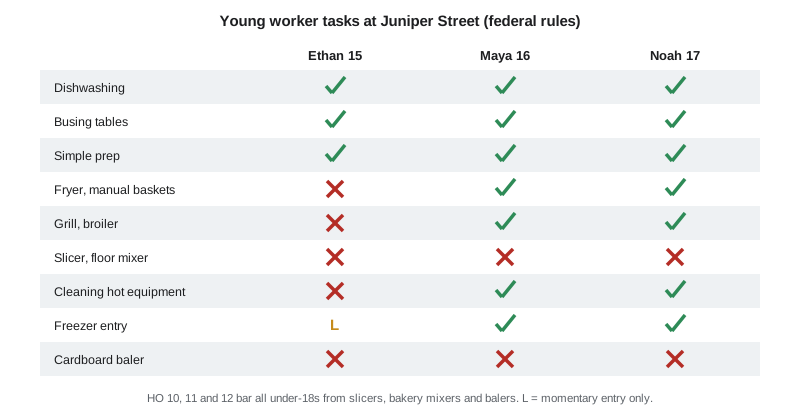
For 14- and 15-year-olds, 29 CFR 570.34 allows most restaurant work, including dishwashing, busing, serving, cashiering and cleaning, but places tight limits on cooking. They may cook with electric or gas grills that do not involve cooking over an open flame, and with deep fryers that automatically lower and raise the baskets. They may not use rotisseries, broilers or pressurized equipment, including pressure fryers. They may clean kitchen equipment and handle hot oil only when the equipment, surfaces, containers and liquids are no hotter than 100 °F (38 °C). They may enter a freezer only momentarily to retrieve items. They may not bake, work from ladders or scaffolds, or operate power-driven food slicers, grinders, choppers or cutters.
At Juniper Street, Ethan is 15. He can wash dishes and bus tables, but Juniper's fryers have manual baskets, so he may not work the fryer at all, and he may not use the charbroiler or the salamander broiler. He may help clean the line only after it has cooled to 100 °F (38 °C) or less, which in practice means at the start of the next day rather than at closing. His hours are limited too: no more than 3 hours on a school day, including Fridays, 18 hours in a school week, 8 hours on a non-school day and 40 hours in a non-school week, and only between 7 a.m. and 7 p.m., extended to 9 p.m. from June 1 to Labor Day. So Ethan can never close the dish pit on a school night.
The Hazardous Occupations Orders apply to everyone under 18, including Maya and Noah. Three matter most in restaurants. HO 10 bars minors from operating, feeding, setting up, adjusting, repairing, oiling or cleaning power-driven meat-processing machines, including meat slicers, wherever they are used, including restaurants and delicatessens, and even when the slicer is used on cheese or vegetables. HO 11 bars minors from operating power-driven bakery machines such as floor dough mixers, with a narrow exception allowing 16- and 17-year-olds to use certain small countertop mixers. HO 12 bars minors from operating or unloading balers and compactors, with narrow exceptions for loading certain machines that meet safety standards. HO 2 limits driving, which matters for delivery work covered in HSE-383. Noah, at 17, may work the fryer and grill with training, but not the slicer, the floor mixer or the baler, and Juniper's house rule matches the federal rule exactly.
Checking a young worker's schedule
Kitchen managers build schedules quickly, often on a phone, and it is easy to break a federal hours limit. The program below checks a school week of shifts for Ethan against the limits in 29 CFR 570.35 for 14- and 15-year-olds outside the summer period.
# Check a 14- or 15-year-old's school week against 29 CFR 570.35 (invented shifts).
shifts = [  # day, start hour, end hour, school day?
    ("Mon", 16.0, 19.0, True),
    ("Wed", 16.0, 19.5, True),
    ("Fri", 15.5, 19.0, True),
    ("Sat", 10.0, 17.0, False),
    ("Sun", 11.0, 15.0, False),
]
week = 0.0
for day, start, end, school in shifts:
    hours = end - start
    week += hours
    problems = []
    if school and hours > 3:
        problems.append("over 3 hours on a school day")
    if not school and hours > 8:
        problems.append("over 8 hours on a non-school day")
    if start < 7 or end > 19:
        problems.append("outside 7 a.m. to 7 p.m.")
    print(f"{day}: {hours:.1f} h", "; ".join(problems) or "ok")
print(f"Week total: {week:.1f} h", "over the 18-hour school-week limit" if week > 18 else "ok")Mon: 3.0 h ok Wed: 3.5 h over 3 hours on a school day; outside 7 a.m. to 7 p.m. Fri: 3.5 h over 3 hours on a school day Sat: 7.0 h ok Sun: 4.0 h ok Week total: 21.0 h over the 18-hour school-week limit
The check finds that Wednesday's shift is three and a half hours on a school day and ends at 7:30 p.m., and that the week totals 21.5 hours, over the 18-hour limit. Olivia cut the Wednesday shift to 4 to 7 p.m. and shortened Saturday to 10 a.m. to 3 p.m., bringing the week to 16 hours.
For supervisors: young workers on your shift
- Keep a list of every worker under 18 with their birth date, posted where the shift lead can see it.
- Label every machine minors may not operate, clean or adjust, as OSHA's Young Worker Safety in Restaurants eTool recommends.
- Build schedules for 14- and 15-year-olds with the hours limits in mind, and check them against state law, which may be stricter.
- Treat every request from a coworker as your problem. Ethan's slicer near miss happened because a new cook did not know the rule.
- Remember that hazardous occupation violations can bring civil penalties for each minor involved, and that serious violations involving injury bring much larger penalties.
Orientation and training
OSHA standards require training on specific hazards, such as hazard communication, personal protective equipment and lockout, before a worker is exposed, in a language the worker understands. There is no single federal list of orientation topics, but OSHA's guidance and many state rules expect new workers to learn the hazards of their job, safe procedures, emergency exits, first aid and how to report an injury before they start. Lesson 12 builds Juniper's first-shift orientation around that list.
Summary and key terms
- Employers, supervisors and workers all have legal duties; a shift lead directing work is a supervisor for those hours.
- US workers have rights to a safe workplace, information, training, reporting and protection from retaliation, and a narrow right to refuse imminently dangerous work.
- Federal rules let 14- and 15-year-olds do most restaurant work but limit cooking, hot equipment cleaning and hours, and Hazardous Occupations Orders bar everyone under 18 from slicers, bakery mixers and balers.
- Schedules, task assignments and supervision for young workers must be checked against the law, and a stricter house rule is often the simplest approach.
- New and young workers need a documented orientation before they start work.
- Internal responsibility system
- The principle that everyone in a workplace shares responsibility for safety according to their authority.
- Light work
- Work that a 14- or 15-year-old may do in BC because it is unlikely to harm their health, education or development.
- Hazardous Occupations Order
- A US federal rule listing a type of work that no one under 18 may do in non-farm jobs.
- General Duty Clause
- The OSH Act requirement that employers keep the workplace free from recognized serious hazards.
- Joint health and safety committee
- A committee of worker and employer members that helps identify and fix workplace hazards.
Speaking up in a busy kitchen
Rights on paper only help if people use them, and kitchens have a strong culture of toughing it out. A new dishwasher may not want to tell the chef that the dish machine door sticks, and a young cook may not want to admit that the fryer scares him. Supervisors set the tone. At Juniper Street, Tomás starts every pre-shift meeting with one question: what is broken, missing or unsafe today? Anything raised goes on a whiteboard by the office door with a name and a date for the fix, and the list is reviewed at the monthly committee meeting.
Workers can make speaking up easier for each other too. A cook who sees a coworker reach across a hot flat-top can say so in the same calm voice used to call an order. Calling out is normal in kitchens already; the words behind, hot, sharp and corner are part of the kitchen language taught in Lesson 3, and a quick heads-up about a hazard is just one more call. When everyone does it, nobody feels singled out.
When someone is hurt, the same culture helps them come back safely. A return-to-work plan with modified duties, such as prep at a stool instead of a full line shift, gets the worker back sooner and keeps their skills sharp. Hana's five days of restricted duty after her back strain were planned this way, and the committee used her injury to look at how stockpots are moved, which Lesson 8 covers.
Common mistakes
MistakeAny adult can supervise a 15-year-old dishwasher.
InsteadSupervision is not defined by age in the federal rules, but the supervisor must know and enforce the task and hours limits for 14- and 15-year-olds.
MistakeIf a 17-year-old is trained, they can clean the slicer.
InsteadFederal HO 10 bars anyone under 18 from operating or cleaning a power-driven meat slicer, trained or not.
MistakeReporting small injuries just makes paperwork.
InsteadSmall injuries reveal hazards and protect the worker if the injury gets worse later.
Practice problems
Work each problem on paper first, then reveal the answer to check.
Can Ethan, 15, step into the walk-in freezer to grab a box of fries?
Show answer
Yes, momentarily to retrieve an item; he may not stay in to stock or clean it.
Noah, 17, is asked to load the cardboard baler. May he?
Show answer
No. HO 12 bars minors from operating balers, with narrow exceptions for loading machines that meet specific safety standards; Juniper does not use them.
Who is a supervisor on a Sunday night when the chef is off?
Show answer
Whoever is directing the work, such as the shift lead running the line.
Lesson quiz · 5 questions
Score 60% or more to complete this lesson.
Create a free account to save your progress, take quizzes and earn a certificate.