
HSE-380 · Lesson 2 of 12 · 18 min
Rights, roles and young workers in restaurants
▶ Video coming soon A video version of this lesson is on the way.
Every kitchen safety rule in this course sits on a legal foundation. The law says who is responsible for what, what workers are entitled to know and do, and which jobs young people may not do at all. HSE-101 covers workplace safety law in general. This lesson applies it to a restaurant, with special attention to the young workers who make up so much of the industry's workforce.
Who is responsible
In British Columbia, the Workers Compensation Act and the Occupational Health and Safety Regulation set out duties for employers, supervisors and workers, and WorkSafeBC enforces them. Ontario has its Occupational Health and Safety Act and regulations, and Alberta its OHS Act and OHS Code. The details differ, but every province uses the same basic structure, called the internal responsibility system: everyone in the workplace has a share of the responsibility for safety, matched to their authority.
- The employer, in Juniper's case the owner Elena Varga and the business she owns, must provide safe equipment and a safe workplace, train and supervise workers, keep records and make sure supervisors know their duties.
- Supervisors, such as Tomás, Aisha and Olivia, must make sure the workers they direct know the hazards, follow safe procedures and use the protective equipment provided. A supervisor is anyone who directs the work of others, whatever the job title.
- Workers must follow safe procedures, use the equipment and protective gear provided, report hazards and injuries, and not put themselves or others at risk.
A shift lead who runs the line on a Sunday night is a supervisor in law for those hours, even without the title. BC's regulation makes this explicit: a supervisor must ensure the health and safety of all workers under their direct supervision, know the regulations that apply to the work, and make sure workers are told about hazards.
Workers' rights
Canadian safety law gives every worker three basic rights.
- The right to know: to be told about the hazards of the job and how to work safely, including chemical information under WHMIS.
- The right to participate: through a joint health and safety committee or a worker health and safety representative, and in inspections and investigations.
- The right to refuse unsafe work: to refuse a task the worker reasonably believes is dangerous, without being punished for it.
Refusing unsafe work in BC follows set steps under section 3.12 of the regulation. The worker reports the refusal to the supervisor or employer, who must investigate right away and either fix the problem or decide that it is not dangerous. If the worker still believes the work is unsafe, the investigation continues with a joint committee worker member or another worker chosen by the worker present. If it is still unresolved, a WorkSafeBC officer investigates. The worker may be given other work in the meantime, and if another worker is asked to do the refused task, that worker must be told about the refusal and why. Ontario's process under section 43 of its Act and Alberta's under section 31 of its Act follow a similar pattern.
Committees and representatives
In BC, a workplace with 20 or more regular workers must have a joint health and safety committee with worker and employer members, and a workplace with more than 9 but fewer than 20 must have a worker health and safety representative. Juniper Street, with about 60 workers, has a joint committee of four: Kofi is the worker co-chair, Nadia represents the front of house, and Aisha and Daniel are the employer members. It meets monthly, takes part in inspections and investigations, and makes recommendations the employer must answer in writing. Ontario requires a joint committee at 20 or more workers and a representative at 6 to 19; Alberta requires a committee at 20 or more and a representative at 5 to 19.
Reporting injuries and hazards
Every injury, however small, should be reported to a supervisor and written in the first-aid log. Small injuries reveal hazards, and an unreported injury can become a problem later if it gets worse and there is no record of how it happened.
In BC, the employer must report a lost-time injury or one that needs medical treatment to WorkSafeBC within three days of learning about it, and the worker files their own report. The employer must start a preliminary investigation within 48 hours of an incident and complete a full investigation within 30 days. Serious injuries, deaths and major structural failures must be reported to WorkSafeBC immediately. Ontario requires a report to the WSIB within three business days of learning of an injury that needs health care or causes lost time, and notice to the Ministry of Labour for critical injuries.
Why young workers need special rules
Teenagers are not just small adults. They are often in their first job, they may not know that they can say no, they want to impress, and they are less likely to recognize a hazard they have never seen. Their bodies are still growing, and an injury such as a hand amputation from a slicer changes their whole life. For these reasons every province and the United States limit the jobs and hours of young workers, and restaurants are one of the main places those limits apply.
British Columbia changed its rules in 2021. The general minimum working age is now 16. Children aged 14 and 15 can do light work with a parent's or guardian's consent, and food service is on the list of light work: preparing food, busing tables, dishwashing, hosting, setting up and taking down tables and buffet equipment, and serving food or non-alcoholic drinks. But light work does not include operating machinery or equipment that could harm the child, entering a walk-in freezer or cooler except to put away or retrieve an item, or using, handling or being exposed to a hazardous substance. Children under 16 must work under the direct supervision of someone at least 19 years old. A child under 15 may not work during school hours or more than 4 hours on a school day, 7 hours on a non-school day, 20 hours in a school week or 35 hours in a non-school week. BC also lists hazardous work that no one under 18 may do, such as confined spaces and work with chainsaws; most restaurant work is not on that list.
Ontario sets minimum ages by type of workplace rather than by task. A worker must be at least 15 to work in a restaurant kitchen, which the province treats like a factory, but 14 is enough for the serving area of a restaurant. Alberta allows 13- and 14-year-olds to work only in listed jobs, which in food service include host, cashier, dishwasher, busser, server and assembling food orders, and food service employers must provide continuous adult supervision. Cooking is not on Alberta's list for that age group. Alberta workers aged 15 to 17 may work in restaurants and other retail and hospitality jobs between 9 p.m. and midnight only with an adult present, and not at all between 12:01 a.m. and 6 a.m.
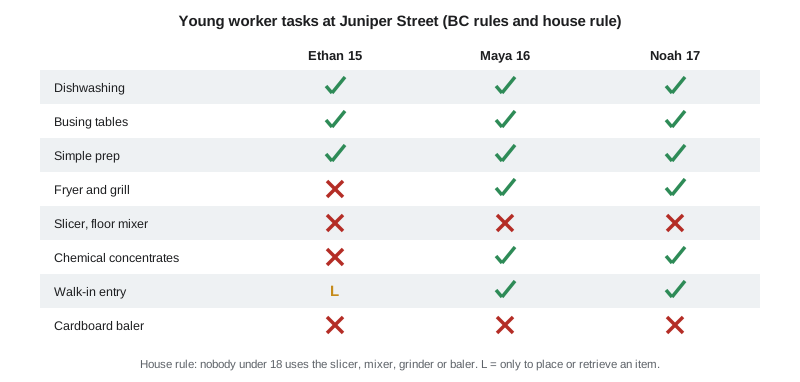
At Juniper Street, Ethan is 15. Under BC rules he can wash dishes, bus tables and help with simple prep under the direct supervision of an adult 19 or older, with his parent's consent on file. He may step into the walk-in only to put something away or pick it up. He does not run or clean the slicer, mixer or grinder, does not handle chemical concentrates, and does not change the dish machine's chemical containers. Maya, 16, and Noah, 17, are past the light-work age, so BC law lets them do most kitchen work with proper training and supervision, including the fryer. BC law would even allow a trained 16-year-old to use the meat slicer. Juniper's house rule is stricter: nobody under 18 operates, cleans or adjusts the slicer, the floor mixer, the grinder or the cardboard baler.
Other provinces would treat Ethan differently, which is why a restaurant group with locations in several provinces must check each one. In Ontario he could work in the kitchen at 15, but a 14-year-old could only work in the dining room. In Alberta, a 15-year-old can work any restaurant job but needs an adult present after 9 p.m. and cannot work after midnight.
Checking a young worker's schedule
Kitchen managers build schedules quickly, often on a phone, and it is easy to break a hours limit or leave a 15-year-old without an adult supervisor on a quiet afternoon. The program below checks a week of shifts for Ethan against two simple BC requirements, the light-work task list and direct supervision by someone 19 or older, and then checks the same shifts against Alberta's late-night limits to show how a move to Calgary would change things.
# Check a 15-year-old's week against simple BC and Alberta rules (invented shifts).
LIGHT_WORK = {"dishwashing", "busing", "prep", "hosting"}
shifts = [  # day, start hour, end hour, task, age of supervising adult on shift
    ("Fri", 16, 20, "dishwashing", 34),
    ("Sat", 11, 17, "busing", 29),
    ("Sat", 17, 22, "dishwashing", 18),
    ("Sun", 11, 16, "fryer", 41),
]
print("BC check (light work, adult 19 or older supervising):")
for day, start, end, task, sup in shifts:
    problems = []
    if task not in LIGHT_WORK:
        problems.append("task is not light work")
    if sup < 19:
        problems.append("supervisor is under 19")
    print(f"  {day} {start}:00-{end}:00 {task:12s}", "; ".join(problems) or "ok")
print("Alberta comparison (15 to 17, restaurant work):")
for day, start, end, task, sup in shifts:
    late = end > 21
    note = "adult must be present after 9 p.m." if late else "ok"
    if end > 24:
        note = "not allowed after midnight"
print(f" {day} {start}:00-{end}:00 {note}")BC check (light work, adult 19 or older supervising): Fri 16:00-20:00 dishwashing ok Sat 11:00-17:00 busing ok Sat 17:00-22:00 dishwashing supervisor is under 19 Sun 11:00-16:00 fryer task is not light work Alberta comparison (15 to 17, restaurant work): Fri 16:00-20:00 ok Sat 11:00-17:00 ok Sat 17:00-22:00 adult must be present after 9 p.m. Sun 11:00-16:00 ok
The check finds two problems. Saturday evening's dish pit is run by a newly hired 18-year-old, so Ethan would not have direct supervision by someone 19 or older, and the Sunday shift puts him on the fryer, which is not light work under Juniper's interpretation of the rules because the fryer is equipment that could harm him. Olivia moved Ethan's Saturday evening shift to a night when Kofi runs the dish pit and replaced the fryer task with busing.
For supervisors: young workers on your shift
- Keep a list of every worker under 18 with their birth date, posted where the shift lead can see it, and a copy of the parental consent for anyone under 16.
- Mark the equipment young workers may not use. OSHA's restaurant eTool suggests labels on machines that minors may not operate, and the same idea works in any province.
- Make sure a qualified adult is on every shift a 14- or 15-year-old works, not just someone over 18.
- Treat every request from a coworker as your problem. Ethan's slicer near miss happened because a new cook did not know the rule.
- Check the provincial rules again when you open a new location or hire someone younger than usual.
Orientation and training
BC's regulation gives special attention to young or new workers, defined as any worker under 25 or any worker new to the workplace, returning after an absence, or doing a new task. Before they start, they must get a workplace orientation that covers the supervisor's name and how to contact them, the worker's rights and responsibilities, workplace rules, known hazards, safe work procedures, working alone or late-night rules where they apply, personal protective equipment, the location of first aid and how to report an injury, emergency procedures, and WHMIS instruction. The employer must keep a record of the orientation. Lesson 12 builds Juniper's first-shift orientation around this checklist.
Summary and key terms
- Employers, supervisors and workers all have legal duties; a shift lead directing work is a supervisor for those hours.
- Canadian workers have the rights to know, to participate and to refuse unsafe work, with a set procedure for refusals.
- BC's 2021 rules limit 14- and 15-year-olds to light work, which includes dishwashing, busing and simple food preparation but not dangerous equipment, hazardous substances or lingering in walk-ins.
- Schedules, task assignments and supervision for young workers must be checked against the law, and a stricter house rule is often the simplest approach.
- New and young workers need a documented orientation before they start work.
- Internal responsibility system
- The principle that everyone in a workplace shares responsibility for safety according to their authority.
- Light work
- Work that a 14- or 15-year-old may do in BC because it is unlikely to harm their health, education or development.
- Hazardous Occupations Order
- A US federal rule listing a type of work that no one under 18 may do in non-farm jobs.
- General Duty Clause
- The OSH Act requirement that employers keep the workplace free from recognized serious hazards.
- Joint health and safety committee
- A committee of worker and employer members that helps identify and fix workplace hazards.
Speaking up in a busy kitchen
Rights on paper only help if people use them, and kitchens have a strong culture of toughing it out. A new dishwasher may not want to tell the chef that the dish machine door sticks, and a young cook may not want to admit that the fryer scares him. Supervisors set the tone. At Juniper Street, Tomás starts every pre-shift meeting with one question: what is broken, missing or unsafe today? Anything raised goes on a whiteboard by the office door with a name and a date for the fix, and the list is reviewed at the monthly committee meeting.
Workers can make speaking up easier for each other too. A cook who sees a coworker reach across a hot flat-top can say so in the same calm voice used to call an order. Calling out is normal in kitchens already; the words behind, hot, sharp and corner are part of the kitchen language taught in Lesson 3, and a quick heads-up about a hazard is just one more call. When everyone does it, nobody feels singled out.
When someone is hurt, the same culture helps them come back safely. WorkSafeBC and the employer work with the worker on a return-to-work plan, often starting with modified duties such as prep at a stool instead of a full line shift. Hana's five days of light duty after her back strain were planned this way, and the committee used her injury to look at how stockpots are moved, which Lesson 8 covers.
Common mistakes
MistakeAny adult can supervise a 15-year-old dishwasher.
InsteadIn BC, a child under 16 must be directly supervised by someone at least 19 years old.
MistakeIf a 17-year-old is trained, they can clean the slicer.
InsteadBC law might allow it, but many restaurants, including Juniper, set a house rule that nobody under 18 operates or cleans the slicer.
MistakeReporting small injuries just makes paperwork.
InsteadSmall injuries reveal hazards and protect the worker if the injury gets worse later.
Practice problems
Work each problem on paper first, then reveal the answer to check.
Can Ethan, 15, step into the walk-in cooler to grab a case of lemons in BC?
Show answer
Yes, entering to retrieve or put away an item is allowed; staying in to stock or clean it is not light work.
A 14-year-old applies for a dishwasher job at a restaurant in Toronto. Can they work in the kitchen?
Show answer
No. Ontario requires workers in restaurant kitchens to be at least 15; a 14-year-old could work in the serving area.
Who is a supervisor on a Sunday night when the chef is off?
Show answer
Whoever is directing the work, such as the shift lead running the line.
Lesson quiz · 5 questions
Score 60% or more to complete this lesson.
Create a free account to save your progress, take quizzes and earn a certificate.