
HSE-380 · Lesson 1 of 12 · 19 min
Hazards in food service work
▶ Video coming soon A video version of this lesson is on the way.
A busy restaurant kitchen packs more hazards into a small room than almost any other workplace most people will ever see. In a space the size of a large living room, a dozen people work with razor-sharp knives, machines with spinning blades, oil heated to 175 °C (350 °F), open flames, steam, boiling stockpots, wet and greasy floors, rooms kept below freezing, strong cleaning chemicals and heavy loads, all while racing to get plates out on time. Most of the people doing that work are young, many are new, and many are working their first job. This course is about how they get hurt and the practical controls that keep them safe.
This is the first course in the food services track. It covers the everyday physical hazards of kitchen and restaurant work for cooks, dishwashers, servers and supervisors. HSE-381 follows with safe food handling and food safety law, HSE-382 covers kitchen fires, gas appliances and hood systems, and HSE-383 covers the front of house, alcohol service and delivery. Where a topic is taught in depth in the safety core, this course points to it rather than repeating it: HSE-102 for chemical hazard communication, HSE-103 for hazard recognition and risk assessment, HSE-104 for personal protective equipment, HSE-105 for fire and emergencies, HSE-106 for slips and falls, HSE-107 for manual handling, HSE-110 for first aid and HSE-243 for heat and cold stress.
Throughout the course, and the three courses that follow it, we use one invented restaurant: Juniper Street Kitchen and Bar in Victoria, British Columbia. Juniper Street is a full-service restaurant with a 110-seat dining room, a 16-seat bar and a 48-seat patio that opens from May to September. It serves lunch and dinner seven days a week, the kitchen runs from 11 a.m. to 10 p.m., and the bar stays open until midnight on Fridays and Saturdays. About 60 people work there, most of them part-time.
Meet the Juniper Street team
The owner, Elena Varga, opened Juniper Street in 2019 in a converted brick building. Daniel Okafor is the general manager. Tomás Reyes is the executive chef and runs the kitchen, and his sous chef, Aisha Rahman, is also the restaurant's safety lead: she keeps the first-aid log, runs new-hire orientation in the kitchen and leads the monthly safety walk. Olivia Brooks manages the front of house.
On the line, Ben Carter, 24, works fry and grill, and Hana Kim, 29, works sauté. Luis Moreno, 41, is the prep cook and one of only two people allowed to sharpen knives. Kofi Mensah, 34, is the lead dishwasher and has worked in the dish pit longer than anyone. Chloe Martin and Sam Patel are servers, Nadia Haddad tends bar and Rafael Silva, 19, is the barback.
Juniper Street also employs three young workers you will meet often. Ethan Clarke, 15, washes dishes and buses tables on weekends. Maya Singh, 16, helps with prep in the afternoons and hosts on busy nights. Noah Fischer, 17, is a line cook trainee learning the fryer and grill. Lesson 2 explains the special legal rules that apply to them, and the rest of the course keeps asking what each hazard means for a worker their age.
The kitchen and its hazard zones
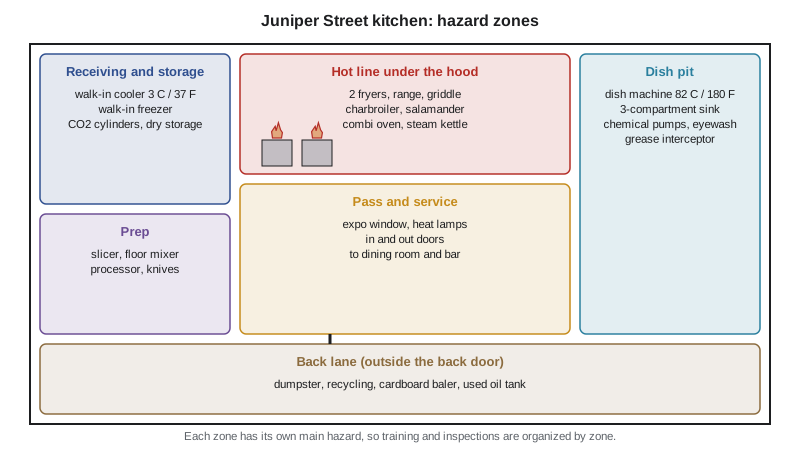
Juniper's kitchen is about 150 m² (1,600 ft²). Like most restaurant kitchens it is organized into zones, and each zone has its own typical hazards. Knowing the zones helps a new worker understand where to be careful, and it gives supervisors a simple way to organize inspections.
- Receiving and storage: the back door, dry storage shelving, the walk-in cooler and the walk-in freezer. Hazards include heavy deliveries, cold, being shut in, and the bar's compressed gas cylinders stored in the cooler.
- Prep: the prep tables, the meat slicer, the floor mixer, the food processor and the knife station. Hazards include cuts, amputations, repetitive motion and standing for hours.
- The hot line: two floor fryers, a six-burner range, a flat-top griddle, a charbroiler, a salamander broiler, a combi oven and a tilting steam kettle under one large hood. Hazards include burns, scalds, fire, heat stress and greasy floors.
- The dish pit: the dish machine, a three-compartment sink, the pre-rinse sprayer and the chemical pumps. Hazards include hot water and steam, chemicals, wet floors, broken glass and awkward reaching.
- The pass and the dining room: the expo window, the service corridor, swinging doors, the bar and the patio. Hazards include collisions, hot plates, broken glass, stairs, and the customers themselves.
- The back lane: the dumpster, recycling bins, the cardboard baler and the used cooking oil tank. Hazards include lifting, sharp waste, hot oil and the baler.
Why food service injures so many workers
Food service is not the most dangerous industry for deaths; construction, transportation and agriculture are far worse. But it is one of the largest employers of all, and its injury rate is close to or above the average for private industry. In absolute numbers, restaurants produce an enormous number of injuries every year, and a large share of those injuries happen to workers under 25.
In British Columbia, go2HR, the province's tourism and hospitality health and safety association, publishes injury profiles built from WorkSafeBC claims. Its 2024 profile for food and beverage service found that cuts and scrapes made up about 36% of injuries, muscle strains about 26% and heat burns about 13%. Other kitchen staff accounted for about 35% of injuries and cooks and chefs about 30%, with servers at about 12%. Workers aged 15 to 24 had 38% of the sector's injuries, far more than their share of the workforce in most industries. WorkSafeBC reported in 2025 that nearly 7,000 young workers are hurt on the job in the province each year, and that service-sector jobs had more young worker claims in 2024 than any other sector, ahead of construction and retail. Other provinces publish similar data through their compensation boards and show the same pattern.
The numbers vary from year to year and from place to place, but the profile does not. Cuts, burns, strains and slips account for most kitchen injuries. A few things about the industry explain why.
- Young and new workers. Restaurants hire many teenagers and young adults, often for their first job. New workers of any age are injured most often in their first months, before they know where the hazards are and before good habits form.
- High turnover. Many restaurants replace a large part of their staff every year, so there is always someone new on the line or in the dish pit.
- Speed. The rush is built into the business. When tickets pile up, people take shortcuts: they reach across the fryer, run in the kitchen, skip the cut glove and leave the spill for later.
- Tight spaces. Kitchens are crowded, with people carrying hot pans and knives past each other in narrow aisles.
- Heat and long shifts. Hot kitchens and double shifts cause fatigue, dehydration and mistakes.
- Small employers. Many restaurants are small businesses without a full-time safety person, so safety depends on the owner, the chef and the supervisors on each shift.
Juniper Street's injury year
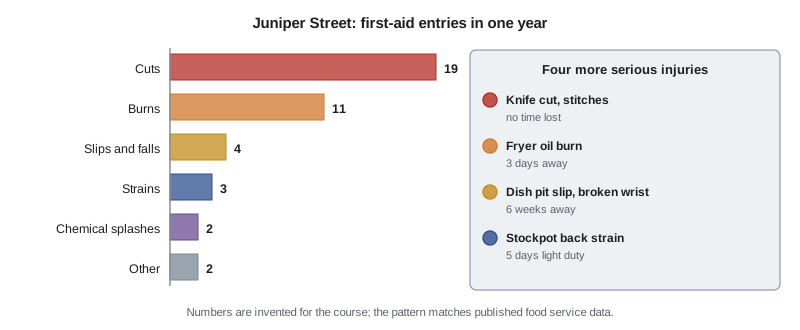
Aisha began her work as safety lead by going through a full year of records. Juniper's 60 workers worked about 96,000 hours that year, roughly 48 full-time equivalents. The first-aid log showed 41 entries: 19 cuts, 11 minor burns, 4 slips or falls, 3 strains, 2 chemical splashes and 2 others. Four injuries were more serious and needed treatment beyond first aid.
- Luis cut his left index finger while dicing onions on a busy Saturday and needed stitches. He went back to work the next day.
- Ben was burned on the forearm when he dropped a basket of frozen fries that still had ice on them into the fryer and the oil spattered. The second-degree burn kept him off work for three days.
- Kofi slipped on the greasy floor of the dish pit while carrying a rack of glasses and broke his wrist. He was off work for six weeks.
- Hana strained her back lifting a full stockpot off the range and worked light duties for five days.
Aisha also found three near misses that worried her more than some of the injuries. A newly hired cook had asked Ethan, who is 15, to clean the meat slicer. The latch on the walk-in freezer door had been sticking for weeks. And someone had stored a jug of bleach next to the acid delimer used on the dish machine, a combination that can release chlorine gas if the two are mixed. None of these hurt anyone, but each could have caused a serious injury.
Measuring injuries: rates instead of counts
A count of injuries means little on its own. Ten injuries a year is a poor record for a café with eight workers and a good one for a hotel kitchen with three hundred. Injury rates divide the number of cases by the hours worked so that workplaces of different sizes, and the same workplace in different years, can be compared. The standard base is 200,000 hours, which is roughly what 100 full-time workers work in a year at 40 hours a week for 50 weeks.
Canadian compensation boards and most employers describe injury performance with lost-time measures. A lost-time claim is one where the worker misses time from work beyond the day of the injury; a health care only claim (often called medical aid) is one where the board paid for treatment but the worker lost no time. The program below calculates Juniper's lost-time frequency and its all-claims frequency, both for every 200,000 hours worked.
# Injury rates for an invented restaurant (Canadian style).
hours = 96_000            # total hours worked in the year
lost_time = 2             # fryer burn (3 days) and wrist fracture (6 weeks)
health_care_only = 2      # stitches, back strain on light duties
first_aid = 41

fte = hours / 2000
lt_freq = lost_time * 200_000 / hours
all_freq = (lost_time + health_care_only) * 200_000 / hours
print(f"Full-time equivalent workers: {fte:.0f}")
print(f"Lost-time claims per 200,000 hours: {lt_freq:.2f}")
print(f"All claims per 200,000 hours: {all_freq:.2f}")
print(f"First-aid cases per claim: {first_aid / (lost_time + health_care_only):.1f}")Full-time equivalent workers: 48 Lost-time claims per 200,000 hours: 4.17 All claims per 200,000 hours: 8.33 First-aid cases per claim: 10.2
Juniper's lost-time frequency of about 4.2 claims for every 200,000 hours looks high next to many other industries, and that is a useful lesson in itself. With only 96,000 hours a year, a single claim moves the rate by about 2. A small restaurant can have a perfect year and a terrible year by luck alone, so Aisha watches the first-aid log and the near-miss reports as well. Those leading indicators, such as the number of safety walks completed, the number of hazards fixed and the share of new hires who finished orientation on day one, change month by month and show whether prevention is working long before the lost-time numbers do.
Rates matter beyond the restaurant too. WorkSafeBC sets each employer's insurance premium from its industry's base rate and adjusts it for the employer's own claim costs through experience rating, so a restaurant with fewer and shorter claims pays less. go2HR's 2024 profile listed a base rate of 0.58 for the restaurant classification for 2026 (in dollars for every 100 dollars of assessable payroll, written without the dollar sign here), up from the year before.
For supervisors: reading your own data
- Read the first-aid log every week, not every year. Four cuts at the same prep station in a month is a signal about knives, cutting boards or training at that station.
- Count near misses as wins. A near-miss report means someone noticed a hazard before it hurt anyone. Thank people for reporting them, and fix what they find.
- Compare like with like. Compare this year's rate with your own past years, or with restaurants of a similar size and menu, not with a factory or an office.
- Look at who is getting hurt. If most injuries happen to people in their first three months, the fix is in orientation and supervision, not in posters.
Hazards that come with the job, not the person
It is tempting to blame kitchen injuries on carelessness: the cook who did not watch his hand or the dishwasher who did not watch the floor. Investigations usually show that the hazard was built into the job. Ben's burn happened because frozen fries came out of the freezer coated in ice and the fry station had no place to shake them off. Kofi slipped on a floor that had been greasy for months because the dish pit mats were worn smooth and the floor drain was half blocked. Luis cut himself at the end of a long prep list with a knife that needed sharpening on a cutting board that slid on the steel table.
The most effective fixes therefore change the job, not just the worker's attention. This follows the hierarchy of controls taught in HSE-103. First remove the hazard if you can, and then engineer it out. Next, change how the work is organized. Only after that should you rely on training and personal protective equipment. In a kitchen, that might mean an automatic basket lift on the fryer, a drip shelf for frozen product, new anti-slip mats and a cleared drain, a damp towel under every cutting board, a knife-sharpening schedule and more prep help on Saturdays.
| Injury | Juniper example | Main controls | Lesson |
|---|---|---|---|
| Cut | Knife slip while dicing onions | Sharp knives, stable boards, claw grip, cut gloves | 3 |
| Machine injury | Cleaning a slicer that is still plugged in | Guards, lockout before cleaning, age rules | 4 |
| Burn or scald | Oil spatter from wet frozen fries | Drain and shake product, basket lifts, oil transfer tools | 5 |
| Slip or fall | Greasy dish pit floor | Mats, drains, cleaning, slip-resistant shoes | 6 |
| Cold or trapped | Sticking freezer door latch | Inside release, door checks, time limits | 7 |
| Strain | Lifting a full stockpot off the range | Ladle out first, carts, two-person lifts | 8 |
| Chemical | Bleach stored beside acid delimer | Labels, segregation, dispensers, eye protection | 9 |
| Dish pit and waste | Broken glass in the dish water | Glass racks, separate broken glass bin | 10 |
| Heat illness | Line cook dizzy during a summer rush | Ventilation, water, breaks, watching each other | 11 |
How the course is organized
Lesson 2 covers rights, roles and the special rules for young workers. Lessons 3 to 11 each take one hazard: knives, kitchen machines, burns, floors, walk-ins, lifting and repetitive work, chemicals, dish pits and waste, and heat. Each lesson explains how the hazard causes injuries, what the law expects, and what workers and supervisors can do, with a box of extra points for supervisors. Lesson 12 brings it all together in a first-shift orientation for a new worker and a full kitchen safety walk of Juniper Street.
Summary and key terms
- Restaurant kitchens combine knives, machines, hot oil, steam, wet floors, cold rooms, chemicals and heavy loads in a small, crowded space.
- Cuts, burns, strains and slips cause most kitchen injuries, and young and new workers have a large share of them.
- Injury rates divide cases by hours worked so that workplaces of different sizes can be compared; small restaurants should also track leading indicators.
- Most kitchen injuries come from hazards built into the job, so the best fixes change equipment, layout and work organization, not only behaviour.
- Juniper Street Kitchen and Bar is the invented restaurant used throughout this course and the rest of the food services track.
- Hazard zone
- An area of a kitchen, such as the hot line or the dish pit, with its own typical hazards.
- Lost-time claim
- A compensation claim in which the injured worker misses time from work beyond the day of the injury.
- Recordable case
- An injury or illness that needs treatment beyond first aid, causes days away or restricted work, or meets another recording criterion.
- Near miss
- An event that could have caused an injury but did not.
- Leading indicator
- A measure of prevention activity, such as inspections completed or hazards fixed, that changes before injury rates do.
Common mistakes
MistakeRestaurants are low-risk because nobody uses heavy machinery.
InsteadKitchens have slicers, mixers, fryers, steam and chemicals, and food service produces a very large number of injuries every year.
MistakeA small restaurant with a perfect year has solved its safety problems.
InsteadWith few hours worked, injury rates swing by chance; first-aid logs, near misses and inspections show the real trend.
MistakeMost cuts and burns happen because workers are careless.
InsteadMost come from dull knives, unstable boards, wet frozen food, worn mats and rushed staffing, which are fixable job conditions.
Practice problems
Work each problem on paper first, then reveal the answer to check.
A café worked 30,000 hours and had one injury that needed stitches. What is its rate per 200,000 hours?
Show answer
One case times 200,000 divided by 30,000 hours is about 6.7 cases per 200,000 hours.
Name the kitchen zone where Juniper keeps the draft beer gas cylinders.
Show answer
The walk-in cooler, which is part of the receiving and storage zone.
Why did Aisha treat the slicer near miss as seriously as an injury?
Show answer
A 15-year-old cleaning a slicer could have suffered an amputation, and the request showed a gap in what new cooks knew about the house rules and the law.
Lesson quiz · 5 questions
Score 60% or more to complete this lesson.
Create a free account to save your progress, take quizzes and earn a certificate.