
HSE-380 · Lesson 9 of 12 · 18 min
Cleaning and sanitizing chemicals
▶ Video coming soon A video version of this lesson is on the way.
Restaurants clean constantly, and cleaning means chemicals. Dish machine detergent, oven and grill cleaner, degreasers, drain cleaners and delimers are strong alkalis or acids that burn skin and eyes. Sanitizers are designed to kill microorganisms and must be mixed to the right strength. And some common products produce toxic gas if they are mixed. At Juniper Street, two of the 41 first-aid entries were chemical splashes, and one of the year's three serious near misses was bleach stored next to acid delimer. HSE-102 covers chemical hazard communication in general. This lesson applies it to the chemicals in a commercial kitchen and shows how to mix sanitizer correctly.
Juniper's chemical shelf
Aisha's first step was a full inventory. She found eleven products, a typical number for a full-service restaurant.
| Product | Main hazard | Where used | Key precaution |
|---|---|---|---|
| Dish machine detergent | Corrosive alkali | Dish machine pump | Change containers with goggles and gloves |
| Rinse aid | Eye irritant | Dish machine pump | Goggles when changing containers |
| Quaternary ammonium sanitizer | Corrosive as a concentrate | Wall dispenser, sanitizer buckets | Use the dispenser; test the strength |
| Chlorine bleach | Corrosive, releases chlorine gas with acids | Some sanitizing and stain removal | Never mix with acids or ammonia |
| Oven and grill cleaner | Strong alkali, severe burns | Ovens, griddle, charbroiler | Goggles or face shield, long gloves, cool surfaces |
| Floor degreaser | Alkali, skin and eye irritant | Kitchen floors | Dilute through the dispenser |
| Delimer | Acid, corrosive | Dish machine, steamers | Store away from bleach |
| Drain cleaner | Strong acid or alkali | Floor drains | Supervisor only; never pour into standing water |
| Glass cleaner | Mild irritant | Windows, pass shelf | Label spray bottles |
| Stainless steel polish | Aerosol, flammable | Hood, equipment fronts | Keep away from heat |
| Hand soap and sanitizer | Low hazard | Hand sinks | Refill from the original container |
Strong alkalis such as sodium hydroxide in oven cleaner and dish detergent are especially dangerous because they do not sting right away the way acids do. They dissolve skin and eye tissue and keep working until they are washed off, so a splash in the eye can cause permanent damage within minutes.
Hazard communication law
In Canada, hazardous products used at work are covered by WHMIS, the Workplace Hazardous Materials Information System. WHMIS 2015 brought Canada in line with the Globally Harmonized System of Classification and Labelling of Chemicals, the GHS. Suppliers must classify their products and provide supplier labels and 16-section safety data sheets. Employers must make sure products are labelled, keep the safety data sheets available to workers, and train workers on the hazards and safe use of the products they work with. Amendments to the federal Hazardous Products Regulations came into force on December 15, 2022, aligning WHMIS with newer editions of the GHS, with a three-year transition that ended on December 14, 2025. Each province adopts WHMIS in its OHS law; in BC it is in Part 5 of the regulation.
One detail matters in restaurants. Products sold as consumer products, such as some bleach and glass cleaners bought at a grocery store, are exempt from WHMIS supplier labelling and safety data sheet requirements because they carry consumer chemical labels instead. The employer must still train workers on how to use them safely, and Juniper buys commercial products with safety data sheets wherever possible so everything is handled the same way.
Reading a label
Supplier labels under the GHS follow the same pattern everywhere: a product identifier, one or more red-bordered pictograms, a signal word, hazard statements, precautionary statements, and the supplier's name and contact information. The signal word is Danger for the more severe hazards and a milder word for less severe ones. The corrosion pictogram, showing liquid eating into a hand and a metal bar, appears on dish detergent, oven cleaner, delimer and concentrated sanitizer.
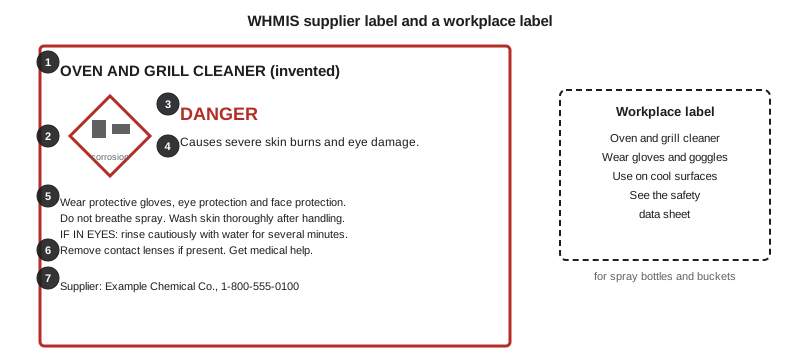
When a product is moved into a spray bottle or bucket, the new container needs a workplace label with the product identifier, safe handling information and a reference to the safety data sheet. A bucket that is filled and used up within the same shift by the person who filled it is an exception in most provinces, but Juniper labels every sanitizer bucket anyway so nobody mistakes it for water.
Never mix chemicals
Two combinations cause most chemical gas incidents in restaurants. Bleach mixed with an acid, such as a delimer, some drain cleaners or some toilet bowl cleaners, releases chlorine gas. Bleach mixed with ammonia or products containing it releases chloramine gas. Both gases irritate the eyes and lungs and can cause serious lung damage in a small, poorly ventilated room like a dish pit or a restroom. Mixing can happen by accident: pouring one product into a bucket that still holds another, using two products on the same drain, or a leak on a shelf where the products sit side by side.
- Never mix cleaning products, and use one product at a time on a surface, rinsing between them.
- Store acids and chlorine products on separate shelves, with the acids below and away from the bleach. At Juniper, the delimer moved to its own tub on the bottom shelf on the other side of the room.
- Store chemicals below food and away from food prep areas, in their original or properly labelled containers.
- If you smell a sharp chlorine smell or your eyes start to sting while cleaning, leave the area, ventilate it if you can do so safely, and tell a supervisor.
Dispensers and dilution
The safest way to use concentrated chemicals is not to handle them at all. Juniper's chemical supplier installed a wall-mounted dispenser that mixes the sanitizer and floor degreaser with water at the right strength, and pumps that feed the dish machine directly from closed containers. Workers fill a labelled bucket or bottle from the dispenser instead of pouring concentrate. Only adults trained by the supplier change the concentrate containers, wearing goggles and gloves.
When sanitizer must be mixed by hand, as with bleach on the patio or during a dispenser breakdown, the strength matters in both directions. Too weak and it does not kill the germs it is meant to kill; too strong and it can irritate skin and eyes, damage surfaces and leave residues on food contact surfaces. Strength is measured in parts per million, abbreviated ppm. HSE-381 covers the food safety side of sanitizing; here the concern is mixing it safely and correctly.
# Dilute a concentrate to a target sanitizer strength (metric).
def concentrate_ml(target_ppm, stock_ppm, batch_l):
    return target_ppm * batch_l * 1000 / stock_ppm

bleach = 82_500     # 8.25% sodium hypochlorite = 82,500 ppm available chlorine
for batch in (4, 10, 20):
    ml = concentrate_ml(100, bleach, batch)
    print(f"{batch:2d} L of 100 ppm chlorine: {ml:5.1f} mL of bleach")

quat = 100_000      # an invented quat concentrate at 10% active
print(f" 4 L of 200 ppm quat: {concentrate_ml(200, quat, 4):5.1f} mL of concentrate")4 L of 100 ppm chlorine: 4.8 mL of bleach 10 L of 100 ppm chlorine: 12.1 mL of bleach 20 L of 100 ppm chlorine: 24.2 mL of bleach 4 L of 200 ppm quat: 8.0 mL of concentrate
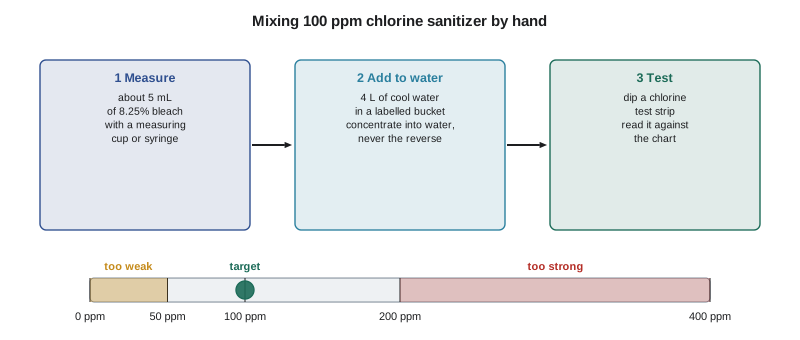
The calculation shows why a measuring cup matters: 100 ppm needs only about 5 mL of 8.25% bleach in 4 L of water, a little over a teaspoon. A glug from the jug is usually several times too strong. Always add the concentrate to the water, not water to the concentrate, use cool water because hot water drives chlorine off, and check every batch with the test strips for that sanitizer. Health authorities, including BC's, commonly call for about 100 ppm chlorine or the label strength of quaternary ammonium, often 200 ppm, for food contact surfaces.
Protective equipment and eyewash
The safety data sheet for each product lists the protective equipment needed. In a kitchen that usually means chemical splash goggles and rubber or nitrile gloves for changing concentrate containers and cleaning ovens and drains, with long gloves, a face shield and a waterproof apron for oven and grill cleaner. Ordinary safety glasses do not stop splashes from running in from the sides. Oven cleaner is applied only to cool or warm surfaces as the label directs, never sprayed into a hot oven at face height. HSE-104 covers the selection of chemical protective equipment.
Where workers handle corrosive chemicals, BC's regulation requires emergency washing facilities matched to the hazard, such as an eyewash station. Juniper has a plumbed eyewash in the dish pit, within a few seconds' walk of the chemical shelf and the dish machine pumps, and tests it weekly by running it.
For a chemical splash to the eye, flush immediately with lukewarm water for at least 15 minutes, holding the eyelids open, then get medical care with the product's safety data sheet. For skin, remove contaminated clothing and rinse the skin for at least 15 minutes. One of Juniper's first-aid entries was Ben's splash of degreaser on his wrist; he rinsed it at the hand sink and reported it, and the investigation found the dispenser nozzle had cracked and sprayed sideways.
For supervisors: chemical control
- Keep an up-to-date chemical inventory and a safety data sheet for every product, in a binder by the office door or on a tablet everyone can reach.
- Train every worker on the products they use before they use them, including what the pictograms mean, how to dilute, what to wear and what to do if there is a splash.
- Check that every spray bottle and bucket is labelled, every day.
- Separate acids from bleach and keep chemicals below and away from food.
- Keep young workers away from concentrates.
- In BC, 14- and 15-year-olds may not use, handle or be exposed to hazardous substances as part of light work, so Ethan does not change containers, clean ovens or use drain cleaner.
Summary and key terms
- Kitchen cleaners include strong alkalis and acids that cause severe skin and eye burns, and alkalis keep damaging tissue until washed off.
- WHMIS 2015 requires supplier labels, 16-section safety data sheets, workplace labels and training; the amended regulations' transition ended on December 14, 2025.
- Never mix chemicals: bleach with acid makes chlorine gas and bleach with ammonia makes chloramine; store acids away from bleach.
- Use dispensers where possible, mix by hand only with a measure and always check the strength with test strips.
- Wear splash goggles and gloves for concentrates and oven cleaner, and flush eye splashes for at least 15 minutes at an eyewash.
- Safety data sheet
- A 16-section document from the supplier describing a product’s hazards, safe handling, protective equipment and first aid.
- Workplace label
- A label on a container a product has been transferred into, identifying the product and its safe handling.
- Signal word
- The word on a label that shows how severe the hazard is, with Danger for the most severe.
- ppm
- Parts per million, the usual unit for sanitizer strength.
- Corrosive
- A chemical that destroys skin, eyes or metal on contact.
Cleaning up a chemical spill
Concentrate containers sometimes leak or fall. A small spill of detergent or sanitizer concentrate is cleaned by an adult wearing goggles and gloves, using the absorbent and steps on the product's safety data sheet, with the area kept clear until it is done. Spilled corrosives are never wiped up with bare hands or a food towel, and the waste goes in a sealed bag or container labelled with the product name. Spills of incompatible products, such as acid near bleach, a large spill, or any spill that releases fumes, mean clearing the room, ventilating it if that can be done safely, and calling the supplier's emergency number on the safety data sheet. Juniper keeps a small spill kit with absorbent pads, a scoop, bags, goggles and gloves on the chemical shelf.
Worked problem
Checking a sanitizer bucket during service
At 7 p.m. Sam dips a test strip into the sanitizer bucket at the server station. The strip reads about 25 ppm quat, far below the 200 ppm on the label. What should she do, and what might have caused it?
Show solution
- Stop using the bucket for sanitizing tables and surfaces, since the solution is too weak to work.
- Empty it, refill it from the wall dispenser, and test the new solution with a fresh strip.
- If the new batch also reads low, tell the supervisor so the dispenser and concentrate can be checked.
- Think about the cause: quat strength falls when cloths made of cotton absorb the active ingredient, when the water is very dirty with food, and over time, so buckets need changing every few hours and whenever they look dirty.
Answer: Sam replaces the bucket from the dispenser, tests it again and reports the problem if it is still low; regular changes and test strip checks keep the sanitizer at label strength.
Juniper records the result of a test strip check at each sanitizer bucket on the hourly floor walk. The log is a food safety record, which HSE-381 covers, but it is also a chemical safety record: a reading far above the label strength means someone is pouring concentrate by hand instead of using the dispenser.
Common mistakes
MistakeA little extra bleach makes the sanitizer work better.
InsteadToo strong sanitizer irritates skin and eyes and leaves residues; mix to the target ppm and test it.
MistakeOven cleaner works faster in a hot oven, so spray it right after service.
InsteadSpraying into a hot oven creates fumes at face height; follow the label, which usually calls for a cool or warm surface.
MistakeA spray bottle of sanitizer does not need a label if everyone knows what it is.
InsteadEvery decanted container needs a label so nobody mistakes it for water or another product.
Practice problems
Work each problem on paper first, then reveal the answer to check.
How much 8.25% bleach makes 10 L of 100 ppm sanitizer?
Show answer
About 12 mL, from 100 times 10 times 1,000 divided by 82,500.
Kofi smells chlorine while cleaning a floor drain. What should he do?
Show answer
Leave the area, ventilate it if he can do so safely, tell a supervisor, and check whether two products were mixed.
Why are alkali splashes to the eye especially dangerous?
Show answer
Alkalis do not sting right away but keep dissolving tissue until washed off, so damage can be severe within minutes.
Lesson quiz · 5 questions
Score 60% or more to complete this lesson.
Create a free account to save your progress, take quizzes and earn a certificate.