
HSE-391 · Lesson 2 of 12 · 23 min
Policies, laws and standards for patient handling
▶ Video coming soon A video version of this lesson is on the way.
Lesson 1 showed why manual patient handling injures workers. This lesson looks at the rules that apply to it: the general duties in health and safety law, the specific laws and regulations that some jurisdictions have added, the standards and guidelines that describe good practice, and the hospital's own policy. HSE-390 Lesson 2 covered the general structure of healthcare safety law at Northbridge. Here the focus narrows to moving and handling people.
The short version for the United States is that there is no federal OSHA standard for patient handling, but the General Duty Clause, OSHA's guidelines, Minnesota's safe patient handling law and national professional standards together add up to a clear obligation: the hospital must assess the risk, provide the equipment and training to control it, and make sure staff use them.
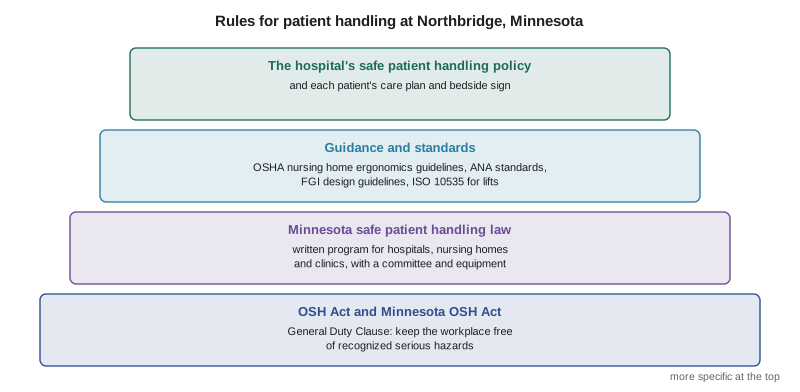
The general duty
The federal Occupational Safety and Health Act does not mention patients, lifts or slings either. Section 5(a)(1), the General Duty Clause, requires every employer to keep the workplace free of recognized hazards that are causing or likely to cause death or serious physical harm. OSHA and the courts have accepted that the risk of musculoskeletal injury from manual patient handling is a recognized hazard in healthcare, with feasible ways to reduce it. OSHA has used the General Duty Clause to cite nursing homes and hospitals for patient handling hazards, and since 2015 it has told its inspectors to look at patient handling whenever they inspect a hospital or nursing home, along with workplace violence, bloodborne pathogens, tuberculosis and slips. MNOSHA applies the same duty under the Minnesota OSH Act.
Workers have duties too. Section 5(b) requires them to comply with the standards, rules and orders that apply to their own actions, and hospital policies make the use of required equipment a condition of the job. A certified nursing assistant who knows that the care plan calls for a ceiling lift and moves the resident by hand to save time is breaking the hospital's policy, and a supervisor who knows it is happening and does nothing is failing to enforce it.
Laws written for patient handling
Several states have gone further than the General Duty Clause and passed laws written for patient handling. Minnesota is one of them, and its law applies at Northbridge:
- Minnesota Statutes section 182.6553, passed in 2007, requires every licensed hospital and nursing home to adopt a written safe patient handling policy whose goal is to reduce manual lifting by nurses and other direct care workers, mainly through the use of equipment. The program must include a patient handling hazard assessment, an adequate supply of appropriate equipment, initial and ongoing training, attention to construction and remodeling so that buildings support the program, and periodic evaluation.
- The facility must have a safe patient handling committee, or give the work to an existing committee. At least half of its members must be nonmanagerial nurses and other direct care workers, chosen by their union where there is one, and the employer must pay them for committee time. The committee does the hazard assessment, recommends equipment, training and remodeling, and evaluates the program every year.
- A later section extends similar requirements to clinics and other clinical settings where patients are handled.
- The state can make grants of up to 40,000 dollars per facility for equipment and training, normally matched dollar for dollar, and MNOSHA enforces the law.
Minnesota is not alone. By the mid-2010s eleven states had passed safe patient handling laws or rules: California, Illinois, Maryland, Minnesota, Missouri, New Jersey, New York, Ohio, Rhode Island, Texas and Washington. Most require hospitals, and often nursing homes, to have a program with a policy, a committee that includes direct care workers, equipment, training and data collection. Some have special features: Washington gave hospitals a tax credit for lift equipment, New Jersey protects workers who refuse unsafe manual lifts, and California requires hospitals to have trained lift teams. Ohio's law was an interest-free loan program for nursing homes rather than a requirement, and it has since been repealed. Bills for a federal safe patient handling standard have been introduced in Congress several times, but none has passed.
Guidelines and standards
Laws say what must be achieved. Guidelines and standards describe how good programs achieve it, and inspectors, accreditors, courts and arbitrators often use them as the measure of what is reasonable.
- OSHA's Guidelines for Nursing Homes: Ergonomics for the Prevention of Musculoskeletal Disorders, first published in 2003 and revised in 2009, describe a program of management support, worker involvement, task assessment, equipment, training and evaluation. OSHA points hospitals to the same approach.
- The American Nurses Association's Safe Patient Handling and Mobility: Interprofessional National Standards, first published in 2013 and revised in a second edition, set out eight standards for a program: a culture of safety; a program that is implemented and sustained; ergonomic design; selecting, installing and maintaining technology; education, training and competence; patient-centered assessment and care planning; reasonable accommodation and return to work; and comprehensive evaluation. Lesson 12 uses them as a framework.
- The Facility Guidelines Institute (FGI) guidelines for designing hospitals and outpatient facilities, adopted by many states, require a patient handling and mobility assessment when a facility is designed or renovated, so that lifts and space are planned from the start.
- ISO 10535 is the international standard for hoists used to transfer people. Manufacturers design and test their lifts and slings to it, and it sets out the information they must give users.
- the FDA regulates lifts and slings as medical devices and publishes recalls and safety communications about them.
Collective agreements also matter. The agreements between Northbridge and its nursing and service unions include health and safety articles that require equipment and training, give the safety committee a role in choosing equipment, and set out how disputes about staffing and workload are raised. Many nurses' unions have campaigned for safe patient handling laws and programs for years.
Refusing an unsafe lift
What can a worker do when asked to lift a patient by hand in a situation they believe is dangerous? Federal law gives workers a limited right to refuse work only where there is a real danger of death or serious injury, there is no time to get it fixed through normal channels and the employer will not fix it. New Jersey and some other states have added specific protection for workers who refuse unsafe patient lifts, and Minnesota law protects workers who refuse in good faith when there is an imminent danger. In practice, refusal is a last resort. A broken ceiling lift is not a reason to lift by hand, and moving a patient who is not in distress can usually wait the few minutes it takes to fetch another lift. Most unsafe lifts are prevented much earlier, by raising the problem with the charge nurse or supervisor, who must then find a safe way to do the task.
There is one firm exception to waiting. If a patient is in immediate danger, for example sliding out of a chair or in a fire, staff act to protect the patient. Even then, the safest action is usually to lower the patient to the floor in a controlled way and get equipment, not to lift. Lesson 8 covers this.
Northbridge's policy, before and after
When Grace started as coordinator, she found that Northbridge's policy was a three-page document called Lifts and Transfers, last revised in 2019. It said that staff should use mechanical lifts "when appropriate", that lift training was part of orientation, and that equipment problems should be reported to maintenance. It did not say who decided what was appropriate, how patients were assessed, how often training was repeated, who was responsible for slings, or how the program was measured. Most staff had never read it.
Grace did a gap analysis, comparing the policy with the elements that a strong program needs. She kept the results in a short script so she could rerun it as the policy improved.
# Gap analysis of the Lifts and Transfers policy (2019)
# 2 = fully in place, 1 = partly, 0 = missing
elements = {
    "Clear goal: minimize manual lifting":          1,
    "Leadership responsibility named":              0,
    "Committee with frontline workers":             0,
    "Patient mobility assessment tool":             0,
    "Assessment linked to equipment choice":        0,
    "Enough equipment on every unit":               1,
    "Slings: supply, laundry, inspection":          0,
    "Equipment maintenance and charging":           1,
    "Training at hire and at least yearly":         1,
    "Unit peer leaders or champions":               0,
    "Injury and near-miss data reviewed":           1,
    "Design review for new or renovated space":     0,
    "Return to work after injury":                  1,
    "Annual evaluation and policy review":          0,
}
score = sum(elements.values())
print(f"score {score} of {2 * len(elements)}  ({score / (2 * len(elements)):.0%})")
print("missing:")
for name, v in elements.items():
    if v == 0:
print(" -", name)score 6 of 28 (21%) missing: - Leadership responsibility named - Committee with frontline workers - Patient mobility assessment tool - Assessment linked to equipment choice - Slings: supply, laundry, inspection - Unit peer leaders or champions - Design review for new or renovated space - Annual evaluation and policy review
A score below a third told Grace that the hospital had equipment and good intentions but not a program. The missing elements were mostly about organization: who decides, who checks, who is responsible. Over the next months, Grace and the safety committee rewrote the policy as a Safe Patient Handling and Mobility policy. Its key points, which the rest of this course explains, are:
- Goal: manual lifting of all or most of a patient's weight is eliminated wherever equipment can do the job, and staff are expected to use the equipment the assessment calls for.
- Assessment: every patient and resident has a mobility assessment on admission, at least every shift in acute care and whenever their condition changes, using a standard tool (Lesson 3).
- Care plan: the result is recorded in the chart and on a sign at the bedside, so everyone moving the patient knows the method.
- Equipment: each unit has the lifts, slings, sit-to-stand aids and friction-reducing devices its patients need, stored close to where they are used, charged and maintained (Lessons 4 to 7 and 11).
- Training: hands-on training at hire, yearly refreshers and training whenever new equipment arrives, with checks of competence on the unit.
- Peer leaders: trained staff on every unit and shift who coach colleagues and report problems.
- Data: injury and near-miss reports, equipment problems and audit results reviewed by the committee every quarter.
- Design: every new or renovated space is reviewed for lift coverage and room space.
- Review: the program is evaluated and the policy reviewed every year.
Worked problem
Lina and the broken lift
At 0700, Lina finds that the ceiling lift in a Birch resident's room will not move. The resident, who is fully dependent and weighs 175 lb (about 80 kg), needs to get up for breakfast and a medical appointment at 0900. A colleague suggests that the two of them lift her to the chair by hand, as they did years ago. What should Lina do?
Show solution
- The resident's care plan calls for a ceiling or floor lift, so a manual lift would mean each worker holding 88 lb (about 40 kg), far over the guideline. It would also be against the hospital's policy and the long-term care rules on safe transferring.
- The resident is not in danger, so there is time to find another way. Lina tags the lift as out of service, reports it to maintenance and the charge nurse, and fetches the floor lift and a compatible sling from the Birch equipment room.
- If the floor lift were in use, the charge nurse would borrow one from Cedar or rearrange the morning so the resident gets up later. Missing breakfast in the dining room is a much smaller harm than a dropped resident or an injured worker.
- Lina records the problem on the equipment log, and the safety committee sees it at its next review. If lifts are often broken or unavailable, that is a system problem that the program must fix.
Answer: Do not lift by hand. Tag and report the broken lift, use the floor lift or another unit's lift, and adjust the schedule if needed; the resident is not in danger, so there is time to do it safely.
Common mistakes
MistakeAssuming there are no rules because OSHA has no patient handling standard.
InsteadThe General Duty Clause, Minnesota's law and recognized guidelines together require assessment, equipment, training and use.
MistakeWriting a policy that says to use lifts "when appropriate".
InsteadSay who decides, how patients are assessed, what equipment each result calls for, and how the program is checked.
MistakeTreating the right to refuse as the main protection against unsafe lifts.
InsteadMost unsafe lifts should be stopped much earlier, by reporting problems and having equipment and staff available.
MistakeLeaving frontline workers out of the program.
InsteadMinnesota law requires at least half the committee to be nonmanagerial direct care workers, and their knowledge is essential.
MistakeWriting the policy and never reviewing it.
InsteadEvaluate the program and review the policy at least once a year.
Summary and key terms
- There is no federal OSHA patient handling standard, but the General Duty Clause applies to the recognized hazard of manual patient handling.
- Minnesota's 2007 law requires hospitals and nursing homes to have a policy to reduce manual lifting, a hazard assessment, equipment, training, design review, annual evaluation and a committee at least half made up of direct care workers.
- Eleven states have safe patient handling laws or rules, with features such as tax credits, refusal protection and lift teams.
- Guidance such as OSHA's nursing home guidelines, the ANA national standards, the FGI guidelines and ISO 10535 describe good practice.
- Workers must use the equipment and methods required, and supervisors must make sure they do.
- The right to refuse is a last resort; a broken lift is a reason to fetch another one, not to lift by hand.
- A strong policy names who decides, how patients are assessed, what equipment is used, how staff are trained and how the program is measured.
- General duty
- The employer's duty under section 5(a)(1) of the OSH Act to keep the workplace free of recognized serious hazards.
- Safe patient handling policy
- A written policy that sets out how a facility minimizes manual lifting through assessment, equipment, training and evaluation.
- Gap analysis
- A comparison of what is in place with what a good program needs, to find what is missing.
- ISO 10535
- The international standard for hoists used to transfer people, including their slings.
- Peer leader
- A trained frontline worker who coaches colleagues on safe patient handling and reports problems.
Practice problems
Work each problem on paper first, then reveal the answer to check.
Which Minnesota statute requires hospitals and nursing homes to have a safe patient handling program?
Show answer
Minnesota Statutes section 182.6553.
What share of Minnesota's safe patient handling committee must be nonmanagerial direct care workers?
Show answer
At least half.
Name three elements that Northbridge's 2019 policy was missing.
Show answer
Any three of: a named leader, a committee with frontline workers, a mobility assessment tool, a link from assessment to equipment, sling management, peer leaders, design review and annual evaluation.
A ceiling lift is broken and a resident needs to get up. Is this a reason to lift by hand?
Show answer
No. Tag and report the lift, use another lift, and adjust the schedule if needed.
Why do guidelines and standards matter if they are not law?
Show answer
Inspectors, accreditors, courts and arbitrators use them as the measure of what is reasonable and good practice.
When may staff act without equipment to protect a patient?
Show answer
When the patient is in immediate danger; even then, lowering the patient in a controlled way is usually safer than lifting.
Lesson quiz · 5 questions
Score 60% or more to complete this lesson.
Create a free account to save your progress, take quizzes and earn a certificate.