
HSE-391 · Lesson 5 of 12 · 24 min
Slings: selection, fit and inspection
▶ Video coming soon A video version of this lesson is on the way.
A lift is only as safe as its sling. The sling is the part that holds the patient, touches their skin, takes their whole weight and connects them to the machine. Most serious lift incidents involve the sling: the wrong type for the patient, the wrong size, a sling that does not match the lift, loops attached wrongly, or a sling that was worn out. This lesson covers how slings are chosen, sized, fitted, kept clean and inspected, and how a hospital keeps enough of the right ones where they are needed.
Types of sling
Manufacturers make many slings, each designed for a particular kind of patient and task. The main types at Northbridge are:
- Universal or divided-leg slings. The most common type, with a back piece and two separate leg pieces that pass under the thighs. Used for most bed-to-chair, chair-to-commode and similar transfers, with the patient lifted in a seated position. Versions with a high back support the head and neck.
- Hammock or full-body slings. One continuous piece from head to thighs with no separate legs. Used for patients who have very poor trunk and head control, have had a leg amputation, or need to be lifted in a more reclined position.
- Toileting or access slings. A short sling that supports the back and thighs but leaves the buttocks free so that clothing can be adjusted for toileting. Only for patients with good head and trunk control and some upper body strength, because they give the least support.
- Repositioning slings. Large sheet-like slings with several attachment points along each side. Used with a ceiling lift to turn a patient, move them up the bed or lift them slightly for bed changes. Some are made to stay under the patient between moves.
- Limb slings. Narrow straps for lifting and holding a leg or arm during wound care, dressing changes or putting on stockings.
- Ambulation vests and walking slings. Harnesses that let a lift support part of a patient's weight while they practice standing and walking. Lesson 6 covers them.
- Bathing slings. Made of mesh that drains water, for use in the tub room and shower.
- Bariatric slings, wider and stronger, rated for heavier patients (Lesson 9).
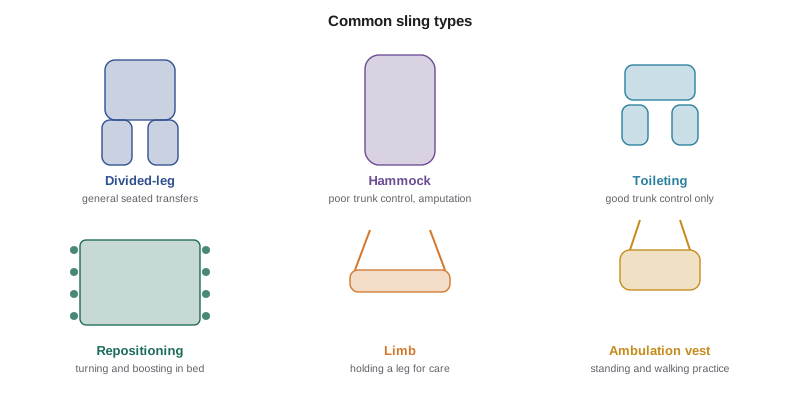
The care plan names the sling type and size for each patient, based on the mobility assessment and, for complex patients, the advice of a physical therapist or occupational therapist. Staff should not swap one type for another because it is the one in the cupboard. A toileting sling used for a patient with poor trunk control is a serious hazard: the patient can slump and slide out.
Matching the sling to the lift
Slings attach to the spreader bar in one of two ways. Loop slings have fabric loops at each attachment point that hook over the ends of the bar. Clip slings have plastic or metal clips that fit into slots on the bar. A loop sling cannot be used safely on a clip-type bar, or the other way round, and even slings of the same kind from different manufacturers may not fit each other's bars correctly. Manufacturers test their slings with their own lifts, and the combination they have tested is the one that is known to be safe.
For that reason, Northbridge's policy is that slings are used only with lifts they are approved for, as listed in the equipment register, and that a new combination of lift and sling is checked by Grace and clinical engineering before it is used. Several of the lift incidents reported to the FDA over the years involved slings from one maker used on another maker's lift.
Loop slings usually have several loops of different lengths on each strap, often color-coded. Which loop is used changes the patient's position in the sling. Shorter loops at the shoulders and longer loops at the legs sit the patient more upright; the other way round tilts them back. The care plan records which loops to use, so that the patient is lifted in the same safe and comfortable position every time.
Sizing
A sling that is too small digs into the patient's thighs and armpits, puts pressure on the skin, and may not support the head. A sling that is too large is more dangerous: the patient can slip down through the leg openings or out of the back. Every manufacturer has its own sizing method, usually based on measuring the patient's back from the base of the spine to the top of the shoulders or head, sometimes combined with weight and hip width. Sizes are usually color-coded on the edge binding or the label, from extra small to extra large and bariatric sizes.
Staff size a sling using the manufacturer's guide, not by eye and not by the patient's weight alone: two patients of the same weight can need different sizes. When a patient is between sizes, the guide usually says which way to go for each type. The size goes in the care plan and on the bedside sign. A patient whose weight changes a lot, for example after a long illness, needs to be resized.
Fitting the sling
Most fitting errors are visible before the lift if staff look for them. Northbridge teaches a fit check that staff do every time, with the patient in the sling and the loops attached but before lifting more than a few centimeters:
- The sling is centered under the patient, with the middle seam or label lined up with the spine.
- The top of the sling is at the right height for the design: at the shoulders, or behind the head for a high-back sling.
- The leg pieces are under the thighs, not under the buttocks, and are positioned as the sling design requires. Some slings cross the leg pieces under the opposite thigh; others do not.
- The base of the back piece is at or just below the tailbone.
- No part of the sling is twisted, and no handles, tags or straps are caught.
- The loops on each side are of the lengths in the care plan.
- The patient's arms are inside the sling unless the design and plan say otherwise.
- Lines, catheters and drains are free and will not be pulled.
If anything looks wrong, staff lower the patient and fix it. The few seconds this takes prevent most sling incidents.
Leaving slings in place
Standard transfer slings should be removed after the patient is in the chair or bed, because the seams, folds and fabric can cause pressure injuries and keep the skin warm and damp. Some slings are designed to be left in place between transfers, usually made of a thin breathable fabric without hard seams. Leaving a sling under the patient saves a roll and a reposition and can be the right choice for some patients, but only with a sling designed for it, and with the skin checked as often as the care plan says.
Keeping slings clean
Slings touch patients' skin and body fluids and can spread infection. At Northbridge, every patient who needs a sling has one or more slings assigned to them for their stay. The sling stays in the patient's room, is labeled with the room number, and is not used for anyone else until it has been laundered. Slings for patients on additional precautions stay in the room for the whole stay and go to the laundry in the same way as other linen from the room.
Slings are laundered in the hospital laundry, which Marta Kowalski works in one week in four. Laundry staff follow the manufacturer's instructions for temperature and chemicals, because hot drying, bleach and some disinfectants weaken sling fabric and fade labels. Single-patient-use slings, which some units use for patients in isolation or with heavy soiling, are labeled as such and are thrown away when the patient leaves, not laundered.
Inspecting slings
A sling can look fine from a distance and be dangerously worn. Every sling is checked by the user before each use, and every reusable sling has a documented inspection by a trained person at regular intervals, which at Northbridge is every six months, and after any incident.
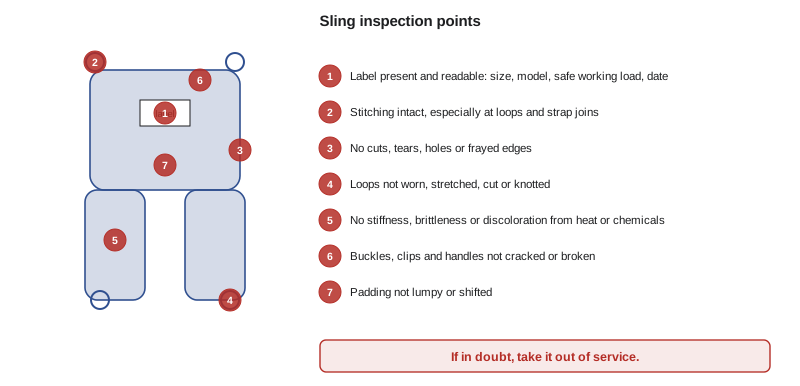
The check before each use takes about ten seconds:
- The label is present and readable. Without the label, nobody can confirm the type, size, safe working load or age, and the sling must not be used.
- Stitching is intact, especially at the loops and where straps join the body of the sling.
- There are no cuts, tears, holes, burns or frayed edges.
- Loops are not worn, stretched, cut or knotted. A knotted loop is a sign that someone has tried to shorten it, which weakens it.
- The fabric is not stiff, brittle, faded or discolored, which can mean damage from heat or chemicals.
- Buckles, clips and handles are not cracked or broken.
- The sling is clean.
Anything that fails is taken out of service at once: tagged, removed from the patient area and sent to the coordinator, not put back in the cupboard. Every sling also has a service life set by the manufacturer, counted in years from manufacture or in wash cycles, and it is retired at the end of it even if it looks good.
Grace keeps the six-monthly inspection records in a spreadsheet. A short script reads the export and lists slings that must be removed or are due for inspection.
# Six-monthly sling review on Birch, Maple Court (review date: 2026-10-01)
from datetime import date
TODAY = date(2026, 10, 1)
SERVICE_LIFE_YEARS = 3       # from the manufacturer's instructions
MAX_WASHES = 150

slings = [
    # id, made, washes, label_ok, damage, last_inspected
    ("B-01", date(2024, 3, 1), 92, True, "", date(2026, 4, 2)),
    ("B-02", date(2023, 6, 1), 140, True, "", date(2026, 4, 2)),
    ("B-03", date(2024, 9, 1), 61, False, "", date(2026, 4, 2)),
    ("B-04", date(2025, 1, 1), 48, True, "frayed leg loop", date(2026, 4, 2)),
    ("B-05", date(2025, 8, 1), 22, True, "", date(2026, 2, 10)),
    ("B-06", date(2022, 11, 1), 155, True, "", date(2026, 4, 2)),
]

for sid, made, washes, label_ok, damage, last in slings:
    age = (TODAY - made).days / 365.25
    reasons = []
    if age > SERVICE_LIFE_YEARS: reasons.append(f"age {age:.1f} y")
    if washes > MAX_WASHES: reasons.append(f"{washes} washes")
    if not label_ok: reasons.append("label unreadable")
    if damage: reasons.append(damage)
    overdue = (TODAY - last).days > 183
    status = "REMOVE: " + ", ".join(reasons) if reasons else "keep"
    if overdue and not reasons:
        status += " (inspection overdue)"
print(f"{sid}: {status}")B-01: keep B-02: REMOVE: age 3.3 y B-03: REMOVE: label unreadable B-04: REMOVE: frayed leg loop B-05: keep (inspection overdue) B-06: REMOVE: age 3.9 y, 155 washes
Four of the six slings on Birch had to go: one past its service life, one past its wash limit, one with an unreadable label and one with a frayed loop. Sling B-02 was close to both limits and was marked for replacement at the next order. When Grace looked across all units, she found that about one sling in five was overdue for retirement, mostly because labels had faded and nobody knew how old the slings were. The new program now records each sling's date of first use on a barcode tag, and the laundry scans slings as they are washed.
Having the right slings in the right place
Even good slings are useless if the right size cannot be found at 0300. A common problem at Northbridge was that slings went to the laundry and came back to a different unit, or sat in a laundry cart for days, so that units ran short of the sizes they used most. Staff then used the wrong size or did the transfer by hand. The program fixed this in three ways:
- Par levels: each unit has a set number of each sling type and size, based on its patients, with enough for every patient who needs one plus spares for the time slings spend in the laundry. On Birch, where most residents use slings, that means about three slings for every resident who needs one.
- Tracking: slings are tagged with their home unit, and the laundry returns them there.
- A daily check: the night certified nursing assistant or nursing assistant checks the sling cupboard against the par level at 0500 and calls the laundry if anything is short.
Worked problem
Choosing a sling for a new resident
A new resident arrives on Birch. Mrs. Okoye is 84, weighs 139 lb (63 kg), has had a stroke that left her right side weak, and has poor sitting balance. Her assessment is level 1. Her daughter asks whether she can use a toileting sling, because her mother hated having her clothes pulled down in the last home. How should Lina and the nurse choose the sling?
Show solution
- Level 1 means a full-body lift. Poor sitting balance and one-sided weakness mean Mrs. Okoye needs a sling that supports her back and head. A toileting sling, which gives the least support, is not safe for her: she could slump to her weak side and slide out.
- They choose a high-back divided-leg sling, which can be used for toileting with the clothing adjusted before she is lifted, and they measure her using the manufacturer's guide. She measures as a medium.
- Lina fits the sling, checks the fit points, attaches the loops with the lengths that keep her upright, and lifts her just clear of the bed to check. Mrs. Okoye is secure and comfortable.
- The nurse explains to the daughter why the toileting sling is not safe yet and what they will do to protect her mother's dignity. The plan records the sling type, size and loop lengths, and asks the physical therapist to reassess in two weeks, when a toileting sling might become possible if her balance improves.
Answer: A high-back divided-leg sling in the size her measurement gives, because her poor trunk control makes a toileting sling unsafe; record type, size and loops in the plan and reassess later.
Common mistakes
MistakeUsing whatever sling is in the cupboard.
InsteadUse the type and size in the care plan, chosen from the assessment.
MistakeUsing a sling from one manufacturer on another's lift.
InsteadUse only combinations approved in the equipment register.
MistakeSizing a sling by eye or by weight alone.
InsteadMeasure using the manufacturer's guide and record the size.
MistakeUsing a sling with a faded or missing label.
InsteadWithout a label the type, size, rating and age are unknown, so take it out of service.
MistakeKnotting a loop to shorten it.
InsteadUse the right loop length, or a different sling; knots weaken the loop.
MistakeLeaving a standard transfer sling under a patient.
InsteadOnly slings designed to stay in place may be left, with regular skin checks.
Summary and key terms
- The sling holds the patient and is involved in most serious lift incidents.
- Main types are divided-leg, hammock, toileting, repositioning, limb, ambulation and bathing slings, each for particular patients and tasks.
- Slings must match the lift: loop or clip, and only approved combinations.
- Size with the manufacturer's guide; record type, size and loop lengths in the care plan.
- Do a fit check every time, with the patient lifted only a few centimeters.
- Slings are assigned to one patient, laundered as the manufacturer says, and single-use slings are discarded.
- Check every sling before use and inspect it formally every six months; retire it on damage, lost label or end of service life.
- Par levels, tracking and a daily check keep the right slings on each unit.
- Divided-leg sling
- A sling with a back piece and two separate leg pieces, used for most seated transfers.
- Hammock sling
- A one-piece sling from head to thighs, used for patients with poor trunk control.
- Toileting sling
- A short sling that leaves the buttocks free, only for patients with good trunk control.
- Par level
- The number of each item, such as a sling size, that a unit should always have available.
- Service life
- The time or number of wash cycles after which the manufacturer says a sling must be retired.
Practice problems
Work each problem on paper first, then reveal the answer to check.
Why is a toileting sling unsafe for a patient with poor trunk control?
Show answer
It gives the least support; the patient can slump and slide out.
What happens to the patient's position if shorter loops are used at the shoulders?
Show answer
The patient sits more upright.
Which is more dangerous, a sling that is too small or one that is too large, and why?
Show answer
Too large, because the patient can slip through the leg openings or out of the back.
Name five things to check on a sling before each use.
Show answer
Any five of: readable label, intact stitching, no cuts or fraying, loops not worn or knotted, fabric not stiff or discolored, buckles and clips intact, clean.
A sling looks perfect but is four years old and the service life is three years. What should happen?
Show answer
It is retired, because it is past its service life.
What three measures keep the right slings on each unit?
Show answer
Par levels, tracking slings to their home unit, and a daily check against the par level.
Lesson quiz · 5 questions
Score 60% or more to complete this lesson.
Create a free account to save your progress, take quizzes and earn a certificate.