
HSE-391 · Lesson 8 of 12 · 24 min
Falls and controlled lowering
▶ Video coming soon A video version of this lesson is on the way.
Patients and residents fall. They fall getting out of bed at night to go to the toilet, when their knees buckle during a transfer, when they stand up too fast and faint, and when confusion makes them forget they cannot walk alone. Falls are one of the most common harms to patients in hospitals and long-term care, and preventing them is a major part of nursing work. Falls are also a major cause of injury to staff, in two ways: at the moment of the fall, when a worker tries to catch the patient, and afterwards, when staff try to get the patient up off the floor.
At Northbridge last year, 8 of the 52 patient handling injuries happened while staff were catching or lowering a falling patient, and several more happened while lifting fallen residents from the floor. This lesson covers what to do when a patient starts to fall, how to help a patient who is already on the floor, and how safe patient handling helps prevent falls in the first place.
Why you must not catch a falling patient
When someone you are helping starts to fall, the instinct to grab them is very strong, especially in people whose job is to protect patients. Acting on it is dangerous for the worker and usually does not help the patient.
- The load is sudden. A falling person accelerates toward the floor, and stopping them in a fraction of a second takes a force several times their body weight. No worker's back or shoulders can safely take that.
- The posture is the worst possible. The worker grabs with arms extended, often twisting and bending forward at the same moment, which is exactly the combination that tears muscles and damages discs.
- The patient often falls anyway. A worker who catches a 165 lb (75 kg) patient rarely holds them up. More often both end up on the floor, sometimes with the worker underneath or the patient twisted awkwardly, so both are hurt.
Northbridge's policy is written plainly: do not catch a falling patient. If a worker is close to the patient and in the right position, they may guide the patient down to the floor in a controlled way. If they are not close, they do not lunge; they let the patient fall, protect the patient's head if it is safe to do so, and call for help.
Controlled lowering
Controlled lowering means guiding a patient who is starting to fall so that they slide down to the floor slowly, rather than dropping or being held up. It is only possible when the worker is already right beside or behind the patient, usually holding a gait belt, at the moment the patient's knees start to go. It is not a technique for heavy patients, for patients who are falling forward or away from the worker, or for situations in which the worker would need to move to reach them.
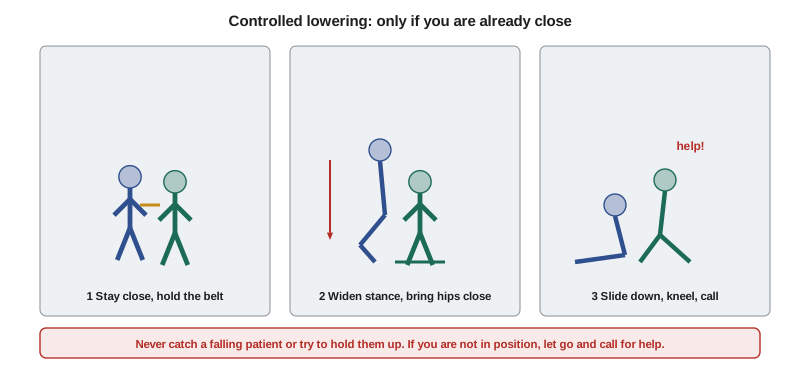
The steps, as taught at Northbridge with a partner in a training room, are:
- Stay close. When walking or transferring a patient who might fall, stand close behind and slightly to one side, holding the gait belt, with your feet apart and knees soft.
- Widen your base. As soon as the patient starts to fall, step one foot behind you and widen your stance.
- Bring them close. Pull the patient's hips in toward your body using the gait belt, so that their weight is close to you rather than out at arm's length.
- Slide them down. Let the patient slide down your leg toward the floor, bending your knees as you go and keeping your back as straight as you can. Guide them; do not take their weight.
- Protect the head. As they reach the floor, keep their head from hitting anything if you can do so without twisting.
- Stay and call. Kneel or crouch beside them, keep them still and call for help.
If at any point the worker feels they are taking the patient's weight, or the patient is falling in a direction the worker cannot follow, the right action is to let go and step away. A patient who falls a short distance onto the floor is usually less hurt than a patient and worker who fall together.
After a fall: first, assess
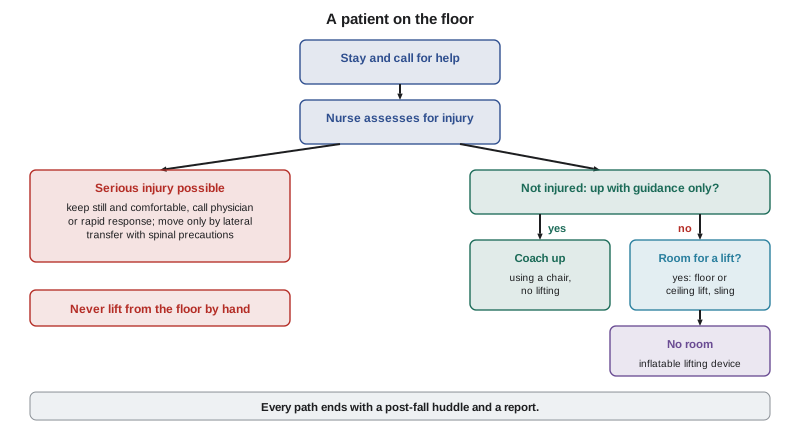
A patient on the floor is not in a hurry to be moved, unless they are in danger where they are. Moving them too soon can turn a hidden fracture or head injury into a disaster, and rushing leads staff to lift by hand. Northbridge's post-fall procedure starts with stopping and assessing:
- Stay with the patient and call for help, using the call bell, a staff alarm or a shout. Do not leave them.
- The nurse checks for injury before the patient is moved: consciousness, breathing and bleeding; pain; signs of a hip or other fracture, such as a leg that is shortened or turned out; whether they hit their head, and whether they take blood thinners, which make bleeding inside the skull more likely.
- If a serious injury is possible, especially to the head, neck, back or hip, the patient is kept still and made comfortable on the floor with a pillow and blanket while the physician or rapid response team is called. Moving such a patient is a lateral transfer onto a spine board or scoop stretcher with spinal precautions, using the methods in Lesson 7.
- If the patient is not injured, staff decide how they will get up.
Getting a patient up off the floor
Lifting a person from the floor by hand is one of the most hazardous patient handling tasks there is. The load starts at floor level, the workers kneel or squat with their backs bent, the patient has nothing to hold, and even three or four workers each take more than the guideline. Lesson 1's script showed that three workers lifting a 75 kg resident each held 55 lb (about 25 kg). Northbridge's policy forbids it except to remove a patient from immediate danger, such as a fire.
There are three safe ways to get an uninjured patient up:
- The patient gets up themselves, with guidance. A patient who is uninjured, alert and strong enough can often get up on their own with verbal coaching: rolling onto their side, getting onto hands and knees, crawling to a sturdy chair, and pushing up to kneeling and then to sitting on the chair. Staff guide and steady but do not lift. This is the method physical therapists teach patients for falls at home.
- A floor lift or ceiling lift with a sling. Most floor lifts can lower their spreader bar to the floor. The sling is put under the patient by rolling them or sliding it behind them as they sit, and the lift raises them into a chair or onto the bed. Where ceiling track covers the floor area, a ceiling lift is easier still.
- An inflatable lifting device. These are cushions or chairs in sections that are slid under the patient flat and inflated one section at a time with a small compressor, raising the patient gradually from lying to sitting at chair height. They work in small spaces such as bathrooms, where a floor lift does not fit, and Maple Court and the Northbridge Home Health team both use them.
Every unit at Northbridge now has at least one of these methods available within a few minutes, and each fall kit includes a sling for floor use.
What the Maple Court falls log showed
Maple Court records every resident fall in a log. When Grace and the Maple Court manager looked at the last year of entries, they wanted to know how residents had been helped up and whether that was linked to staff injuries.
# Maple Court falls last year: how residents were helped up, and staff injuries
falls = {
    # method: (number of falls, staff injury reports)
    "got up with guidance":       (41, 0),
    "floor lift with sling":      (63, 1),
    "inflatable lifting device":  (18, 0),
    "manual lift, 2 staff":       (22, 4),
    "manual lift, 3 or 4 staff":  (15, 3),
    "left on floor for EMS":      (9, 0),
}
total = sum(n for n, _ in falls.values())
print(f"falls: {total}")
for method, (n, inj) in falls.items():
    rate = 100 * inj / n
    print(f"{method:28} {n:3} falls  {inj} injuries  ({rate:4.1f} per 100 lifts)")

manual = [v for k, v in falls.items() if k.startswith("manual")]
m_falls = sum(n for n, _ in manual)
m_inj = sum(i for _, i in manual)
print(f"\nmanual lifts: {m_falls} of {total} falls, but {m_inj} of "
f"{sum(i for _, i in falls.values())} staff injuries")falls: 168 got up with guidance 41 falls 0 injuries ( 0.0 per 100 lifts) floor lift with sling 63 falls 1 injuries ( 1.6 per 100 lifts) inflatable lifting device 18 falls 0 injuries ( 0.0 per 100 lifts) manual lift, 2 staff 22 falls 4 injuries (18.2 per 100 lifts) manual lift, 3 or 4 staff 15 falls 3 injuries (20.0 per 100 lifts) left on floor for EMS 9 falls 0 injuries ( 0.0 per 100 lifts) manual lifts: 37 of 168 falls, but 7 of 8 staff injuries
About one fall in five ended with a manual lift, and those lifts produced seven of the eight staff injuries. The reasons staff gave were familiar: the floor lift was on another home area, the fall was in a bathroom where the lift would not fit, or it was the middle of the night and the resident was cold and upset. The fixes were a second floor lift for Maple Court, an inflatable lifting device in each of the four households, and the rule that a resident who is not injured and not in danger waits on the floor, warm and comfortable, for the equipment to arrive.
Falls prevention and safe patient handling
Falls prevention and safe patient handling support each other. Many patient falls happen during transfers and walking, and the equipment in this course makes them less likely: a patient in a sling or a sit-to-stand aid cannot fall to the floor, and a patient in a walking vest can practice walking without risk. Regular toileting rounds, call bells within reach, non-slip footwear, good lighting and early mobility, which keeps patients strong, all reduce falls.
Some falls prevention measures create handling hazards of their own, and the program has to plan for them:
- Low beds that go almost to the floor protect patients who climb out of bed, but staff must raise them to working height before any care. A low bed left at floor height while a worker changes the patient is a bent-back task.
- Floor mats beside the bed cushion a fall but are a trip hazard for staff and for patients who walk, and they must be moved before using a floor lift.
- Bed and chair alarms bring staff running to a patient who is getting up, and staff who arrive in a hurry are tempted to grab. The response to an alarm is to approach calmly, speak to the patient, and guide them to sit back down or help them stand with the right equipment.
The post-fall huddle
After every fall, Northbridge's units hold a short huddle, within the shift if possible, with the staff involved. They ask what happened, why, and what will prevent the next one, for the patient and for staff. The huddle reviews the patient's mobility assessment and care plan, the equipment that was or was not available and how the patient was helped up. A staff injury or near miss during the fall is reported as a separate incident (Lesson 11 of HSE-390).
Worked problem
A fall in the bathroom at night
At 0230, Lina's colleague on Birch finds Mr. Bauer, 79, sitting on the bathroom floor beside the toilet. He weighs 194 lb (about 88 kg), is alert, and says he slipped while trying to stand up alone. The bathroom is too small for a floor lift. The other night certified nursing assistant on Birch suggests that the two of them lift him back to his bed. What should happen?
Show solution
- Stay with him and call the nurse. The nurse checks him: he is alert, did not hit his head, has no pain in his hips or legs, can move all his limbs and is not on blood thinners. He is cold and embarrassed.
- A two-person manual lift would put 97 lb (about 44 kg) on each worker from floor level, a severe hazard. It is not allowed.
- Can he get up with guidance? He tries to roll onto his knees but his legs are too weak. So the options are a lift or the inflatable device. The bathroom is too small for the floor lift, so they bring the inflatable lifting cushion from the Birch equipment room.
- They cover him with a blanket while it is fetched, slide the deflated cushion under him in sections, and inflate it until he is at chair height. They then use a sit-to-stand aid from the cushion to the wheelchair, as his care plan allows, and take him back to bed.
- The nurse records the fall, the staff hold a short huddle at handover, and his care plan is updated with a toileting round at 0200 and a bedside commode.
Answer: Assess first; he is uninjured but cannot get up with guidance, so use the inflatable lifting device in the small bathroom and an aid to the wheelchair; never lift him by hand, and hold a post-fall huddle.
Common mistakes
MistakeCatching a falling patient.
InsteadNever catch; guide them down only if you are already close and in position, otherwise let them fall and call for help.
MistakeGetting a fallen patient up straight away.
InsteadStay, call for help and let the nurse assess for injury first.
MistakeLifting a patient from the floor by hand with several people.
InsteadUse guidance, a floor or ceiling lift, or an inflatable lifting device.
MistakeRushing to a bed alarm and grabbing the patient.
InsteadApproach calmly, speak, and guide the patient to sit or use equipment.
MistakeLeaving a low bed at floor level while giving care.
InsteadRaise it to working height for care and lower it again afterwards.
Summary and key terms
- Falls injure staff when they try to catch patients and when they lift fallen patients from the floor.
- Never catch a falling patient: the sudden load and twisted posture injure workers and the patient usually falls anyway.
- Controlled lowering guides a patient to the floor, and is only for a worker already close and in position.
- After a fall, stay, call for help and let the nurse assess for injury before anyone moves the patient.
- Uninjured patients get up by guidance, a floor or ceiling lift, or an inflatable lifting device, never by a manual lift.
- Safe patient handling equipment prevents many transfer falls; low beds, mats and alarms need handling plans.
- A post-fall huddle reviews the patient's plan and the equipment, and staff injuries are reported separately.
- Controlled lowering
- Guiding a patient who is starting to fall down to the floor, without trying to hold them up.
- Post-fall assessment
- The nurse's check for injury before a fallen patient is moved.
- Inflatable lifting device
- A cushion or chair in sections that is slid under a fallen patient and inflated to raise them.
- Post-fall huddle
- A short meeting after a fall to find out why it happened and prevent another.
- Low bed
- A bed that can be lowered close to the floor to reduce injury from falls out of bed.
Practice problems
Work each problem on paper first, then reveal the answer to check.
Give three reasons not to catch a falling patient.
Show answer
The sudden force is several times their weight, the worker is in an extended, twisted posture, and both usually end up on the floor anyway.
When is controlled lowering appropriate?
Show answer
Only when the worker is already close beside or behind the patient, usually holding a gait belt, and the patient is not too heavy or falling away.
What must happen before a fallen patient is moved?
Show answer
Staff stay and call for help, and the nurse assesses for injury.
Name the three safe ways to get an uninjured patient up from the floor.
Show answer
Getting up with guidance, a floor or ceiling lift with a sling, and an inflatable lifting device.
In the Maple Court log, what share of staff injuries came from manual lifts?
Show answer
Seven of eight, although manual lifts were used in only about one fall in five.
How can a low bed create a handling hazard, and how is it managed?
Show answer
Staff bend to floor level to give care; raise the bed to working height for care and lower it afterwards.
Lesson quiz · 5 questions
Score 60% or more to complete this lesson.
Create a free account to save your progress, take quizzes and earn a certificate.