
HSE-391 · Lesson 3 of 12 · 23 min
Assessing patient mobility
▶ Video coming soon A video version of this lesson is on the way.
The right way to move a patient depends on the patient. A woman recovering from pneumonia who can stand and walk with a frame needs supervision and perhaps a gait belt. A man who has just had a stroke and cannot hold himself upright needs a full-body lift. A resident with dementia who could stand yesterday morning may not be able to stand this evening. Choosing the method by habit, or by whatever equipment is nearest, is how the 3 East shoulder injury in Lesson 1 happened.
This lesson explains how to assess a patient's mobility quickly and consistently, how the result is turned into a method and a piece of equipment, how often the assessment is repeated, and how it is communicated to everyone who moves the patient. It connects the patient's needs, which the nursing and therapy staff already think about, with the worker's safety, which they often do not.
What a mobility assessment looks at
A mobility assessment for safe handling is not the same as a full physical therapy assessment. It answers a narrower practical question: what can this patient do for themselves right now, and therefore how much of the work, and which equipment, will staff need? The main factors are:
- Weight-bearing: can the patient take their weight on both legs, one leg, or neither? For how long?
- Upper body strength and trunk control: can the patient sit upright without support, hold on, pull, and lean forward?
- Cognition and cooperation: can the patient understand and follow instructions, and remember them during the move? Are they calm, agitated, sedated or confused?
- Size and shape: weight, height and body shape, which decide whether standard equipment will fit and is strong enough.
- Medical factors: pain, recent surgery, fractures and precautions such as hip precautions, low blood pressure on standing, lines, drains, catheters and oxygen, skin condition, contractures, spasticity and amputations.
- Behavior and history: a history of falls, grabbing or striking out, fear of being moved, and what has worked before.
- The patient's goals and preferences: what the patient wants to do, and whether they agree to the method.
The assessment does not need to take long. For most patients, a trained nurse can do it in two or three minutes at the start of a shift, by talking to the patient and asking them to do a few simple movements. The aim is to see what the patient can do rather than to rely on what the chart said yesterday.
A structured tool: the Bedside Mobility Assessment Tool
Northbridge's new policy uses a structured tool so that every nurse assesses patients the same way and the result points directly to the equipment. Many hospitals in North America use the Bedside Mobility Assessment Tool, known as BMAT, developed by the nurse Teresa Boynton and updated as BMAT 2.0 in 2020. It has four short tests in sequence. The patient moves on to the next test only if they pass the one before, and the level they reach tells staff how to move them.
- Level 1, Sit and shake. From lying with the head of the bed raised to at least 30 degrees, the patient sits up on the edge of the bed and stays sitting without support for up to a minute, then reaches across the middle of their body to shake the nurse's hand, once with each hand. A patient who cannot do this, or who becomes dizzy, sweaty or breathless, stays at level 1.
- Level 2, Stretch. Still sitting, the patient straightens one knee and pumps the ankle at least three times, then does the same with the other leg. This shows leg strength and control.
- Level 3, Stand. The patient moves forward and stands up from the bed or chair and keeps their balance standing for up to a minute, using their usual walking aid if they have one.
- Level 4, Step. The patient marches on the spot three times, then steps forward and back with each foot.
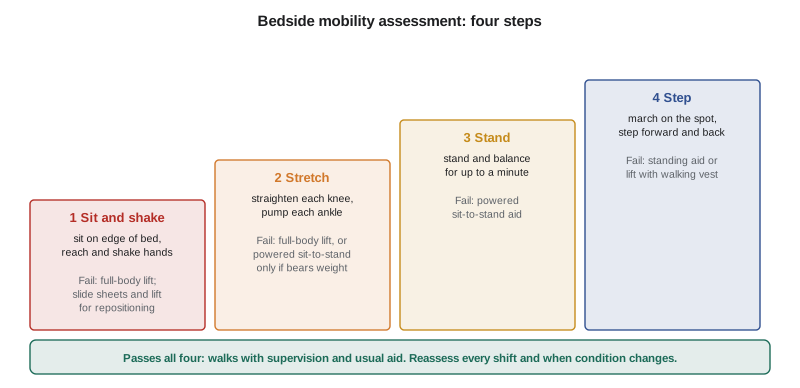
The result is a mobility level from 1 to 4, and each level comes with a recommended method:
| Level reached | What the patient can do | Transfers | Repositioning in bed |
|---|---|---|---|
| 1 (fails sit and shake) | Cannot sit unsupported or reach | Full-body lift (ceiling or floor) with sling | Slide sheets with two staff, or ceiling lift with a repositioning sling |
| 2 (fails stretch) | Sits but has weak legs | Full-body lift; powered sit-to-stand only if able to bear some weight | Slide sheets; patient helps where able |
| 3 (fails stand) | Sits and moves legs but cannot stand and balance | Powered sit-to-stand aid | Patient helps; slide sheet if needed |
| 4 (fails step) | Stands but cannot step safely | Non-powered standing aid, or lift with walking vest | Patient mostly independent |
| Passes all four | Stands and steps | Supervision, gait belt for steadying, usual walking aid | Independent |
The table is a guide, not a substitute for judgment. A level 3 patient who is confused and pulls back unpredictably may be safer in a full-body lift. A level 4 patient who becomes dizzy every time she stands may need a sit-to-stand aid until her blood pressure is controlled. The rule at Northbridge is that the nurse may choose a safer method than the level suggests but may not choose a less safe one without a physical therapist or the safe patient handling coordinator agreeing and the reason being written in the care plan.
Other tools
BMAT is not the only option. The VA's safe patient handling program has its own algorithms for each type of move, and many nursing homes use a simple transfer status assessment that sorts residents into independent, one-person assist, two-person assist with a standing aid, and full mechanical lift. Some rehabilitation units use more detailed functional scales. The important thing is that a unit uses one tool consistently, that the tool leads to a method, and that staff are trained to use it.
Turning the level into a plan
Grace wrote a short script to check the logic of the unit's decision rules before they went into the electronic chart. It takes the level from the bedside test and adds the most common modifiers.
# Choose a transfer method from a bedside mobility level and modifiers
def method(level, kg, confused=False, dizzy_on_standing=False):
    if level == 1:
        plan = "full-body lift"
    elif level == 2:
        plan = "full-body lift (sit-to-stand only if bears weight)"
    elif level == 3:
        plan = "powered sit-to-stand"
    elif level == 4:
        plan = "standing aid or lift with walking vest"
    else:
        plan = "supervision with usual walking aid"
    # modifiers can only add support, never remove it
    if confused and level >= 3:
        plan = "full-body lift (confused: unpredictable standing)"
    if dizzy_on_standing and level >= 4:
        plan = "powered sit-to-stand until blood pressure is stable"
    if kg > 136:
        plan += " + bariatric-rated equipment"
    return plan

patients = [
    ("Room 406", 1, 68),
    ("Room 409", 3, 120),
    ("Room 412", 2, 82),
    ("Room 415", 5, 59),
    ("Room 418", 4, 74, False, True),
    ("Room 421", 4, 150),
    ("Room 424", 3, 66, True),
]
for room, level, kg, *mods in patients:
print(f"{room}: level {level}, {kg} kg -> {method(level, kg, *mods)}")Room 406: level 1, 68 kg -> full-body lift Room 409: level 3, 120 kg -> powered sit-to-stand Room 412: level 2, 82 kg -> full-body lift (sit-to-stand only if bears weight) Room 415: level 5, 59 kg -> supervision with usual walking aid Room 418: level 4, 74 kg -> powered sit-to-stand until blood pressure is stable Room 421: level 4, 150 kg -> standing aid or lift with walking vest + bariatric-rated equipment Room 424: level 3, 66 kg -> full-body lift (confused: unpredictable standing)
The rules in the script follow one principle: a modifier can move the plan toward more support, never toward less. Room 424's patient reached level 3, but because he is confused and may not follow instructions while standing, the plan becomes a full-body lift. Room 421's patient can stand but weighs 330 lb (150 kg), so whatever she uses must be rated for her weight. Lesson 9 covers bariatric equipment.
When to assess
Mobility changes, sometimes within hours. A patient who was steady before surgery may faint when first standing after it. A resident with dementia may be able to stand in the morning and not in the evening. Pain medicine, sedation, infection, low blood sugar and fatigue all change what a patient can do. Northbridge's policy sets the minimum times to assess:
- On admission or transfer to a unit, before the first move.
- At least once every shift in acute care, usually at the start.
- Before the first time a patient gets up after surgery, sedation or a procedure.
- Whenever the patient's condition changes, including after a fall, a new medicine that causes drowsiness or a change in behavior.
- In the nursing home, on admission, at least every quarter as part of the care plan review, and whenever a resident's ability changes. Staff also do a quick check before each transfer, because residents with dementia vary from hour to hour.
- In home health, at the first visit and whenever the client's condition, equipment or home changes.
The quick check before each move, part of the bedside check described in Lesson 3 of HSE-390, is the last line of defense. If the patient seems different from what the care plan says (weaker, drowsier, more confused), the worker stops and uses a safer method or asks the nurse to reassess.
Communicating the plan
An assessment helps only if everyone who moves the patient knows the result. At Northbridge, four places carry it:
- The electronic chart, where the nurse records the level, the method, the equipment and the sling size, and any special instructions.
- A sign at the bedside, out of public view inside the wardrobe door or on the room whiteboard, with a simple picture of the method: a lift, a sit-to-stand, a standing aid or a person walking, and the sling size and color. Visitors do not need to see the details, but staff do.
- Shift handover, where the mobility level is part of every patient's report.
- The transfer form, when a patient goes to imaging, the operating room or another unit, so that transporters and receiving staff know how to move the patient before they arrive.
Kevin Tran says the transfer form changed his work more than anything else in the program. Before, he would arrive to take a patient to imaging and find out only at the bedside that she could not stand. Now the request tells him whether to bring a stretcher and an air-assisted transfer mat or a wheelchair, and imaging knows whether to have the ceiling lift ready in the scanning room.
Patients who decline
Some patients do not want to be moved with equipment. They may be frightened of the lift, feel it is undignified, or believe they can manage on their own. Their wishes matter, and many objections disappear with explanation, a demonstration, or a few uses. Staff can explain that the lift is safer for the patient as well as for staff, let the patient touch the sling and see the controls, and start with a gentle, slow move.
A patient's refusal does not, however, oblige a worker to lift them by hand. If a patient who needs a lift declines it, staff do not substitute a manual lift that exceeds safe limits. They explain the risks, offer alternatives (a different sling, a different lift, a different time), involve the nurse in charge, the physical therapist and, where appropriate, the family or substitute decision maker, and record the discussion. A care plan may then be agreed that respects the patient's wishes as far as possible without putting staff at risk, for example by staying in bed until a chosen time, or by using a sit-to-stand aid while the patient builds confidence.
Worked problem
The first time up after surgery
A 210 lb (95 kg) patient on 3 East had a bowel operation yesterday. He is on a pain pump and has an IV and a urinary catheter. The surgeon wants him sitting in a chair today. Before the BMAT, he says, "I'm fine, I just need a hand up." How should the nurse assess him and choose the method?
Show solution
- This is a first time up after surgery, one of the trigger points for an assessment, and the 3 East injury in Lesson 1 happened in exactly this situation. The nurse checks his blood pressure lying down and organizes the lines so they will not pull.
- Level 1: with the head of the bed raised, he sits on the edge of the bed. He stays upright for a minute without feeling faint and reaches across to shake hands with each hand. He passes.
- Level 2: he straightens each knee and pumps each ankle three times. He passes, though he winces with pain.
- Level 3: he tries to stand but cannot push up from the low bed without pulling on the nurse, and his legs shake. He fails at level 3, so the plan is a powered sit-to-stand aid.
- The nurse explains the aid, positions it, fits the sling, and brings him to standing with the machine taking most of the weight. She pivots him to the chair and lowers him. She records level 3 and the sit-to-stand method in the chart and on the room sign, and plans to reassess before he walks tomorrow.
Answer: Do the BMAT before he gets up; he fails at the stand test (level 3), so use a powered sit-to-stand aid rather than a manual lift, and record the plan.
Common mistakes
MistakeUsing yesterday's assessment for today's move.
InsteadAssess at least every shift in acute care and whenever the patient's condition changes.
MistakeTaking the patient's word for what they can do.
InsteadAsk them to show you, one step at a time, with a structured test.
MistakeLetting a modifier move the plan toward less support.
InsteadConfusion, dizziness or size can only make the method more supportive, never less.
MistakeKeeping the result in the chart only.
InsteadPut it on the bedside sign, in handover and on the transfer form so everyone who moves the patient knows.
MistakeLifting by hand because a patient refuses a lift.
InsteadExplain, offer alternatives, involve the team and record it, but do not substitute an unsafe manual lift.
Summary and key terms
- A mobility assessment for handling asks what the patient can do now, and therefore what method and equipment staff need.
- It looks at weight-bearing, upper body and trunk strength, cognition, size, medical factors, behavior and the patient's wishes.
- BMAT 2.0 uses four tests in sequence: sit and shake, stretch, stand and step.
- Each level points to a method, from a full-body lift at level 1 to supervision for a patient who passes all four.
- Modifiers such as confusion, dizziness and size can move the plan toward more support, never less.
- Assess on admission, every shift in acute care, before the first time up after surgery and whenever the condition changes.
- The plan goes in the chart, on a bedside sign, into handover and on transfer forms.
- Mobility assessment
- A short check of what a patient can do for themselves, used to choose a safe handling method.
- BMAT
- The Bedside Mobility Assessment Tool, a four-level nurse-led test of sitting, leg strength, standing and stepping.
- Weight-bearing
- The ability to take some or all of one's body weight through the legs.
- Modifier
- A factor, such as confusion or size, that changes the method suggested by the mobility level.
- Transfer status
- The method recorded for moving a patient, such as independent, standing aid or full mechanical lift.
Practice problems
Work each problem on paper first, then reveal the answer to check.
What are the four BMAT tests, in order?
Show answer
Sit and shake, stretch, stand and step.
A patient sits and moves both legs well but cannot stand. Which level and method?
Show answer
Level 3; a powered sit-to-stand aid.
A patient passes all four tests but is very confused. Can the plan be less supportive than the level suggests?
Show answer
No; modifiers can only make the plan more supportive. Confusion may call for a sit-to-stand or full-body lift.
Name four times a patient must be reassessed in acute care.
Show answer
On admission or transfer, every shift, before the first time up after surgery or sedation, and when their condition changes, including after a fall.
Where does Northbridge communicate the mobility plan?
Show answer
In the chart, on a bedside sign, at handover and on transfer forms.
What should staff do when a patient who needs a lift refuses it?
Show answer
Explain, demonstrate, offer alternatives, involve the team and family, and record it; do not substitute an unsafe manual lift.
Lesson quiz · 5 questions
Score 60% or more to complete this lesson.
Create a free account to save your progress, take quizzes and earn a certificate.