
LES-102 · Lesson 1 of 12 · 23 min
What is criminology? Crime, deviance and the study of offending
▶ Video coming soon A video version of this lesson is on the way.
On the first evening of the course, Professor Ray Desjardins writes three questions on the whiteboard at Maumee Valley Community College: why do people commit crime, why do some places have far more crime than others, and what actually works to prevent it? He tells the class that in 28 years with the Port Ardent police he answered these questions every shift, mostly by instinct. Some of his instincts were right. Others, he learned later, were contradicted by decades of research. Criminology, he says, is the discipline that tests those instincts against evidence, and an officer who knows it makes better decisions about where to patrol, whom to refer to a program and when an arrest will help or harm.
The five students around the table bring different starting points. Amara Okafor, who wants to become a major crimes detective, assumes most crime is committed by a small number of bad people. Marco DiSanto, the National Guard veteran, thinks punishment has to be swift and certain or it means nothing. Priya Sandhu, who spent five years catching fraud at a bank, points out that the people she caught were mostly respectable professionals under financial pressure. Jesse Morningstar wants to know why people from his community are so often in the system. Linh Tran, who plans to become a crime analyst, wants to know how anyone can measure crime when so much of it is never reported. By the end of the course each of them will have a more precise answer, and each will find part of their starting assumption both supported and challenged.
What criminology studies
Criminology is the scientific study of crime, of the people who commit it and are harmed by it, and of society's responses to it. The American criminologist Edwin Sutherland gave a definition in the 1920s that is still widely quoted: criminology is the study of the processes of making laws, breaking laws and reacting toward the breaking of laws. Each part of that definition opens a field. Law making asks why some acts are defined as crimes and others are not. Law breaking asks why people offend, and why crime is concentrated among certain people, places and times. Reacting to law breaking covers policing, courts, punishment and prevention, and asks whether these responses reduce crime or make it worse.
Criminology draws on many disciplines. Sociology contributed theories about neighborhoods, inequality and social bonds. Psychology contributed research on personality, learning, thinking patterns and risk assessment. Biology and neuroscience contribute research on brain development, genetics and environmental toxins. Economics contributed models of decisions under risk. Law supplies the definitions of crime and the procedures for responding to it, and geography contributes the study of crime and place. Criminology is therefore less a single theory than a meeting place, and one of the skills of a good criminologist is knowing which lens fits a particular problem.
Criminology is related to, but different from, criminal justice studies. Criminal justice studies focus on how the institutions of the justice system work: how police are organized, how courts process cases and how corrections supervise offenders. You studied much of that in the first course of this program. Criminology asks more fundamental questions about the causes and patterns of crime and about whether the system's responses work. The two overlap constantly. A study of whether arrest reduces repeat domestic violence is both a criminal justice question and a criminological one, and its answer has shaped police policy in both countries.
Defining crime: legal and social definitions
The simplest definition of crime is legal: a crime is an act or omission that the law prohibits and punishes. In the United States, each state has its own criminal code, Congress makes federal crimes, and cities add ordinances. Crimes are usually graded as felonies, punishable by more than a year in prison, and misdemeanors, with lesser penalties. The legal definition has the great advantage of clarity. It tells police what they can act on and gives researchers a starting point for counting.
The legal definition also has limits. Laws differ between countries and change over time. Cannabis possession was a crime throughout Canada until October 2018 and remains a federal crime in the United States, although most states now allow medical or adult use. Same-sex sexual activity was criminal in Canada until 1969. Attempted suicide was a crime in Canada until 1972. Drinking and driving was treated far more leniently a generation ago than it is now. If crime is only what the law says, then the amount of crime can rise or fall simply because lawmakers change their minds, without any change in what people actually do.
Criminologists therefore distinguish crime from deviance. Deviance is behavior that violates social norms, the shared expectations of a group, whether or not it breaks the law. Some deviance is criminal, such as assault. Some is not, such as being rude to a server or wearing a swimsuit to a funeral. And some crime is barely deviant at all in the eyes of many people: driving a little over the speed limit is illegal, but so common that most drivers do not consider it wrong. Many criminologists study harmful conduct that falls outside criminal law, such as unsafe working conditions or environmental damage, on the ground that the harm matters more than the label.
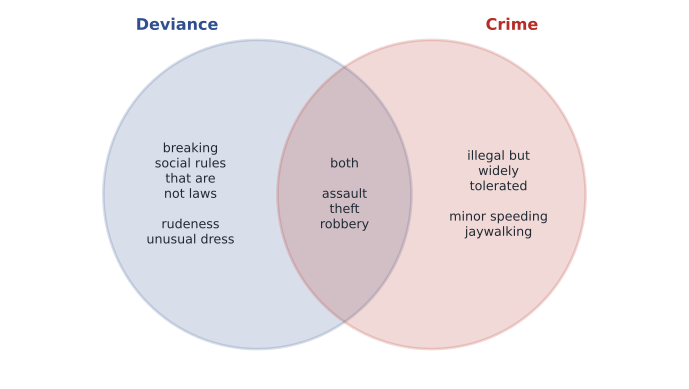
Consensus and conflict views of crime
Two broad views explain why certain acts become crimes. The consensus view holds that criminal law reflects values shared by most of society. Murder, robbery and sexual assault are crimes because almost everyone agrees they are deeply harmful. Some scholars distinguish acts that are wrong in themselves, called mala in se, from acts that are wrong only because a law prohibits them, called mala prohibita. Murder is mala in se; failing to register a business or driving on the wrong side of the road are mala prohibita. The consensus view fits the serious core of criminal law well.
The conflict view holds that criminal law reflects the interests of those with the power to make it. Supporters point to laws that once targeted particular groups, such as vagrancy laws used against the poor, the Black Codes and vagrancy laws used to control freed people after the Civil War, and drug laws whose early history was tied to hostility toward Chinese and Mexican immigrants. They also note that harms caused by corporations and powerful people are often handled through regulation rather than criminal law. A third view, the interactionist view, emphasizes that crime is defined through social interaction: an act becomes a crime when people with authority label it so and react to it.
Professor Desjardins asks the class which view is right. Priya argues for the conflict view; the bank executives whose decisions she saw cost thousands of customers money were never charged, while the teller who stole a few hundred dollars was. Marco argues for consensus; nobody needs to be told that robbing a convenience store is wrong. The professor says both are partly right, and that this is typical of criminology. The consensus view explains the core of criminal law, the conflict view explains much of its margins and its history, and the interactionist view explains how laws are applied in daily practice, including by police officers deciding whom to stop and whom to charge.
| View | Why acts become crimes | Best explains |
|---|---|---|
| Consensus | The law expresses widely shared values about serious harm | The core of criminal law: murder, robbery, sexual assault |
| Conflict | The law reflects the interests of those with power to make it | Historic laws aimed at particular groups; light treatment of corporate harm |
| Interactionist | Acts become crimes when people in authority label and react to them | How laws are applied: who is stopped, charged and convicted |
Types of crime
Criminologists group offenses in several ways. One common grouping is by the target or harm involved. Violent crimes, or crimes against the person, include homicide, assault, sexual assault, robbery and threats and stalking. Property crimes include theft, break and enter or burglary, motor vehicle theft, fraud and mischief or vandalism. Other categories include drug offenses, crimes against public order such as disturbing the peace, and crimes against the administration of justice, such as breaching a release condition or failing to appear in court. Traffic offenses form their own category in most statistics.
Other groupings cut across these. White-collar crime, a term Sutherland coined in 1939, refers to crime committed by respectable people in the course of their occupation, such as embezzlement, securities fraud and bribery. Corporate crime is committed by organizations, such as price fixing or knowingly selling unsafe products. Organized crime refers to continuing criminal enterprises, from motorcycle gangs to international drug networks. Cybercrime covers offenses committed using computers, from online fraud and extortion to the sharing of intimate images without consent. Hate crime is crime motivated by bias against a group. Each of these categories raises distinct questions about cause, measurement and response.
Port Ardent's police records show how these categories translate into daily work. In 2025 the service recorded 5,620 criminal incidents, not counting traffic offenses, in a city of 98,000 people. Linh Tran, who is volunteering a few hours a week with the service's crime analyst, has the counts by category. The code below calculates each category's share and the overall crime rate per 100,000 residents, the standard way of comparing places with different populations.
# Port Ardent: criminal incidents recorded by police in 2025 (traffic excluded)
counts = {
    "theft": 1840, "assault": 880, "mischief and vandalism": 820,
    "fraud": 610, "break-ins": 470, "threats and harassment": 340,
    "motor vehicle theft": 260, "drugs and other": 245,
    "sexual assault": 95, "robbery": 60,
}
population = 98000
total = sum(counts.values())
print(f"total incidents: {total}")
print(f"crime rate: {total / population * 100000:,.0f} per 100,000 residents")
for kind, n in sorted(counts.items(), key=lambda kv: -kv[1]):
    print(f"  {kind:24s} {n:5d}  {n / total:6.1%}")
violent = counts["assault"] + counts["sexual assault"] + counts["robbery"] + counts["threats and harassment"]
print(f"violent share: {violent / total:.1%}")total incidents: 5620 crime rate: 5,735 per 100,000 residents theft 1840 32.7% assault 880 15.7% mischief and vandalism 820 14.6% fraud 610 10.9% break-ins 470 8.4% threats and harassment 340 6.0% motor vehicle theft 260 4.6% drugs and other 245 4.4% sexual assault 95 1.7% robbery 60 1.1% violent share: 24.5%
Two things stand out. First, property crime dominates. Theft, mischief, fraud, break-ins and vehicle theft make up about 71% of incidents, a pattern found in almost every community in both countries. Second, Port Ardent's rate of about 5,735 incidents per 100,000 people is close to the average for American cities of its size. Rates allow comparison, but Linh notes a problem she will return to in the next lesson: these are only the incidents that reached the police.
How criminologists know what they know
Criminology aims to be a science, which means its claims should be tested against evidence. A theory is a set of connected statements that explains why something happens and predicts what should happen under certain conditions. A hypothesis is a specific, testable prediction drawn from a theory. If a theory says that strong bonds to school reduce delinquency, a hypothesis might be that students who report caring about their teachers' opinions commit fewer offenses over the following year. Researchers then gather data to test it.
Criminologists use several research methods. Surveys ask large samples of people about their experiences as victims or offenders. Official records from police, courts and corrections provide data on reported crime and system decisions. Longitudinal studies follow the same people for years or decades, which allows researchers to see what comes before offending rather than only what goes with it. Experiments randomly assign people or places to a treatment, such as a program or a patrol strategy, and compare them with a control group. Field observation, interviews and case studies provide depth. Each method has strengths and weaknesses, and the most convincing findings are those replicated with different methods and in different places.
Two ideas from research methods appear throughout this course. The first is that correlation is not causation. Neighborhoods with more police officers often have more crime, but that is usually because police are sent where crime is high, not because police cause crime. The second is the hierarchy of evidence. A well-designed randomized experiment provides stronger evidence about whether a program works than a comparison of places that chose whether to adopt it, which in turn is stronger than a before-and-after look at a single place. The National Institute of Justice and international groups such as the Campbell Collaboration rate the strength of evidence for crime prevention programs, and police services increasingly use these ratings.
Worked problem
Separating correlation from causation
A council member in Port Ardent notices that the city's three busiest bar districts have the highest assault rates and the most police patrols. She proposes cutting patrols there, arguing that police presence provokes confrontations. How should a criminologist respond?
Show solution
- Identify the claim: more patrols cause more assaults.
- Look for reverse causation: patrols were assigned to the bar districts because assaults there were already high, so the arrows may run the other way.
- Look for a common cause: large numbers of people drinking late at night raise the risk of assault and also draw police attention.
- Ask what evidence would test the claim: compare assault trends before and after patrol changes, or, ideally, an experiment in which some similar areas receive extra patrols and others do not.
Answer: The correlation alone does not show that patrols cause assaults. The likely explanation is reverse causation and a shared cause, late-night drinking crowds. Research on focused patrols in high-crime places generally finds reductions in crime, so cutting patrols on the strength of this correlation would be unwise. The council member's concern about confrontations is still worth taking seriously, and could be tested by looking at how patrols interact with people, not only at how many there are.
Why criminology matters for police
Criminology has changed policing more than many officers realize. Studies in the 1970s showed that random preventive patrol and rapid response to every call did less to reduce crime than people assumed, which led services to focus on problem solving and on the small places where crime concentrates. Research on the way people judge police fairness shaped training in procedural justice. Research on young offenders shaped youth justice laws that favor diversion for minor offenses. Research on repeat victimization taught police to protect people who had just been victimized. In each case, evidence corrected an assumption that had seemed like common sense.
Professor Desjardins ends the class by asking each student to write down one belief about crime they hold strongly. They will revisit these at the end of the course. Amara writes that most crime is committed by a few people. Marco writes that harsher punishment deters crime. Priya writes that crime is driven by opportunity. Jesse writes that the justice system is unfair to Indigenous people. Linh writes that we cannot know how much crime there really is. The professor collects the cards and says that each contains an important truth and at least one hidden assumption, and that the purpose of criminology is to find out which is which.
Common mistakes
MistakeCriminology and criminal justice are the same thing.
InsteadCriminal justice studies how the system's institutions work; criminology studies the causes and patterns of crime and whether responses to it work. The two overlap.
MistakeA crime is simply anything harmful.
InsteadLegally, a crime is conduct the law prohibits and punishes. Criminologists also study harmful conduct outside the law, but they keep the distinction clear.
MistakeIf two things are correlated, one causes the other.
InsteadCorrelation can arise from reverse causation or a shared cause. Causal claims need stronger designs, ideally experiments or long-term studies.
MistakeMost crime is violent.
InsteadProperty crime makes up the large majority of police-reported incidents in both countries.
Summary and key terms
- Criminology is the scientific study of law making, law breaking and reactions to law breaking, drawing on sociology, psychology, biology, economics, law and geography.
- Crime has a legal definition, conduct prohibited and punished by law, while deviance is any violation of social norms; the two overlap but differ.
- The consensus view sees criminal law as shared values; the conflict view sees it as reflecting power; the interactionist view stresses labeling and reaction.
- Offenses are grouped as violent, property, drug, public order and administration of justice offenses, with cross-cutting categories such as white-collar, organized, cyber and hate crime.
- Crime rates per 100,000 people allow comparison between places of different size.
- Criminological claims are tested with surveys, records, longitudinal studies and experiments, and correlation must not be mistaken for causation.
- Criminology
- The scientific study of crime, offenders, victims and society's responses to crime.
- Deviance
- Behavior that violates the norms of a social group, whether or not it is illegal.
- Mala in se
- Acts considered wrong in themselves, such as murder.
- Mala prohibita
- Acts that are wrong because a law prohibits them, such as driving on the wrong side of the road.
- White-collar crime
- Crime committed by respectable people in the course of their occupation.
- Crime rate
- The number of incidents per 100,000 people in a population over a period, usually a year.
Practice problems
Work each problem on paper first, then reveal the answer to check.
Give Sutherland's three-part definition of criminology.
Show answer
The study of the processes of making laws, breaking laws and reacting toward the breaking of laws.
Give one example of deviance that is not a crime and one crime that many people do not see as deviant.
Show answer
Examples: rudeness or unusual dress; minor speeding or jaywalking.
A town of 24,000 people records 1,560 criminal incidents in a year. What is its crime rate?
Show answer
1,560 / 24,000 × 100,000 = 6,500 per 100,000 residents.
Why does a correlation between police patrols and crime not show that patrols cause crime?
Show answer
Patrols are usually sent where crime is already high (reverse causation), and busy places attract both crime and patrols (a shared cause).
Lesson quiz · 5 questions
Score 60% or more to complete this lesson.
Create a free account to save your progress, take quizzes and earn a certificate.