
LES-102 · Lesson 11 of 12 · 24 min
Crime prevention: situational, developmental and community approaches
▶ Video coming soon A video version of this lesson is on the way.
Port Ardent's city council has set aside money for crime prevention and has asked the police service for advice on how to spend it. Chief Diane Kowalczyk passes the question to Professor Desjardins's class as a real exercise. There is no shortage of proposals. One council member wants more surveillance cameras. Another wants a program that takes teenagers on tours of the jail to frighten them away from crime. A community group wants funding for an after-school program, a nurse wants support for home visits to young mothers, and a business association wants better lighting and private security downtown. The professor tells the class that good intentions are not enough. Some of these ideas have strong evidence behind them, some have weak or mixed evidence, and one of them has been shown to make things worse.
Crime prevention covers any action taken to reduce the risk of crime and its harmful effects. Every theory in this course points to some kind of prevention. Rational choice and routine activity theory point to changing opportunities. Biosocial, psychological and life-course theories point to helping children and families early. Social disorganization theory points to strengthening neighborhoods. Deterrence research points to raising the certainty of being caught. This lesson brings those threads together and asks the question the council is asking: what works?
Ways of classifying prevention
A classification borrowed from public health divides prevention into three levels. Primary prevention is aimed at the general population or environment before any problem appears, such as better street lighting or parenting education for all new parents. Secondary prevention is aimed at people or places at elevated risk, such as a mentoring program for children whose parents are in prison or extra attention to a high-crime block. Tertiary prevention responds after crime has occurred, to prevent it happening again, such as treatment programs for people on probation or protection for repeat victims.
A second classification divides prevention by its approach. Situational prevention changes the immediate setting to make crime harder, riskier or less rewarding. Developmental prevention intervenes early in life to reduce the risk that children will become offenders. Community prevention works to strengthen the social conditions and institutions of neighborhoods. Criminal justice prevention uses police, courts and corrections to deter and incapacitate. Most successful strategies combine several approaches. Linh Tran sorts the council members' proposals into the grid on the board and notices that each idea fits somewhere different, which helps explain why the debate has been so confused.
Situational crime prevention
Situational crime prevention was developed by Ronald Clarke, then working in the British Home Office, in the late 1970s. It starts from a specific crime problem in a specific setting and asks how the setting can be changed so that the crime becomes less attractive to a reasoning offender. Clarke and Derek Cornish organized the techniques into five groups, later expanded to 25 specific techniques. Increase the effort, by hardening targets and controlling access. Increase the risks, by extending guardianship and improving surveillance. Reduce the rewards, by concealing or removing targets. Reduce provocations, by easing frustrations and avoiding disputes. Remove excuses, by setting clear rules and making it easy to comply.
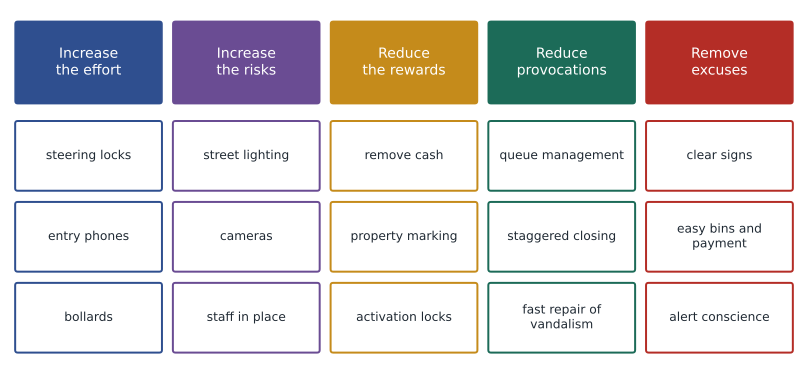
The examples are often ordinary. Steering column locks on new cars in Germany in the 1960s produced a lasting fall in car theft. Exact-fare systems and safes on buses ended many bus robberies, because drivers no longer carried cash. Caller identification reduced obscene phone calls. Toughened glass beer mugs reduced injuries in bar fights. Staggering bar closing times and providing late-night transport reduced the crowding that fuels violence at closing. Clear signs, posted rules and easy payment reduce excuses such as I did not know or I had no choice. Each technique is modest, but together they show that crime can be reduced without changing anyone's character.
A related field is crime prevention through environmental design, usually called CPTED. It grew from the work of the criminologist C. Ray Jeffery and the architect Oscar Newman, whose 1972 book Defensible Space argued that the design of public housing projects in New York made them easy targets because nobody could see or claim the shared spaces. CPTED practitioners focus on natural surveillance, such as windows overlooking paths and parking; access control, such as clear entrances and fencing; territorial reinforcement, which signals that a space belongs to someone; and maintenance, because a broken, neglected space signals that nobody cares. Many American cities use CPTED principles in reviewing development plans, and police departments train officers to conduct CPTED surveys of homes, businesses and parks.
Displacement and diffusion of benefits
The most common objection to situational prevention is displacement: if you make one place or target harder, offenders will simply move to another place, time, target, method or type of crime, and overall crime will not fall. Clarke and other researchers took the objection seriously and tested it in many studies. Reviews of more than a hundred evaluations have found that displacement does occur sometimes, but it is usually limited and rarely total. Offenders' awareness spaces, routines and preferences are not easily changed, and moving takes effort.
Researchers also found the opposite effect, which they called diffusion of benefits. When a place is protected, crime often falls in the surrounding area too, because offenders are unsure exactly where the protection begins and ends. A well-known study by David Weisburd and colleagues in Jersey City, New Jersey, in 2006 targeted drug and prostitution hot spots with intensive police attention and watched the surrounding blocks. Crime in the target areas fell, and crime in the catchment areas around them fell as well rather than rising. Diffusion is now found about as often as displacement in evaluations of place-based prevention.
Two years ago, Port Ardent's bus terminal, a crime generator in zone 1, received a CPTED makeover: new lighting, the removal of a blind alcove, glass walls on the waiting room, a staffed information desk and a cleaning schedule that removed graffiti within a day. Linh wants to know whether crime simply moved to the surrounding streets. Analysts use the weighted displacement quotient to measure this. It compares the change in a buffer zone around the target area with the change in the target area itself, each relative to a control area that received nothing.
# Weighted displacement quotient: Port Ardent bus terminal CPTED project
# incidents in the 12 months before and after the changes
target  = {"before": 210, "after": 118}   # terminal and its forecourt
buffer  = {"before": 160, "after": 141}   # streets within two blocks
control = {"before": 900, "after": 873}   # rest of zone 1 and zone 2

def ratio(area, period):
    return area[period] / control[period]

success = ratio(target, "after") - ratio(target, "before")   # negative means the target improved
buffer_change = ratio(buffer, "after") - ratio(buffer, "before")
wdq = buffer_change / success
print(f"target change relative to control: {success:+.4f}")
print(f"buffer change relative to control: {buffer_change:+.4f}")
print(f"weighted displacement quotient: {wdq:+.2f}")
if wdq > 0:
    print("diffusion of benefits: the buffer improved as well")
elif wdq < -1:
    print("displacement larger than the gain: the project made things worse")
else:
print("some displacement, but less than the gain in the target area")target change relative to control: -0.0982 buffer change relative to control: -0.0163 weighted displacement quotient: +0.17 diffusion of benefits: the buffer improved as well
The target area improved by much more than the control area changed, and the buffer zone improved too, so the quotient is positive. That indicates a diffusion of benefits rather than displacement. A negative quotient between zero and minus one would mean some crime had moved but less than was prevented, and a quotient below minus one would mean more crime moved than was prevented. Professor Desjardins warns that one year of data from one site is not proof, and that the result could also reflect other changes, such as a new shelter that opened nearby. Still, it is the kind of evidence the council should ask for before it spends money on any project.
Developmental prevention
Developmental prevention aims to change the risk factors in childhood and adolescence that you studied in lessons 4, 5 and 8, such as harsh or inconsistent parenting, early aggression, poor school performance and impulsivity. Its results take years to appear, but some of the strongest evidence in criminology comes from it, because several programs were tested in randomized experiments and followed participants into adulthood.
The Nurse-Family Partnership sends trained nurses to visit low-income first-time mothers from pregnancy until the child's second birthday, helping with health, parenting and life planning. In the original trial in Elmira, New York, children whose mothers were visited had fewer arrests and convictions by age 15 than children in the control group, and the mothers had fewer arrests as well. The High/Scope Perry Preschool project in Michigan provided high-quality preschool to disadvantaged children in the 1960s; by age 40, participants had been arrested much less often than the control group. Parent training programs, which teach consistent and positive discipline, reduce children's conduct problems in many trials. The Stop Now And Plan program, developed in Toronto and now used in parts of the United States, teaches children aged 6 to 11 with serious behavior problems, and their parents, to stop and think before acting, and evaluations have found reductions in aggression and later justice system contact. Multisystemic Therapy, which works intensively with the families of young people already in trouble, has reduced rearrest in many American trials.
Cost-benefit analysts have argued that well-run early programs repay their costs many times over in lower spending on justice, health and social services, and in higher earnings. The estimates vary widely and depend on assumptions, but the direction is consistent. Marco DiSanto, who started the course believing that punishment was the main answer, admits that he is surprised by how much a nurse visiting a young mother can do. Professor Desjardins replies that both matter. Developmental prevention reduces the number of future offenders, while policing and situational prevention deal with the offenders and opportunities that exist today.
Community prevention
Community prevention tries to strengthen the neighborhood conditions that social disorganization and collective efficacy theory identify. Approaches include neighborhood watch, community development, after-school and recreation programs, mentoring, and partnerships between schools, health services, police and residents. The evidence is more mixed than for situational and developmental programs, partly because community programs are hard to evaluate with experiments.
Some approaches have reasonably good support. Reviews of neighborhood watch find modest reductions in crime on average. Mentoring programs such as Big Brothers Big Sisters have shown small benefits when mentoring relationships are sustained. Communities That Care, a system in which local coalitions assess risk factors and choose tested programs to address them, reduced delinquency and substance use in a randomized trial across 24 American towns. Violence interruption programs, which employ outreach workers, often people with past street involvement, to mediate disputes and prevent retaliation, have produced reductions in shootings in some cities and none in others, depending heavily on how they were run.
Focused deterrence, sometimes called group violence intervention, combines community and criminal justice approaches. It began with Operation Ceasefire in Boston in 1996. Police, prosecutors, community leaders, outreach workers and service providers meet directly with members of groups involved in shootings. They deliver a clear message that violence will bring swift and certain consequences for the whole group, offer real help with jobs, housing and treatment, and express the community's moral voice against violence. Youth homicides in Boston fell sharply after the program began, and a systematic review of later programs found an overall reduction in crime, especially gang violence. The approach applies the deterrence lesson from lesson 3: certainty and clarity matter more than severity.
What does not work
Some popular programs have been tested and failed. The most striking example is Scared Straight, in which young people at risk are taken to prisons to meet inmates who describe prison life in frightening terms. A systematic review of randomized trials found that participants were more likely to offend afterward than similar young people who did not take part. Military-style boot camps for young offenders have shown no reduction in reoffending compared with ordinary sentences. The original school-based DARE program, delivered by police officers, had little or no effect on drug use in many evaluations, and the program was later redesigned. Programs that bring high-risk young people together in groups without skilled adult supervision can increase problem behavior, because the participants learn from each other.
These failures matter because the programs were popular, plausible and well meant. Professor Desjardins says that the council member's jail tour proposal is the clearest example of why evidence must come before enthusiasm. The National Institute of Justice's CrimeSolutions website and international reviews by the Campbell Collaboration rate programs as effective, promising or ineffective, and police services increasingly consult these ratings before adopting new initiatives.
| Program | Approach | Evidence |
|---|---|---|
| Nurse home visiting | Developmental | Effective: fewer arrests of children and mothers in long-term trials |
| Parent training and Stop Now And Plan | Developmental | Effective: reduced conduct problems and later justice contact |
| Hot spots policing | Criminal justice, place-based | Effective: crime falls with little displacement and often diffusion |
| Focused deterrence | Community and criminal justice | Effective: reductions in group and gang violence |
| Improved street lighting | Situational | Promising: reductions in many but not all studies |
| Neighborhood watch | Community | Promising: modest average reductions |
| Boot camps | Criminal justice | No effect on reoffending |
| Scared Straight | Deterrence | Harmful: participants offend more |
Worked problem
Advising the council
Port Ardent's council has 400,000 dollars a year for three years. The proposals are: 40 new surveillance cameras downtown, a Scared Straight style jail tour for 200 students a year, nurse home visits for 60 first-time mothers a year, and lighting, design and maintenance upgrades for the eight downtown blocks with the most incidents. What should the class recommend?
Show solution
- Reject the jail tour: randomized trials show it increases offending.
- Support the nurse home visits: strong long-term evidence, although the crime benefits will appear years from now.
- Support the downtown place-based upgrades: the eight blocks hold a large share of downtown incidents, and lighting, design and maintenance have promising evidence, with diffusion more likely than displacement.
- Treat the cameras as a possible part of the place-based plan rather than a separate program: reviews find cameras work best in car parks and when actively monitored, and have weaker effects in city centers.
- Build in evaluation: count incidents on the target blocks, a buffer zone and a control area before and after, and track outcomes for the home visiting families.
Answer: Recommend a balanced package: nurse home visiting for long-term prevention, a place-based plan for the eight hottest blocks that combines lighting, design, maintenance and a small number of monitored cameras where they are most likely to help, and evaluation of both. Recommend against the jail tour, and explain the evidence that it causes harm.
Common mistakes
MistakeSituational prevention only moves crime somewhere else.
InsteadDisplacement is usually limited and rarely total, and diffusion of benefits to nearby areas is found about as often.
MistakeFrightening young people with prison tours keeps them out of trouble.
InsteadRandomized trials show Scared Straight programs increase offending.
MistakeEarly childhood programs are social policy, not crime prevention.
InsteadPrograms such as nurse home visiting and quality preschool reduce arrests decades later in randomized trials.
MistakeIf a program is popular and well meant, it probably works.
InsteadSeveral popular programs, including boot camps and Scared Straight, failed or caused harm when tested; evidence must come first.
Summary and key terms
- Prevention can be classified by target (primary, secondary, tertiary) and by approach (situational, developmental, community, criminal justice).
- Situational prevention changes specific settings to increase effort and risk, reduce rewards and provocations, and remove excuses; CPTED applies similar ideas to design.
- Displacement is usually limited; diffusion of benefits is common. The weighted displacement quotient measures which occurred.
- Developmental programs such as nurse home visiting, quality preschool and parent training have strong long-term evidence.
- Community approaches have mixed evidence; focused deterrence has good evidence for reducing group violence.
- Scared Straight increases offending and boot camps do not reduce it; programs should be chosen and evaluated on evidence.
- Primary prevention
- Prevention aimed at the general population or environment before problems appear.
- Situational crime prevention
- Changing the immediate setting to make a specific crime harder, riskier or less rewarding.
- CPTED
- Crime prevention through environmental design: natural surveillance, access control, territorial reinforcement and maintenance.
- Displacement
- The movement of crime to another place, time, target, method or type of offense as a result of prevention.
- Diffusion of benefits
- A reduction in crime beyond the area or targets that a prevention measure covered.
- Developmental prevention
- Early intervention to reduce childhood risk factors for later offending.
- Focused deterrence
- A strategy that delivers a direct message, swift consequences and real help to groups involved in violence.
Practice problems
Work each problem on paper first, then reveal the answer to check.
Classify a mentoring program for children of prisoners by level of prevention.
Show answer
Secondary prevention, because it targets a group at elevated risk.
Name the five groups of situational prevention techniques.
Show answer
Increase the effort, increase the risks, reduce the rewards, reduce provocations and remove excuses.
A weighted displacement quotient is minus 0.3. What does it mean?
Show answer
Some crime moved to the buffer zone, but less than was prevented in the target area, so there was a net benefit.
Why might a violence interruption program work in one city and fail in another?
Show answer
Results depend heavily on implementation: the quality and training of outreach workers, management, partnerships and how consistently the program is delivered.
Which program in the table was found to be harmful?
Show answer
Scared Straight, whose participants offended more than similar young people who did not take part.
Lesson quiz · 5 questions
Score 60% or more to complete this lesson.
Create a free account to save your progress, take quizzes and earn a certificate.