
LES-102 · Lesson 6 of 12 · 21 min
Social structure theories: disorganization, strain and subcultures
▶ Video coming soon A video version of this lesson is on the way.
Professor Desjardins hangs a map of Port Ardent on the wall, divided into the eight patrol zones the service redrew in 2023. He has shaded each zone by its rate of police-recorded violent crime. The darkest zones form a ring around the old downtown near the lake, the lightest ones lie on the edges of the city. He tells the class that when he joined the police, the darkest zones were the same ones, even though most of the people who lived there then have long since moved away and been replaced by others. If crime belonged to particular people, he asks, why does it stay in the same places when the people change? That question gave birth to the sociological theories of crime that this lesson covers.
The Chicago School and social disorganization
In the 1920s, sociologists at the University of Chicago treated their rapidly growing city as a laboratory. Robert Park and Ernest Burgess described Chicago as a set of concentric zones: the central business district, then a zone in transition of factories, cheap rooming houses and newly arrived immigrants, then working-class homes, then middle-class residential areas and finally commuter suburbs. As the city grew, each zone pushed outward into the next. The zone in transition was always in flux, as each new immigrant group arrived, found its footing and moved outward, to be replaced by the next.
Clifford Shaw and Henry McKay mapped the home addresses of thousands of young people who came before Chicago's juvenile court between 1900 and the 1930s. Delinquency rates were highest in the zone in transition and fell steadily toward the suburbs. Crucially, the high rates persisted in the same neighborhoods over decades, even as the ethnic groups living there changed completely from Germans and Irish to Poles and Italians and later to Black migrants from the South. Each group's delinquency fell as it moved outward. Shaw and McKay concluded that delinquency was produced by the characteristics of neighborhoods, not of the people who lived in them.
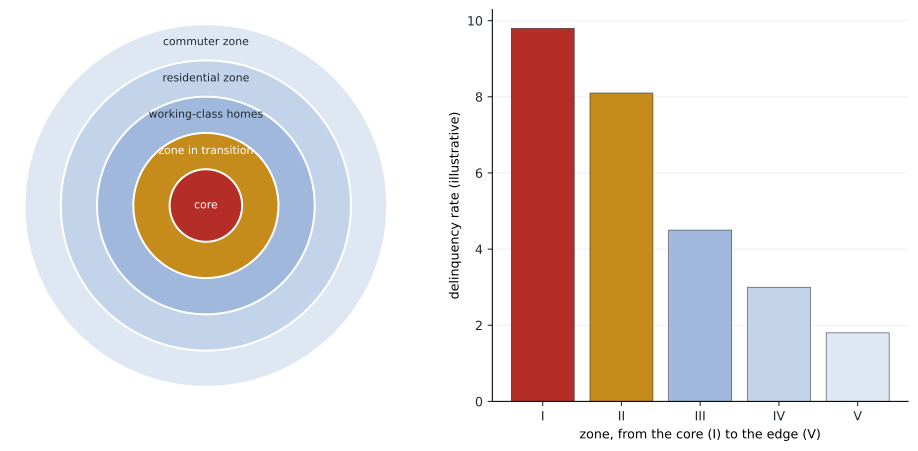
Shaw and McKay identified three features of high-delinquency neighborhoods: poverty, residential instability, as people moved in and out quickly, and ethnic heterogeneity, as many groups with different languages lived side by side. These conditions, they argued, produced social disorganization: the inability of residents to work together to solve common problems and to supervise young people. Where neighbors do not know each other, do not stay long and cannot easily communicate, informal controls weaken. Nobody tells a parent that his son was seen breaking windows, nobody organizes for a better park, and gangs fill the gap left by weak community institutions.
Collective efficacy
Social disorganization theory lost favor for several decades, partly because it was hard to measure the concept directly. It returned in the 1990s through the work of Robert Sampson and his colleagues in the Project on Human Development in Chicago Neighborhoods. They measured what they called collective efficacy: social cohesion among neighbors combined with their willingness to intervene for the common good. Residents were asked, for example, whether people in their neighborhood could be trusted and whether neighbors would do something if children were spray-painting graffiti on a building or skipping school and hanging out on a street corner.
Collective efficacy turned out to be a powerful predictor of violence. Neighborhoods with similar levels of poverty differed markedly in violent crime depending on their collective efficacy, and collective efficacy explained much of the link between concentrated disadvantage and violence. Sampson's later work showed that neighborhood inequality in the United States has been remarkably durable, and that living in a severely disadvantaged neighborhood has lasting effects on children's verbal ability and life chances. Similar research in Canadian cities has found that concentrated poverty and residential instability are linked to higher crime, although the extremes of segregation are less severe than in many American cities.
For police the theory has a practical message. Police cannot create collective efficacy, but they can support or undermine it. Community policing, problem solving with residents and responsive service can help residents work together. Disrespectful enforcement can do the opposite, persuading residents that calling the police is pointless or dangerous, which weakens one of the tools of informal control. Jesse describes how Nimkii Bay's community safety committee, made up of elders, parents and the band's police officers, has organized patrols, youth evenings and a phone tree for when young people go missing. The professor says that is collective efficacy in action.
Testing the theory in Port Ardent
Linh decides to see whether Port Ardent fits the pattern. The city's 2024 community survey asked residents the collective efficacy questions, and census data give the share of households below the low-income line and the share of residents who moved in the previous five years. She combines these with violent crime by zone and calculates the correlation between each neighborhood feature and the violent crime rate. A correlation runs from minus 1 to plus 1; values near zero mean little relationship.
# Port Ardent's eight patrol zones: area features and violent crime (2025)
zones = [  # zone, residents, low-income share, moved in past 5 years, collective efficacy (1-5), violent incidents
    (1, 9800, 0.31, 0.52, 2.6, 286), (2, 11200, 0.24, 0.45, 3.0, 248),
    (3, 12600, 0.12, 0.33, 3.6, 143), (4, 13100, 0.15, 0.38, 3.3, 200),
    (5, 14300, 0.08, 0.27, 3.9, 116), (6, 10900, 0.20, 0.41, 3.2, 160),
    (7, 13700, 0.06, 0.22, 4.1, 97),  (8, 12400, 0.10, 0.30, 3.8, 125),
]
def corr(x, y):
    n = len(x); mx = sum(x) / n; my = sum(y) / n
    sxy = sum((a - mx) * (b - my) for a, b in zip(x, y))
    sxx = sum((a - mx) ** 2 for a in x); syy = sum((b - my) ** 2 for b in y)
    return sxy / (sxx * syy) ** 0.5
rate = [v / p * 1000 for _, p, _, _, _, v in zones]
print("zone  violent per 1,000 residents")
for z, r in zip(zones, rate):
    print(f"  {z[0]}   {r:5.1f}")
print(f"total residents: {sum(z[1] for z in zones):,}; violent incidents: {sum(z[5] for z in zones):,}")
for i, name in [(2, "low-income share"), (3, "residential turnover"), (4, "collective efficacy")]:
print(f"correlation with {name:21s} {corr([z[i] for z in zones], rate):+.2f}")zone violent per 1,000 residents 1 29.2 2 22.1 3 11.3 4 15.3 5 8.1 6 14.7 7 7.1 8 10.1 total residents: 98,000; violent incidents: 1,375 correlation with low-income share +0.98 correlation with residential turnover +0.96 correlation with collective efficacy -0.97
The 1,375 violent incidents the service recorded in 2025 are far from evenly spread. The rate in zone 1, the old downtown core, is about 29 per 1,000 residents, roughly four times the rate in zone 7 on the city's western edge. Each neighborhood feature is strongly correlated with violence, positively for low income and turnover and negatively for collective efficacy. Linh is careful about what this does and does not show. Eight zones are few, the features are correlated with each other, so their separate effects cannot be untangled here, and correlation does not prove causation. Zone data also cannot say anything about individuals: most residents of zone 1 are never involved in violence. Drawing conclusions about individuals from area data is a mistake known as the ecological fallacy.
Strain theory: Merton and anomie
A second family of structural theories focuses on the gap between what society encourages people to want and what it allows them to achieve. The French sociologist Emile Durkheim had used the term anomie to describe a state of normlessness, when social rules break down during rapid change. In 1938 the American sociologist Robert Merton applied the idea to American society. The culture, he argued, emphasizes success, especially wealth, as a goal for everyone, while the legitimate means of achieving it, such as education and good jobs, are unequally distributed. People who accept the goal but lack the means experience strain, and some respond by turning to illegitimate means.
Merton described five ways people adapt to this strain. Conformists accept both the goals and the legitimate means, even if they fall short. Innovators accept the goals but use illegitimate means, such as theft, fraud or drug dealing; this is the adaptation most directly linked to crime. Ritualists abandon the goals but cling to the rules, like the clerk who has stopped hoping for promotion but follows every procedure. Retreatists reject both, withdrawing through addiction or vagrancy. Rebels reject both and seek to replace them with new goals and means, as in political movements. Priya points out that the innovators she caught at the bank were not poor. Merton anticipated this: the pressure to succeed is felt at every level, which helps explain white-collar crime.
| Adaptation | Cultural goals | Legitimate means | Example |
|---|---|---|---|
| Conformity | Accept | Accept | Working and studying to get ahead |
| Innovation | Accept | Reject | Theft, fraud, drug selling for money |
| Ritualism | Reject | Accept | Following rules with no hope of advancement |
| Retreatism | Reject | Reject | Withdrawal through addiction |
| Rebellion | Replace | Replace | Seeking a new social order |
General strain theory
In 1992 Robert Agnew broadened strain theory to focus on individuals and emotions rather than social structure alone. His general strain theory identifies three main sources of strain: failure to achieve valued goals, including money, status and respect; the removal of positively valued things, such as the loss of a parent, a breakup or being suspended from school; and the presentation of negative stimuli, such as abuse, bullying, discrimination, harsh discipline or victimization. Strain produces negative emotions, especially anger and frustration, and crime is one way to cope: to get what one wants, to strike back or to escape bad feelings through drugs.
Agnew emphasized that most people facing strain do not offend. Strains most likely to lead to crime are those seen as unjust, that are severe, that occur where social control is low and that create pressure or incentive for criminal coping, such as being bullied by peers who respect toughness. Whether strain leads to crime also depends on coping resources: supportive relationships, problem-solving skills and self-control. Research supports the theory, particularly for strains such as criminal victimization, harsh parenting and discrimination. For police, general strain theory helps explain why victimization and offending are often linked: people who are assaulted are more likely to assault others, partly out of anger and partly from a belief that they must protect themselves.
Subcultural theories
Subcultural theories argue that some groups develop values that support or tolerate crime. In 1955 Albert Cohen argued that working-class boys who could not succeed by middle-class standards at school suffered status frustration, and some formed delinquent subcultures that turned those standards upside down, valuing toughness and defiance. Richard Cloward and Lloyd Ohlin added that illegitimate opportunities are also unequally distributed: where adult criminal networks exist, young people can learn to become criminals; where they do not, frustration may produce violent conflict gangs; and those who fail in both may retreat into drug use. Walter Miller argued instead that lower-class culture had its own focal concerns, such as toughness, smartness and excitement, that brought young men into conflict with the law.
The best known modern work in this tradition is Elijah Anderson's Code of the Street, published in 1999 after years of fieldwork in Philadelphia. Anderson found that most families in a poor, mostly Black neighborhood held mainstream decent values. But where people believed that police and the justice system would not protect them, a street code had emerged that governed interpersonal behavior: respect had to be earned and defended, and showing weakness invited victimization. Even young people from decent families had to know the code and sometimes act on it to stay safe. The code was not a choice of deviant values so much as a response to a lack of trust in formal protection. Jesse says that sounds like an argument for building trust in police, not for more arrests. The professor agrees that Anderson would say much the same.
Worked problem
Applying the theories to one neighborhood
Port Ardent's zone 1 has the city's highest violent crime rate, the highest share of low-income households, high residential turnover from rooming houses and short-term rentals, and the lowest collective efficacy score. A group of young men there has been involved in a series of fights over perceived disrespect. How would each structural theory explain the problem, and what would each suggest?
Show solution
- Social disorganization: poverty and turnover have weakened neighbors' ability to supervise young people and act together. Suggest supporting resident organizations, stable housing and community institutions.
- Strain: blocked opportunities for work and respect create anger and frustration. Suggest youth employment, training and mentoring that offer legitimate routes to status.
- Subculture and the code of the street: where residents doubt formal protection, toughness and retaliation become ways to stay safe. Suggest building trust in police through fair, responsive service, and violence interruption programs that offer face-saving alternatives.
- Compare: the theories are complementary; each points to a different lever, and combined strategies are more likely to work.
Answer: No single theory explains zone 1's problem, but together they suggest a plan: strengthen community capacity, open legitimate opportunities for young men and rebuild trust so that residents rely on police instead of retaliation. Police can contribute directly to the third and support the first two through partnerships.
Common mistakes
MistakeHigh-crime neighborhoods are high-crime because of the people who live there.
InsteadShaw and McKay found that crime persisted in the same places as populations changed, pointing to neighborhood conditions.
MistakeIf a neighborhood has a high crime rate, most of its residents are offenders.
InsteadMost residents of high-crime areas are never involved in crime; inferring individual behavior from area data is the ecological fallacy.
MistakeStrain theory explains only crime by the poor.
InsteadThe pressure to succeed is felt at every level; Merton's innovation also explains white-collar crime.
MistakeThe code of the street means residents of poor neighborhoods reject mainstream values.
InsteadAnderson found most families held decent values; the code was a response to distrust of formal protection.
Summary and key terms
- The Chicago School found delinquency concentrated in the zone in transition and persisting there as populations changed.
- Social disorganization theory links poverty, residential instability and heterogeneity to weak informal social control.
- Collective efficacy, the combination of cohesion and willingness to intervene, strongly predicts lower violence.
- Merton's strain theory describes five adaptations to the gap between cultural goals and legitimate means; innovation is most linked to crime.
- Agnew's general strain theory links failure, loss and negative treatment to negative emotions and criminal coping, moderated by coping resources.
- Subcultural theories, including Anderson's code of the street, explain how values supporting violence can emerge where formal protection is distrusted.
- Social disorganization
- The inability of a community to realize common values and maintain effective social control.
- Collective efficacy
- Social cohesion among neighbors combined with their willingness to intervene for the common good.
- Anomie
- A state of normlessness in which social rules lose their force.
- Strain
- Pressure produced by a gap between goals and the means to reach them, or by negative experiences.
- Ecological fallacy
- Drawing conclusions about individuals from data about groups or areas.
- Code of the street
- Informal rules governing respect and violence in some neighborhoods where formal protection is distrusted.
Practice problems
Work each problem on paper first, then reveal the answer to check.
Why did Shaw and McKay conclude that delinquency came from neighborhoods rather than people?
Show answer
High delinquency persisted in the same areas over decades as the groups living there changed completely.
Which of Merton's adaptations accepts cultural goals but rejects legitimate means?
Show answer
Innovation.
Name Agnew's three main sources of strain.
Show answer
Failure to achieve valued goals, removal of positively valued things and presentation of negative stimuli.
A zone with a high crime rate is described as full of criminals. What error is this?
Show answer
The ecological fallacy: inferring individual behavior from area-level data.
Lesson quiz · 5 questions
Score 60% or more to complete this lesson.
Create a free account to save your progress, take quizzes and earn a certificate.