
LES-102 · Lesson 7 of 12 · 21 min
Social process theories: learning, control and labeling
▶ Video coming soon A video version of this lesson is on the way.
Professor Desjardins opens week seven with a puzzle from the last lesson. If neighborhood conditions drive crime, why do most young people who grow up in Port Ardent's zone 1 never get into serious trouble, while some from the comfortable western zones do? Structural theories explain why crime rates differ between places, he says, but they say less about which individuals in a place will offend. Social process theories fill that gap. They look at the relationships and interactions through which people learn to offend, are held back from offending or are pushed into criminal identities by the way others react to them. These theories also speak directly to police work, because police reactions are among the most powerful social processes in a young person's life.
Differential association
In 1939 Edwin Sutherland, who had already coined the term white-collar crime, proposed the theory of differential association. Criminal behavior, he argued, is learned like any other behavior, through interaction with other people, mainly in small intimate groups such as families and friendships. What is learned includes both techniques, such as how to pick a lock or falsify an account, and the motives, drives, rationalizations and attitudes that make crime seem acceptable. A person becomes delinquent, Sutherland said, because of an excess of definitions favorable to violation of law over definitions unfavorable to violation of law.
Sutherland added that associations vary in frequency, duration, priority and intensity. Associations that come early in life, last long, happen often and involve people we care about matter more than fleeting contacts. The theory explained something that earlier biological and psychological theories could not: why crime is found among respectable businesspeople, who learn from colleagues that cutting corners is normal, as well as among street gangs. It also explained why young people commit most offenses in groups. Priya recognizes it immediately. At the bank, she says, the frauds she uncovered often ran in teams where a senior employee had taught newer ones that a certain kind of manipulation was simply how things were done.
Social learning theory
Ronald Akers extended Sutherland's theory in the 1960s and 1970s by adding the learning principles of psychology you met in lesson 5. His social learning theory has four main elements. Differential association is the people one interacts with and the behavior they model. Definitions are one's own attitudes and justifications about whether an act is right or wrong. Differential reinforcement is the balance of rewards and punishments that follow behavior, from money and excitement to approval or disapproval from friends. Imitation is copying the behavior of admired models. A young person who spends time with friends who shoplift, hears them say it is harmless, gets a thrill and their approval from doing it and sees an older cousin admired for his nerve has all four elements pushing in the same direction.
Social learning theory is one of the best supported theories in criminology. Having delinquent friends is among the strongest and most consistent correlates of delinquency in studies across many countries. Researchers have debated how much of the link reflects influence, friends teaching each other, and how much reflects selection, the tendency of young people who are already inclined to offend to choose similar friends. Longitudinal studies suggest both processes operate. The theory has also been applied to online settings, where people learn techniques and justifications for hacking, fraud and extremism from communities they may never meet in person.
Testing the link with peers
Port Ardent's school district joined the police service and a local university in 2024 to run an anonymous self-report survey of grade 10 students. Among other questions, students were asked whether any of their close friends had been in trouble with police in the past year and whether they themselves had committed a property offense, such as theft or vandalism. Linh uses the results to calculate an odds ratio, a common measure of how strongly two yes-or-no characteristics are associated.
# Grade 10 self-report survey: delinquent friends and own property offending (2024)
# counts: [offended, did not offend]
friends_in_trouble = [96, 144]
no_such_friends    = [92, 668]
def odds(row): return row[0] / row[1]
for label, row in [("friends in trouble", friends_in_trouble), ("no such friends", no_such_friends)]:
    print(f"{label:20s} n = {sum(row):4d}  offended {row[0] / sum(row):5.1%}  odds {odds(row):.2f}")
print(f"odds ratio: {odds(friends_in_trouble) / odds(no_such_friends):.1f}")
total = sum(friends_in_trouble) + sum(no_such_friends)
print(f"students surveyed: {total}; overall offending {(friends_in_trouble[0] + no_such_friends[0]) / total:.1%}")friends in trouble n = 240 offended 40.0% odds 0.67 no such friends n = 760 offended 12.1% odds 0.14 odds ratio: 4.8 students surveyed: 1000; overall offending 18.8%
Students whose close friends had been in trouble with police were more than three times as likely to have committed a property offense as those whose friends had not, and the odds ratio of about 4.8 is typical of what such surveys find. Linh notes two cautions. The survey is cross-sectional, taken at one point in time, so it cannot show whether friends led to offending or offending led to the choice of friends. And most students with friends in trouble, 60% of them, did not offend at all, so peers are an influence, not a sentence.
Neutralization: how offenders excuse themselves
In 1957 Gresham Sykes and David Matza challenged the idea that delinquents hold values opposed to mainstream society. Most young offenders, they observed, express guilt or shame, admire honest people and distinguish between acceptable and unacceptable targets. They drift between conventional and delinquent behavior by learning techniques of neutralization that temporarily switch off their conventional values. Sykes and Matza described five: denial of responsibility, as in it was not my fault; denial of injury, as in nobody really got hurt; denial of the victim, as in he deserved it; condemnation of the condemners, as in the police are crooks themselves; and appeal to higher loyalties, as in I had to back up my friends.
These techniques appear everywhere, from schoolyards to boardrooms. The cottage burglar Professor Desjardins described in lesson 5, who said the owners were rich and would not miss anything, was using denial of injury and denial of the victim. Priya heard condemnation of the condemners from bank employees who pointed to executives' bonuses. For officers, recognizing neutralizations is useful in interviews and in conversations with young people, because naming the excuse and pointing to the real harm can reconnect a person with values he or she already holds.
Control theories and the social bond
Learning theories ask why people offend. Control theories turn the question around: given that crime often offers easy rewards, why do most people not offend? Their answer is that people are held back by controls, and offend when those controls are weak. Early versions focused on inner containment, such as a positive self-concept, and outer containment, such as family and community supervision. The most influential version is Travis Hirschi's social bond theory, set out in Causes of Delinquency in 1969.
Hirschi identified four elements of the bond between a young person and conventional society. Attachment is emotional closeness to others, especially parents, teachers and conventional friends, so that a young person cares what they think. Commitment is investment in conventional goals, such as education or a career, which offending would put at risk. Involvement is time spent in conventional activities, such as school, work, sports and clubs, leaving less time for delinquency. Belief is acceptance of the moral validity of society's rules. The stronger each element, the less likely a person is to offend. Hirschi tested the theory with a survey of about 4,000 California high school students and found that attachment to parents and school and commitment to education predicted lower delinquency.
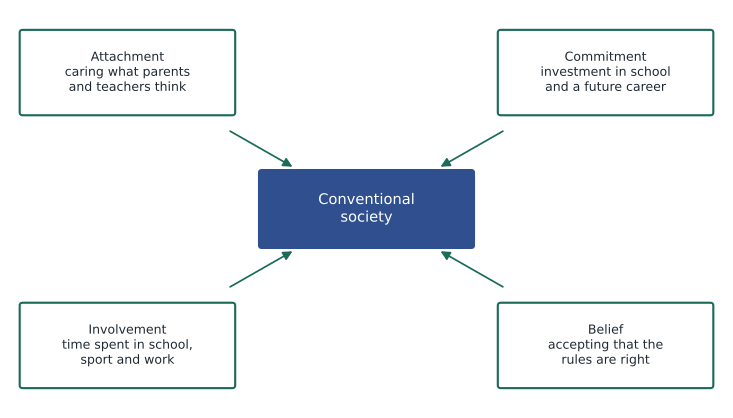
Control theory has a natural partner in the life-course research you will meet in lesson 8, which shows that adult bonds such as stable work and a good relationship help people stop offending. It also explains a finding that puzzles many people: the involvement element works only if the activities are supervised and structured. Unstructured time spent with peers without adults, such as driving around or hanging out at night, is linked to more delinquency, not less, because it gives opportunities with no controls. Marco says this explains why his reserve unit's youth program, with its fixed schedule and adult leaders, seemed to keep his nephew out of trouble when hanging around a mall had not.
Labeling theory
Labeling theory, developed in the 1950s and 1960s, shifted attention from the offender to the reaction. Edwin Lemert distinguished primary deviance, the initial acts of rule breaking that almost everyone commits at some point, from secondary deviance, which arises when a person begins to see himself or herself as a deviant and acts accordingly, often in response to how others react. Howard Becker argued in Outsiders in 1963 that deviance is not a quality of the act but a consequence of the application by others of rules and sanctions: the deviant is one to whom that label has successfully been applied. Earlier, Frank Tannenbaum had described the dramatization of evil, in which a young person caught in a minor offense is publicly tagged as bad and begins to become what he is described as being.
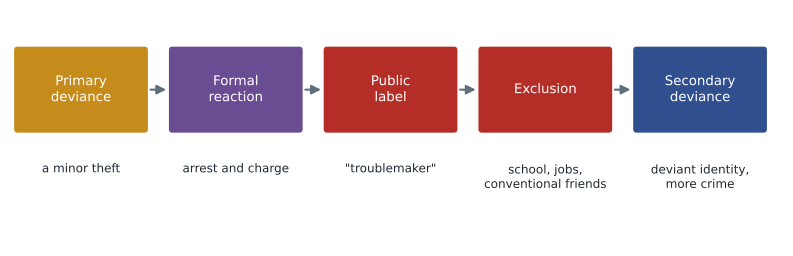
A label can close doors. A young person known as a troublemaker may be watched more closely by police and teachers, so his offenses are more likely to be detected. A criminal record makes it harder to find work, rent an apartment or travel, which weakens the bonds of control theory and pushes the person toward others with similar labels. Research gives labeling theory real but qualified support. Studies that follow similar young people find that those who are arrested or formally processed for minor offenses often offend more afterward than similar young people who are not, especially when processing leads to school failure or unemployment. In a frequently cited meta-analysis, formal court processing of juveniles did not reduce later offending and in many studies increased it compared with diversion.
The Australian criminologist John Braithwaite added an important refinement in 1989. Shaming can be stigmatizing, treating the offender as a bad person and casting him or her out, which tends to increase offending; or it can be reintegrative, condemning the act while respecting the person and welcoming him or her back after amends are made, which tends to reduce it. Reintegrative shaming is the idea behind restorative justice conferences, in which offenders meet victims and community members to repair harm. Jesse points out that many tribal justice traditions, including the peacemaking courts of the Navajo Nation and other nations, work on similar principles.
What social process theories mean for police
Each of these theories points to decisions officers make every shift. Social learning suggests that breaking up delinquent peer groups through positive alternatives, such as mentoring and structured activities, can reduce offending, and that police should avoid becoming the source of reinforcement, such as status among peers for defying police. Control theory suggests that responses that preserve a young person's bonds to school, family and work, rather than cutting them, protect public safety. Labeling theory suggests that the formal machinery of arrest and charge should be reserved for situations that need it. This is the reasoning behind juvenile diversion programs in most states, which handle many first offenses outside of court. None of this means ignoring offenses; it means choosing responses that hold people accountable without pushing them deeper into crime.
Worked problem
Choosing a response that fits the theories
A 15-year-old boy in Port Ardent is caught spray-painting a tag on a school wall with two friends at 11 p.m. on a Saturday. He has no record, is on the school basketball team and is mortified. His friends have both been warned by police before. What response would social learning, control and labeling theories each favor?
Show solution
- Social learning: the behavior was learned and reinforced in a group. A response should weaken the group reinforcement and strengthen conventional models, such as involving his coach.
- Control: his bonds to school and sport are strong assets. A response should protect them rather than threaten them, for example by avoiding suspension from the team.
- Labeling: a formal charge and record could brand him as a vandal and weaken those bonds. A diversion referral with reparation, such as cleaning the wall and meeting the principal, condemns the act while keeping him in the community.
- Combine: a reintegrative response holds him accountable, involves his parents and coach and addresses the friends separately, since their pattern of warnings suggests a different level of risk.
Answer: All three theories point toward a reintegrative, non-court response for this boy: repair the damage, involve the adults he respects, protect his place on the team and avoid a formal label. His friends, with prior warnings, may need a more structured response, but the same principles apply.
Common mistakes
MistakeCriminal behavior is mainly inherited or invented, not learned.
InsteadDifferential association and social learning theory show that techniques, motives and justifications for crime are learned in interaction, especially in close groups.
MistakeDelinquents reject society's values.
InsteadSykes and Matza found most delinquents share conventional values and use neutralizations to excuse themselves temporarily.
MistakeKeeping young people busy always reduces delinquency.
InsteadSupervised, structured activities help; unstructured time with peers and no adults is linked to more delinquency.
MistakeArresting young people for minor offenses always teaches them a lesson.
InsteadFormal processing for minor offenses often increases later offending compared with diversion, as labeling theory predicts.
Summary and key terms
- Differential association holds that crime is learned in intimate groups, including techniques and definitions favorable to law breaking.
- Akers' social learning theory adds definitions, differential reinforcement and imitation; delinquent peers are among the strongest correlates of offending.
- Sykes and Matza's techniques of neutralization let people excuse offending while keeping conventional values.
- Hirschi's social bond theory says attachment, commitment, involvement and belief hold people back from crime.
- Labeling theory distinguishes primary from secondary deviance and shows how formal reactions can deepen offending.
- Braithwaite's reintegrative shaming condemns the act while welcoming the person back, the basis of restorative justice.
- Differential association
- Sutherland's theory that criminal behavior is learned through interaction in intimate groups.
- Techniques of neutralization
- Justifications that let offenders temporarily set aside conventional values.
- Social bond
- Hirschi's four ties to conventional society: attachment, commitment, involvement and belief.
- Primary deviance
- Initial rule breaking that does not change a person's self-image.
- Secondary deviance
- Deviance that follows from adopting a deviant identity, often after being formally reacted to.
- Reintegrative shaming
- Disapproval of an act combined with respect for the person and acceptance after amends.
- Odds ratio
- A measure of association: the odds of an outcome in one group divided by the odds in another.
Practice problems
Work each problem on paper first, then reveal the answer to check.
Name the four elements of Hirschi's social bond.
Show answer
Attachment, commitment, involvement and belief.
A shoplifter says big chains build theft into their prices so nobody is hurt. Which neutralization is this?
Show answer
Denial of injury.
In a survey, 50 of 200 students with gang-involved friends and 40 of 800 without such friends report carrying a weapon. What is the odds ratio?
Show answer
(50/150) / (40/760) = 0.333 / 0.0526 ≈ 6.3.
What is the difference between stigmatizing and reintegrative shaming?
Show answer
Stigmatizing shaming casts the person out as bad; reintegrative shaming condemns the act but welcomes the person back after amends.
Lesson quiz · 5 questions
Score 60% or more to complete this lesson.
Create a free account to save your progress, take quizzes and earn a certificate.