
PHOT-102 · Lesson 11 of 12 · 25 min
Lighting products and still life
Products and still-life subjects do not move, blink or tire, so they reward patience: every highlight, edge and reflection can be placed exactly. They also present lighting problems that portraits rarely do. A glass bottle has almost no surface of its own to light; a polished metal object reflects the whole room, including the photographer; a white product on a white background can disappear. The solutions come directly from the principles in Lesson 2, especially the three kinds of reflection and the family of angles. This lesson covers the tabletop studio and its tools, lighting by surface type (matte, glossy, glass, metal and liquids), white and black backgrounds, food, color accuracy, and practical techniques such as focus stacking and compositing used in commercial product photography.
The tabletop studio
Product photography needs only a small space and a few tools: a sturdy table, a sweep (a curved sheet of paper, vinyl or acrylic that bends from the tabletop up the wall behind, giving a seamless background with no horizon line), clamps, stands, one to three lights with modifiers, and a collection of white, black and silver cards, small mirrors and diffusion panels. Shooting tables with a translucent curved acrylic surface can be lit from below and behind for shadowless white backgrounds. Light tents (cubes of diffusion fabric) surround small products with soft light, convenient for simple e-commerce work but limited in control because everything is lit evenly.
A tripod and tethered shooting, with the camera connected to a computer so that each frame appears immediately on a large screen, are standard: they allow precise framing and fine adjustment of reflections that would be invisible on the camera's screen. Because products are still, low ISO, small apertures and long exposures with continuous light or several flash pops are all possible.
Lighting by surface type
The first question for any product is: which of its surfaces reflect diffusely, and which directly? The lighting strategy follows from the answer.
- Matte surfaces (paper, fabric, unglazed ceramics, wood, many plastics): reflect diffusely, so their brightness depends only on how much light falls on them. They are lit like faces, with a key light giving direction and modeling, side light to reveal texture, and fill to control contrast. The position of the camera does not change how bright they look.
- Glossy surfaces (polished plastic, lacquer, glazed ceramics, painted metal, phone screens): reflect directly. They look like what they reflect, so they are lit by deciding what they should reflect, usually large, soft sources with smooth gradients, placed within the family of angles, and black areas where the surface should be dark to show its shape. A glossy black product lit only with matte-style light looks like a black hole; lit with a large softbox reflected along its edges, it gains shape and finish.
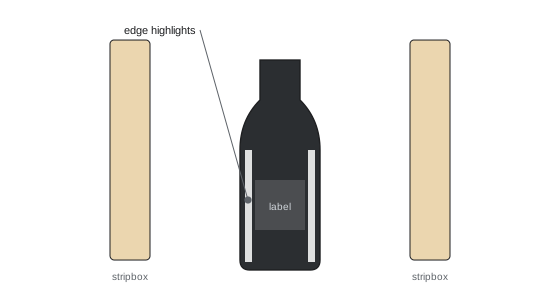
- Most products combine both: a printed label (matte) on a glossy bottle. These need lights placed so that the glossy reflection does not cover the label, often by moving the main source outside the label's family of angles and lighting the label with a separate, angled source.
Glass
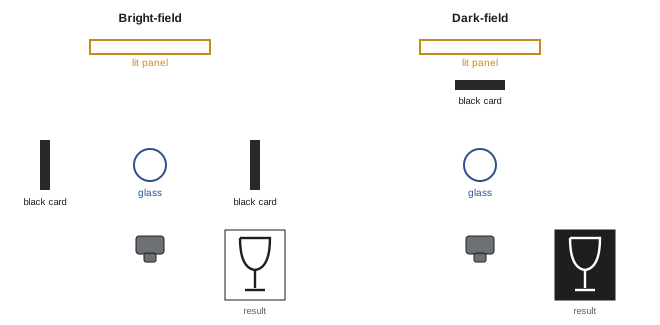
Transparent glass has almost no diffuse reflection: what the camera sees is the background through the glass, refracted and distorted, plus direct reflections of whatever surrounds it. Glass is therefore defined by its edges, and the edges are made visible by contrasting them with the background. There are two classic approaches:
- Bright-field lighting: the glass is placed in front of a bright, evenly lit background, such as a lit white panel or a softbox behind it. The background shows through the glass, and the edges, where light refracts away from the camera, appear dark. Black cards placed just outside the frame on each side, within the edges' family of angles, strengthen the dark outlines. The result is a clean, dark-outlined glass on a white background, the standard for catalog work.
- Dark-field lighting: the glass is placed in front of a dark background, with a bright light source behind it but larger than the frame, typically a lit panel with a black card in the middle the size of the glass silhouette as seen from the camera. The edges, which refract light from the bright border around the black card, appear bright against the dark background. The result is a dramatic, glowing outline, used for luxury and editorial work.
Both approaches avoid front lighting, which would only add distracting reflections of the light and the studio on the glass. Highlights are then added deliberately, for example a long, narrow reflection from a stripbox to suggest a smooth curve. Glasses and bottles containing liquid are usually lit from behind so the liquid glows; adding a white or silver card cut to shape behind the glass (out of view) brightens the liquid evenly.
Worked problem
Setting up a dark-field shot of a wine glass
Describe a dark-field setup for a clear wine glass on a black background, and how to size the central black card.
Show solution
- Place a softbox or lit translucent panel about 1 m behind the glass, facing the camera, and the camera on a tripod at the glass's height.
- Cut a black card and place it in front of the panel, centered behind the glass. From the camera position, size and move it until it just covers the area seen through the glass, leaving a thin band of the bright panel visible around the glass's outline.
- The edges now refract light from the bright border, appearing as bright lines, while the rest of the glass shows the black card.
- Keep all other light off the glass and use black flags to prevent the panel from flaring into the lens; check reflections tethered on a large screen.
Answer: The size of the black card relative to the panel controls the thickness of the bright outline: a card nearly as large as the panel gives fine lines; a smaller card gives broader, brighter edges.
Metal and other highly reflective surfaces
Polished metal is a mirror. A chrome kettle reflects the lights, the stands, the camera, the photographer and the studio walls. The strategy is to control everything it sees:
- Surround the object with large, diffused sources and white or black panels, so its reflections show smooth gradients rather than a cluttered room. A light tent is an extreme version; professionals build enclosures from large diffusion panels and cards.
- Use black cards and gaps between sources to create dark lines that define edges and shape: an entirely white surround makes the object look flat and featureless, like a white blob.
- Hide the camera by shooting through a hole in a panel, using a long lens from further away, or placing the camera so it is reflected in an area that will be dark anyway.
- Dulling spray, a removable matte coating, reduces specular reflection where shape matters more than shine, though it changes the material's appearance and is avoided for luxury finishes.
- Brushed and satin metals scatter reflections into streaks along the grain; light parallel to the grain looks different from light across it.
Jewelry combines tiny polished metal surfaces and gemstones whose sparkle depends on small, hard light sources, so it is often lit with soft enclosures for metal and small bare or gridded lights for stones, frequently in separate exposures combined later.
White on white and black on black
Pure white backgrounds are required by many online marketplaces and catalogs: the background should record as pure white (RGB 255, 255, 255) without losing the product's edges or shadows. The standard method is to light the background separately, about one to one and a half stops brighter than the product, so it clips to white, while the product is lit for correct exposure. Too much background light spills around the edges of the product, reducing contrast and causing flare; too little leaves a gray background. A white product on white needs a shadow or edge definition: light it from the side to create soft shadows, or use black cards near the edges to darken its outline, keeping the background slightly separated in tone.
Black products on black backgrounds pose the opposite problem: the product disappears unless its edges and surfaces are defined by highlights. Use rim lights and stripboxes to create bright outlines and reflections on glossy black surfaces, and expose to keep the background a few stops below the product so it records as black without noise.
Food and drink
Food photography borrows from both still life and natural-light portraiture. A large soft source from behind or to the side, often a window or a large diffusion panel, gives food texture and appetizing highlights on glazes and sauces, while white cards in front fill the shadows. Back light makes steam, drinks and translucent ingredients glow, while front light tends to flatten food and make it look dull. Speed matters: herbs wilt, ice melts, sauces skin over and steam fades, so lighting and composition are set with a stand-in plate before the real food arrives. Drinks are often lit from behind through the liquid, with condensation made from a mix of water and glycerin sprayed on the glass to last through the shoot.
Color accuracy and consistency
Product photographs often serve as the customer's only view of the product before buying, so color must be accurate and consistent across a range. Practices include using lights with high CRI (Lesson 9); photographing a color reference target under the actual lighting at the start of each setup and building a camera profile from it; setting a custom white balance; working on a calibrated monitor; and keeping lighting, distances and camera settings identical across all products in a series, recorded in a lighting diagram. Fabrics with optical brighteners and certain dyes can photograph differently from how they look to the eye; comparing the image with the physical product under controlled viewing light catches these problems.
Focus stacking and compositing
Small products photographed close up have very shallow depth of field even at small apertures, and very small apertures soften the image through diffraction (PHOT-101, Lesson 3). Focus stacking solves this: a series of frames is taken with the focus moved in small steps through the subject, then software combines the sharpest parts of each frame. Many cameras automate the focus steps. Compositing goes further: a product may be photographed in several exposures, each with lights optimized for one part (the label, the glossy cap, the liquid, the background), and the parts combined in editing. This is standard practice in commercial product photography, though for marketplaces and editorial uses the final image must still represent the product honestly.
Common mistakes
MistakeLighting glossy products like matte ones.
InsteadDecide what the surface should reflect and place sources in its family of angles.
MistakeFront-lighting glass.
InsteadUse bright-field or dark-field lighting from behind.
MistakeSurrounding metal entirely with white.
InsteadAdd black cards and gaps to define shape.
MistakeOverlighting a white background so it spills onto the product.
InsteadLight the background 1 to 1.5 stops brighter and flag spill.
MistakeJudging product color on an uncalibrated screen.
InsteadUse a color reference, custom profile and calibrated monitor.
Summary and key terms
- A tabletop studio uses sweeps, cards, mirrors, diffusion, a tripod and tethering.
- Matte surfaces are lit for direction and modeling; glossy surfaces by controlling what they reflect.
- Glass is defined by its edges: bright-field gives dark outlines on white, dark-field bright outlines on black.
- Metal reflects its surroundings; control them with large sources, black cards and hidden cameras.
- White backgrounds are lit about 1 to 1.5 stops above the product; white and black products need edge definition.
- Food benefits from back or side light, fill cards and speed.
- Color accuracy, focus stacking and compositing are standard commercial practices.
- Sweep
- A curved seamless background running from tabletop to wall.
- Tethered shooting
- Camera connected to a computer to view frames immediately.
- Light tent
- A cube of diffusion fabric surrounding a product with soft light.
- Bright-field lighting
- Glass against a bright background, showing dark edges.
- Dark-field lighting
- Glass against a dark background, showing bright edges.
- Dulling spray
- A removable matte coating that reduces reflections.
- Stripbox
- A long, narrow softbox used for edge highlights.
- Focus stacking
- Combining frames focused at different distances for greater depth of field.
- Compositing
- Combining parts of several exposures into one image.
- Color reference target
- A chart of known colors used to profile a camera.
Practice problems
Work each problem on paper first, then reveal the answer to check.
What is a sweep and why is it used?
Show answer
A curved background sheet that gives a seamless background with no horizon line.
Why does camera position not change how bright a matte surface looks?
Show answer
Diffuse reflection scatters light equally in all directions.
How are glossy products lit?
Show answer
By choosing and placing the sources they will reflect, within the family of angles.
What does bright-field lighting produce?
Show answer
Dark-edged glass on a bright background.
In dark-field lighting, what controls the thickness of the bright edges?
Show answer
The size of the black card relative to the bright panel behind.
Why add black cards when lighting chrome?
Show answer
To create dark lines that define shape.
How much brighter than the product is a white background usually lit?
Show answer
About 1 to 1.5 stops.
Why is food often backlit?
Show answer
It reveals texture, highlights and makes translucent items and steam glow.
Why use focus stacking rather than f/32?
Show answer
Very small apertures soften the image through diffraction.
Name two practices for color accuracy.
Show answer
High-CRI lights, color target and custom profile, custom white balance, calibrated monitor.
Lesson quiz · 5 questions
Score 60% or more to complete this lesson.
Create a free account to save your progress, take quizzes and earn a certificate.