
PHOT-102 · Lesson 2 of 12 · 27 min
How light behaves: distance, size and reflection
Lighting can seem like an art of intuition and trial and error, but most of what happens when you place a light follows a handful of physical principles. How quickly light falls off with distance, why a larger source gives softer shadows, where reflections will appear on a shiny object, and why a polarizing filter removes some reflections and not others can all be predicted. Knowing these principles saves time on every shoot: instead of moving a light at random until the picture looks right, you can reason about where it needs to go. This lesson covers the inverse square law and its consequences for falloff and background control, the relationship between source size, distance and softness, the three ways surfaces reflect light, the family of angles that governs reflections, diffusion and transmission, polarization, and how light is measured.
The inverse square law
Light from a small source spreads out as it travels, so the same amount of light covers a larger area further away. The illuminance on a surface facing the source falls with the square of the distance:
where E is the illuminance, I the intensity of the source and d the distance. Doubling the distance from a light reduces the light on the subject to a quarter, a loss of two stops; halving the distance quadruples it. In stops, the change in exposure when a light moves from distance d₁ to d₂ is:
So moving a light from 1 m to 1.4 m costs about one stop (because 1.4² ≈ 2), and from 1 m to 2 m costs two stops. The law applies strictly to point sources; large sources such as softboxes and windows fall off more slowly close up, behaving more like point sources at distances greater than a few times their size. The sun is so far away that moving around on Earth makes no difference to its intensity: sunlight does not fall off across a scene.
Falloff and the background
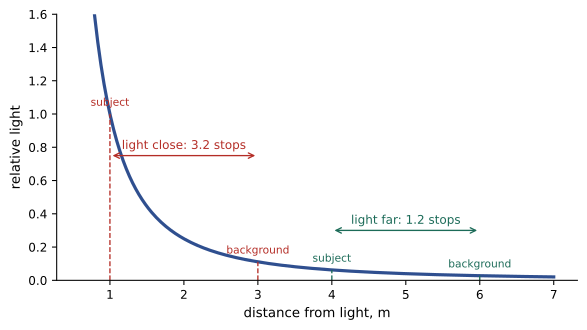
The inverse square law has a powerful practical consequence. Because the change in light is relative to distance, a light close to the subject falls off quickly across the scene, while a light far away falls off slowly. This controls how bright the background appears relative to the subject.
Worked problem
Controlling background brightness with distance
A portrait subject stands 2 m in front of a white wall. Compare the brightness of the wall relative to the subject when the light is 1 m from the subject (3 m from the wall) and when it is 4 m from the subject (6 m from the wall), with the light on the camera-subject axis.
Show solution
- Light at 1 m: the wall is 3 m from the light, so it is 2 × log₂(3 ÷ 1) = 2 × 1.58 = 3.2 stops darker than the subject.
- Light at 4 m: the wall is 6 m from the light, so it is 2 × log₂(6 ÷ 4) = 2 × 0.58 = 1.2 stops darker than the subject.
- The same white wall can therefore appear dark gray or nearly white, depending only on the light's distance.
Answer: With the light close, the white wall is rendered about 3 stops darker than the subject and appears dark gray; with the light far away, only about 1 stop darker and light gray. Moving a light closer is a simple way to darken a background without changing it, and moving it away gives more even light across a group or a large scene.
This principle explains several common observations. Flash photographs of a person at night show a well-exposed subject against a black background, because the background is far from the flash. A group photograph lit by a light close to one end is much brighter on that side. Window light is very bright near the window and falls off dramatically into the room. When you need even illumination across a large area, such as a group, a wall or a product line-up, move the light further away and increase its power; when you need the subject to stand out from its surroundings, bring the light closer.
Feathering
Light sources do not emit equally in all directions: a flash with a reflector, a softbox or a window is brightest straight ahead and dimmer toward the edges of its beam. Feathering means aiming the light so that the subject is lit by the edge of the beam rather than the center. Photographers use it to even out the light across a group (aiming the brighter center at the far person and the dimmer edge at the near one, so that the falloff with distance is compensated), to reduce the brightness on a nearby surface such as a white shirt, or to create a gradient on a background. With soft sources, the edge of the beam is also often softer than its center.
Size, distance and softness
Lesson 1 introduced the idea that the softness of light depends on the apparent size of the source. The geometry is simple. The shadow of an object lit by a point source has a sharp edge. A source of finite size can be thought of as many point sources side by side; each casts its own shadow, slightly displaced from the others, and the overlap of all these shadows produces a dark core (the umbra) surrounded by a gradual transition (the penumbra). The wider the source appears from the subject, the wider the penumbra and the softer the shadow. The apparent size is often expressed as the angle the source subtends:
where w is the width of the source and d its distance. Two practical rules follow. First, to make a light softer, either use a larger source or move the same source closer; to make it harder, use a smaller source or move it further away. Second, moving a soft source closer makes it softer and also brighter and gives faster falloff, so the background darkens at the same time; these effects always come together. The softest light comes from a large source very close to the subject, just outside the frame.
| Source and distance | Width | Distance | Apparent size |
|---|---|---|---|
| Sun in a clear sky | 1.39 million km | 150 million km | 0.5° |
| Bare speedlight | 7 cm | 2 m | 2° |
| 60 cm softbox | 60 cm | 3 m | 11° |
| 60 cm softbox | 60 cm | 1 m | 33° |
| 120 cm octabox | 120 cm | 1 m | 62° |
| Overcast sky | whole sky | all directions | up to 180° |
Diffusion only softens light if it makes the source larger. A small diffuser cap on a speedlight barely changes its apparent size and so barely softens the light, unless it is used indoors where it spreads light onto nearby walls and ceilings that then act as large sources. A large diffusion panel between the sun and the subject, on the other hand, turns the 0.5° sun into a source the size of the panel, transforming harsh sunlight into soft light.
How surfaces reflect light
Every photograph is made of light reflected from the subject, and surfaces reflect in three distinct ways:
- Diffuse reflection: light is scattered in all directions by a matte surface such as paper, unpolished wood or skin (partly). The brightness of a diffuse surface does not depend on the camera position, only on how much light falls on it, and diffuse reflection carries the color of the surface.
- Direct (specular) reflection: a polished surface such as a mirror, chrome or glass reflects light at an angle equal to the angle of incidence, like a ball bouncing off a wall. Direct reflection shows an image of the light source itself, can be as bright as the source, and appears only when the camera is in the right position. It usually carries the color of the light, not of the surface, except for colored metals such as gold and copper.
- Polarized direct reflection: direct reflections from non-metallic glossy surfaces such as water, glass, paint and leaves are partly polarized, which allows a polarizing filter to reduce them (see below).
Most real surfaces combine these: skin has a diffuse component that shows its color and a specular component (the sheen on the forehead or cheekbones) that shows the light source. Lighting a subject well often means deciding how much of each type of reflection to show. Glossy products such as cars, bottles and phones are lit mostly by controlling the direct reflections: they are defined by the shapes of reflected light sources rather than by diffuse illumination (Lesson 11).
The family of angles
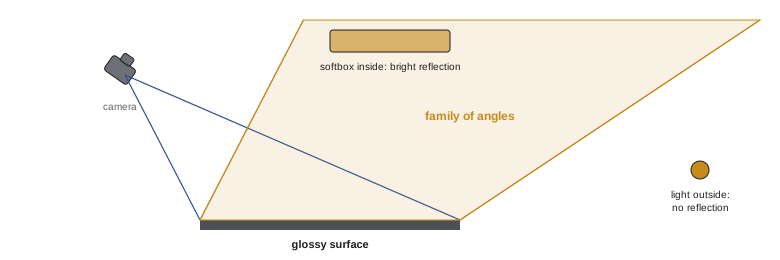
Because direct reflections obey the law of reflection, there is a specific set of positions from which a light source will produce a direct reflection visible to the camera on a given surface. This set is known as the family of angles. For a flat, shiny surface, it is the region of space that the camera would see reflected in that surface, like looking into a mirror. Any light placed inside the family of angles will appear as a reflection on the surface; any light outside it will not produce a direct reflection, only diffuse light.
This gives a simple procedure. To make a flat glossy surface appear bright and even, place a large light source so that it fills the whole family of angles; the surface will reflect the source and look bright from edge to edge. To make it appear dark and show its color or texture instead, keep all lights outside the family of angles and make sure the area inside it is dark, for example black card. On curved surfaces, the family of angles is spread over a wide region, which is why a curved chrome object reflects almost everything around it and is lit by surrounding it with large, controlled sources and dark areas.
Transmission and diffusion
Light passing through materials is also controlled for photography. Clear materials such as glass and clear plastic transmit light without scattering it; translucent materials such as diffusion fabric, frosted acrylic, tracing paper, white umbrellas and thin clouds scatter it, turning the area of material into a new, larger source. Diffusion materials are graded by how much they scatter and how much light they lose: a light diffusion loses perhaps half a stop and only slightly softens the light, while heavy diffusion loses one to two stops and produces very even, soft light. Colored filters (gels) transmit some wavelengths and absorb others, changing the color of the light (Lessons 7 and 9). Neutral density materials, such as scrims and nets, reduce quantity without changing quality or color.
Polarization
Light waves vibrate in planes perpendicular to their direction of travel. Ordinary light vibrates in all planes; polarized light vibrates mainly in one. Direct reflections from non-metallic surfaces are partly polarized, completely so at a particular angle, Brewster's angle, which is about 56° from the perpendicular for glass and about 53° for water. Light from the blue sky is also polarized, most strongly at 90° from the sun.
A polarizing filter transmits light vibrating in one plane and blocks light vibrating at right angles. Rotating it can block polarized reflections, so a polarizer can remove glare from water to show what lies beneath, cut reflections from shop windows, deepen the color of foliage by removing the shine from leaves, and darken a blue sky at 90° from the sun. It cannot remove reflections from bare metals, which are not polarized on reflection, and has little effect on reflections viewed straight on or at grazing angles. Circular polarizers are used on modern cameras because linear polarizers can confuse their autofocus and metering systems. In studio work, polarizing gels placed over the lights, combined with a polarizer on the lens rotated at 90°, can remove almost all direct reflections, a technique called cross-polarization, used for copying artwork and for some product and medical photography.
Measuring light
Light is measured in several related units. Luminous flux, in lumens, is the total visible light output of a source, the figure printed on light bulb packages. Luminous intensity, in candelas, is the light emitted in a particular direction. Illuminance, in lux (lumens per square meter), is the light falling on a surface, which is what determines exposure for an incident reading. Full sun is roughly 100,000 lux, an overcast day 1,000 to 10,000 lux, a bright office 500 lux, and a living room at night 50 to 100 lux. Photographic exposure is related to illuminance approximately by:
so 10,000 lux corresponds to about EV 12 at ISO 100. A handheld incident light meter measures the light falling on the subject, independent of the subject's reflectance, by pointing its white dome from the subject toward the camera or toward a particular light. Reflected meters, including the camera's own meter, measure the light coming off the subject and assume it is a mid-gray (PHOT-101, Lesson 6). Incident metering is especially useful in lighting work because it lets you measure each light separately and set ratios precisely (Lesson 10).
Common mistakes
MistakeExpecting even light across a scene from a close source.
InsteadMove the light further away and increase its power for even coverage.
MistakeAdding a small diffuser to soften light outdoors.
InsteadIncrease the apparent size of the source with a large modifier or by moving closer.
MistakeMoving lights at random to fix reflections on glossy surfaces.
InsteadWork out the family of angles and place lights inside or outside it.
MistakeExpecting a polarizer to remove reflections from metal.
InsteadUse positioning, dulling or cross-polarized lighting for metal.
MistakeRelying on the camera meter for lighting ratios.
InsteadUse an incident meter to measure each light.
Summary and key terms
- Illuminance from a small source falls with the square of distance: double the distance, lose two stops.
- A close light falls off steeply and darkens the background; a distant light gives even coverage.
- Feathering uses the edge of a beam to even out or reduce light.
- Softness depends on apparent size, the angle the source subtends at the subject.
- Surfaces reflect diffusely, directly or with polarized direct reflection.
- The family of angles predicts where lights will appear as reflections on glossy surfaces.
- Polarizers reduce polarized reflections; incident meters measure light falling on the subject.
- Inverse square law
- Illuminance from a point source varies inversely with distance squared.
- Falloff
- The decrease in light with distance from a source.
- Feathering
- Aiming a light so the subject is lit by the edge of its beam.
- Penumbra
- The partly shaded transition at the edge of a shadow.
- Diffuse reflection
- Scattering of light in all directions by a matte surface.
- Direct reflection
- Mirror-like reflection at an angle equal to the angle of incidence.
- Family of angles
- Positions from which a light will appear reflected in a surface.
- Brewster's angle
- The angle at which reflections from a non-metal are fully polarized.
- Lux
- Unit of illuminance, lumens per square meter.
- Incident meter
- A meter that measures light falling on the subject.
Practice problems
Work each problem on paper first, then reveal the answer to check.
A light moves from 2 m to 4 m from the subject. How much light is lost?
Show answer
Two stops (a quarter of the light).
Approximately how far must a light move from 1 m to lose one stop?
Show answer
To about 1.4 m.
A subject is 1.5 m from a light and the background 6 m. How much darker is the background?
Show answer
2 × log₂(4) = 4 stops.
Why does sunlight not fall off across a landscape?
Show answer
The distance to the sun is so great that local distance changes are negligible.
What is the apparent size of a 1 m softbox at 2 m?
Show answer
2 × arctan(0.25) ≈ 28°.
Why does a small diffuser cap barely soften a flash outdoors?
Show answer
It hardly increases the apparent size of the source and there are no walls to bounce from.
What kind of reflection shows the color of the surface?
Show answer
Diffuse reflection.
How do you make a flat glossy surface look bright and even?
Show answer
Fill the family of angles with a large light source.
At what angle are reflections from water fully polarized?
Show answer
About 53° from the perpendicular (Brewster's angle).
Approximately what EV at ISO 100 corresponds to 2,500 lux?
Show answer
log₂(1,000) ≈ EV 10.
Lesson quiz · 5 questions
Score 60% or more to complete this lesson.
Create a free account to save your progress, take quizzes and earn a certificate.