
PHOT-302 · Lesson 2 of 12 · 25 min
Genres: editorial, campaign, lookbook, e-commerce and beauty
Fashion photography is not one job but many. A magazine story, a global advertising campaign, a lookbook for buyers, a day of e-commerce images and a cosmetics close-up all involve clothes or beauty and people, but they differ in purpose, client, team, pace, budget, creative freedom and technical requirements. Knowing these genres helps a photographer quote correctly, prepare the right way, build an appropriate portfolio and choose a direction for a career. This lesson describes the main genres: fashion editorials, covers and celebrity portraits, advertising campaigns, lookbooks and collection images, e-commerce and catalog photography, beauty photography, runway and backstage, street style, and brand social content, with their typical requirements and how they relate.
Fashion editorials
A fashion editorial is a story of several images, typically six to twelve pages in print or a longer sequence online, built around a theme, a mood or a narrative, with clothing credited from several designers. The fashion editor or stylist chooses the clothes; the photographer, stylist and editor develop the concept together; and the publication sets the page count and deadlines. Editorials offer the most creative freedom in fashion: they can be conceptual, cinematic, documentary, surreal or minimal. Their requirements include a coherent idea that connects the images, variety of shots that sequence well (Lesson 11), clear presentation of the clothes even when the mood dominates, accurate credits for every item, and adherence to the publication's style. Editorials for independent and digital publications are an important route for emerging photographers to be published, often with very small budgets.
Covers and celebrity portraits
Magazine covers are a distinct challenge. A cover must work at small sizes on newsstands and screens, leave space for the masthead and cover lines, show the subject clearly and attractively, and connect with the magazine's identity. Covers are usually vertical with the subject's eyes near the top third and clear space around the head for the title. Publications often specify crops, space for text and a variety of options with different framings, expressions and outfits. Celebrity portraits for covers and features involve limited time, publicists, approval processes and sometimes contractual restrictions on retouching or image use. Preparation, efficiency and the ability to create rapport quickly (PHOT-220) are essential, because the subject may give you only minutes.
Advertising campaigns
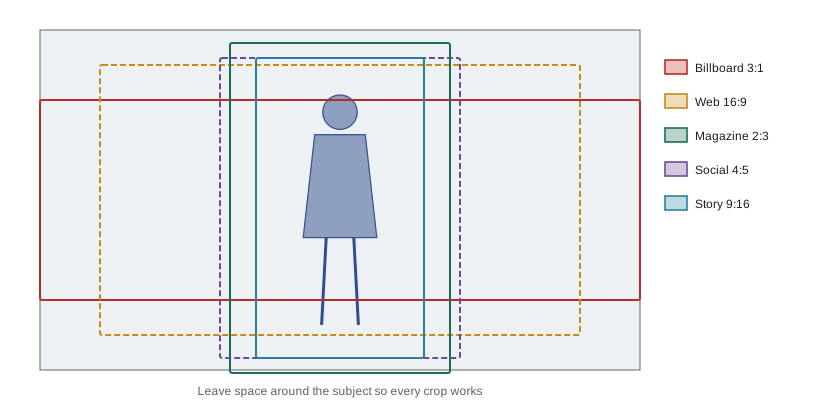
An advertising campaign promotes a brand or collection through images used in print, outdoor advertising, digital ads, social media, retail displays and the brand's own channels. Campaigns are usually developed by the brand's creative team or an advertising agency, which presents the photographer with a brief and layouts; the photographer then interprets them within agreed limits. Campaign shoots have larger budgets, larger teams, more pre-production and stricter control: the client and agency attend, approve images on set, and may request specific products, poses and expressions. Images must work across many formats, from a vertical social story to a horizontal billboard, so photographers often shoot with extra space around the subject for cropping, and may capture video and stills at the same time. Usage licenses determine fees (Lesson 12).
Lookbooks and collection images
A lookbook presents a designer's collection, look by look, so that buyers, press and customers can see each outfit clearly. Lookbook images are usually simple and consistent: full-length shots of each look on a model, against a plain background or a consistent location, with the same lighting, framing and pose style across the set, plus a few detail or mood images. They are often shot quickly, with many looks in a day, and must show construction, fabric, fit and color accurately. A collection of 30 looks may need 30 full-length images and perhaps 30 more alternates or details in one day, so efficiency matters: a locked camera position, consistent lighting and a clear running order help. Lookbooks overlap with campaign work for smaller brands, which may use the same shoot for both.
E-commerce and catalog photography
E-commerce photography produces the images on product pages of online shops: on-model images showing front, back, side and detail views, flat lays or ghost mannequin images of garments alone, and sometimes short videos. It is the highest-volume genre, with studios producing hundreds of images a day for large retailers, and it depends on consistency: every image must match the retailer's style guide for background, lighting, crop, pose, model height in frame, color accuracy and file naming, so that hundreds of products look coherent on a page. E-commerce studios typically use fixed lighting setups, marks on the floor for model and camera positions, templates for crops, tethered capture with live overlays, and production workflows that track every product through shooting, retouching and upload. The work is less creative than editorial but offers steady income and develops precision, speed and teamwork. PHOT-202 covered product retouching, and PHOT-310 covers product photography in depth.
Worked problem
Planning an e-commerce day
A studio must photograph 60 garments on a model, each needing front, back, side and one detail shot. Each garment takes about 3 minutes to change and 4 minutes to shoot all angles; the studio day is 8 hours with a 30-minute lunch and two 15-minute breaks. Is the day achievable? How many images are produced?
Show solution
- Time per garment: 3 + 4 = 7 minutes.
- Total: 60 × 7 = 420 minutes = 7 hours.
- Available shooting time: 8 h − 0.5 h − 0.5 h = 7 hours.
- The plan fits exactly, with no margin; add a second stylist to prepare garments in parallel, cutting change time, or reduce the count.
- Images: 60 × 4 = 240 selected images, plus alternates.
Answer: It just fits at 7 hours, with no margin; parallel dressing would add safety. About 240 final images.
Beauty photography
Beauty photography focuses on faces, skin, hair, makeup, nails and fragrance, for magazines and cosmetic and hair care brands. It demands close-up precision: lighting that flatters skin and reveals product texture, such as glossy lips, shimmer and matte foundations (PHOT-211 covers beauty lighting); immaculate makeup and hair work; sharp focus on the right detail at macro or near-macro distances; and careful retouching that respects advertising rules on product claims (PHOT-202). Beauty campaigns for cosmetics must accurately represent what products do; regulators and advertising standards bodies have acted against advertisements that exaggerate results through retouching, and some brands now label or limit retouching. Beauty also includes hair photography for salons and hair brands, nail art, and skincare imagery that increasingly celebrates natural skin texture.
Runway, backstage and street style
Runway photography documents fashion shows: photographers in the pit at the end of the runway capture each look as the model walks toward them, with long lenses, high frame rates and consistent framing, usually for agencies and publications that publish all looks within hours. Access is limited and accredited. Backstage photography captures the atmosphere, hair and makeup and preparation behind the scenes, closer to documentary work. Street style photography, which grew enormously with blogs in the 2000s, photographs stylish people outside fashion shows and in cities, combining documentary instinct with fashion awareness. These genres reward speed, anticipation and an eye for detail, and they offer routes into fashion photography for those who build an audience.
Brand social content
Brands now need constant content for social platforms: short videos, behind-the-scenes images, product close-ups, styled flat lays, user-style images and stories. This content may be shot by photographers, content creators or in-house teams, often on the same day as larger shoots, with phones and mirrorless cameras, and with fast turnaround. It favors authenticity, movement and vertical formats over polished perfection. Photographers who can deliver both polished stills and social-ready content, including video, are increasingly valuable, though they should price the additional work and usage fairly rather than adding it for free.
Comparing the genres
| Genre | Client | Creative freedom | Pace and volume | Key requirement |
|---|---|---|---|---|
| Editorial | Publication | High | 6–12 images per day or two | A coherent story |
| Cover | Publication | Medium | Few images, limited time | Works small with text |
| Campaign | Brand or agency | Low to medium | Few hero images, large team | Brief, product and usage |
| Lookbook | Brand | Low | 20–60 looks per day | Clear, consistent looks |
| E-commerce | Retailer | Very low | Hundreds of images per day | Style guide consistency |
| Beauty | Publication or brand | Medium | Few images, high detail | Skin and product accuracy |
| Runway and street | Agency or publication | Low to medium | Very high volume | Speed and anticipation |
Building a portfolio for the genres you want
Clients hire photographers based on work similar to what they need. A portfolio aimed at editorial work should show stories with strong concepts and sequencing; one aimed at campaigns should show polished hero images with clear products and a recognizable aesthetic; one aimed at e-commerce should show consistency, accurate color and an understanding of style guides; and one aimed at beauty should show flawless close-ups and product detail. Many photographers keep separate portfolios or sections for different markets. Test shoots (Lesson 4) let photographers create portfolio work in a target genre before being hired to do it.
Beauty work in more depth
Beauty photography concentrates on faces, skin, hair, makeup, nails and fragrance, and it is among the most technically demanding genres. Images are usually tight crops at very high resolution, so tiny flaws in makeup, focus or lighting become obvious. Beauty work is often shot with longer macro or portrait lenses at small apertures to keep the eyes, lips and skin in focus, and with carefully controlled reflections on skin and products. Teams include specialist makeup artists, hair stylists and manicurists, and the client may be a cosmetics brand with strict guidelines on how the product, shade and packaging must look. PHOT-211 covered the lighting setups used for beauty; in this course, beauty is treated as a genre with its own clients, budgets and expectations.
Hybrid formats and motion
Many commissions now combine genres. A brand may ask for campaign hero images, a lookbook, e-commerce product views, social media content and short videos from the same production, sometimes in a single day. These hybrid shoots need careful planning, since each format has different lighting, framing and pace, and the schedule must protect the most important deliverables. Motion content is increasingly common: short vertical clips for social platforms, behind-the-scenes footage and moving versions of still images. Photographers may direct the motion themselves, work alongside a videographer, or shoot stills and video simultaneously with continuous light. Understanding how each genre is used helps photographers advise clients and quote realistically.
Choosing your genre focus
Few photographers work equally in every genre. Some build careers in high-fashion editorials and campaigns; others specialize in e-commerce, catalog or beauty, where steady volume provides reliable income; many combine a creative editorial practice with commercial work that pays the bills. Early in a career, trying several genres helps photographers discover where their strengths and interests lie. Portfolios should be organized by genre so that clients can quickly see relevant work: an e-commerce manager wants to see consistency and accuracy, while a magazine editor wants to see storytelling and a distinctive point of view.
Deliverables by genre
Each genre comes with typical deliverables that shape the shoot. An editorial delivers a sequence of eight to twelve images with credits, often with a cover option. A campaign delivers a small number of hero images in several crops and formats for print, digital and outdoor placements. A lookbook delivers one or two images of every look in the collection, usually full-length on a clean background, for buyers and press. E-commerce delivers several standard views of each product, sized and named to the retailer's specifications. Beauty delivers close-ups of faces and products, often with space for copy. Agreeing on deliverables before the shoot keeps everyone focused and makes the quote realistic.
Understanding these differences also helps photographers read briefs correctly. A request that mixes the language of several genres, such as an editorial look with e-commerce volume, signals a hybrid job that needs extra planning, more time on the schedule and a clear conversation about priorities before the quote is sent.
Common mistakes
MistakeShooting an editorial as a set of unrelated images.
InsteadBuild a coherent story with varied shots.
MistakeFraming campaign images tightly.
InsteadLeave space for crops across formats.
MistakeChanging lighting between lookbook looks.
InsteadKeep lighting, framing and pose consistent.
MistakeIgnoring the e-commerce style guide.
InsteadMatch every specification exactly.
MistakeExaggerating cosmetic results in retouching.
InsteadRepresent products accurately.
Summary and key terms
- Editorials tell stories with credited clothes and creative freedom.
- Covers must work small and leave space for text.
- Campaigns follow briefs, involve large teams and must suit many formats.
- Lookbooks and e-commerce demand clarity, consistency and efficiency.
- Beauty demands close-up precision and honest product representation.
- Runway, backstage and street style reward speed and anticipation.
- Portfolios should target the genres a photographer wants to work in.
- Fashion editorial
- Magazine story built around clothing.
- Cover lines
- Text on a magazine cover describing stories.
- Masthead
- Magazine title on the cover.
- Layout
- Agency sketch or plan of an advertisement.
- Look
- One complete outfit in a collection.
- Ghost mannequin
- Garment image with the mannequin removed.
- Style guide
- Specification for consistent product images.
- Pit
- Photographers' area at the end of a runway.
- Street style
- Fashion photography of people in public.
- Hero image
- The main image of a campaign.
Practice problems
Work each problem on paper first, then reveal the answer to check.
How many images does a typical editorial include?
Show answer
About six to twelve.
What must a cover image allow for?
Show answer
Masthead and cover lines; works at small sizes.
Why leave space around campaign subjects?
Show answer
For crops across many formats.
What must lookbook images show accurately?
Show answer
Construction, fabric, fit and color.
What makes e-commerce images coherent?
Show answer
Following a style guide consistently.
Images for 40 garments × 4 views?
Show answer
160.
What must beauty images avoid?
Show answer
Exaggerating product results.
What lenses do runway photographers use?
Show answer
Long lenses with high frame rates.
What does brand social content favor?
Show answer
Authenticity, movement and vertical formats.
What should an editorial portfolio show?
Show answer
Stories with strong concepts and sequencing.
Lesson quiz · 5 questions
Score 60% or more to complete this lesson.
Create a free account to save your progress, take quizzes and earn a certificate.